|
April 18, 2011
Henry Dixon stands out not because of his discoveries, or because he introduced a new technique in photography, but simply because he made what must be the very first systematic photographic record of London. He did this for the "Society for the Photographing of Relics of Old London".
Prompted by the imminent demolition of an old London inn near St Paul's, the Society for the Photographing of Relics of Old London set about using photography as a means of documenting buildings that represented old London threatened with destruction.
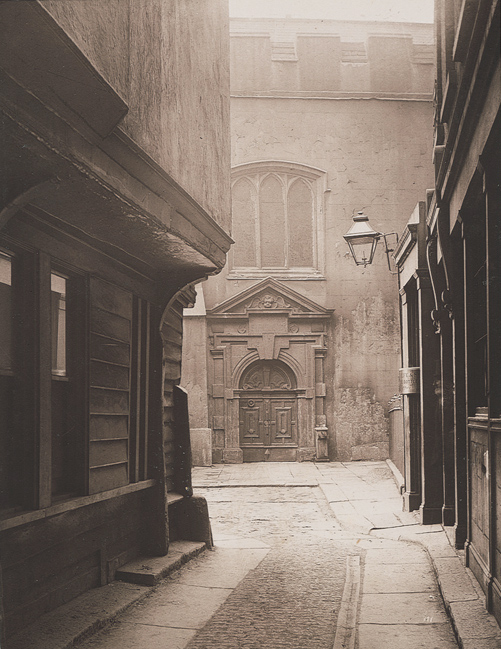 Henry Dixon, St Helens, London, 1886
Dixon recorded the Holborn Valley Improvements, one of the largest building projects undertaken in mid-Victorian London which altered the face of that section of the City. Most famously he photographed London's threatened buildings in the 1870s and 80s.
His photographs for the Society for Photographing Relics of Old London record a heritage on the verge of destruction as Victorian London re-invented itself. Amongst the subjects recorded were the galleried coaching inns which had existed in some form since the time of Chaucer and which were swept away by the coming of the railways. Most ended their days as slum dwellings before being demolished. Only one, the George, now survives.
Dixon also captured the atmosphere of humbler streets for the City Sewers Commission with a series of photographs which now only survive as glass-plate negatives in the Guildhall Library.
|


