|
October 10, 2003
This is urban reconstruction on a grand scale.
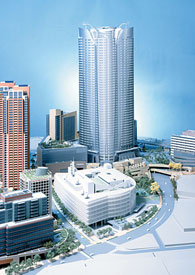
Some visuals and corporate descriptions can be found here.
Some comments can be found here and here.
The development rejects the sprawling low-rise density typical of the city of Tokyo. Development such as this is going to change Tokyo from a horizontal city to a vertical one.
Roppongi Hills promises to be an efficient, well-designed future--like that envisioned by the modernist American developers in the 1950s.
Update
Is this an example of Japanese modernist architecture? It does contain a vision of modernity with its rejection of the old. Does it gesture back to the early modernist avant garde programme that modern architecture contains the potential for building a new world?
Or does it work with a new sense of space and time? One in which buildings are no longer rooted in the ground but float above it? A conception of space time in which the social and political connotations have been purged along with all reference to social experiments and the revolutionary aims of modernist architecture? A conception of a synthesis of space time in which developments in architecture correspond to a deeper level of reality behind the chaotic appearances.
It is an integrating architecture that is dislodged from the old modernist European avant garde, with its manifesto of negation and destruction.
Next
|


I assume you're being ironic?