|
April 16, 2005
The Grateful Dead's "Dark Star" is a cultural touchstone in rock music as it signifies the experimental side of rock music through casting aside the once-accepted demands of the short, self-contained pop song.
'Dark Star crashes
pouring its light into ashes-
Reason tatters,
the forces tear loose from the axis-
Searchlight casting
for faults in the clouds of delusion-
Shall we go,
you and I while we can-
through
the transitive nightfall of diamonds?'
Grateful Dead,Dark Star, lyrics Robert Hunter
Hunter was the premier lyricist for the Grateful Dead.
I've been trying to get Suzanne to listen the Grateful Dead. It has been hard work. The early Anthem of the Sun, (1968)
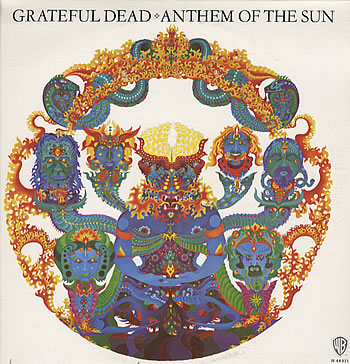 which contains some of the band's most adventurous music, is rejected as noise. which contains some of the band's most adventurous music, is rejected as noise.
It remains noise to her even though I point out that it is an album that transgresses a rock album as just a collection of songs.
It can be viewed as the Dead creating one piece of music through combining/layering both studio and live performances.
What is created is a psychedelic musical soundscape- a musicalscape for someone going on an acid trip. BUt it is too hard-edged for Suzanne.
The Dead circa 1969/70 (Live/Dead), which turned me on, is far too harsh. LIVE DEAD, which is a snapshot of the evolution Grateful Dead circa 1969, applied the free-jazz lessons of John Coltrane to their finely-tuned, manic, and flowing boogie. It indicated that the live Dead were a wholly different, multi-headed band than the band that recorded in the studio. Piero Scarffi says that the Dead's:
'...greatest invention was the lengthy, free-form, group jam, the rock equivalent of jazz improvisation. Unlike jazz, in which the jam channelled the angst of the Afro-american people, Grateful Dead's jam was the soundtrack for LSD "trips"'.
I just loved the musical relationships and explorations in "Dark Star", and the wild improvisations of "St. Stephen" and its mutation into the dynamic "The Eleven." Here was a fusion of rock and roll energy with the psychedelic experience to fashion an endlessly elaborate interplay of sound. I reckon that Live/Dead holds its place as one of the great rock and roll records of the 20th century.
In response to Suzanne's rejection of psychedelic Dead I mention that they have their roots in American traditional folk music, bluegrass and blues, and that they played different kinds of music over the next 15 years. Though she acknowledges the differences in the music over the years, she says of the 1972 Americana Dead (the albums Workingman's Dead and American Beauty that showcase the band's songwriting sophistication) that they cannot sing. True I say. K.D, Laing they are not. They are basically a live band that plays improvised music,not a singer with a backup band. It's boring she says, when I pay some of the improverised music.
My experiences are well expessed by this quote from Steven Scaggs:
"It's an uncomfortable experience that practically every lover of Grateful Dead music has encountered: trying to explain the mojo of the Grateful Dead to someone who has never heard them before. There's the "Best Pop Hope" technique: flip on "Truckin'" and hope for the best; the "Literary History Technique": you start out with a long exegesis on the Beats, Cassidy and the Acid Trips before launching into "That's It For The Other One"; and the frontal assault on any commonly-held misconceptions, the "Metallica They Ain't" technique: playing the entire American Beauty CD in endless repeat mode.
Truth is, none of these gambits is likely to succeed. The musical world of the Dead is too broad for any single or CD to cover and it is the breadth itself that is a major hook for Deadheads. Breadth alone is insufficient though for, in certain tunes that open into jams, it is the depth of musical exploration that is the turn-on. And, of course, the fact that this music evolved in performance over a thirty year period of time plays a significant role. So one could say that the Dead is four-dimensional: the breadth, depth and time components all combine to produce the musical heights."
Occasionally she says of a piece of music circa 1977 Dead in concert that it is beautiful. But not Dark Star:
"Mirror shatters
in formless reflections
of matter
Glass hand dissolving
to ice petal flowers
revolving
Lady in velvet
recedes
in the nights of goodbye
Shall we go,
you and I
While we can?
Through
the transitive nightfall
of diamonds
|


Several of our recent podcasts dealt with this topic. Check out podcast 8, 11 and 12 at
http://slapcast.com/users/closetdeadhead
-- Sam