|
April 4, 2005
new post.
That minimalism was because I was too tired to post.
So a note on Miles Davis: the 1959's Kind of Blue album and the transition to electronic jazz rock via In a Silent Way. In a Silent Way marked the beginning of a new era in jazz; one that moved towards rock. The jazz community was bitterly divided over the notion of Miles Davis incorporating rock. Its unholy marriage of Sly and the Family Stone's There's a Riot Goin' On, sludge-funk, rock's bombastic backbeats, and jazz's reeling improvisation bitterly split the jazz community down the middle.
Many found Davis' new "directions in music" offensive to the jazz idiom. Davis' use of electric instruments and funk and rock rhythms during this period was seen as a betrayal of jazz and a commercial sellout. It is a hard to seehow walls of electrified noise and wah-wah pedals is a commercial sellout.
I've really struggled to understand the blended improvisational rock and jazz on the seminal Bitches Brew (1969) with its dense keyboard textures and polyrhythmic percussion. And I still do.
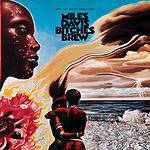 I was attracted to the spontaneous invention the swirling free-form chaos that became a kind of jagged soundscape that signified jazz's transformation. Davis brought the elements of jazz and rock together, overlaying one on top of the other in order to create a densely woven tapestry. I was attracted to the spontaneous invention the swirling free-form chaos that became a kind of jagged soundscape that signified jazz's transformation. Davis brought the elements of jazz and rock together, overlaying one on top of the other in order to create a densely woven tapestry.
Still the fusion music after In a Silent Way left me left me floundering. Bitches Brew, Live at the Fillimore East and the latter A Tribute to Jack Johnson, are loud, amplified, improvisational music. It was harsh, raw and black-sounding for someone coming from the improvisations created by the 1970s Grateful Dead.
I'm beginning to realize the Dead's space jams around 1989/1990 were influenced by the improvisional fusion work of Davis that started with his In a Silent Way. In the Grateful Dead's final fifteen years their adoption of MIDI-based technology, enabled them to simulate an array of sounds and instruments. This further opened up the music, momentarily reawakened the group’s creative tendencies and allowed the sounds to be sliced, diced, shifted, and mutated with great dexterity. This is quite different from the late 1960s band that muscled its way through adrenaline-soaked exchanges.
I now realize that Davis' jazz rock fusion albums of the 1970s were spliced and collaged from the jam sessions into In a Silent Way and Bitches Brew by Miles Davis and his producer Teo Macero. Elaborate editing and post-production work is a new way to approach composition.
The other side of this is the live, spontaneous 'jam' performances of the band as in Live- Evil. It indicates that Davis was reaching outside his immediate musical environment for new inspiration. The music world of the 1970s was one of the electric guitar, the Beatles, psychedelia, loud amplifiers and Jimi Hendrix. The live music performed by Davis from this period was full of energy and it grooved. This fusion of rock and jazz took the excitement and energy of rock and combined it with the complexity of jazz.
The other approach is simplifying the melody or improvisation down to rock's level then adding jazz's more mellow qualities. That ends up with boring, easy-listening fusion.
|


Gary,
I admire your search for simplicity in complex areas.
I think this post goes as far as you can possibly go.