|
February 14, 2005
The Kyoto Protocol, which is a first attempt to address global warming becomes international law on Wednesday.Melissa Fyfe, writing in The Age, reports that most scientists now agree that greenhouse gases from industry, electricity use and cars have caused the planet to warm 0.6 degrees in the past century. Because the gases can live in the atmosphere for 50 to 200 years, another increase in warming is already locked in, regardless of action on cutting back pollution.
Global warming is causing polar glaciers and Brown Glacier on Heard Island to melt, Pacific Islands to flood, and oceans to turn acidic from absorbing carbon dioxide. The Great Barrier Reef is also threatened:
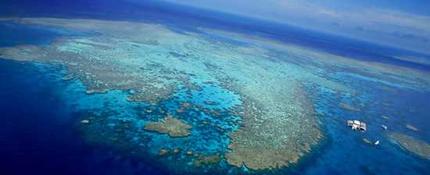
The Great Barrier Reef's coral could disappear in as little as 20 years as sea temperatures rise faster than expected, says Professor Ove Hoegh-Guldberg, director of the Centre for Marine Studies at the University of Queensland. He says bleaching will occur and coral will die regardless of what happens in the battle against global warming.
"It is shocking to wake up and realise we really are in a desperate time...We may see a complete devastation of coral communities on the reef and a major change to the pristine values, which at the moment are our pride and joy.We are likely to see corals rapidly disappear from great parts of the Barrier Reef, as it has already from large parts of the Caribbean."
Modelling by marine scientists shows that coral regularly bleaches when global temperatures rise between one and two degrees, but it may recover in some summers when bleaching does not occur. At two degrees and above, coral bleaches every year - with most dying off. If a remnant population managed to survive and carbon dioxide was stabilised in the atmosphere our beautiful coral reefs will come back in a couple of hundred years.
So why such little action? This is one reason:
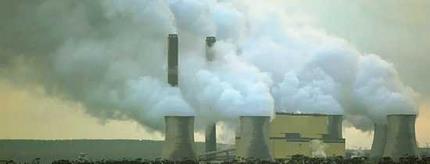
Loy Yang
Though Victoria promote itself as a clean, green state, leading the way on environmental initiatives, it is one of the nation's worst greenhouse gas polluters.The state's electricity is generated by burning brown coal in the La Trobe Valley cheap source of power, and it was used to help build a manufacturing industry in Victoria.
But today the question is whether the benefits of cheap coal fired electricity outweighs the costs to the environment.
previous
|


