|
October 7, 2008
If modernism in photography is about purity of form (Greenberg) then postmodernism adds history and narrative. Does that snapshot hold up? I don't know. I do not know what the pre-modernist visual order or pictorial field in Australia was like. Gum tree paintings? The sentimental post-impression of the Heidelberg School?
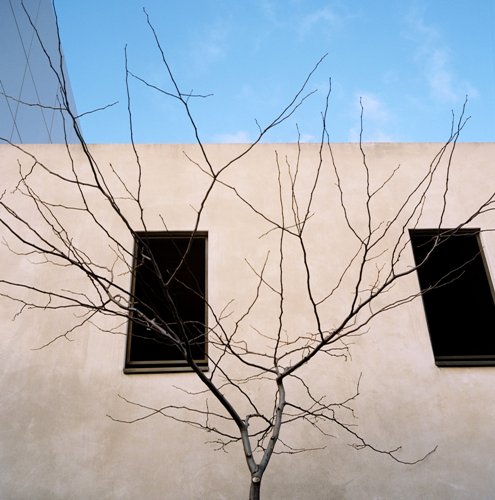 Gary Sauer-Thompson, winter in Adelaide, 2008
Purism (ie., the the qualities inherent to photography) was the American contribution to a range of 20th-century artistic practices grouped under the label of modernism. Like modernism in painting and sculpture straight photography was based on the idea that every artistic medium has its own distinct properties, which artists should seek to exploit. Or so argued John Szarkowski, thereby making photography a modernist medium in Clement Greenberg's sense of the term--an art form that can be distinguished in its essential qualities from all other art forms.
The US modernist photographers taught that by mastering technique, they would be freed to express their personal vision and they offered themselves as a model of how high art photographers could live and work outside the popular commercial realms of photojournalism, fashion, and advertising. In that way--ie., through aesthetic autonomy and subjectivity---that photographers could lay claim to the artists mantle (artist genius who invents at will) and downplay photography's (realist) connection to a world outside art. Photography, according to the formalist, was discovered to be art since the 1830s and the emphasis is on the artist's style of expression.
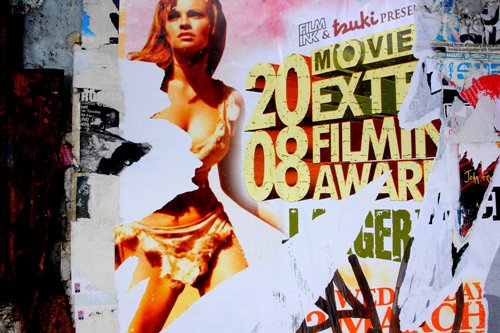 Gary Sauer-Thompson, a picture surface, Newton,
From a postmodern perspective aesthetic autonomy and subjectivity was an effect of the discourse of the art institution, and in terms of meaning of the art work we had the displacement of the artist subject by the spectator subject interpreting the work. This challenged the modernist assumption that the art object by itself had a fixed and transhistorical meaning. Since meaning was seen as specific to historical context and to a socially specific site, then it was the art institution that constructed art as autonomous, universal and timeless. Formalism was the method used to disconnect the art object from its social and political context.
Therefore it is the art institutions claims to represent art coherently that were questioned by postmodernism.
|


Gary,
I thought that postmodernism insisted on a different kind of picture surface upon which information is organized than modernism. It does not evolve from--it is a radical break or rupture with the modernist past.
The postmodern picture surface is a flatbed surface that can contain a vast and heterogeneous array of culture images and artifacts--eg., the assemblage work of Robert Rauschenberg in the 1960s. That implies that modernism is not just a period style, it is also an epistemology of art; one that is eroded.