|
September 11, 2008
As mentioned earlier Vitamin, is a South Australian visual culture quarterly, with an online gallery. Its current online exhibition is “Urban Differences”, an exhibition of photography, or more specifically read art photography---meaning art school trained photographers who exhibit their work in the local art galleries. At the other end of the photography world are the professional studio photographers producing images for the culture (fashion, design etc) industry who supported the vibrant medium format camera business. In between are the serious amateurs who also supported medium format because of the image quality.
Then along came digital. Between 2000 and 2006 the digital steamroller decimated medium format. Film was disappearing rapidly. With the ever-hastening demise of film, medium format camera makers had a difficult time, and many of them went out of the medium format business, including Contax, Bronica and to a large extent Fuji. Pentax soldered on, but without the ability to accept digital backs it was doomed. Rolleli's flagship medium format camera was the Rollei 6008 and Rollei got sideswiped.
With film in its final days there were four and a half companies making medium format digital backs for a small market that is probably less than 6,000 units a year world-wide. The companies included Hasselblad, Phase One, Leaf, Sinar (Jenoptic / Eyelike), and the half company, Mamiya. Phase One, Leaf, Sinar needed a camera to put their back on. It was not to be Hasselblad, who used the biennial show Photokina in 2006, to announce a new H3D with a dedicated, though removable digital back. Since no other company's backs would be able or be allowed to attach to a Hasselblad H3D, so Hasselblad became a closed system.
At the same show Leaf and Sinar moved to sell their backs on the Hy6 system, based on the Rollei platform made by Franke & Heideche. They built the body from ground zero with funding from Jenoptik and Sinar.
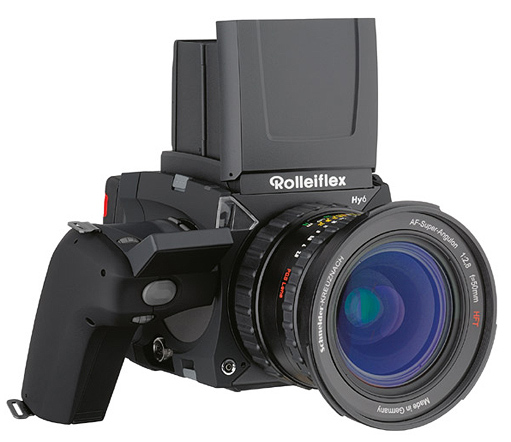
The Hy6 was designed as an open platform with an eye toward the future. The “Hy” stands for “hybrid,” since the camera can be used with both digital and conventional film backs. It can handle 120 and 220 film and digital backs from Sinar and Leaf and it employs the Rollei lens mount which accepts Sinaron, Schneider and Zeiss glass.
Phase One now has its own camera system available based on the Mamiya platform. A new Phase One designed / Mamiya built medium format (Phase One 6X45) camera appeared in the first quarter of 2008 as an open platform. This model is probably just the first of what will be a major new medium format camera and lens line.
Though the Hy6 is based in part on the Rollei 6008 it doesn't come cheap---it is between $US 25, 000 to $US45,000. So it is not going to bought by the typical amateur photographer/hobbyist. It is for the studio pro. The large studio centers who switched from medium format to DSLRs a while back are now switching to MF digital again, simply because of the superior image quality which it can produce. For the amateur/hobbyist it is back to using older medium format cameras and film, which is really returning the world once left behind.
|


