Thought-Factory.net Philosophical Conversations Public Opinion philosophy.com Junk for code

Mandy Martin, Puritjarra 2, 2005. For further information on MANDY MARTIN, refer here: http://www.mandy-martin.com/
If there are diverse kinds of knowledge and ways of knowing place, then we need to learn to value the different ways each of us sees a single place that is significant, but differently so, for each perspective.
RECENT ENTRIES
SEARCH
ARCHIVES
Library
Thinkers/Critics/etc
WEBLOGS
Australian Weblogs
Critical commentary
Visual blogs
CULTURE
ART
PHOTOGRAPHY
DESIGN/STREET ART
ARCHITECTURE/CITY
Film
MUSIC
Sexuality
FOOD & WiNE
Other
www.thought-factory.net
looking for something firm in a world of chaotic flux

Josef Koudelka: romantic artist « Previous | |Next »
September 29, 2008

Josef Koudelka is a key exponent of Czechoslovakian humanistic and documentary photography of the1960s and 1970s. He is seen to work with objective and open eye that captured a reality, which caused them trouble with the old communist regime. Koudelka's reputation was made internationally by the photographs he shot of the invasion of Prague by Warsaw Pact troops (in August 1968) So he emigrated and joined Magnum.
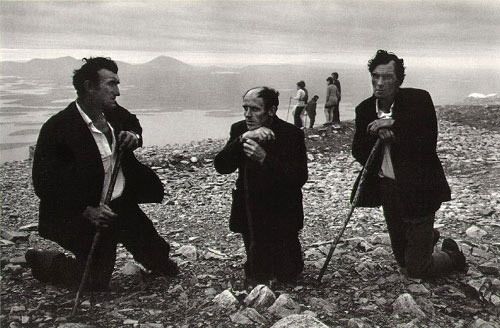
koudelkaJ.jpg Josef Koudelka, Ireland,1972

Though Koudelka joined Magnum he became stateless, restless and rootless even though Paris was his adopted home. He defined his freedom as a nomad constantly on the move alone with this camera and sleeping bag. Until he returned from exile to Czechoslovakia in the 1990s with his semi-mythic status as a celebrated exponent of 20th century reportage by a romantic artist.

Sleeping under a desk the Magnum office or crashing in a mate's pad for several years in London, sleeping in sleeping bag in the open, walking away from one's kids and being just alone with one's camera is not a practical role for contemporary photographers.

| Posted by Gary Sauer-Thompson at 11:35 PM | | Comments (2)
Comments

Comments

From memory in the 1980’s in Australia, there was a lot of work by art school trained photartists that questioned and rejected the documentary nature of photography.

One of the techniques used in this photoart was to completely stage the shot. This kind of work was grouped under 'postmodern photography'.

Croagh Patrick may not have been that 'staged'.

Go to the Magnum web-site type 'Belfast' or 'Ireland',

The Irish have a way with being photographed,

I have always sought out Akron Ohio, or the crummbing post-industrial rust belt towns,

and with the Soviet Union I found a home from home.

Croagh Patrick, that's still a valid part of the national psyche.

I grew up with 'grim' as the panorama, and it motivated me to look for similar,

Hence my post-industrial art, the stark sadness of it, that's what made any number of my personalities known.

My 'Sudeten' work was about East Prussia, it wasn't about the Czechs.