|
September 2, 2010
I saw a BBC film about Anish Kapoor on SBS 2 last night. The film was structured around his exhibition at the Royal Academy. I was impressed by his use of colour (crimson, yellow) and form (voids, orifices and bulges) as well as the appearance of formlessness.
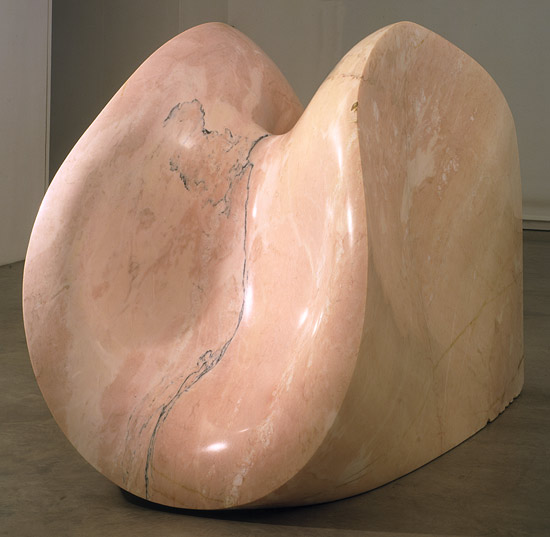 Anish Kapoor, Untitled, 2001 Pink marble
The seductive shapes, shiny surfaces, bright colours and mysterious voids invites the viewer to touch the surfaces and internal space, but we are forbidden to do so in an art galley. We can only look as we walk around the object.
The exhibition at the Royal Academy showed his roots in modernism, minimalism and the monumental sculpture of industrial production that invited climbing inside the void or black hole:
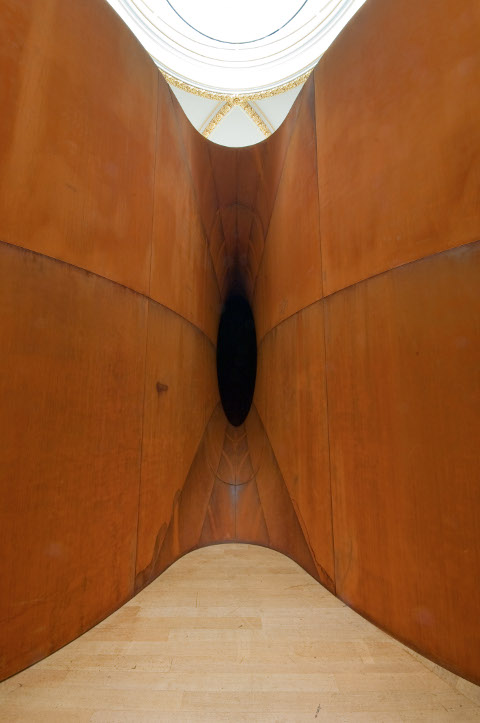 Anish Kapoor, Hive
There was a turn to formlessness which invoked the body --menstrual blood, wounds, violence, intestines--funnels and squirming nests, writhing columns of turds, lava-like puddles.
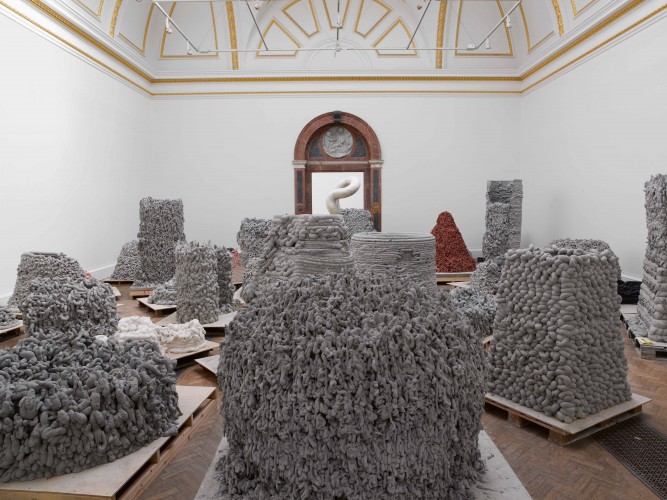 Anish Kapoor, Greyman Cries, Sharman Dies, Billowing Smoke, Beauty Evoked (2008-09)
This is art without the hand as it drawn and produced with the aid of a computer-assisted piping machine. It is a world of worm-cast mountains, intestinal tubing, funnels and squirming nests, tails and slugs, writhing columns of turds, lava-like puddles and drools, hollow cakes and all sorts towers and pyramids. It is formlessness because the material is often broken and coming apart over itself.
|


For Rosalind Krauss and Yves-Alain Bois in Formless: A User's Guide maps out a third area between the traditional dichotomy of form and content in the visual arts as originally suggested by the French theoretician, Georges Bataille. The informe is a way of dismembering the conflicts of form and content that structure the history of modernism.
Bataille described the formless as subversive of the traditional duality of form and content. While Bois and Krauss do not define the formless, they do characterize it as horizontal, base materialism, pulse, and entropy. The horizontal refers more to a bringing down (literally and figuratively) than a distinct spatial configuration. Jackson Pollock's drip paintings created on a floor rather than vertically on an easel exemplify this idea of the horizontal.
Base materialism indicates the opposite of idealization, whereas the pulse alludes to the shaking up of a unified visual field. Entropy in this case signifies the degradation of energy, the wearing down of hierarchy or order.