|
September 8, 2010
Paris Photo 2010 is the yearly European venue to discover the most current happenings in art photography from around the world, bringing together, from November 18th to the 21st, one hundred international galleries and publishers showcasing work from more than 25 countries – with a special emphasis on photography from Central Europe.
One of those selected or exhibiting (I don't know how it works) is Matt Wilson:
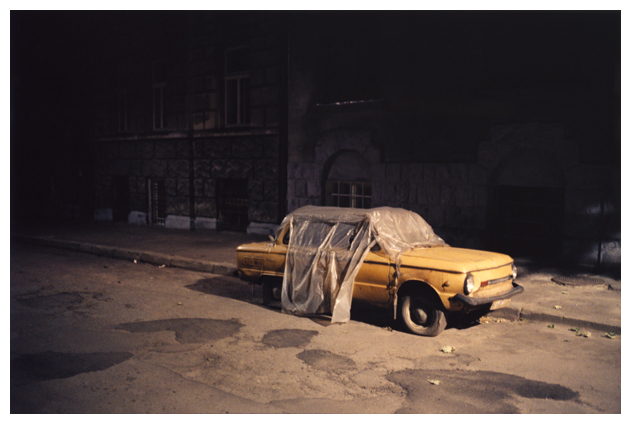 Matt Wilson, Untitled, Lviv #7 from Looking East
There is not that much information online about Wilson or his work. He is British born. I am interested in his work because be works within the tradition mapped by Simon Schama in his Landscape and Memory.
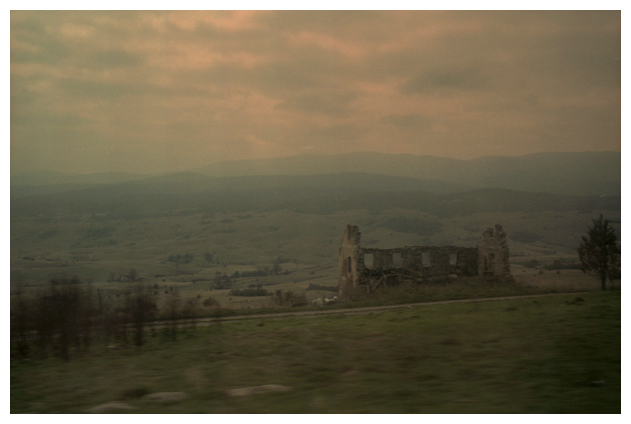 Matt Wilson, Untitled, Bosnia, from The Lamb and the Falcon
We see the ghostly outline of the old landscape beneath the covering of the contemporary and become aware of the centuries of associations. Schama says:
Landscapes are culture before they are nature; constructs of the imagination projected…but it should also be acknowledged that once a certain idea of landscape, a myth, a vision, establishes itself in an actual place, it has a peculiar way of muddling categories, of making metaphors more real than their references; of becoming, in fact, part of the scenery.
Hence the idea of both inherited ancient nature and landscape myths and traditions embodied in the landscape and landscape memory.
There are a lot of images online at Paris Photo 2010. According to the preview by Lens culture photography is one of Central Europe's richest forms of artistic expression:
From the very beginning of the 20th century, Bratislava, Budapest, Prague, Ljubljana and Warsaw were home to an intellectual avant-garde promoting a new vision of photography. Many artists from these cities revolutionized the history of photography, from André Kertész and Mohology-Nagy to František Drtikol, Josef Sudek, Brassaï and Robert Capa. Since the fall of the Berlin Wall, the countries of the former Eastern Bloc have undergone a political, social and cultural revival. Photography remains the preferred language through which Central European artists express a new political and social reality, borrowing from diverse practices ranging from the visual and performing arts to documentary and subjective forms.
I'll keep digging around the online gallery and see if what comes up can be built into a post on junk for code.
|


