|
September 14, 2010
Walter Benjamin's work eloquently testifies that reading 'the rags, the refuse' of culture reveals much about the constitution of culture. What a culture does not value speaks as much about that culture as what it does value. In a consumer economy that fetishises the commodity and consumption the realm of waste, that which is left over or left behind, is politicised.
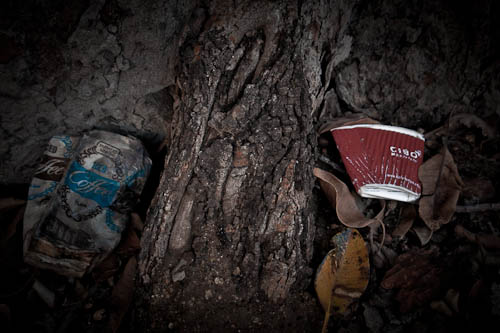 Gary Sauer-Thompson, Cibo + Iced Coffee, Adelaide Parklands, 2010
The politics of waste centres around waste as profligate or excess consumption, or as leftover material, or as something that has deteriorated through neglect or lack of effort. Whether it is rubbish, junk, clutter or other extravagance excess, and squander, waste is too much.
It also too little in the sense of ‘not making the best use of something’ (time, resources, opportunities). This gestures to another stream of waste that is associated with the Enlightenment idea of progress. Progress is movement away from scarcity, disorder and deficiency towards enlightened reason, discipline and mastery. The shadow is waste land that needs to be filled in.
It is anachronistic unused space that needs to be made useful by developers.
|


