|
June 3, 2011
Though we now live in a digital orientated future--eg., the national broadband network--- we are mesmerised by our analogue past---eg., the Hipstamatic-style apps for the iPhone. Or the Instagram. Both give snapshots the period look associated with the mass cameras and film from the 70s and 80s.
When I'm at Victor Harbor I've been focusing on the architecture of that specific place. Unlike the work of Mathilde Mestrallet it is nothing systematic, as its impetus is to document the old style beach architecture before it disappears and is replaced by ten apartments or a McMansion.
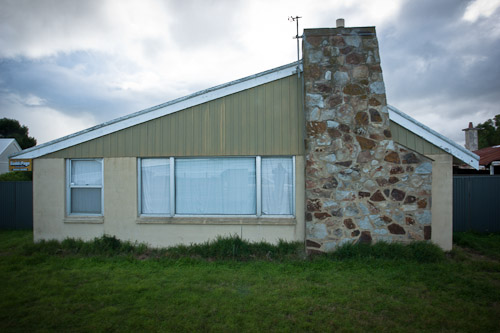 Gary Sauer-Thompson, beach architecture, Victor Harbor, 2011
Mathilde Mestrallet is far more systematic in the sense that her Résidences secondaires (2) project explores Sables-d'Or-les-Pins, a French resort town of Côtes-d'Armor, located in the communes of Frehel and Plurien.
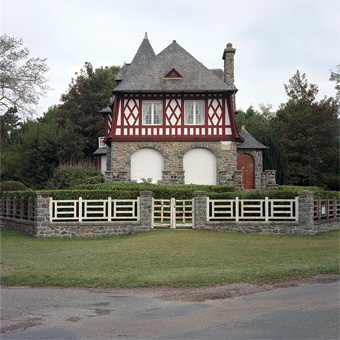 Mathilde Mestrallet, untitled, from Résidences secondaires (2)
This resort town was created from scratch in the 1920s. It had some glory years, especially with wealthy clients come to occupy the villas of Anglo-Breton pink granite, then the crisis of 1929, it was forgotten. This photographic series is the result of a wandering in the station emptied of its population, the houses mostly appear as closed theaters inanimate curtains remained closed, where it should open a window for him to play something, a moment.
In South Australia there is a nostalgia for the old. The place that the future once occupied in the imagination (eg., the 1960s) has been displaced by the past: that's where the romance now lies, with the idea of things that have been lost. The accent is not on discovery but on recovery. It's as if we want too transport to yesterday, or to shuffle and share architectural detritus from long ago .
|


Nostalgia happens when people are unsure about the future and feel safer living in the past.