|
June 13, 2011
Boris Mikhailov has used photography to document and to come to grips with the turmoil of life under the Soviets, and after the collapse of the Soviet Union. His Case History touches on such subjects as Ukraine under Soviet rule, the living conditions in post-communist Eastern Europe, and the fallen ideals of the Soviet Union.
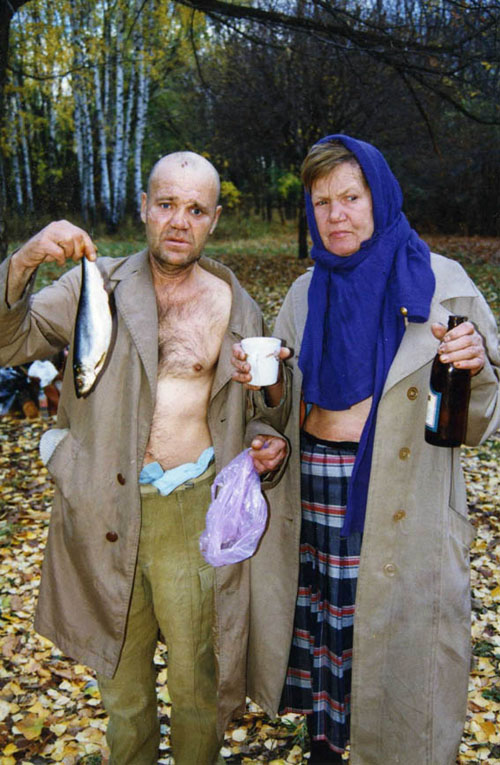 Boris Mikhailov, Untitled, from Case History, 1999
Mikhailov worked as an engineer in a camera factory until KGB agents discovered naked pictures he had taken of his wife. Suddenly jobless, he supported himself as an underground entrepreneur, enlarging and printing snapshots from customers’ family albums. He also exhibited his own work in small galleries and, after the fall of Communism, finally gained some attention for hand-coloured monochromes of everyday life.
In the intervening three decades, he has become, with llya Kabakov, one of the more important artists to have emerged from the former Soviet Union.In the Red Series (1968-75), Mikhailov documents the slogans and symbols of the Soviet era as heroic backdrops to the mundanities of everyday life. His interest in the personal is also evident in the Private Series (late 1950s), intimate black-and-white photographs of people dancing, socialising, or lying naked in their apartments - aspects of private lives which had no place in the official iconography of the Soviet Union.
In 1997 he returned to his home town of Kharkov after a year in Berlin and found this industrial city transitioning clumsily into capitalism. The rich paraded their fresh fortunes; the poor sank deeper into penury or fell into the new society’s chasms, or were spat out on to the street. The Soviets had managed to suppress homelessness, or hide it, but with the apparatchiks gone, the bomzhi (those of uncertain address) suddenly materialised in Mikhailov’s field of vision – and now he was free to capture them on film.
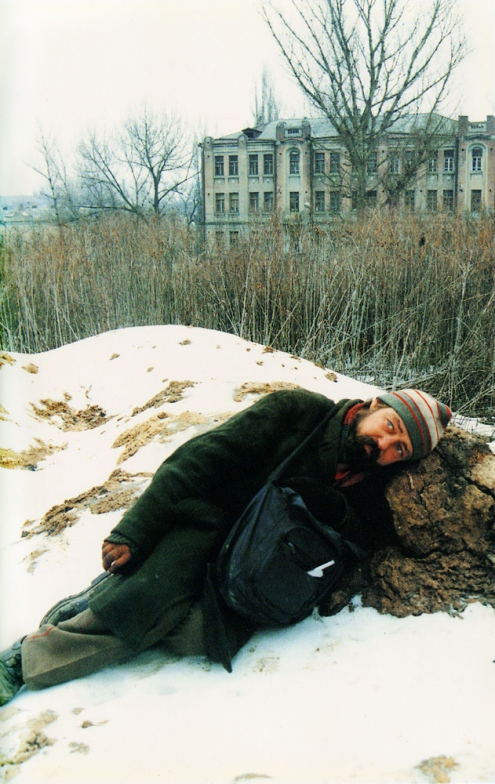 Boris Mikhailov, Untitled, from Case History, 1999
He concentrates on the homeless and orphans (the bomzhes) who are abandoned by the country’s social safety net and, in most instances, with no positive prospects for the future.While the subject matter may recall photojournalism, Mikhailov’s work diverges from it in at least one major way—Mikhailov paid his subjects to pose for him. Traditional photojournalists balk at the notion, believing that paid subjects will give them a performance instead of honesty.
|


