|
June 15, 2011
Although I admire, and have enormous respect, for the way that Wood S Lot successfully combines poetry and photography--- as some form of poetics?--- I have operated with an opposition between a literary and visual culture. Until I attended a book launch of New Poets 16 by some of the Friendly Street Poets in Adelaide last week.
Then the penny dropped. I could see the overlap. These guys were creating visual images with words and doing it successfully. I was creating creating visual images with a camera. We both think in pictures.
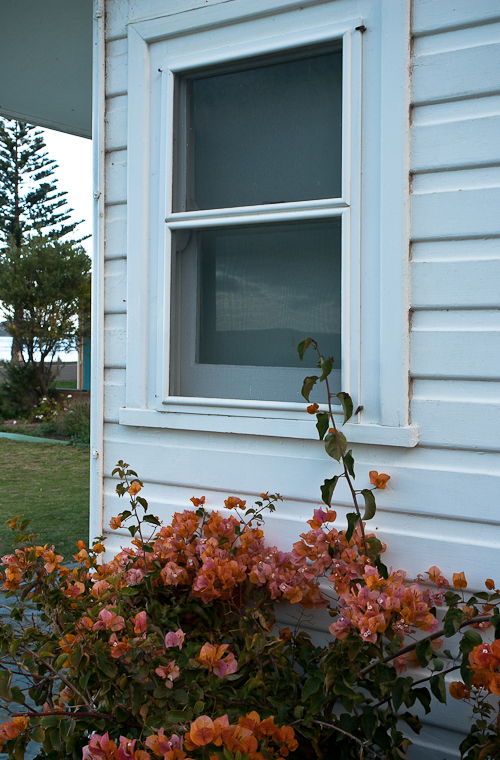 Gary Sauer-Thompson, Bougainvillea, Encounter Bay, Victor Harbor, 2011
I kept on thinking about some of the text that Straun Gray had placed next to his photographs, which I'd read earlier this week. The insights have been resonating whilst I've been down at Victor Harbor this week whilst Suzanne is in Italy.
He says in relation to his Sand Boils project that:
...indulging a personal nostalgia is not my goal when I say I want to make a meaningful photograph of the sand boils. Instead, I am interested in using poetic forms of photography to illustrate the mixture of memories and feelings this place invokes as part of the life of the present, as well as its continuing relationship with the cultural landscape in which it is embedded. I want to show the competing and contradictory aspects of the area, all together, and all at the same time, so they can be absorbed together as a complete, nuanced description.
Competing and contradictory is how I feel about Victor Harbor as a place I thought. It's having the confidence to see what is there.
Gray adds that his sort of poetics is common in photographs of people, but it is rare in landscapes.
Rare, at least, in landscapes made in the last fifty to sixty years, since the sixties sneered off the deadly serious post-war last gasp of modernism. Contemporary photographers will establish tension between their landscapes and their titles, or with concepts expressed in an accompanying essay, but they shy away from putting that tension into the work itself. It is usually easy to tell what we are looking at: the important question is why it is being shown to us, and the answers are given outside the frame in the form of context, venue and reputation.
He adds that such photographs are unpopular because they demand an informed response - or at least, an openhearted attempt at one - and they actively rebuke those who want simply to consume without engagement or effort.
When a photograph does not straightforwardly present information, but instead works by reference - and obliquely at that---t assumes a common body of knowledge between the photographer and the viewer. It prioritises certain sorts of experience, and publicly rewards those that know more than those that don't, which these days is just plain unacceptably rude.
|


