|
July 6, 2011
The Royal Academy of Arts has an exhibition entitled Eyewitness: Hungarian Photography in the 20th Century. It is dedicated to the birth of modern Hungarian photography and features the work of Brassaï, Robert Capa, André Kertész, László Moholy-Nagy and Martin Munkácsi. These left their Hungarian homeland to make their names in Europe and the USA, and they profoundly influenced the course of modern photography.
The majority of the photographs on display in the exhibition focus on ‘Moving Away’. When Hungary lost 70% of its territory after the First World War, thousands fled abroad to escape an increasingly fascist anti-Semitic government. Brassaï, Capa, Kertész, Moholy-Nagy and Munkácsi are each known for the important changes they brought about in photojournalism, documentary, art and fashion photography.
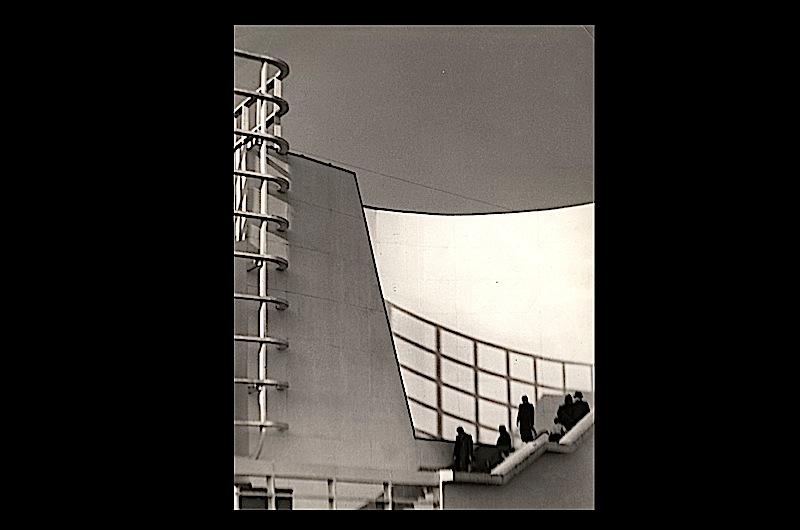 Angelo, Airport steps, Budapest, 1936. © Hungarian Museum of Photography, Kecskemét
The exhibition includes other photographers who remained in Hungary, such as Rudolf Balogh, Károly Escher and József Pécsi, to the more recent documentary and art photography of Péter Korniss and Gábor Kerekes are also represented.
After 1945, the Soviet regime encouraged a return to a new Magyar style of Socialist Realism which romanticised urban industry and labour; however, the fall of communism brought with it the globalisation of art, photography and much else besides.
Over 200 photographs from 1914 to 1989 will show how these world renowned photographers were at the forefront of stylistic developments and reveal their achievements in the context of the rich photographic tradition of Hungary.
Colin Ford's essay in the catalogue, is an attempt to explain the curious success of Hungarian photographers between about 1920 and 1950. Political events, wars, anti-semiticism and the pull of the west drew many Hungarian photographers out of their native land to Berlin, Paris and eventually New York, where they began to dominate the industry. However the Hungarian sensibility seems hard to explain in terms of imagery. The acute angles and artful composition dominated photography and other art-forms across Europe in the first half of the twentieth century.
|


