|
July 19, 2011
Junk food advertising creates meanings for consumers through visual imagery. These meanings in turn, shape consciousness and behaviour subtly by sanctioning some forms of thought and behaviour while de-legitimising others.
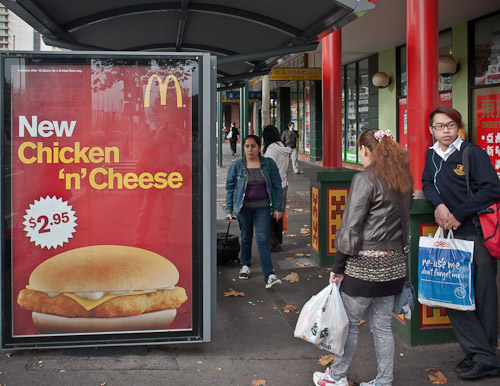 Gary Sauer-Thompson, Gouger St, Adelaide, 2011
Advertisements in fact place less emphasis on communicating specific product information and more on communicating the social and symbolic uses of products. Effectively, this means that in a consumer-oriented society, people define themselves as consumers and they are persuaded that they gain a fundamental gratification from consumption.
So advertisers generate systems of meaning, prestige and identity by associating their products with certain life-styles, symbolic values and pleasures.The subtle influence of advertising works in a variety of ways:
*Promotion of images that do not equate to the truth, but are presented in ways that appear to be ‘truthful’. So, people are convinced that buying product ‘A’ will make them happy or younger or more attractive—it must be so because the advertisements ‘prove’ it.
*Repetition of messages which stress minor differences between products, for example, Coca Cola and Pepsi Cola, can influence unconscious decisions on what becomes a preferred product.
*Even if consumers dislike some annoying advertisements, the constant repetition of messages can still influence their purchasing actions.
Junk food and drink marketing to children continues to be poorly regulated in Australia. It's mostly self-regulated and the food industry response to calls for changes has been minimal to date.
|


