|
April 6, 2010
Portraits from above Hong Kong's informal rooftop communities is a text by by Rufina Wu + Stefan Canham that explores the rooftop communities on five buildings located in older districts in the Kowloon Peninsula that are slated for redevelopment by the Urban Renewal Authority of Hong Kong. Canham's previous project was Bauwagen: Mobile Squatters.
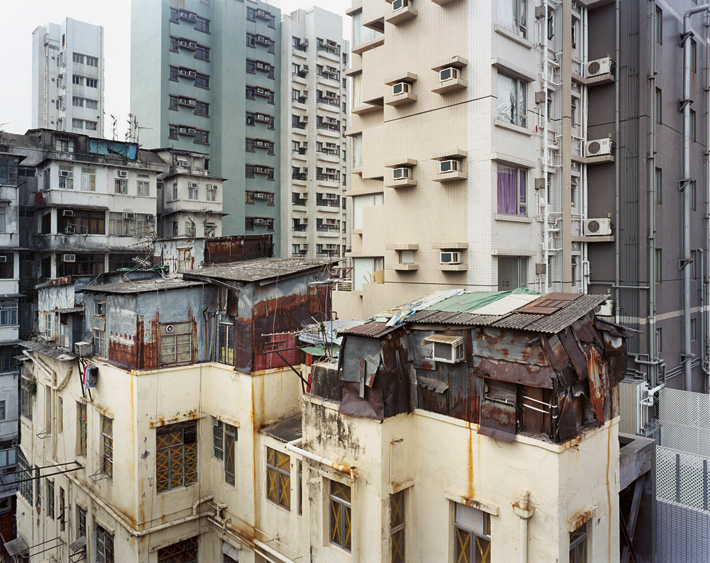 Stefan Canham + Rufina Wu, rooftops, Hong Kong, 2010
They say that the rise of rooftop communities is closely linked to the migration history from Chinese Mainland to Hong Kong. With each of China’s tumultuous political movements in the 20th century, like the Great Leap Forward and the Cultural Revolution, there was a corresponding wave of Mainland Chinese migrating to Hong Kong. These successive population influxes into a city notoriously short of flat land resulted in severe housing shortages and ultimately fostered the emergence of informal settlements. Flat roofs became attractive construction sites in the context of Hong Kong’s mountainous terrain and subtropical climate.
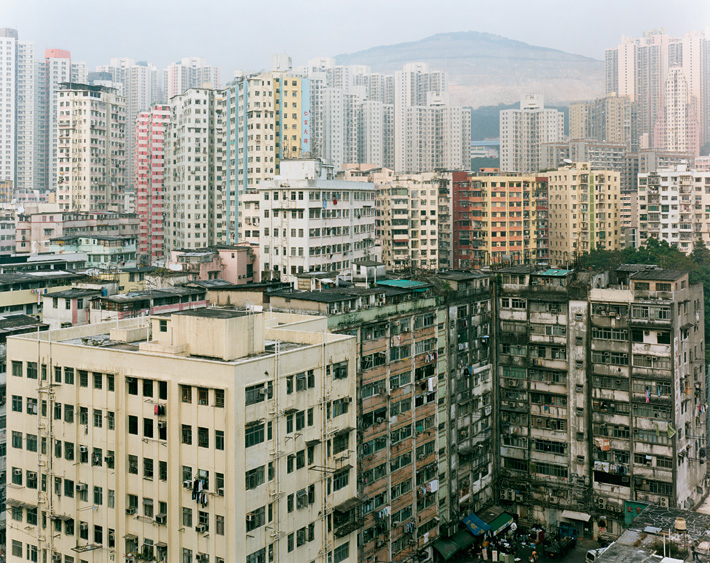 Stefan Canham + Rufina Wu, Hong Kong
Currently there is a seven-year residency requirement before one can claim eligibility for public housing and other social welfare. In effect, this stringent requirement denies migrants access to public housing. Those who cannot afford accommodations in the private sector but are also ineligible for public housing are left with very limited choices. The majority of current rooftop residents are Chinese immigrants—54,000 arrive in Hong Kong annually—although people from other parts of Asia and the Middle East are similarly enticed by Hong Kong's employment opportunities, higher wages, education, and health care.
Rooftop housing enables the underprivileged to live in the city by providing affordable housing where it is needed: in central urban areas, in the vicinity of employment opportunities, and in areas with well-established social networks.
|


