|
April 4, 2010
A.D. Coleman in The Photographs of Wynn Bullock written for an exhibition at the See Galley observes that the American version of modernist photography (he means the f64 group) had strict rules regarding photographic practice. It rejected all experimental darkroom procedures for film development and subsequent printmaking; for them, even such purely photographic techniques as photomontage and solarization were anathema.
He adds that:
Bullock, by contrast, had absorbed from Moholy-Nagy and Man Ray (and perhaps from his mentor Kaminsky) a more open-ended, European version of photographic modernism. He accepted photomontage, solarization, the photogram, light drawing, the negative print, the blur resulting from long time exposure, and even the creation of a synthetic negative for the production of prints as legitimate methods, seeing each as part of the medium's inherent and distinctive assortment of tools, materials, and processes. His ability to reconcile both these approaches to photographic praxis, the European and American versions of modernism, has few parallels in the field. The consequent breadth of his investigation of the medium makes him one of the most experimental photographers working in the U.S. in his time.
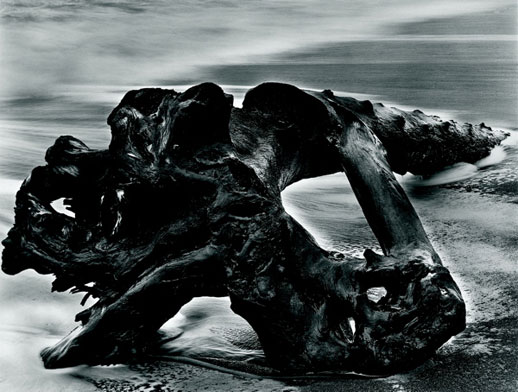 Wynn Bullock, Driftwood Tree Trunk, 1951
This is part of the elegant, romantic fine print tradition of the US landscape photography. It was taken on a 10 x 8 camera with a long exposure, and the dark contorted highlights of the smooth wet driftwood contrast heavily with the blurred waves in the background. The wood is rendered more like solidified lava.
 Wynn Bullock, half an apple.
I much prefer these kind of studio shots to all the passive female nudes in nature that he did and is well known for.
|


