Thought-Factory.net Philosophical Conversations Public Opinion philosophy.com Junk for code

Mandy Martin, Puritjarra 2, 2005. For further information on MANDY MARTIN, refer here: http://www.mandy-martin.com/
If there are diverse kinds of knowledge and ways of knowing place, then we need to learn to value the different ways each of us sees a single place that is significant, but differently so, for each perspective.
RECENT ENTRIES
SEARCH
ARCHIVES
Library
Thinkers/Critics/etc
WEBLOGS
Australian Weblogs
Critical commentary
Visual blogs
CULTURE
ART
PHOTOGRAPHY
DESIGN/STREET ART
ARCHITECTURE/CITY
Film
MUSIC
Sexuality
FOOD & WiNE
Other
www.thought-factory.net
looking for something firm in a world of chaotic flux

junk « Previous | |Next »
April 21, 2010

I'm taking photos of urban waste --- the emptied out, the used up, the broken, the outgrown, the obsolete; the dispossessed, the lost, the left behind, the rubbish, the mass produced throwaway. Our commodity culture is now a throwaway world and, if the remnant embodies a mode of ‘critical memory’ as Walter Benjamin claimed, then we have an aesthetics of decay.
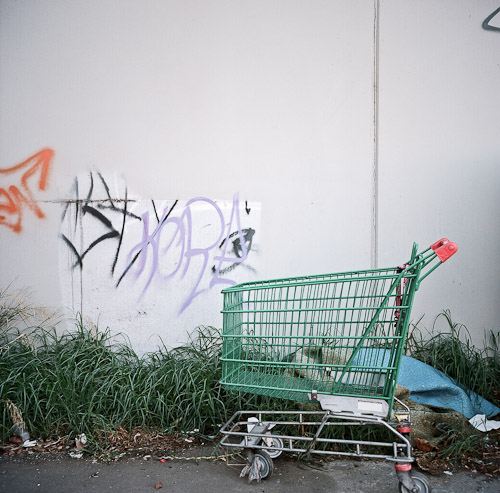
09June15_New Zealand_304.jpg Gary Sauer-Thompson, trolley+ rubbish, Port Adelaide, 2009

Trash is especially evident with old technology. Not many of us would bother to repair a seriously malfunctioning television these days. If it was under warranty, we would return it; if not, it’s probably trash like old computers. Yet there was a time when television sets were taken to a shop to be repaired.

A shift in our technological economy that favors replacement over repair explains some part of technological trash. It is now trash because changes in everything to which it must connect have made it unusable, especially with the shift from analogue to digital television.They become unusable.

Same with digital cameras. Mechanical analogue cameras continue to be repaired. Digital cameras, like mobile phones are, become throwaways.They don't need to be malfunctioning, failed or burnt-out. They are obsolete.

Trash belongs with garbage, junk, rubbish, refuse, debris, and waste. ‘Trash’ refers to the inorganic (thus distinct from ‘garbage’) and the useless (thus different from ‘junk’) which is unwanted but usable) residue of global capitalism. It becomes trash the moment a person can no longer use it. What are you supposed to do with the paper cup your french fries come in after you have eaten?

Take it home and photograph it in the studio with an expensive Rolleiflex SLR camera and film?

| Posted by Gary Sauer-Thompson at 11:39 AM | | Comments (5)
Comments

Comments

If both our habits and engagement with our habitat constitute an embodied ethics, then how we live with waste also embodies our ethical relations with it (or, our dwelling with it).

So how we deal with waste is more complex than just dumping it; or reducing waste in order to save the planet.

You might be interested in this photo essay about the recycling of subway cars in NYC:
http://www.acurator.com/#/2/26/0

Megan,
thanks. Gee, I love acurator as an online photography magazine. They have an interesting blog.

I found Stephen Mallon's fascinating Subway Series --the recycling of NYC subway cars--- intriguing. Are they just dumping the subway cars in the sea? How is that recycling? Or are they recovering them from being dumped in the sea--as reclamation suggests? I love his American Reclamation series that chronicles the recycling culture and industry in America. Impressive.

I notice from the acurator American Reclamation blog entry that Mallon is interested in:

"the secret worlds of salvage", photographing the recycling industry; for example, rubber processing plants, methane reclamation, incinerators, and the U.S.S. New York which is crafted from steel salvaged from the World Trade Center site.

And he does it so well.

Thanks for the link. Much appreciated.

I have heard of a number of coastal gov'ts taking this approach: http://www.inhabitat.com/2008/04/22/sunken-subway-cars-form-new-reef/

Megan,
thanks again. That's fascinating--retired New York subway cars being dumped into the ocean deep in an effort to start a new reef off New York's coast cos the natural reefs are dying from the ocean warming up. Apparently the artificial reef is quite successful.