|
April 26, 2010
This post picks up on Megan Raven's post at her Salon du Schadenfreude on the work of photoartist Melissa Fleming. Megan was attracted by Fleming's intriguing Under the Glass series.
My interest lies with Fleming's recent Sentient series of night seascapes in which the horizon line between sky and sea is blurred so that become one:
 Melissa Fleming, sentient iv, from the Sentient series
Fleming is a New York based photographer/artist--ie., an interdisciplinary artist who does photo-based installations and sculptural work.
Fleming describes her Sentient series thus:
Although the ocean is physically the same at night as it is in the day, our perception of it changes in the dark. Unable to see the water at night, we feel uncertain of our surroundings. Even photography, a medium of light, captured only the white crash of waves, the lone visible sign of the water in the darkness. The white seemed sentient and in a sense was the mark by which we could know the ocean at night.
The reason this series caught my eye is my interest in exploring seascapes down at Victor Harbor with a large format camera. I've done a few initial sketches/explorations on smaller cameras to see how things look:
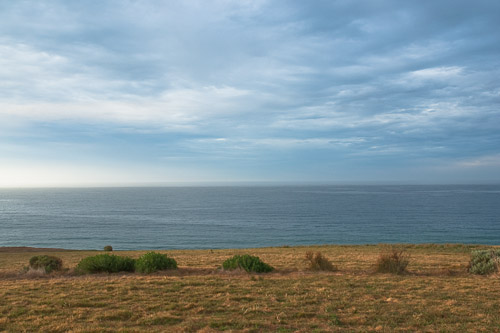 Gary Sauer-Thompson, seascape, Victor Harbor, 2010
As a result I've pulled my very old 8x10 Cambo monorail out the cupboard that I found lying in a box in a suburban photography shop a decade or so ago, ordered a new standard bellows from Custom Bellows in the UK, and bought some black and white film.
I plan to stand on the cliff tops and take seascape images in the low light--ie., early in the morning around dawn---for the atmospherics and the wind factor.There s little wind to move the bulky 8x10 at that time of the morning.
|


thanks Gary--but it is Megan Schade. Ryan isn't bad tho'!