|
June 30, 2010
I didn't know about Walker Evans' body of SX-70 Polaroid work auto-focus camera done in the last years of his life. I am surprised by this work given Evans' aversion to colour photography, which he characterized as 'garish,'and 'vulgar' --a bebop of electric blues, furious reds and poison greens.
The Polaroids are part of the Walker Evans Archive at the Metropolitan Museum of Art and they made made between September 1973 and November 1974 just before Evans’ death in April 1975.
I'm attracted to the snapshots of the ordinary weathered advertising signs and notices that are enhanced by the peculiar and subdued color palette of Polaroid SX-70 film:
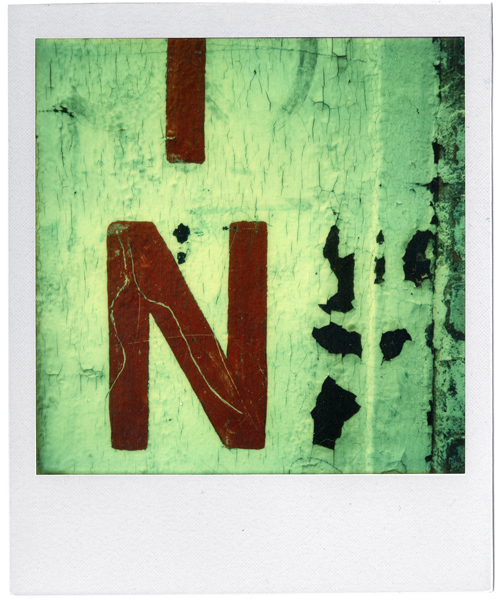 Walker Evans, Untitled, 1974 Unique Polaroid
These are very direct and concise, and they strip photography to its bare core, refined composition, limited technique and photographic seeing that are freed from the “tornado of color”. They are simple compositions of ordinary objects---empty buildings, discreet portraits, signs, found language----that indicate a mastery of composition. They appear to be Evans' equivalent of the scissors and paper for the older Matisse.
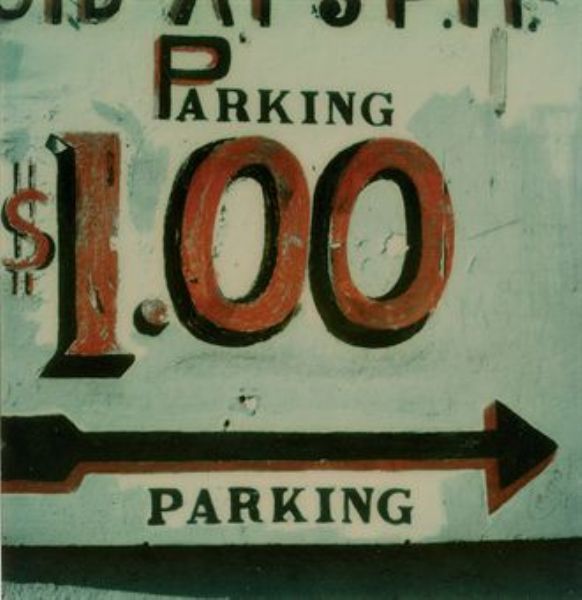 Walker Evans, Untitled, 1974 Unique Polaroid
The Polaroids are published in a book Walker Evans: Polaroids From what I understand Evans started taking color pictures as early as 1946 for Fortune Magazine and the majority of his work from that point on was color.
Outside of this collaboration with Fortune, the Polaroids from 1973 and 1974 are the next largest body of work in color. They take on an added resonance with the discontinuation of Polaroid’s consumer films and they serve as an important reference point for colour photography.
|


Walker Evans contributed a short wall text to the Museum of Modern Art's retrospective in 1971 which included some some of the signs he had been collecting, under glass. He said:
The signs had been put under glass, presented just like his own photographs: artefacts of a moment in time, an intersection between Evans and a situation that is framed. Evans claims that these two gestures of appropriation are somehow equivalent.