|
March 3, 2010
I see that Rudd has agreed with the common criticism of his government:--that the government has not progressed enough on delivering on its promises and Labor has not managed its issues - in particular the emissions trading scheme - effectively. Acknowledgment and acceptance of criticism is the first step.
Is it a tactical move---a circuit-breaker? Maybe. Maybe not. Stephen Leeder gives Rudd credit.
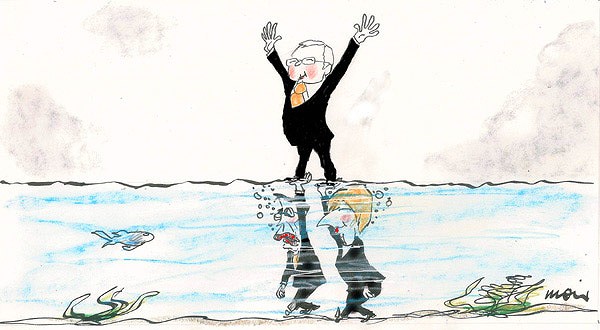
At least the criticism has resulted in steps taken towards health reform--- to get back to shaping the political agenda again shift. The reforms aim to shift away from Australia's heavy dependency on hospitals; to establish a new "independent umpire" at arm's lengths from government; to set "efficient national prices" of health services to be paid for by federal and state governments; the federal government taking over full funding responsibility for primary health care outside the hospital system; and new "Local Hospital Networks" paying for services, replacing the traditional model of Commonwealth grants to the states and territories.
An optimistic interpretation is that the Rudd Government is seeking to reduce not increase use of public hospitals, thus easing the strain, by putting in place a more efficient, integrated arrangement which, it is hoped, will spur people to be treated by less expensive primary health, (ie outside hospital) services.
However, what has been tabled in the reform agenda is two systems of government talking to one another with the commonwealth saying its gonna be xyz. Will the states concur? Will they reject it? No doubt more bribes (extra money as bait says Michelle Grattan) will be required to get them to accept national performance standards and the historic shift of power to Canberra on health care.
Update
I've re-read Rudd's Better health, better hospitals speech more closely. The core emphasis is that this fundamental reform is about improving hospitals. Rudd says this is:
Reform that for the first time enables eight state-run systems to become part of a single national network, using consistent national standards to drive and deliver better hospital services. Funded nationally. Run locally.The National Health and Hospitals Network contains seven major reforms. For the first time, the Australian Government will take on the dominant funding responsibility for all Australia's public hospitals from the states because the states simply cannot afford to fund the future growth of the system.
The Australian Government's funding share will almost double, from 35 per cent today to 60 per cent into the future - equating to an additional $11 billion per year from next year.The Australian Government will take clear financial leadership in the hospital system, permanently funding 60 per cent of the efficient price of every public hospital service provided to public patients.We will fund 60 per cent of recurrent expenditure on research and training functions undertaken in public hospitals.We will fund 60 per cent of capital expenditure - both operating and planned new capital investment - to maintain and improve public hospital infrastructure.
No previous Australian Government has accepted any responsibility for the funding of hospital infrastructure - let alone 60 per cent.Over time, we will also pay up to 100 per cent of the efficient price of 'primary care equivalent' outpatient services provided to public hospital patients.These reforms will permanently reverse the decline in the Australian Government funding contribution for public hospital services over the last decade.They will put an end to the tiresome cycle of the blame game between the Australian Government and the states over hospital funding.
There really wasn't that much on primary care and nothing about health inequalities. During questions after the speech Rudd suggested that it’s hard for governments to invest in prevention because the benefits won’t be seen for 10 years or more. Therein lies the limits of this fundamental reform.
|





Initial leaks had me worried in that it looked like the new scheme would only involve hospitals, but what he announced today, as you note, is much more, and much better, than that. Taking control of primary health care is, I think, the key to controlling what happens in hospitals. It is also closer to what the states have been arguing for too, so I think this will meet with less resistance than people are presuming.
Anyway, haven't had a really close look yet, but this is looking promising.