« August 2009 | Main | October 2009 »
September 30, 2009
goodbye to the media as watchdog
Roy Greenslade makes a penetrating point about what is happening to the British Press:
The press is no longer acting as a watchdog. It does not bite or bark. It has muzzled itself and retired to the kennel to live off PR scraps.
Isn't that the same in Australia, especially with the rural press in regional Australia, which is more or less owned by Fairfax Media and Rural Press. Margaret Simons observation about the rural press:
The main conclusion is that there has been little interest, or ability, to unify the various businesses. They are nothing if not various. What energies have been expended have been focused on unifying the advertising, not the quality of the journalism.
In the smaller capital cities such as Adelaide, journalism is sinking into casual endemic civic corruption because the commercial and political authorities are no longer held accountable by journalists. Journalism functions as part of the publicity machine of commercial and political authority through the cut and paste of the press release that produces bland pap.
Simons goes on to ask:
Surely at a time of drought, reduced water allocations to irrigators, political neglect and so on and so forth, there is more to say and room for a sharper edge to rural news reporting? And where is the leveraging of the journalistic strength of Fairfax? The investigative pieces on water allocations, that could run in the cities and across the group? Or the gutsy state political reporting of issues of rural relevance? Or the evidence that Fairfax reporters are primed with tough questions from the regions to throw at state and federal politicians? So much potential, unexploited.
Clay Shirkey argues that we are headed into a long trough of decline in accountability journalism because the old models are breaking faster than the new models will be put in their place.
If commercial media is a death by a thousand cuts, then not-for-profit journalism becomes a distinct alternative, if only because it represents a break from commercial media. So argues Greenslade.
Posted by Gary Sauer-Thompson at 8:30 PM | Comments (4) | TrackBack
Washington Post + social media
As Jay Rosen points out the rhetoric of American journalism describes itself as an adversarial fourth estate, a redoubt for professional skeptics who scrutinize authority in the name of the public and help keep the public discourse honest. This self-image is moth-eaten since the corporate media mostly amplifies the agendas of others—the prominent and the powerful—and tends to aggressively assume its adversarial role only when someone or something—a president, a CEO, an institution—is wounded and vulnerable.
There is little dissent in the sense of refusing to accept that the range of possible solutions to the nation’s problems must necessarily come from the centers of power and influence or to sustained coverage of ideas and—crucially—solutions. One way of doing this questioning and debating is through blogs, as blogs, which are part of the gift economy, represent passage to the public sphere.
What journalists discover is that the “sphere of legitimate debate” as defined by journalists doesn’t match up with their own definition.The authority of the press to assume consensus, define deviance and set the terms for legitimate debate is weaker when people can connect horizontally around and about the news.
It takes us to “news as conversation,” more of a back-and-forth debate and less of a pronouncement or lecture as well as a shift in power from the traditional media's content providers to a self-informing public. The task of the press is to encourage the conversation in the public sphere not to preempt it or substitute for it or supply it with information as a seer from afar.
The Washington Post has Social Media Guidelines are severe:
Post journalists must refrain from writing, tweeting or posting anything—including photographs or video—that could be perceived as reflecting political, racial, sexist, religious or other bias or favoritism that could be used to tarnish our journalistic credibility. This same caution should be used when joining, following or friending any person or organization online. Post journalists should not be involved in any social networks related to advocacy or a special interest regarding topics they cover, unless specifically permitted by a supervising editor for reporting and so long as other standards of transparency are maintained while doing any such reporting.
So there are to be no independent voices on the Post even though many journalists now have one foot outside the corporation.Twitter is a way for journalists to connect with others, scholars, friends, locals, whomever, often with the goal of knowledge-building and sharing.
These rules are about the control of independent voices and an attempt to reassert the traditional news authority to maintain order by either keeping the deviant out of the news entirely or identifying it within the news frame as unacceptable or radical.
Posted by Gary Sauer-Thompson at 7:24 AM | Comments (4) | TrackBack
September 29, 2009
finance capital rules
In Australia the recession has been announced as more or less over by the Reserve Bank of Australia (RBA). Various conservative voices are calling loudly for an exit strategy (freezing the stimulus, beginning a programme of retrenchment of government spending to allow the private sector to resume its starring role, and averting any mild danger of inflation) whilst defending the bonus culture of finance capitalism.
The good ole days are back and the spectre of socialism recedes into the background:

So what have we learned from the global financial and economic crisis that is still continuing in the form of massive simultaneous economic contraction across the industrialised west?
Will Hutton says not much:
Western governments took unprecedented and extraordinary action to avoid what undoubtedly would have been a global slump. The good news is that they have succeeded. The bad news is that what caused the crisis – the stranglehold of a new financial oligarchy upon public policy – has hardly been touched.. Governments have got to reform the entire structure of western finance –bonuses, credit rating agencies, capital adequacy requirements, banks that are too big to fail, the use of offshore tax havens, the role of derivatives – from top to bottom.
Governments aren't and they won't. Finance capital is too powerful. The G20 is just a forum where the heads of state of 20 economies discuss some important economic issues. Team Obama derailed serious proposals regarding financial reform for Wall Street at the G20 meeting.
So we are left with markets trampling over values that society holds dear, the need is for the profit motive always to triumph, financial markets must be allowed their freedoms, and equality must be subordinated to individual freedom. The casino of finance is the way things are and the governments role is to bail the bankers out when things go wrong, not reforming the financial system.
The big banks have gotten bigger and bigger --- we have an oligopoly of banks and “the oligopoly has tightened” --- and their very size distorts the markets and limits the growth of smaller banks. However, the Rudd government shows little interest in decentralize power and deposits and increasing the variety of banking models, to create a healthier financial system. The RBA is saying naught about breaking up the big four banks.
Posted by Gary Sauer-Thompson at 5:07 PM | Comments (1) | TrackBack
September 28, 2009
Quadrant on "the Left"
Quadrant Online has a forum on the Left that picks up on the What's Left series of articles run by The Australian. Here some of Australia’s leading Left thinkers explain what it means to be Left. Left more or less means social democracy, the ALP's light on the hill, social justice and the Rudd Government.
Mervyn F. Bendle says that:
the very best the Left can come up with as a unifying value is “equality”, understood in various incompatible ways, from the comparatively straightforward nostrums of “equality of opportunity” and “equality of outcomes”, to the more obscure “equality of conditions”, and “equal power to participate in the social life of the community” (with “social life” presumably referring to politics and not “party-time”). Allied to that ill-defined notion at the core of the social democrat “narrative” is the notorious oxymoron “social justice”, manifest in either its vague “welfarist or capabilities” mode beloved of some Blairites, or as the abstract “theory of justice” proposed by John Rawls in America.
How odd that there is no mention of sustainability by Bendle, given climate change, the dried out rivers in the Murray-Darling Basin and water shortages in the capitol cities. Why the blindness to this? Isn't this destruction of the ecological underpinnings of the economy and the biosphere by business-as-usual a key issue of the day?
Bendle ignores the 'New Left’ that emerged in the 60s and then the green left in the 1970's to concentrate on a social democracy that concentrates on growing the economy to finance the welfare state through redistributing wealth. Bendle says that:
the central problem with social democracy and the Left generally, as Soutphommasane reluctantly is forced to concede – for them, it is only about power and the rise of “a new, professional political class drawn from the ranks of advisers and apparatchiks”, committed only to “the art of campaigning to win and stay in government”, and characterized by the “bland yet affable, intelligent yet uncontroversial, poll-tested, sound-bite-spouting, professional politicians” that blight our television screens with their inane policy pronouncements.
This reduces the left to the the ALP in power and it using its political power imposing its agenda upon the people of Australia. Gee I thought a majority of the people of Australia voted for the Rudd Government's social democratic policy agenda. Or doesn't that count?
What of the critics who contest the failure of the ALP's social democrats to address the issue of sustainability in a substantive fashion. Aren't they on, or of, the Left? Aren't there conflicts and divisions within "the Left"?
Bendle's position is that politics has to be based on fundamental principles – “inalienable rights” - about human beings, and, secondly, that the state is not intrinsically an enabling or empowering entity that can be used as an instrument of “social justice”, but rather is an inherently burdensome and even deadening presence in the life of a free society. So you can swap "sustainability" for "social justice" and still make the same critique about the interventionist state crushing human freedom. Freedom is understood in the terms of classical liberalism---as negative liberty.
Bendle implies that the Left doesn't have any fundamental principles--it's just a professional political caste out to grab power and to hang onto it. The left is consumed by a lust for power---it has been reduced to the NSW Right! What has happened to the old philosopher king/social engineeer meme so favoured by those on the Right?
Posted by Gary Sauer-Thompson at 4:09 PM | Comments (21) | TrackBack
September 27, 2009
they mine water in SA
Despite the threats of climate change to Australia it is still business as usual. Resources are the key to Australia's prosperity. Australia is selling as much gas and coal and uranium as we can whilst paying lip service to the environment.
 Bill Leak
No where are the contradictions starker than in SA where the Rann Government is spruiking the long-term economic and social benefits of mining development.
BHP Billiton has been mining the Great Artesian Basin for years at no cost for the Olympic Dam copper and uranium mine at Roxby Downs.It plans to increase the amount of water it mines from the Basin as part of its proposal to turn Olympic Dam, in far-north South Australia, into the world's largest open-cut mine. The price BHP Billiton will pay for all this water is nothing.
The Rann Government's response is don't worry baby any concerns about the use of water will be addressed by BHP Billiton. The Rudd Government says that there s no indication that the use that's being made of groundwater by BHP is unsustainable. All three concentrate on the economic benefits and ignore and downplay the environmental costs.
For them it is acceptable that BHPBilliton expects to continue to extract water from the Great Artesian Basin AB for free.
Posted by Gary Sauer-Thompson at 9:53 AM | Comments (5) | TrackBack
September 26, 2009
socialism: a note
Socialism is such a dirty word these days. Few would admit to being socialist in spite of the failure of free market economics around the global financial crisis and global heating, the subsequent government bailout of the big banks and the rejection of the policies of neo-liberalism by many western governments.

Socialism is seen as belonging to the class centred era of industrial capitalism and it is equated with totalitarianism, worship of the state, terror, and the denial of human freedom. There is a sense of the redundancy of traditional socialist ideas about the imposition of socialism through the state, central planning and bureaucratic collective provision, whether done in the names of Keynes and Beveridge or Marx and Lenin.
The right-wing neo-liberal response to the increasingly intrusive role of the state into peoples' lives in civil society is to abandon ideas of the common good and collectivism and to roll back the state to the most minimal forms possible. In its place neo-liberals put the individual and the pursuit of private self-interest as the governing principles of economic and political organization.
Rather than rejuvenating any kind of market socialism, the global economic crisis is showing the strength of varieties of capitalism that resisted the turn to neo-liberalism--more statist forms of governance--rather than some form of market socialism in which firms are owned and controlled by the government but then sell their products to consumers in competitive markets.
The most fruitful strand rethinking of socialism is the democratization of socialism through new forms of decentralization, citizenship and participation which go beyond conventional liberal democracy.The citizenship socialists are more concerned with democratizing the state and decentralizing state powers into civil society than they are with separating off the state from civil society and minimizing its role.
Posted by Gary Sauer-Thompson at 8:10 AM | Comments (3) | TrackBack
September 25, 2009
dreaming California
It will be realistic to assume that the G20 summit in Pittsburgh will not deliver much by way of regulating the power of global financial capital or reducing global heating. Despite Kevin Rudd’s priority, as part of his “creative middle power diplomacy”, to sell the American foreign policy establishment on the benefits of the G20 as the “driving centre” of a new global framework, little will happen in Pittsburgh.
Its business as usual for finance capital. The big banks feel confident that they can count on the government to bail them out – for who would now risk “another Lehman”? They are too big to fail and they can more or less ignore calls for lower leverage and greater regulation.

The G20 are talking about global limits on bankers’ bonuses and IMF reforms to include China in the context of Europe’s marginalisation, not the grand bargain on climate change. That will be avoided as lowest common denominator politics is back in Pittsburgh Will they have the courage to agree to reduce the subsidies that encourage the use of fossil fuels? Remember the fossil fuel lobby.
In contrast, we have action on energy in California. Ronald Brownstein says in The Atlantic that:
The collapse of the state’s (latest) real-estate bubble has sent California’s economy into free fall. A short list of the state’s current problems would include surging unemployment, struggling schools, and a budget deficit larger than the entire budget in almost every other state. But on energy and climate change, the story is very different. .... The state emits only about half as much carbon per dollar of economic activity as the rest of America. It generates significantly more electricity than any other state from non-hydroelectric renewable energy sources like solar, wind, and biomass. California registers more patents associated with clean energy than any other state and attracts most of the venture capital invested in U.S. “cleantech” companies exploring everything from electric cars to solar power generation.
Though some of California’s edge can be traced to the state’s natural advantages, particularly a temperate climate that does not require as much heating in the winter or cooling in the summer, the difference is also rooted in conscious policy decisions.California’s experience says the evolution to a lower-carbon, more energy-efficient economy is possible and compatible with economic growth, but that the change requires endurance, consistency, and flexibility.
Says something about Australia doesn't it. It is not accepted that Australia's economy would boom thanks to the push to cleaner technology; nor is it accepted that 33 per cent of that nation's electricity should come from renewable sources by 2020. Australia has shown no interest in "bending the curve,” to reshape how we produce, sell, and use energy by attacking the problem from all angles.
Posted by Gary Sauer-Thompson at 8:40 AM | Comments (12) | TrackBack
September 24, 2009
media140 Sydney
There is a Future of Journalism in the Social Media Age. It is being driven by Julie Posetti, who is part of Media140, an independent global movement creating unique multimedia conferences and events to explore the future of the real-time web. The aim is to foster discourse, collaboration and innovation within journalism, media, advertising, entertainment, marketing, PR, gaming and technology industries.
This is the world of user experience and digital optimism. Media140Sydney, as a community gathering place, is concerned with the user experience of journalists, and fostering debate and exploring ideas within the media industry about Twitter and the other social media platforms and practices.
The media industry is defined as the mainstream media (print journalism, radio, television + New Matilda) and it is designed to explore the disruptive nature of ‘real-time’ social media, looking at tools such as Twitter, live-blogging, Facebook and other social networking tools as they rapidly transform the media in real-time.
Oddly, the use of blogging platform Twitter by independent political bloggers does not appear to be explored. Nor is the democratizing potential of the political blogosphere. But then blogs are so 2004, aren't they? They are full of bile, and just shout at each other, don't they? Unlike professional journalists, of course. Blogs are the dirty laundy, whilst journalism is the cleaned-up iron laundry.
What this indicates is that news and journalism are closely aligned with the existing media players, and so their combined futures are mutually dependent in the context of the woes of newspapers (profitability layoffs, consolidations, and outright closings), which are more extensive than in any period in memory.
The background to the relationship between journalism and Twitter is explored by Julie Posetti in her j-scribe as a working tool in their work. She argues that the micro-blogging platform Twitter has become the breakthrough social media tool for journalists, as they use it to cross-promote their own stories, comment on others, connect with contacts outside their usual silos and accumulate followers.
Posetti points out that Twitter has become as a way for journalists to publish news briefs from events they are observing or participating in--eg, the recent the dust storm or --- to share links to stories that are deemed significant etc. Twitter has become embedded as a component of the media's breaking news coverage and its increasing use of user-generated content. This means that newspapers are back in the breaking news business except now their delivery method is electronic and not paper.
Media140Sydney does not appear to venture outside the boundaries of mainstream journalism or what journalists working in the industry make of Twitter. The journalists are debating the ways in which technology is changing the social, political and economic fabric of their working lives. More broadly, it is a debate about digital optimism, that is premised on the threat the internet poses to the authority and relevance of the industrial media.
Posted by Gary Sauer-Thompson at 9:31 AM | Comments (13) | TrackBack
September 23, 2009
sydney dust storm
There are some amazing visuals of the Sydney dust storm getting around. The ABC collection has been steadily growing through the morning. At other sites it's a more personalised affair. If a reporter had been on hand to get a comment from that kid, we'd know about that too.
And, naturally, it's all over Twitter.
Margaret Simons watched the spread of news of the Melbourne tremors from Twitter to media and back again:
It was interesting to look at the Tweets and see the way people were interacting with the mainstream media. Some were waiting for “confirmation” from The Age, news.com.au or the ABC, and were not prepared to believe that it had happened until they read it on an established media site.But others were sneering that it was taking Big Media so long to catch up. And the media-savvy Wolfcat was doing his own checking on the Geoscience Australia site, and updating his followers with the results. He also pointed out that when The Age did carry the story, it was not confirmation but rather simply a reporting of what had already been said on Twitter.
Consuming news has become a layered experience. Watching the nightly news on telly isn't so much about finding out what happened today, as it is about how media will tell the story, or which stories and which bits of stories they'll leave out. It's more noticeably impersonal after you've been exposed to real, live, human on the ground versions and conversations across the country. News isn't something we consume any more. It's something we do.
The sky over the Gold Coast is currently going the colour of milky coffee. At this rate we'll have a Queensland sunset to go with the Sydney sunrise.
Posted by Lyn Calcutt at 11:32 AM | Comments (10) | TrackBack
Gittens + ecological economics
Ross Gittens makes a good point in his article in the Sydney Morning Herald. Referring to the climate crisis he says that though we've seen it coming for years we still can't take it seriously. He says that there is a need to shift from a "growth at all costs" economic model to one that recognizes the real costs and benefits of growth.
The core of Gitten's critique of, and breakout from, the ideology of free market capitalism and unlimited economic growth is this:
Even the economists who brought us the emissions trading scheme don't adequately appreciate the problem we've got. They think all we've got to do is switch to low-carbon energy sources (ideally by finding a way to capture all the carbon emitted by burning coal) and the economy can go on growing as if nothing had happened. Being economists, they see us as all living in an economy, with this thing at the side called the environment that occasionally causes problems we need to deal with. As usual, wrong model.In reality, the economy exists within the ecosystem, taking natural resources from that system, using them and then ejecting wastes, including sewage, garbage and all forms of pollution and greenhouse gases.
He adds that on the one hand we're chewing through non-renewable resources at a rapid rate and using renewable resources faster than their ability to renew themselves. On the other, we're spewing out wastes faster than the ecosystem can absorb them. Global warming is an example of the latter.
Mainstream (neo-classical) economics, with its negative conception of freedom, holds that economic growth, the democratization of affluence, and ever increasing consumption are both the formula for individual and social happiness and the goal of public policy. All traditional economic problems (poverty, overpopulation, unemployment, unjust distribution) have a common solution, namely an increase in wealth.The way to get richer is by economic growth.
This disconnects economics from the economy's biophysical foundations and is blind to the biophysical limits to economic growth. It is flat-earth economics since nature is not a containing envelope, but just a sector of the macro-economy - mines, wells, croplands, pastures, and fisheries.
The possibilities of economic growth increasing costs by more than it increases benefits (which is what climate change suggests) introduces the idea of sustainability. Ecological economics maintains that the economy is a subset of an ecosystem which is finite, non-growing, and materially closed (i.e., no matter enters or leaves it) and that it uses the environment as a source for material inputs and as a sink for wastes.
Unfortunately the economy has become so large relative to the ecosystem that human activity is undermining the ecosystem's ability to support human life. Hence the need for a new model of the economy and development.This requires making the shift from thinking of the economy as a growth machine to ecological economics that models the economy as a living system.
Posted by Gary Sauer-Thompson at 6:24 AM | Comments (7) | TrackBack
September 22, 2009
climate heating: UN negotiates
The Rudd Government has given the impression that its approach to emissions trading scheme has been directed more at placing pressure on a deeply fractured Coalition, rather than reducing greenhouse emissions and shifting Australia to a low carbon economy. Coal rules in Australia and the fossil fuel lobbyists deploy the tactic of delay.
So Australia has targets but no action and we are planning to build more coal-fired power stations to power the nation into a new era of prosperity:
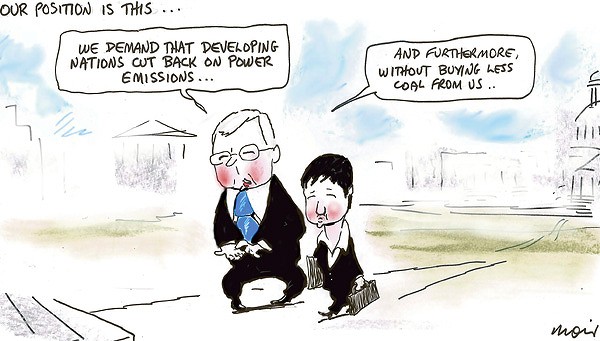
Attention has shifted to the UN in the context of the negotiations for a climate change treaty being adrift. It is marked by the failure of leaders of the big polluting countries to sign on to the deep emissions cuts needed; and the failure of industrialised states to come up with a package on how to compensate poor countries that will suffer the most devastating consequences.
The December Copenhagen summit is unlikely to produce a strong enough agreement that is a successor to the Kyoto protocol. Kyoto was where promises were made but not kept. The Copenhagen negotiations are dangerously stalled.
Even if rich countries clean up their act, a deal to ensure that global emissions peak and start to fall in time to keep temperature rises to less than 2C won't succeed without developing countries, such as China and India. A core issue is how to allow developing nations such as China and India to grow their economies and lift billions from poverty without generating enormous greenhouse gas emissions, as past growth in the developed world did.
The official Chinese position is summarised as "shared burden, differentiated responsibilities", which roughly translates as: We're all in the same boat but it's your fault that it's taking on water, so you'd better do most of the baling. China will not sacrifice its economic growth to prevent the world from warming by more than 2C--- its priority must be economic growth to relieve poverty among its vast population.
Is Beijing is determined to make the rich countries cut deeper and hand over more technology and cash to developing nations? The most vocal arguments are about equity: the rich industrialized world caused the problem so why should the poor world pay to put it right? China's position is that helping developing countries adapt to climate change is not an exercise in charity by rich nations, but their responsibility to help developing countries take a new low-carbon path for development.
Yet Australia is not taking a new low-carbon path for development. The United States is unlikely to be the nation that blazes the trail toward a bold new future in Copenhagen given the political trench warfare in the US,
Posted by Gary Sauer-Thompson at 9:37 AM | Comments (4) | TrackBack
September 21, 2009
behind the headlines
Mark Bowden in The Story behind the News in The Atlantic argues that one of the consequences of the collapse of professional journalism is that:
Work formerly done by reporters and producers is now routinely performed by political operatives and amateur ideologues of one stripe or another, whose goal is not to educate the public but to win. This is a trend not likely to change.
True, Bowden is nostalgic for the good old days of journalism. He says that what gave newspapers their value was the mission and promise of journalism—the hope that someone was getting paid to wade into the daily tide of manure, sort through its deliberate lies and cunning half-truths, and tell a story straight. That is one reason why newspaper reporters, despite polls that show consistently low public regard for journalists, are the heroes of so many films.
Bowden's article gives two examples of the conservative political operatives and amateur ideologues in the US who used snippets from U.S. Circuit Court Judge Sonia Sotomayor early talks to portray her as a racist and liberal activist during the first few weeks following President Obama nominating Sonia Sotomayor to the Supreme Court. He makes his case.
This kind of political partisan work, which can be usefully described as post-journalistic, is one that we informed citizens are already familar with. It is quite extensive in the media landscape of the 24 hours news cycle and this normality operates at different levels.
Bowden goes onto say that the consequences are harmful, as the partisan practitioners see:
...democracy, by definition, as perpetual political battle. The blogger’s role is to help his side. Distortions and inaccuracies, lapses of judgment, the absence of context, all of these things matter only a little, because they are committed by both sides, and tend to come out a wash. Nobody is actually right about anything, no matter how certain they pretend to be. The truth is something that emerges from the cauldron of debate. No, not the truth: victory, because winning is way more important than being right. Power is the highest achievement. would describe their approach as post-journalistic. .....
...The blogger’s role is to help his side. Distortions and inaccuracies, lapses of judgment, the absence of context, all of these things matter only a little, because they are committed by both sides, and tend to come out a wash. Nobody is actually right about anything, no matter how certain they pretend to be. The truth is something that emerges from the cauldron of debate. No, not the truth: victory, because winning is way more important than being right. Power is the highest achievement.
Well, this the classic understanding of politics--what Carl Schmitt called an existential conflict between friend and enemy (any person or entity that represents a serious threat or conflict to one's own interests).
Bowden then argues that journalism prevents this destruction of democracy in that, without journalism, the public good is viewed only through a partisan lens, and politics becomes blood sport. I find this playing off the honest, disinterested reporting versus partisan advocacy by bloggers close to mythmaking. Most practising journalists in the media establishment are already partisan, in that they spinners for political parties, rewrite political and corporate media releases, and are complicit in management of the publicity machine. They are, to put it bluntly, engaged in mass deception not enlightenment.
Secondly, Bowden is pointing the finger at amateur bloggers when the main media institutions simply recycled the material from the Republican noise machine. Journalism these days is not seeking truth to enlighten, far from it. Journalists are a part of the relations of knowledge/power and integrated into our what works politics Thirdly, the sordid reality of actually existing journalism is covered over by Bowden's appeal to an ideal of journalism, and the ideal is then equated with what journalism actually is.
Posted by Gary Sauer-Thompson at 2:12 PM | Comments (13) | TrackBack
Telstra: the strike back
The reaction against the Rudd Government's proposed separation of Telstra is in formation. The resistance is being flushed out, as we can see from two recent op-eds in the nation's broadsheets.
Kenneth Davidson in his Protection racket is bad policy in The Age is blunt. His position is that Telstra should be given carte blanche in its operations, that its competitors ("basically marketing and billing organisations") are parasites in a protection racket, and this is Rudd Labor's equivalent of WorkChoices with the same capacity to destroy the Government! This bloated rhetoric is not backed by an argument:
What is unfolding in the policy announced by Communications Minister Stephen Conroy is a $43 billion protection racket designed to keep Telstra's competitors in business....In Devonport and Hobart, where the Tasmanian Government has been experimenting with building fibre to the home at Commonwealth expense, shows nobody wants it while the cheaper copper alternative is available...As the experience in Tasmania makes blindingly obvious, the only way customers can be induced to take up the fibre-to-the-home option is if the copper network is closed down..It is a blackmail attempt by the Government designed to force Telstra (owned by 1.4 million voters) to divest itself of a copper network, which generates cash flow of around $6 billion a year, and make it worthless within eight years.
Davidson says that Rudd + Conroy are doing this in order to replace it with a system that nobody wants or needs at a cost to households and businesses for access to the telecommunications network 30 to 40 per cent higher than now.
Firstly, the shift to new publicly owned infrastructure technology is the core point of the reforms designed to address Australia's low quality broadband: slow average speed broadband services that are also amongst the most expensive.
Secondly, the copper network is 19th-century technology and its days are numbered. Reliance solely on old-style copper networks is a pathway to oblivion. Given the limitations of the old copper network--expensive to maintain as people move to other modes of communication delivery --- it will be replaced by new fibre-to-the-premises network.
Thirdly, fibre-to-the-premises provides productive opportunities for new data information services (video and internet tv). Davidson, however, claims that households or business do not want or even need the extra services, but he makes no argument for this.
Glenn Milne, the Liberal apologist, argues in The Australian that the intervention into the telecommunications market indicates that Australia is a command economy. Milne relies on Charlie Aitken, formerly of Citibank, runs Southern Cross Equities, part of Australia's largest independent stockbroker and financial advisory groups. His concern is regulatory risk, and he argues that the Rudd government is putting the state at the centre of the market economy. The emissions trading scheme, banking and superannuation are mentioned by Aitken as examples of the Rudd Government's interventionist tendencies, which are spooking the market.
Milne then loads Telstra onto Aitken's account without arguing how greater intervention into the market constitutes the emergence of a command economy. The inference is that government intervention equals command economy. Yet Telstra was created by government intervention----privatisation! Milne's defence of Telstra is wrapped up the rhetoric of the free market orthodoxy under assault from a socialist government.
This anti-reform commentary from Left and Right is poor in policy terms. The two op-eds ignore the need to correct 20 years of policy failure --a deeply flawed policy regime that delivered a private monopoly. No mention is made of Telstra gaming the telecommunications regulatory system, delivering ultimatums to government, delaying the rollout of high-speed broadband and suppressing competition in lieu of bigger and better profits. No mention of the prohibitive cost of backhaul (especially for Tasmania) or that Telstra--the traditional phone network-- also owns the cable TV network.
The anti-reform stance basically amounts to little more than a defence of old technology, old industry and monopoly. The free market crowd of finance capital assumes that government invention to create markets is good but regulation of those markets is bad; and that state-sponsored monopoly's are bad whilst private monopolies are good.
Posted by Gary Sauer-Thompson at 8:34 AM | Comments (10) | TrackBack
September 20, 2009
"What works" politics
In What Works Doesn’t Work in the London Review of Books Ross McKibbin offers an insightful account of modern politics in liberal democracy. He says that in a famous essay published nearly ninety years ago, Max Weber suggested that politics was becoming the territory of the professional: politics was the politician’s whole life, his ‘vocation’, and the modern political party was his home.
Others, like the Italian sociologist Robert Michels, argued further that for the modern politician the political party was a form of social mobility, so that eventually the protection of the party’s bureaucratic structures – the machine – became more important than the interests of the people the parties were supposed to represent.
McKibbin then develops the professionalism in terms of British politics that apply equally to Australia:
Professionalisation has always been a necessary characteristic of modern British parties, but in the last twenty years or so extreme professionalisation has become the dominant characteristic. The typical politician today, whether minister, shadow minister or ‘adviser’, proceeds from student politics (often with a politics degree), to political consultancy or a think-tank, to ‘research’ or the staff of an active politician. He or she is ‘good at politics’ – which means being good at the mechanics of politics, not necessarily at its ideas. The consequence is that the mechanics drives out the ideas, and the immediate expels the long-term.
Politics, he says is what the Daily Mail says today; the long-term is what the Daily Mail might say tomorrow. The crucial relationship now is between the politician, the journalist and the ‘adviser’.
He adds that public opinion is continually tested, but not in ways likely to supply anything other than the desired answer: what the opinion-testing seeks is ways to achieve the answer that’s wanted.
So today’s politician falls into the hands of the focus group. But the focus group, and the question on which it is asked to focus, is manipulated by the political consultant every bit as much as the focus group manipulates him. Each deceives the other. The result is that the political experience of the modern politician, the person good at the mechanics of politics, is exceptionally narrow: the political elite is now probably more divorced from society, and from any wider organising principles or ideology, than at any other time in the last 150 years.
The culture of the focus group (it includes the popular and financial press)reinforces the political status quo and encourages a hard-nosed, ‘realistic’ view of the electorate that denies the voter any political loyalty, except to ‘what works’. ‘What works’, though, is anything but an objective criterion: these days it is what the right-wing press says ‘works’. The war on drugs doesn’t work; nor does building more prisons; nor, one suspects, will many of the anti-terror laws.
The focus group truths are taxation (too high), crime (too much), choice (not enough), asylum seekers (too many), the public sphere (too big) and the elimination of these blemishes became the desideratum of politics.
Posted by Gary Sauer-Thompson at 11:45 AM | Comments (1) | TrackBack
September 19, 2009
Stutchbury on the national broadband network
I have trouble following the arguments of Michael Stutchbury, the Economics editor of The Australian. When writing about the Rudd government's response to to the global financial crisis Stutchbury appears to start from an opposition to the Labor and then hunt around for arguments to show why Labor was plain wrong with its stimulus package. Presumably, what sits underneath the partisanship is a commitment to small government, competitive markets, individual (economic) freedom, lower government spending and less intervention in the economy.
On the Telstra issue he uses Michael Porter, a former adviser to the Kennett government and now research director at the Committee for Economic Development of Australia. Porter says:
I worry that vertical separation is just a mantra response to Telstra's abuse of its monopoly status. I don't see why vertical separation of Telstra is the main game.The government's main game instead should be to promote competitive provision of rival broadband technologies: Telstra's existing copper wire, mobile wireless systems, the hybrid fibre-coaxial cable used by Foxtel and optic fibre. That is, competition between networks rather than competition between rival telcos using the same open-access network.
Stutchbury adds that in contrast, Conroy's NBN largely mandates a particular technology: fixed-line fibre-optic cable. Taking this technological risk may seem safe now because fibre optic is the biggest information pipe available. But the technological revolution has revealed how much consumers value mobility and convenience. That has made wireless the fastest growing area of broadband demand.
There will be competition between networks---- Telstra will continue to develop its mobile broadband under a national broadband network. Why would your strategy be one of infrastructure competition between Telstra's existing copper wire and fibre to the home, when the former has had its day and the latter is a replacement of the former.
Stutchbury response is to quote Conroy critic and economist Henry Ergas who likens the NBN to Sydney's unprofitable Cross City Tunnel.
What we are really saying is we have built this new motorway and we are going to close the other roads because the only way the motorway will cover its costs is if everyone uses it.
It shows that Stutchbury doesn't get it --we are talking about a national information highway around the nation not one tunnel on a particular roadway.
So Stutchbury tacit argument is that there should be no government ownership of infrastructure--it should be privately owned.
Posted by Gary Sauer-Thompson at 3:24 PM | TrackBack
September 18, 2009
Fairfax: time for a change
So Fairfax is involved in a power dispute between the Fairfax family and Ron Walker, the Chairman of the Board of Directors. Fairfax, which was once an Australian publishing institution that stood for quality journalism, has become just another media company.
Walker will go sooner rather than latter. A board room change--new blood and talent in the boardroom--- still leaves this media company under the management of Brian McCarthy from Rural Press, having little idea about future of newspapers or funding quality journalism in a digital world. In fact this management team gives the appearance of denying the crisis they are facing other than keeping on cost cutting. That is a one way track to a cul de sac.
As Stephen Bartholomeusz in Business Spectator observes:
The old core of Fairfax, its metropolitan newspapers, and its two big broadsheets in particular, are imploding as cyclical and structural forces have converged. No-one expects the classified advertising volumes and yields to return to their pre-crisis levels.While the Walker acquisition spree has provided diversification into less competitive and vulnerable media segments, that’s an issue of degree rather than direction. Fairfax has yet to devise a strategy or asset base that will allow it to grow while the old media declines, and both the capital it has raised and the structural issues it confronts will dampen its traditional leverage to economic recovery.
Such a strategy in an industry that is undergoing deep seated structural change outside the control of any management involves Fairfax having to reinvent itself.
Margot Simons in Crikey says that:
The real potential of the Rural Press-Fairfax merger was that it made Fairfax the only media organisation in the country -- with the exception of the ABC -- with depth of journalistic talent and real presence in rural and regional Australia. Fairfax had a unique opportunity. But the approach to Rural Press was mistaken. Fairfax understood that it had to diversify from its metropolitan print mastheads, but it thought that rural papers would continue to do well. In fact, the opportunity was about content and community, not about gaining more print assets. The trick was to invest in the content and the community, while getting away from dependence on the print platform. That was never understood.
If one wants to look at what regional and local presence combined with depth of talent might mean in the new media age, one only has to look at the ABC, where localism, social networking and the building of communities is a central part of the vision for justifying publically funded media in the new age.
Posted by Gary Sauer-Thompson at 2:21 PM | TrackBack
Afghanistan: Nato losing
The European members of Nato are increasingly unhappy with what is happening in Afghanistan --the bodies of dead soldiers returning to their home countries. This includes the Dutch and the Germans along with non-Europeans --the Canadians.
What is happening is the increasing strength of the Taliban even though Al-Qaeda has been on the retreat for some time. Paul Rogers in Open Democracy says that there are credible reports that:
Taliban elements now have control of most of Afghanistan's second city of Kandahar. This has been achieved not by open fighting but by slow and steady encroachment of one district after another; the movement's advance being aided by disillusion of local populations that have no faith in the ability of the Afghan police or army, let alone foreign forces, to provide security. It is difficult to overemphasise the importance of the takeover of Kandahar. Since 2006, Taliban groups have taken over more rural areas in southern and eastern Afghanistan, and proceeded to establish their own rule of law, tax systems and elements of local administration. They have had less impact in the major towns and cities, however.
Hence the increasing use of the drones as a counter measure to the successes of the insurgency in Afghanistan and the call for ever more troops to fight the insurgency. With the rural areas increasingly insecure, many returning Afghans have migrated to towns and cities, causing rapid urbanisation that is contributing to rising poverty, unemployment and criminality
However, the Americans are optimistic --as always--about the proxy war in Pakistan despite state failure of the Karzai Government in Afghanistan. We are been given a Panglossian view of what can be achieved in Afghanistan against 8 years of experience to the contrary.
How soon do we start hearing about "staying the course" in Af/Pak and war critics "losing their nerve" from those neocons and national security hawks whose agenda for American foreign policy is perpetual, unending war?
The Obama administration's goals in Afghanistan are growing overly ambitious and achieving them is unlikely. The goal is to create an effective central government and that means the Americans will be there for decades. As Marc Lynch points out:
The similarity in American thinking about the role assigned to elections in the Iraqi and Afghan case bears particular attention. In each case, the elections are supposed to do very specific things for American strategy: legitimate the political order, bring excluded challengers into the political process, resolve enduring political conflicts, create a political foundation for the counter-insurgency campaign. In Afghanistan, the opposite appears to have happened.
The logics here are more complex than Brendon Nelson's simplistic fighting totalitarianism (clashing civilizations thesis) as we have local struggles for power, intra-communal struggles for power, struggles among economic competitors, patronage and rent-seeking, and the local security problems among fragmented and competitive armed groups.
Moreover, it does not appear that the Obama administration has begun to take steps to repudiate America's imperial strategy, with its military dominance in the world that encourages other nations to form countervailing coalitions and alliances; or begun to replace this kind of foreign policy with a more restrained and more focused one.
Posted by Gary Sauer-Thompson at 8:38 AM | Comments (6) | TrackBack
September 17, 2009
Skukuza 2009: River Murray
The ANU Water Initiative is co-sponsoring the 2009 workshop of the Skukuza Freshwater Group, a biennial gathering of experts from academia, governments and environmental organizations to discuss a key emerging issue in freshwater conservation. Skukuza 2009 will be held on the estuary of the River Murray in Australia, a major Ramsar site at the end of a river system that is severely impacted by river regulation, diversions, over-allocation, deteriorating water quality and climate change.
There was an open meeting in Goolwa on September 9th with the members of the Skukuza Freshwater Group. The key message was that removing the barrages separating the Lower Lakes from the sea will give them the best shot at recovery; and that Ramsar isn't fussed on whether the Ramsar listed wetland was freshwater, seawater, estuarine water or brackish. So long as it is a wetland is what counts. So the lower lakes and Coorong certainly can be marine estuarine, since there is no reason why we cannot change wetlands.
The Skukuza 2009 communique focuses on the management of environmental flows within a changing climate and it emphasize that our societies know enough now to take action to improve the health of our rivers.
Personally I'm in favour of treating the Coorong and the Lower Lakes as one estuary, opening the barrages to the sea, and moving the barrages back to Wellington---pretty much in line with the old Murray-Darling Basin Commission's River Murray Barrages Environmental Flows Report in 2000. The lower lakes and Coorong should not have those 1940’s barrages separating them.
This is in contrast to the Murray Futures, government/community outreach program favouring a freshwater solution only. For the latter seawater is a 'last resort’. The assumption of this position appears to be that the Lower Lakes have predominantly contained fresh water for over and only occasionally become a more estuarine environment for a short period of time. Therefore they need to be kept fresh.
Those who support this position appear to be placing all their eggs in the freshwater basket, with little to no consideration being given to possible management strategies if there is insufficient freshwater available to maintain lake levels above sea level. Currently, there is insufficient fresh water available. The irrigators and state governments have made sure of that.
Posted by Gary Sauer-Thompson at 5:56 PM | Comments (13) | TrackBack
Nelson: a farewell to political life
I'd always seen Brendan Nelson as a social liberal who became a conservative in his pursuit of political power. That was what was required during the Howard decade, if you wanted to be successful. Nelson, no doubt, would dispute this interpretation.
His farewell speech was wry, modest and personal. The witty references to earrings and haircuts (but not to motorbikes and Fender guitars) showed that he was more than a cut out cardboard politician with partisan instincts. He was an emotional human being who related to people and not a cog in a political machine.
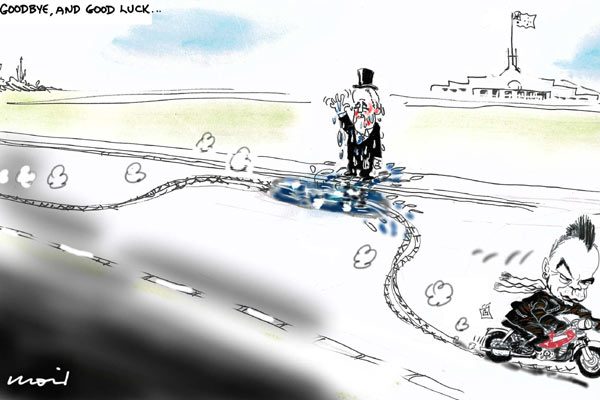
The speech was very weak on policy. His justification for war with Iraq is this:
I supported the toppling of Saddam Hussein in the post September 11 world. He may not in hindsight have been an immediate threat, but he was an inevitable one.
That was it. Not much reflection there. How was Saddam Hussein an inevitable threat to Australia? What about all the lies and deceptions? The torture and renditions? Why George Bush was arguably the most misunderstood and misrepresented figure in recent history? Why the invasion of Afghanistan? Nelson says that our generation is engaged in an epic struggle against resurgent totalitarianism. That's cold war rhetoric.
Nelson does go on to say that there are five key challenges facing Australia. One of these is the environment:
It is time for our generation to live on environmental interest instead of the environmental capital that has sustained us since the industrial revolution. But on climate change, let us not be a nation of intellectual lemmings. Why introduce the biggest change to the economic architecture of this nation in my lifetime with a tax on everything, and massive churning of money through the economy as we emerge from the deepest economic downturn in eighty years, for no environmental gain? To legislate an Emissions Trading Scheme in a country responsible for 1.4% of global emissions before knowing what the three major emitters will do, defies not only logic, it violates the nation’s best interests. The dictum in medicine is Umbirima Fides – to always act in the utmost good faith.
In contrast to the rhetoric about living on environmental interest Nelson's view is that the nation’s best interests are economic, rather than in adapting to the inevitable consequences of global heating. Prosperity rules.
So Nelson is one of those Liberals opposing the scheme so that the Liberals would be "standing for something" as Liberals. Yet the policy the Coalition took to the last election promised that a re-elected Coalition government would "establish the world's most comprehensive emissions trading scheme in Australia, commencing no later than 2012.
Posted by Gary Sauer-Thompson at 8:28 AM | Comments (17) | TrackBack
September 16, 2009
climate change: withering in the vineyards
The Obama administration's recent Global climate change impacts in the United States provides a detailed picture to date of the impacts on the US in the worst case scenarios, when no action is taken to cut emissions. What it indicates is that even if the world is successful in cutting carbon emissions in the future, the various states in the US need to start preparing for rising sea levels, hotter weather and other effects of climate change.
Same for Australia. The states have to adapt, no matter what we do, because of the nature of the greenhouse gases means that they are still going to be in the atmosphere for the next 100 years. Cutting greenhouse gases in the future will take decades to have an effect while the planet continues to warm. States have only recently begun to consider what steps they must take to minimise the damage expected from sea level rise, storm surges, droughts and water shortages because of climate changes.
Climate changes means rising temperatures in south eastern Australia over the next few decades that will lead to more heatwaves, wildfires and droughts. Does that mean withering in the vineyards of South Australia?
Every low-lying community coastal in the country will in the coming decades face the real cost of increased erosion, storms and sea-level rises exacerbated by global warming. This presents local people and the government with a stark dilemma. Is it worth spending billions on defending homes and livelihoods? Or, faced with inexorable sea-level rise, should expensive coastal defences be abandoned, leading to the evacuation of land and houses?
The process of coastal erosion from rising sea levels with cause strong political resistance as farm land is lost, house prices fall and fresh water marshes become salt marshes.
Posted by Gary Sauer-Thompson at 8:42 AM | TrackBack
September 15, 2009
Telstra breakup: a gamechanger
I never thought that the Rudd government had the political courage to correct the mistakes of the previous Howard and Keating governments that created the 600-pound Telstra gorilla in the telecommunications market. We all knew what happened: Telstra stalled on providing access to its copper wire network, charged unfair access fees, offered poor services, and it acted to both undermine regulation and prevent competition to further its monopolistic agenda.
For consumers broadband on the old copper wire was expensive, slow, geographically limited with limited competition. Reforms were long overdue, and the right policy was to structurally split Telstra's wholesale and retail businesses, as well as to build a new publicly owned, high speed cable broadband network. I didn't think that Rudd + Co were up to splitting Telstra, even when they came up with the $43 billion national broadband network--a pure wholesale fibre-to-the-premises network-- which they plan to complete in eight years.
However, this morning Communications Minister Senator Stephen Conroy announced that Telstra would need to structurally separate voluntarily; and if not, then the Government would force a split under a new regulatory regime by preventing Telstra from acquiring new wireless broadband spectrum to build up its wireless internet service (4G services) in direct competition to the NBN. Structural separation, presumably, means the creation of two entirely separate companies.
Conroy also addressed Telstra's vertically integration-- his proposed reforms require Telstra to sell its Foxtel stake and to lose its cable network. He also proposed to strengthen the Australian Competition and Consumer Commission's power to set upfront terms for access to Telstra networks.
These are far reaching and much welcomed reforms. Though Conroy can’t force Telstra to divest the cable and its Foxtel interest, he can coerce it into ‘voluntary’ divestment with that threat of denying it spectrum for its future mobile broadband. Telstra will probably would take the voluntary option, as we are in the dying days of the old copper era, and so begin the cultural shift to being only a retailer and a media company, as well as operating a mobile network
The government's strategy is to create a purely wholesale monopoly by displacing Telstra’s copper and gaining its customer base. The problem here is how can the NBN develop critical mass in the face of a still-operating, fully depreciated copper network capable of delivering fast-enough and cheap-enough broadband to most of the population that would pay for it. The answer is to get the internet service providers to defect from Telstra. Presumably, consumers would shift from Telstra's cheaper copper broadband to the more expensive national broadband network if we’re getting real value added in terms of services that we’re not getting today. Those services are....
Will structural separation reduce the incentive for Telstra to keep its customer base on its existing copper network, and therefore help accelerate the process of building volumes on the NBN? Will Telstra be required to provide regulated access to its upgraded 100Mbps cable network? Who will try and grab Telstra's 50 per cent stake Telstra ($1.5 billion) in Foxtel--- Stokes, Packer or Murdoch? Foxtel is a lucrative business for the telco and it will try and wriggle free by trying to sell something else instead.
Update
Answers to these and other questions will emerge over the next year or so as the legislation passes through Parliament. Stephen Bartholomeusz says in Business Spectator that it is Telstra’s customer base the NBN needs, which means that the copper has to be made unattractive – or unavailable – to Telstra so that the government’s stated objective of having only one wholesale network with a series of competing telcos and ISP's with equal access to that network would be achieved.
Alan Kohler points out the problem for Telstra, as it shifts from wholesale plus retail margin to retail margin only, is how can its huge fixed line customer base be leveraged into high margin mobile and media products before it is eroded by competition on the NBN? It will have to work harder than it ever has before to keep customers.
What happens to the old copper network? Closed down and sold off for scrap?
Will the Coalition support greater competition and more open markets, rather than be tempted to defend Telstra? My gut says that the Nationals will probably support the legislation in the Senate but the Liberals won’t.
Posted by Gary Sauer-Thompson at 2:25 PM | Comments (17) | TrackBack
moral hazard in action
On the anniversary of the end of Lehman Brothers and the public bailout of the rest of Wall Street we realize that, whilst many in Australia suffer from the effects of the recession, bank bosses continue to collect their bonuses.
It's Wall Street business as usual and little appears to have changed amongst the banks except for moral hazard--- the banks know that they will be bailed out if their risks in the finance casino turn bad and they throw the world “into chaos”. Why worry about blowing up the bank when you know the taxpayer will bail you out?
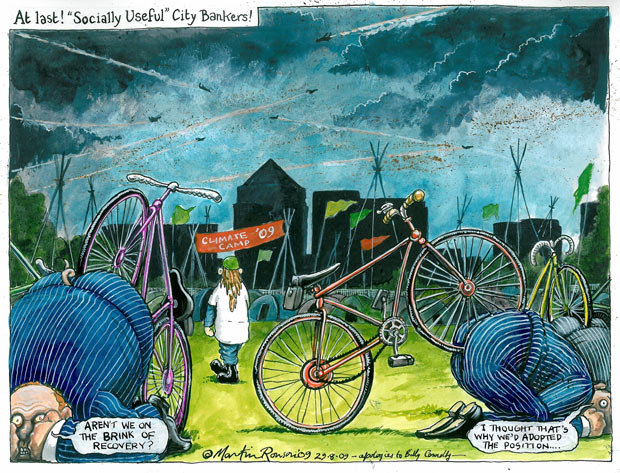 Martin Rowson
The too-big-to-fail banks have become even bigger since the global financial crisis. So what has happened to governments’ attempts to clean up their big banks? Cleaning the banks up in the sense of breaking them up? Moreover, the giant banks continue to make much of their money in trading assets, securities, derivatives and other speculative bets, the banks’ own paper and securities, and in other money-making activities which have nothing to do with traditional depository functions.
The too-big-to-fails have decreased competition in that the too-big-to-fails are actually stifling competition from smaller lenders and credit unions.
Posted by Gary Sauer-Thompson at 9:26 AM | TrackBack
September 14, 2009
National Times
Fairfax have introduced their online commentary magazine Natonal Times, which is in competition with News Ltd's The Punch. The latter is more a tabloid style magazine with different voices and style, whilst the former, basically a resurrected masthead from the mid 80s, is more broadsheet commentary. It promises lively, intelligent engaged debate.
Does it deliver?
Firstly, there is nothing new in the voices in the National Times, as they are just the usual Fairfax commentators collected into one online place without a new visual design or style. No new ground is being broken, and there is no indication that The National Times will develop into an Australian version of The Atlantic or Prospect magazine. That online space is occupied by The Monthly and New Matilda. So why bother with the National Times?
Secondly, one question we could ask is: what is the National Times trying to become if it is not just a collection of existing articles from The Age and Sydney Morning Herald? Is there any original material? If there is new content, then it is buried. Surely Fairfax don't expect that putting this behind a pay wall will work.
Thirdly, the National Times appears to be a defensive attempt to block News Ltd. A counter move as it were with little in the way of an online strategy that recognizes how the commentary world has changed with the emergence of the political bloggers. The boundaries have changed. There is no vision of the future in The National times, and no innovation even in terms of dialogue, use of links, use of Flickr or collaborative networked journalism.
The National Times is still bounded by the 20th century know it all mass media in which the journalists acted as the gatekeepers. They are not going to going to where the conversation is taking place. They are waiting for it to come to them, or think that they are the conversation.
Posted by Gary Sauer-Thompson at 1:22 PM | Comments (7) | TrackBack
September 13, 2009
Afghanistan: strategy debate
Marc Lynch in a post entitled Top Ten Bloggables at Foreign Policy reckons that on the Afghanistan strategy debate:
The pro-escalation side probably has the better of the tactical argument, in terms of the best response once the U.S. decides upon the strategic necessity of combatting the Taliban "insurgency". But the anti-escalation side probably has the better of the strategic argument: U.S. vital interests in Afghanistan to justify the expense remain vague, the arguments made for the costs of "losing" the counter-insurgency war in Afghanistan are relatively far-fetched (please, no more "credibility of the West" or "flytrap" arguments), the critical "safe havens" argument suffers from the profound weakness of the availability of alternative safe havens all over the broader region, and the costs of waging such a war successfully aren't being taken sufficiently seriously.
He adds that a close argument tilts towards the status quo, and won't stop the enormous momentum already built up in the US government towards the escalation strategy.
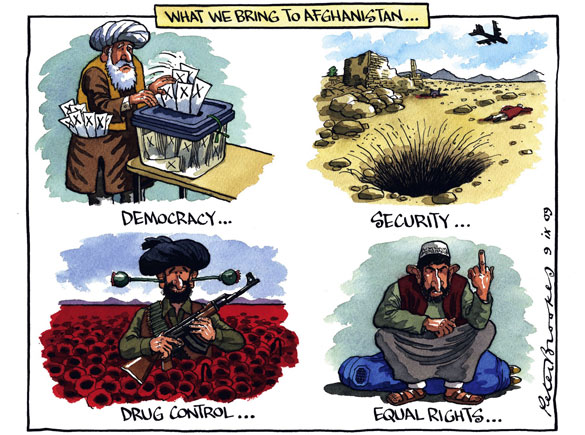 Peter Brookes
Foreign Policy run an Afpak blog for those interested in following the debate around Afghanistan and desiring more than what is offered by Australian newspapers.
In Canberra foreign policy circles it is axiomatic that, as increased Taliban control over Afghan territory would lead to new attacks in the United States, so Australia must stand by the US.There is not much critical thinking going on in Canberra about Afghanistan --even to recognizing that the Taliban and al Qaeda are distinct groupings with autonomous, though sometimes overlapping, agendas.
Posted by Gary Sauer-Thompson at 1:41 PM | Comments (2) | TrackBack
September 12, 2009
policy advice
The Australian public service is not known for its long term strategic whole-of -government thinking. For instance, its strategic response to global heating was, and still is, written by the greenhouse mafia in order to protect the coal-fired power stations. The energy and environmental departments are in never ending conflict with an another
Terry Moran, the Department of the Prime Minister and Cabinet's secretary, in an address to the Institute of Public Administration Australia in July, picked on four main areas where the public service could lift its game. He says:
One, the quality of our policy advice to government must improve. Two, we must not only strengthen our focus on service delivery but enable public servants who create policy to learn from those who deliver it. Three, we must work tirelessly to put the citizen at the centre of our programs and policies. And four, we must strive to attract and retain the highest quality people because if we do that, the right policies and solutions will follow.
It is certainly not citizen focused as exemplified by the Department of Immigration over the last decade. Not has it done very much with respect to the governing the Murray-Darling Basin sustainably.
Moran adds:
By and large, I believe the public service gives good advice on incremental policy improvement. Where we fall down is in long-term, transformational thinking; the big picture stuff. We are still more reactive than proactive; more inward than outward-looking. We are allergic to risk, sometimes infected by a culture of timidity.
That's accurate. But it does not address the way that the bureaucracy has been captured by those with commercial and political power who are opposed to reform.
Posted by Gary Sauer-Thompson at 1:05 PM | Comments (2) | TrackBack
September 11, 2009
SA: reforming the Legislative Council
An insight into the Rann Labor Government in South Australia can be seen in its attempts to reform the Legislative Council. It's an insight that indicates its attitude to democracy and to the checks and balances on political power of the executive.
The reforms suggest attempts by the Executive to gain an advantage over the Legislature in relation to power; even though the Westminster model of parliamentary democracy, with the development of party discipline over the last hundred or so years, is suffering from an excessive dominance by the Executive.
Three years ago the Rann Government proposed to abolish the Legislative Council, thereby ensuring its executive dominance, with minimal checks and balances---The inference is that the Rann Government understands itself as equivalent to a CEO of a company.
A company is structured along authoritarian lines not democratic ones. In effect we would have an elective dictatorship in South Australia because Parliament rubber-stamps the actions of the executive. Therein ends the idea of the separation of powers in the Australian political system.
There is no power for the Parliament to act as watchdog to the executive government and any pretence of respect for the Westminster tradition has been thrown to the wind. The Labor tradition of the caucus, rather than the leader, having sovereignty over the executive, which helps to ensure members of the executive can challenge policy positions of the leader to ensure the greater public good, is weakened by factional conflict.
The Rann Government backed away from the abolition option because of unfavourable public opinion, which wanted parliament to hold the executive to account. Currently, the Rann Government is planning to hold a referendum at next year’s election on whether the number of Upper House members should be reduced from 22 to 16 and if their terms should be cut from eight years to four. They are not interested in increasing the power of the committees to scrutinise Government activity.
The aim here is to reduce the minor parties and ensure a majority is held by the government in the Legislative Council. This would basically reduce the latter's capacity to a house of review and effectively turn it into a house which rubber stamps all Government Legislation.
The former Independent member for North (in the federal House of Representatives) Sydney Ted Mack described the purpose of the House of Representatives (and in turn the legislature) thus:
The House of Representatives is for most of its time a ritualised charade. The Executive totally dominates, while members of the Parliament amuse themselves by being allowed to contribute to an endless flowing river of words dutifully recorded at a great expense (in Emy & Hughes 1991 p361).
This quote is a strong representation of the power that the Executive holds over the legislature in the Australian political system. While there can be instances of the Legislature exerting power, for the most part dominance is almost always seen and used exclusively by the Executive.
Posted by Gary Sauer-Thompson at 11:43 AM | Comments (2) | TrackBack
September 10, 2009
US health care: reform
President Obama addresses Congress on health care reform. The aim of the speech was to persuade lawmakers into approving the health care overhaul that has eluded Washington for 65 years.
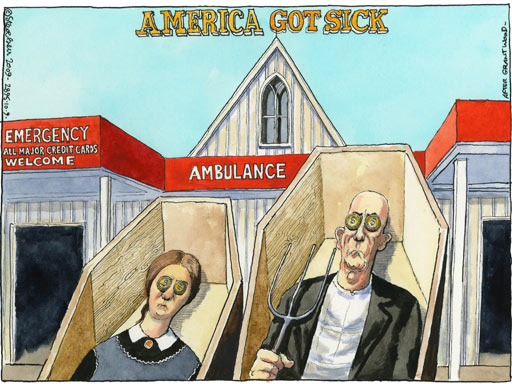 Steve Bell
America is involved in a great debate about whether and how to universalise healthcare coverage. Bipartisan support is a non-starter in the House, if not less so in the Senate, Almost to a person, the Republican political leadership is hostile to the state expanding its healthcare obligations. The Republicans have said they can turn healthcare reform into Obama's "Waterloo", that they can "break him" by destroying the prospects for real change. Why Waterloo rather than trench warfare?
So will it be a sort of political compromise?
Posted by Gary Sauer-Thompson at 1:07 PM | TrackBack
September 9, 2009
health reform: primary health care
Building a 21st Century Primary Health Care System says that it provides a road map to guide future policy and practice in primary; that represents the first comprehensive policy statement for primary health care in Australia’s history; and presents the Australian Government’s views on possible future
directions for a modern 21st century primary health care system.
The right implication is that Australia has been until now, going along without any strategy or sense of direction. The draft strategy acknowledges the obvious: that the health system overall would benefit if a more systematic response from primary health care, together with more effective integration of other health sectors with primary health care, could be achieved and secondly, primary health care services have historically been delivered in a relatively unplanned environment.
Consequently, primary health care in Australia currently operates as a disparate set of services, rather than an integrated service system:
it is difficult for primary health care to respond effectively to changing pressures (such as demographic change, changes in the burden of disease, emerging technologies and changing clinical practice) and tocoordinate within and across the various elements of the broader health system to meet the needs of an individual patient.
The Strategy talks in terms of key building blocks (regional integration, Information and technology, including eHealth, skilled workforce, Infrastructure, and financing and system performance) and priority areas for change (improving access and reducing inequity, better management of chronic conditions, increasing the focus on prevention and improving quality, safety, performance and accountability).
Posted by Gary Sauer-Thompson at 11:53 AM | Comments (1) | TrackBack
September 8, 2009
Remembering the past
One of the nastier aspects of the decade long Howard regime was its policies around asylum seekers and refugees. Their conception of Fortress Australia exhibited a deep hostility towards asylum seekers and refugees despite most peoples fleeing to Australia have legitimate claims, such as persecution and starvation. The harsh policies of the Howard regime were a blot on Australia as a western liberal nation, and the inward-looking nationalism ran counter to the Enlightenment tradition and its commitment to universal human rights.
An example of the harsh policies was the order requiring the Australian navy to turn back the boats of asylum seekers arriving by sea to Indonesia. These orders were imposed in the wake of the Tampa affair, replaced the previous policy of intercepting vessels and transferring those on board to immigration detention on the mainland. Others were the “Pacific solution ” ans locking up children in detention camps.
A further example was the system of charging immigration detainees for their mandatory detention - which often exceeded $250,000.True, only less than three per cent of the debts were collected, and it cost the government more than that to chase down the money. But it was a blot on the Liberal Party, which voted against the Rudd Government's bill to stop charging immigration detainees for their mandatory detention.
After sixteen years of experience, policy makers know beyond doubt that mandatory detention has “dehumanised” and “damaged desperate people.” It gave rise to an departmental culture that regarded immigration enforcement as “a thing in itself, outside the mainstream of administrative law and judicial review, and subject as little as possible to broader precedents about natural justice, rights of review and access to the law.
The Liberal party in opposition continues to argue that the abolition of temporary protection visas and the softening of immigration detention policy have encouraged a renewal of people smuggling, which means that the government is to blame for the spate of unauthorised boat arrivals. Their criteria seems to be the goal of complete border control, and they appear to be determined to hang onto the entire legacy of the Howard government on this issue.
Update
Three cheers for Senator Judith Troth for crossing the floor of the Senate to vote with Labor in support of the government's bill [Migration Amendment (Abolishing Detention Debt] Bill to stop charging immigration detainees for their mandatory detention.
Unlike Senator Brandis Troth questioned the Liberal party's Conservatism that blurred the distinctions between refugees, terrorists and Muslims to their electoral advantage. Troeth’s colleague from New South Wales Concetta Fierravanti-Wells continued to work the politics of contempt and fear with a speech about how dangerous it will be for the government not to continue to impose such crushing debts on asylum seekers. Unfortunately, it is the latter Senator who speaks for the mainstream of the Liberal Party.
Posted by Gary Sauer-Thompson at 11:32 PM | Comments (4) | TrackBack
September 7, 2009
economic fairy tales
As we know few economists saw our current global crisis coming, but this predictive failure was outweighed by the economic profession’s blindness to the very possibility of catastrophic failures in a market economy.
A quote from Paul Krugman's recent article How Did Economists Get It So Wrong? in the New York Times Magazine:
Economics, as a field, got in trouble because economists were seduced by the vision of a perfect, frictionless market system. If the profession is to redeem itself, it will have to reconcile itself to a less alluring vision — that of a market economy that has many virtues but that is also shot through with flaws and frictions.
The model of a perfect, frictionless market system is a myth, or a fairy tale, given the global financial crisis. The neo-classical model (eg, the Chicago School), which is based on the assumptions that everyone is rational and markets work perfectly, is characterised by its utter failure to make sense of the greatest economic crisis in three generations.
If you start from the axioms that people are perfectly rational and markets are perfectly efficient, you have to conclude that unemployment is voluntary and recessions are desirable. As some neo-classical economists do. They reframe the Great Depression as the Great Vacation. Unemployment is high they reason because many workers are choosing not to take jobs.Something has to give when you reach this level of absurdity and end up in a cul de sac.
I mention this because David Burchell in his op-ed in The Australian---An economist's laugh, but joke's on us reduces Keynes to satirical sallies:
we're all still living in the shadow of Keynes's high-spirited, if malicious, economic humour. It was, after all, an elaborate joke on his part to present every other economist in the world as being in the thrall of something called the "classical" economic view, a view according to which, if we were to believe Keynes, all was for the best in this best of all economic worlds, even in the pit of the Great Depression...By the same token, Keynes was toying with us when he suggested that, so foolish and obdurate were classical economists in their refusal to stimulate demand, even as their world collapsed around them, that literally any kind of expenditure would be a better bet than the precepts of economic policy...In practice, a good deal of the fiscal stimulus doled out across the Western world over the past 12 months has followed Keynes's light-hearted spirit.
What Burchill fails to acknowledge is that the neo-classical view of capitalism as a near perfect economic system wasn’t sustainable in the face of mass unemployment. However, as memories of the Depression faded, economists fell back in love with the old, idealized vision of an economy in which rational individuals interact in perfect markets, this time gussied up with fancy equations. The renewed romance with the idealized market is sustainable in the face of the global financial crisis, which indicates that the economy’s market system can undergo sudden, unpredictable crashes.
Posted by Gary Sauer-Thompson at 1:31 PM | Comments (4) | TrackBack
September 6, 2009
SA politics: just a memory
An election is coming in SA. Early 2010. The political rhetoric is being rammed up and the terrain of the battle is being defined by the Rann Government. The Liberal Opposition under Isobel Redmond is notable for its silence and lack of presence in the public sphere. They are still fighting one another--movement conservatism versus those Burkean conservatives who preserve the given order by changing it to make it work better.The Liberals are constantly subordinate to Labor rule and will be so for some time.
What then are the issues that will determine the future of Adelaide? What issues are being selected by Rann Labor to keep the Liberals subordinate? How does it plan to kick on the the Liberal body whilst they lie on the ground wounded?
One issue is not whether a US navy maintenance base in South Australia at Techport Australia eventuates,--ie the Defence State or military industrial complex. Or whether General Motors builds its next-generation electric car in Adelaide---developing green manufacturing in SA. Or the over-allocation of water licences in the Murray-Darling Basin and the death of the lower lakes. Or a sustainable Adelaide in the heated up world of climate change. Or South Australia’s punitive approach to juvenile justice.
Nope it is privatisation, yesterdays privatisation at that! A core issue is the privatisation of the state's electricity and water by the Liberals in the 1990s! The Rann Government would sue the French-owned company which manages Adelaide’s water supply.The Liberals are to blame.
Rann promised that he was determined to:
lift the veil of secrecy that surrounded the Liberals' privatisation agenda" before the next election. I think that it's going to be really interesting to see whether or not they told the truth to the people of this state. We've got a state election coming up next year. Privatisation once again is going to be a key thing that will be fought out at the next election campaign."
Sure the 15 year water privatisation contract with United Water - a wholly-owned subsidiary of the French giant, Veolia -- was real dodgy. United Water’s role is the management of the infrastructure as SA Water owns the pipes. United Water fixes them when they burst. They charge a lot for this.
According to Henrik Grout Labor washes Liberal sins in the Independent Weekly United Water have also been sneaking in a lot of other charges for research, business and industry development costs that haven't happened, and for all of its corporate overhead costs, including things that happened in New Zealand and Ballarat. So United Water has breached its contract. SA Water---gutted and demoralised by years of attrition under the Rann Government-- wants the money back--- a few tens of millions.
So what does the Rann Government suing the French-owned company, which manages Adelaide’s water supply, achieve? We know that multinationals rip us off. Global water companies have a long track record in this. The Rann Government would have know about this since 2003 and it could have changed the price for the management of the water infrastructure in 2006.
Nope, it's a free memory kick on the badly bruised Liberal body. Don't trust the Liberals with privatisation. It's a cover for lack of action on water that is becoming ever more expensive and to hide the neo-liberal mode of governance of the Rann Government.
Privatisation would only be a significant issue if the privatisation of the management of the state's water and waste water systems would be reversed, given the 15-year private sector contract was up for renewal next year. And that is hardly likely, in spite of Labor's entrenched opposition to privatisation of water and electricity when it was in opposition.
Today, the desalinisation plant at Port Stanvac is the next phase in SA’s water privatisation: the $2 billion desalination plant is to be designed, built, commissioned, operated and maintained by AdelaideAqua, which is owned by Bilfinger Berger AG. Neo-liberalism rules in SA despite the marked failure of the economists and their self-regulating economic models in the context of the global financial crisis. In their model there is no room for such things as bubbles and banking-system collapse.
Posted by Gary Sauer-Thompson at 3:52 PM | Comments (7) | TrackBack
September 5, 2009
Beattie on the coal industry
Peter Beattie has come clean on the coal industry and climate change that is obscured by the Labor premiers of Queensland, NSW, Victoria and South Australia.Their rhetoric is about doing something good about climate change whilst defending the expansion of their coal industry and protecting their coal-fired power stations.
Beattie's preferred option to reduce greenhouse gas emissions has been, and still is "clean coal." That will help to protect Australia's coal export industry and ensure that it meets the rising energy demand for coal from China and India. In an op-ed The Australian Beattie says:
The clear and present danger for Australia's coal industry is, unless there is a powerful push to see clean-coal technology developed and implemented, the traditional markets for its product will start slowly shutting down as green energy becomes more price-competitive and public policy continues to demand greener outcomes. The coal industry needs to realise that there has to be a sense of urgency about delivering significant low-emission coal technology and carbon storage projects. Clean coal has to be an integral part of the world's clean-energy mix before it becomes a victim of heavy regulation and other technologies overtake it. The pace of change is faster than most people realise.
Well we knew that. Coal is an old industry. The new investment money is going into renewable energy---this is the pathway of energy innovation. It means no more coal fired power plants as being foreshadowed by some Labor premiers.
CO2 capture and storage is currently the only technological approach that shows promise for enabling Australia to continue to rely on its vast coal reserves to provide electricity while, at the same time, achieving sufficient carbon dioxide (CO2) emission reductions to address climate change. Where Beattie comes clean is at this point:
Too often the coal industry sees its advantages as being too strong to be ignored. These include the abundance of cheap coal against the expense of building new power stations, the cost of gas and solar, and the unreliability of wind and wave power. Lehman Brothers, the big American merchant bank, thought coal was too big to be ignored. That bank doesn't exist any more.
The Australian coal industry doesn't seem to be doing that much to become technologically innovative. Its strategy appears to be to capture the state, use its power to prevent the emergence of the renewable energy industry, ensuring that the state invests in developing the technology for cleaner coal, and ensuring a decades-long delay in the deployment of CCS. They are not talking about retrofitting coal-fueled power plants.
Beattie argues that what needs to be done, if the coal industry is to avoid becoming history, is for Australia's coal companies to increase their research and development investment in order to ensure a future for the Australian coal industry through carbon capture and sequestration (CCS). Beattie recognizes is that a decade long delay will have serious negative impacts on coal’s ability to compete in the electric power sector under future climate-change policies.
Cleaning coal is very expensive, and Australia may not have the right geological conditions to support injecting carbon dioxide emissions into the ground rather than releasing them into the atmosphere. The Pew Centre on Climate Change reckons that a price of at least $25 to $30 per ton of CO2 would be needed to drive coal-based electric power plants to install CCS. The investment money required is estimated to be around $20-30 billion.
Looks like there will be an emerging energy mix of renewables and energy efficiency developing over the next decade.
Posted by Gary Sauer-Thompson at 10:46 AM | Comments (4) | TrackBack
September 4, 2009
Afghanistan: illusions
All is well in Afghanistan. They've just held presidential elections. So we should be optimistic.
Is that the point of the intervention--delivering democracy? NATO's mission is to build a properly functioning state? Well that cannot be it when nearly 40% of the country has slipped out of NATO's control, the Taliban are now knocking on the doors of Kandahar city, and the Karzai Government is deeply corrupt and largely ineffective.
The Taliban insurgency has gotten better, more sophisticated and more NATO troops are being argued for in order to quell the insurgency. In order to achieve what? Democracy and a strong Afghan state?
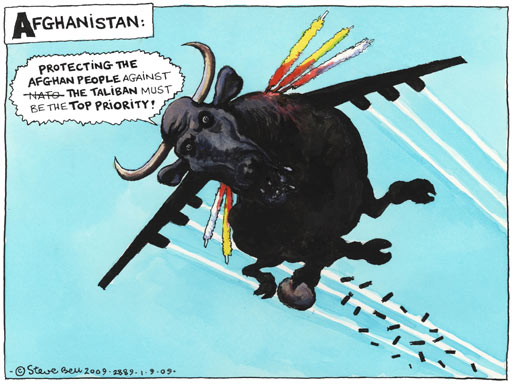 Steve Bell
Is the expanding military presence linked to a strategic counterinsurgency strategy--- that is, effectively fracturing the links between the Taliban insurgency and the community in which the insurgents move? I
If something needs to happen, due to the growing disenchantment in the US with the war, then how is it possible for the US and NATO to build an Afghan state?
Surely the main reason why the US is in Afghanistan is to prevent the chaos in Afghanistan from destabilizing Pakistan.
Posted by Gary Sauer-Thompson at 1:00 PM | Comments (3) | TrackBack
September 3, 2009
Canberra Gaze: Coalition on economics
I watched Joe Hockey on Lateline last night and then I heard Malcolm Turnbull on Radio National Breakfast this morning talking about the Rudd Government's stimulus package and its impact on economic growth.They both argued that the small economic growth figure of 0.6% in GDP, at a time when the global economy is still in deep recession and negative growth, had very little or nothing to do with the government's fiscal stimulus.
What then caused the Australian economy to grow marginally and so avoid a recession? According to Hockey it was: Australia's very strong economic performance under the Coalition (three cheers) ; there was no massive financial collapses by our banks (thanks to good regulation under the Coalition); there were stronger terms of trade than the last days of the Howard Government (lower dollar increases exports to China); and the right monetary policy in that the Reserve Bank cut interest rates more aggressively than anywhere else.
Hockey inferred from this that, since the government's fiscal stimulus spending had minimal impact (just the cash splash and tax rebates for equipment), it needs to be wound back significantly to ease the massive tax burden that is going to impair our economic recovery over the next few years. Debt and inflation is going to strangle us.
I scratched my head. Who accepts this account-- that the fiscal stimulus package had a minor impact (5 minutes of economic sunshine). Haven't consumers have been propped up by the government handouts? Hasn't the stimulus helped to lessen the rise in unemployment and save jobs? Hasn't it stablized the economy from the external shocks?
The Coalition has consistently denied that the fiscal stimulus has worked since last year, even when most economists in Australia accept the importance of the fiscal stimulus for domestic economic growth. The data confirms this picture. So the Coalition is in denial.

What is going on here? Keynes, it would appear, is taboo There is a rejection of Keynes' argument that an increase in government spending is a solution to unemployment. His proposed solution is to increase consumption through government through spending deficit spending an public works projects.This Keynesian counter-revolution is one in which the free market and the ideas of Friedrich Hayek are under massive assault. The Keynesians are again in the saddle, riding the whipping horses of “crisis”, “deflation” and “stimulus” to the largest takeover of the free economy in the nation’s history.
The grounds for rejecting the counterrevolution is that government intervention prevents the efficient functioning of the market---adjust to slow conditions through price and wage rate reductions, unsound investments sold off and redirecting capital into more productive and profitable uses. The market does not make systematic errors. The profit motive will cause them to be self-correcting. This happens from private businesses, investors and workers paying for their mistakes. Markets clear if not interfered with. Government should get out of the way by reducing taxation, spending, regulations, and government control of money and the interest rate.
The problem here is that many of those suffering from the global financial crisis clearly did nothing wrong; they're innocent bystanders:--workers who have lost jobs through no fault of their own, investors who have suffered huge wealth losses due to the misfeasance or malfeasance of corporate executives, and well-run businesses that were forced into bankruptcy solely because of the recession.
Posted by Gary Sauer-Thompson at 2:25 PM | Comments (18) | TrackBack
Melbourne's Docklands + urban renewal
Urbanization has always been a class phenomenon in terms of where people live. Behind this spatial distribution surpluses are extracted from somewhere and from somebody, while the control over their disbursement in the city typically lies in a few hands. This is Marxism, but we are talking about capitalism and its constant search for new markets to ensure the ongoing process of capital accumulation.
David Harvey, the British geographer, has consistently argued that the urban spaces of the city are seen as a tabula rasa for the accumulation of capital and the pursuit of wealth and power. Urbanization, he says, has played a particularly active role, alongside such phenomena as military expenditures, in absorbing the surplus product that capitalists perpetually produce in their constant search for profits.
Urban renewal of the wasteland of empty docklands in Sydney, Melbourne and Adelaide under a neo-liberal mode of governance has taken the form of shaping the city along lines favourable to developers, finance capital and and promoting the city as an optimal location for high-value businesses and a fantastic destination for tourists. What we have is a small political and economic elite who are in a position to shape cities more and more after their own desires. Melbourne's Docklands is a prime example of the city as a building site.
The result so far, in what is Australia's largest urban renewal project--- building the new urban world on the wreckage of the old---is a half-finished development that has resulted in a windy and sterile urbanscape with very limited public green space for people to gather. It is a development that precludes lower-income and even middle-class people from access to accommodation anywhere near the water or the urban centre.
Referring to the recent phrase of capitalist renewal Harvey, in The Right to the City, observes:
As in all the preceding phases, this most recent radical expansion of the urban process has brought with it incredible transformations of lifestyle. Quality of urban life has become a commodity, as has the city itself, in a world where consumerism, tourism, cultural and knowledge-based industries have become major aspects of the urban political economy. The postmodernist penchant for encouraging the formation of market niches—in both consumer habits and cultural forms—surrounds the contemporary urban experience with an aura of freedom of choice, provided you have the money. Shopping malls, multiplexes and box stores proliferate, as do fast-food and artisanal market-places. We now have, as urban sociologist Sharon Zukin puts it, ‘pacification by cappuccino’.
Since the 1980s the property market has directly absorbed a great deal of surplus capital through the construction of city-centre and suburban homes and office spaces, while the rapid inflation of housing asset prices—backed by a extensive wave of mortgage refinancing at historically low rates of interest—boosted the domestic market for consumer goods and services.
Posted by Gary Sauer-Thompson at 10:29 AM | Comments (7) | TrackBack
September 2, 2009
democratic renewal + policy formation
I see that NSW is embracing the Government 2.0 initiative that advocates, and tries to develop, a strong citizen-centric approach in the delivery of government services and a greater public access to government data. Opening up data is the big test for Government 2.0.
Maybe SA will follow NSW lead here instead of just locking up bikies and members of youth gangs. Democracy, if it is to have any substance, should be seen as the task of continually expanding the power of citizens to influence the decisions that affect their lives. Most SA politicians are still using their websites to inform their constituents rather than engage with them. A digital republic? What's that?

What has been developed by the Government 2.0. initiative is the form of engagement. This has been described by Kate Lundy and Pia Waugh at the Centre for Policy Development
They say:
we realised that the inherent strength of the new online social media tools were most effective when used to complement a physical get together - a focused, timely and facilitated presence - ideally with a specific goal that people can rally around. This is why each Public Sphere includes a short conference-style event as well as the open online submissions period for input to the blog or wiki. The discussions are encouraged to be online, whether through Twitter, comments on the Live Blogging (which doesn't require an account) or other methods. This means there is a continual and distributed feedback loop on what is being said or discussed, which helps us understand community responses to ideas being put forward, as they are put forward, and in a way that can be easily analysed after the event. In the traditional sense, people can physically attend the conference and network. However the idea is that people can participate equally in the process and discussions, whether in person or online.
What is not on the NSW open government agenda (the twitter thread ) is an attempt to bring citizens into the formation of public policy. If the formation of public policy is based on inquiries---eg.,the Henry Tax Review--- then a case can be made for participation in policy formation as an example of more direct engagement in government processes, more open and transparent government processes and democratic renewal.
This is one way to facilitating online engagement with the aim of drawing in the information, knowledge, perspectives, resources and even, where possible, the active collaboration of anyone wishing to contribute to public life. At the moment we only have the provision of electronic forms to make submissions to senate inquiries and others which are pretty much one-way discussions with little interaction.
Greater online engagement around inquiries is one pathway for transforming government. the Government 2.0 Taskforce is raising it.
Posted by Gary Sauer-Thompson at 10:33 AM | TrackBack
inevitability of devastating bush fires
A good example of what conservatives mean by wisdom of the past and historical awareness within a technological mode of being in modernity can be found in Tom Griffiths' We have still not lived long enough. In that essay he says that:
lived experience alone, however vivid and traumatic, was never going to be enough to guide people in such circumstances. They also needed history. They needed – and we need it too – the distilled wisdom of past, inherited, learned experience. And not just of the recent human past, but of the ancient human past, and also of the deep biological past of the communities of trees. For in those histories lie the intractable patterns of our future.
There is a dangerous mismatch between the cyclic nature of fire and the short-term memory of communities and that the greatest challenge in fire research is cultural:
Testimony from the 1939 and 2009 fires suggests that there is one thing that we never seem to learn from history. That is, that nature can overwhelm culture. That some of the fires that roar out of the Australian bush are unstoppable....It seems to go against the grain of our humanity to admit that fact, no matter how severe are the lessons of history.
The historical wisdom is the inevitability of devastating fires within the Australian bush, given the failure of public memory to convey the threat posed on Black Saturday.
History, on this account, is a kind of discovery process, a learning process, which mostly transcends the ability of individual persons at one time and place to comprehend; and that the received beliefs contain sufficient ambiguities and inconsistencies that allow for a range of interpretation that open the way for reasonable innovations.
The insight that nature can overwhelm culture strikes a the very heart of modernity, since the Enlightenment tradition in modernity is premised on the domination of nature through the use of science and technology. The Snowy Mountains Scheme was a classic example of trying to subordinate nature to human will and desire.
Posted by Gary Sauer-Thompson at 9:55 AM | Comments (1) | TrackBack
September 1, 2009
River Murray: it's climate change not drought
Finally, some sense on the causes of a warmer south eastern Australia that has seen the annual inflow of one of Australia’s largest river basins drop nearly 80% in the seven years. The hotter drier conditions here have usually been put down to a big drought, with the implication that the drought will break and things will return to normal. 'Normal' in this context means the wetter conditions of the 1950s-1970s.
This is the position of most of the loud irrigator groups along the River Murray. They argue that the federal government needs to modernize the irrigation infrastructure, especially in Victoria (the Foodbowl Modernisation Project) since wetter times will return. The rains will comeback is the position of both the Coalition, who are opposed to the buy back of over-allocated water licences, and it, would appear, the Murray Darling Basin Authority.
 Gary Sauer-Thompson, Clayton, Lake Alexandrina,South Australia, 2008
The South Eastern Australian Climate Initiative was set up in 2006 to find the causes for why south-east Australia had experienced a dramatic loss of rain. The crucial question is the why (drought or climate change?) and, secondly, how the drier conditions in the Murray-Darling Basin will affect stream and river flows in the Basin.
My understanding was that the loss of rain, and the weather patterns in southern Australia shifting to a dry phase was simply due to the rain-bearing storms shifting south off the continent. I had assumed that while the precise role of cyclical changes versus the impact of greenhouse gases remained unclear, changes in the basin are consistent with CSIRO computer modelling of the impacts of increased concentrations of greenhouse gas in the atmosphere.
Melissa Fyfe reports in The Age that scientists working on the research programme have discovered that the 13-year even of hotter drier conditions is not just a natural dry stretch--a drought--- but is a shift related to climate change.
They found that the rain has dropped away because the subtropical ridge - a band of high pressure systems that sits over the country's south - has strengthened over the past 13 years. These dry, high pressure systems have become stronger, bigger and more frequent and this intensification over the past century is closely linked to rising global temperatures.
The Wenthworth Group in their submission to the Senate Inquiry into the Coorong and Lower Lakes stated that we must reduce our extractions of water to:
(1) correct our over-allocation during a period of plenty, (2) to be more sustainable under climate cycles we have experienced in the past and (3) to adjust to declining water availability under climate change.....If we are to maintain healthy rivers and provide high quality water to produce food, our analysis suggests that the consumptive use of water across the Murray Darling Basin may have to be cut by between 42 and 53 percent below the current cap. This will require a re-design of our irrigation industries to bring the demand for water into alignment with the greatly reduced supply capacity from the rivers and groundwater.
If the likely future is one of reduced river flows, then the policy pathway for the Commonwealth is to acquire 300 to 400 GL of river flows into Lake Alexandrina and Lake Albert, to secure a sufficient reserve to maintain lake levels to avoid any significant release of acids this coming summer and autumn. I cannot see that happening myself.
Posted by Gary Sauer-Thompson at 7:51 AM | Comments (5) | TrackBack