Thought-Factory.net Philosophical Conversations Public Opinion philosophy.com Junk for code
parliament house.gif
RECENT ENTRIES
SEARCH
ARCHIVES
Commentary
Media
Think Tanks
Oz Blogs
Economic Blogs
Foreign Policy Blogs
International Blogs
Media Blogs
South Australian Weblogs
Economic Resources
Environment Links
Political Resources
Cartoons
South Australian Links
Other
www.thought-factory.net
"...public opinion deserves to be respected as well as despised" G.W.F. Hegel, 'Philosophy of Right'

Afghanistan: illusions « Previous | |Next »
September 4, 2009

All is well in Afghanistan. They've just held presidential elections. So we should be optimistic.

Is that the point of the intervention--delivering democracy? NATO's mission is to build a properly functioning state? Well that cannot be it when nearly 40% of the country has slipped out of NATO's control, the Taliban are now knocking on the doors of Kandahar city, and the Karzai Government is deeply corrupt and largely ineffective.

The Taliban insurgency has gotten better, more sophisticated and more NATO troops are being argued for in order to quell the insurgency. In order to achieve what? Democracy and a strong Afghan state?
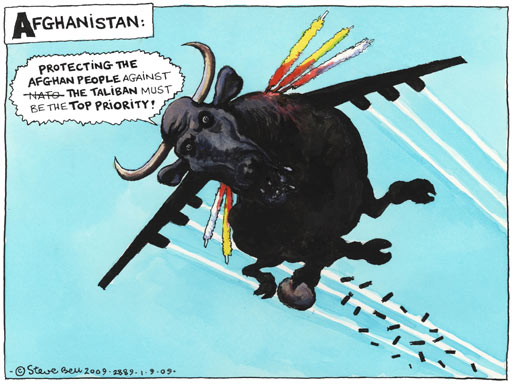
Afghanistanmistakes.jpg Steve Bell

Is the expanding military presence linked to a strategic counterinsurgency strategy--- that is, effectively fracturing the links between the Taliban insurgency and the community in which the insurgents move? I

If something needs to happen, due to the growing disenchantment in the US with the war, then how is it possible for the US and NATO to build an Afghan state?

Surely the main reason why the US is in Afghanistan is to prevent the chaos in Afghanistan from destabilizing Pakistan.

| Posted by Gary Sauer-Thompson at 1:00 PM | | Comments (3)
Comments

Comments

The main argument offered by the supporters of the war is to deny Al Qaeda a safe-haven from which to train and organise attacks on the West. Though terrorism can be organized in Oldham, Hamburg and Marseilles, Al Qaeda still believes it needs safe-havens in places like Afghanistan.

It's a weak argument. According to Stephen Biddle in Is it Worth It? in The American Interest:

The United States invaded Afghanistan in the first place to destroy the al-Qaeda safe haven there—actions clearly justified by the 9/11 attacks. But al-Qaeda is no longer based in Afghanistan, nor has it been since early 2002. By all accounts, bin Laden and his core operation are now based across the border in Pakistan’s Federally Administered Tribal Areas (FATA). The Taliban movement in Afghanistan is clearly linked with al-Qaeda and sympathetic to it, but there is little evidence of al-Qaeda infrastructure within Afghanistan today that could directly threaten the U.S. homeland. If the current Afghan government collapsed and were replaced with a neo-Taliban regime, or if the Taliban were able to secure political control over some major contiguous fraction of Afghan territory, then perhaps al-Qaeda could re-establish a real haven there.

He adds that the risk that al-Qaeda might succeed in doing this isn’t much different than the same happening in a wide range of weak states throughout the world, from Yemen to Somalia to Djibouti to Eritrea to Sudan to the Philippines to Uzbekistan, or even parts of Latin America or southern Africa.

And of course Iraq and Pakistan could soon host regimes willing to put the state’s resources behind al-Qaeda if their current leaderships collapse under pressure. Many of these countries, especially Iraq and Pakistan, could offer al-Qaeda better havens than Afghanistan ever did. Iraq and Pakistan are richer and far better connected to the outside world than technologically primitive, landlocked Afghanistan.

When the pro war crowd, or conservative commentariat, defend the war they appeal to the commonsense of the man in the street who supports the war against the elitist academics full of theory.

It's the standard anti-intellectualism of the Right that scorned argument, knowledge and expertise.
