« July 2011 | Main | September 2011 »
August 31, 2011
High Court rules on Malaysia asylum deal
Under the Malaysia refugee swap Australia would send 800 asylum seekers to Malaysia and in return, receive 4000 people already assessed to be refugees over the next four years. The Minister for Immigration had declared that Malaysia provides sufficient protection for transferred asylum seekers.
The High Court's decision on the Malaysia refugee swap ruled 6-1 against the Gillard Government's Malaysia solution. The Court has also cast doubt over the legality of Nauru, the opposition’s preferred option, and even Manus Island, the government’s plan B.
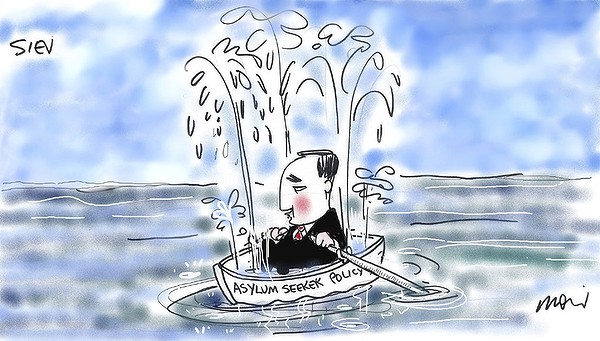
One issue was: did Malaysia provide asylum seekers access to ''effective procedures'' for processing their asylum claims, ''protection'' for persons seeking asylum and did it ''meet relevant human rights standards in providing that protection''?
The second issue related to the minister's guardianship duties for unaccompanied asylum-seeker children. Was the government's argument, that the guardianship duty was subject to other powers set out in the Migration Act and was therefore ''trumped'' by the declaration of safety made under s198A of the Migration Act, a reasonable one in a legal sense?
The decision states:
The Court held that, under s 198A of the Migration Act 1958 (Cth), the Minister cannot validly declare a country (as a country to which asylum seekers can be taken for processing) unless that country is legally bound to meet three criteria. The country must be legally bound by international law or its own domestic law to: provide access for asylum seekers to effective procedures for assessing their need for protection; provide protection for asylum seekers pending determination of their refugee status; and provide protection for persons given refugee status pending their voluntary return to their country of origin or their resettlement in another country. In addition to these criteria, the Migration Act requires that the country meet certain human rights standards in providing that protection.
The Court also held that the Minister has no other power under the Migration Act to remove from Australia asylum seekers whose claims for protection have not been determined. They can only be taken to a country validly declared under s 198A to be a country that provides the access and the protections and meets the standards described above.
The High Court adds:
The Court emphasised that, in deciding whether the Minister's declaration of Malaysia was valid, it expressed no view about whether Malaysia in fact meets relevant human rights standards in dealing with asylum seekers or refugees or whether asylum seekers in that country are treated fairly or appropriately. The Court's decision was based upon the criteria which the Minister must apply before he could make a declaration under s 198A.
My understanding is that the Gillard Government thought that the government had a legally sound case and that it would beat the legal challenge to its Malaysian plan.The federal government's entire Malaysian solution is now in doubt.
Update
What the High Court decision affirms is that governments are bound by the rule of law in liberal democratic society. Governments tend to forget this core constitutional principle from time to time; a principle that has two main functions: it seeks to provide a stable and secure basis for the exercise of government power, and also seeks to limit that power.
Posted by Gary Sauer-Thompson at 4:32 PM | Comments (16) | TrackBack
August 30, 2011
mapping today's journalism
As is well known politics as entertainment is the dominant model of the media's coverage of politics. in this model the Australian media reframes politics as entertainment, seizing on trivial episodes that amuse or titillate and then blowing them up until they start to seem important. The stories are semi-fictionalized to make them more entertaining. Thus we have Lindsay Tanner's conception of the media as a sideshow and manufactured controversies.
In an interview on Lateline last week Jay Rosen, who is to give a keynote speech in the Melbourne Writers Festival, made some acute observations about the current state of the media and political journalism. One observation is that political coverage is broken:
I think we've reached the point where politics as entertainment, the 24-hour news cycle, the fascination with media manipulation and spin doctors, the cult of the insider in political coverage - have gone on for so long they've all come together to the point where I think they're not only distorting politics, but they're actually beginning to substitute for it. This is the sense in which I think political coverage is broken...we have now ... a situation where journalism isn't just representing what political actors do, it is actually changing what they do. And there isn't really an exit from that system no matter what channel you're watching or what news source you're consulting.
The roots of this observation is this earlier interview on Lateline in which he raised the issue of the ABC's Insider's program promoting journalists as insiders in front of the outsiders, the viewers, the electorate…When journalists define politics as a game played by the insiders, their job description becomes: find out what the insiders are doing to “win.” Knowing who the winners are is being savvy and this comes from being more inside than others.
The journalist then claims that their political reporting is agenda-less because they are uninvolved, innocent, merely reporting without stake or interest in the matter at hand. Examples are He said, she said journalism and horse race journalism.
Rosen's argument is that the above three bad ideas--insiders, the ‘cult of saviness’, and innocence-- are constitutive of the identity as a journalist and have made political journalism less useful than it should be. The inference is that political media is dysfunctional and it seems to be getting worse. What is disappearing in practice is the model of the media doing its job if it is providing citizens with the information they need to be more active and full participants in their own system of government.
Consequently, the needs of the democratic citizenry are not being met. An example.. Climate change is real, and anyone who denies it is a liar or wrong - but journalists don't call them on it. The journalist merely reports that x denies climate-change even though they understand that this a political game being played.
Posted by Gary Sauer-Thompson at 1:13 PM | Comments (16) | TrackBack
August 29, 2011
the “too hard, too costly” fear
As we know from the State of Environment Reports from 1996 onwards the economic pressures on the environment are increasing. On this kind of trajectory the future is one in which the coastal zone will be a mess, much of our agricultural land will be degraded, our loss of biodiversity will be appalling and we will face disastrous consequences of climate change: heatwaves, droughts, severe bushfires, extreme storms and flood events.
So its time to start closing down the coal-fired power stations, especially those that rely on brown coal, like this one in Port Augusta, South Australia, that is run by Alinta Energy and which relies on dirty brown coal railed in from Leigh Creek.

Gary Sauer-Thompson, Playford Power Station, Port Augusta, South Australia
Thankfully the Commonwealth has made it quite plain that Playford B will have to be decommissioned. It is actually one of two plants. The other is Hazelwood in Victoria. Those two plants will be closed by way of a contract for closure. Playford B will become a gas- fired plant.
The question is not whether or not we should reduce greenhouse gas emissions, but rather how we reduce them. The coal companies, of course, are engaged in crazy scaremongering and they abruptly dismiss the potential of renewable energy sources. As Giles Parkinson says at Climate Spectator they have the power to block the massive wind resources on the Eyre Peninsula:
This would need more grid infrastructure as well as a bigger interconnector to Victoria to distribute the surplus energy. But, as that state’s attorney general has pointed out, this has been fiercely resisted by the big coal generators because – wait for it – it will lower wholesale energy prices and cause their profits to diminish.
The coal generators exploit the fear of cleantech that circulates through through Australian politics and which often takes the “too hard, too costly” form. The big miners keep calling for the government to build nuclear energy plants to supply some of Australia's future electricity needs.
This fear of cleantech is reinforced by News Corporation, which is a crucial pedlar of junk science in both the US and Australia, and which has a negative stance to renewable energy. In fact the potential solutions to global warming get an even rougher ride in this press than climate science itself, with this negativity is often premised on disinformation about the costs of renewable energy policies on household bills. These costs are wildly inflated.
Posted by Gary Sauer-Thompson at 6:59 PM | TrackBack
August 28, 2011
political froth + bubble
The Canberra Press Gallery is very absorbed in the Craig Thomson affair which they suggest is a big political and moral crisis that could actually bring down the Gillard Government. Gillard and co already have one foot in the abyss, and it will only take a bit of pressure to tip them in.
Yawn. It's how you sell newspapers these days: manufacturing things into a crisis---it recalls 1975 for heaven's sake--- so that we have permanent state of crisis. That is the frame though which the Canberra Press Gallery views political events, such as the conflicts between and within unions and the political factions. The media has turned against the Gillard Government:

The main game is the Gillard Government's governing the nation---that is, pushing on with its reform agenda and getting as much of it done in the next two years whilst it has the support in the House of Representatives and the Senate for its reforms--health, the carbon price, the mining tax and the national broadband network.
Governing is what they are there for and reform is what they say they are about. They need to get get as many things done as is possible. If the Gillard Government is tossed out in 2013 (as most expect), then at least it will gone down in history as a reform government.
The political froth and bubble is the culture of outrage and a vortex of animus from the vested interests (eg., the big miners and their local cheer squad) resisting reform that is sucking everything into the vortex of political hatred.
Update
The more rational of the right wing commentators avoid the "illegitimate bad government" talking point and say that the minority Gillard Government is not really doing much. Thus Graham Young writes:
This government lacks fortitude and that is one of its fundamental problems. It came to power with a limited agenda, has picked fights on too many fronts, and then modified policies in the face of opposition to the point where its victories are only Pyrrhic.
I would have thought that the problem with the Gillard Government at a governance level was that its reform agenda was very broad. Hence all the fights.
The Gillard Government lacks fortitude? The first step in reducing greenhouse gas emissions--increasing the carbon price--will pass this session of Parliament. That means Australia is on its way to implementing an emissions trading scheme in the face of intense and hostile opposition from both the Coalition and business.
Others like Jennifer Hewitt write in terms of the Gillard Government already struggling badly to sell its various policy "reforms", especially the imposition of a carbon tax. The reforms----pricing carbon, the national broadband network, plain tobacco packaging, taxing the miners to ensure others benefit from the boom---aren't really reforms.
Posted by Gary Sauer-Thompson at 4:29 PM | Comments (7) | TrackBack
August 26, 2011
Libya : what next?
As the endgame of the Gaddafi regime in Libya draws to a close with the liberation of Tripoli the western powers (France, Britain and the US) move in to shape the Libyan revolution. They will support a government of national unity but expect a payback for their investment in the Libyan war and regime change.
The payback will be in oil and commercial deals, political support and perhaps even the return of western military bases. No doubt the US will push for the privatisation of the oil assets of what is an oil state with a dependence on a high-priced primary commodity.

The dependence on a high-priced primary commodity such as oil will cause the country’s currency to rise, and that means that manufactures, handicrafts, and agricultural produce from that country artificially cost more to countries with lower currencies. This effect---the so called “Dutch disease”--can be addressed by diversifying the economy. The best way to do so this is to use the petroleum receipts to promote other industries and services.
The cash flow from petroleum exports could make it possible to ease the transition to solar power. Libya’s big desert is ideal for photovoltaic panels and it will be hit hard by global warming.
Update
The US has fought a covert war for regime change in Libya – its third violent overthrow of a government in the Middle East in ten years without congressional authorisation. Michael Boyle in his Obama: 'leading from behind' on Libya in The Guardian says:
At the most basic level, the Beltway take on Libya reveals the narcissistic myopia of the American political establishment. On both sides of the political divide, American foreign policy experts seem incapable of imagining a crisis that does not demand more American "leadership". They cannot believe that events such as the revolution in Libya are possible without the backing of America or that such events are not necessarily a referendum on the foreign policy of the sitting American president. Neither side questions the hyperactive interventionism of American foreign policy or challenges the premise that "regime change" should be pursued even when (as in Libya) it falls well outside the limits of the UN mandate.
The overthrow of the Gadaffi regime – one that murdered its own people, supported terrorism and committed grave human rights abuses – should be credited to the Libyan people with NATO playing a supporting role.
Posted by Gary Sauer-Thompson at 9:45 AM | Comments (2) | TrackBack
August 25, 2011
Gillard Govt: health reform
Credit where credit is due. The Gillard Government is currently besieged by the assaults around the Craig Thomson affair launched by the Coalition, which senses that an election is just around the corner. It is demanding an election right now. Apparently, the country is in crisis.
However, what is not being noticed is that the Gillard Government is a reforming government and that, in spite, of being on the electoral ropes, it is continuing with its programme of health reform.

The latest is the plain cigarette packaging legislation passed the House of Representatives in face of marked hostility from Australian tobacco industry that is controlled from London (British American Tobacco and Imperial Tobacco) and New York (Philip Morris) in order to to prevent similar measures from being introduced against its dangerous products in other countries.
The cigarette packs will now only show the death and disease that can come from smoking. Australia is actually taking a leadership role in global tobacco control, that is supported by the Coalition, in spite of the political donations it receives from Big Tobacco and the attacks launched by some of the ignorant crazies in the Coalition who claim that cigarettes are legal products and not harmful.
Other countries and other governments will now be encouraged by the Australian Government’s world-leading initiative to take on Big Tobacco's use of glamorous packaging as a way of advertising and promoting its products.
This highlights the importance of primary care ---a third of all cancers can actually be prevented through simple lifestyle choices like regular exercise, a healthy diet and quitting smoking.
Posted by Gary Sauer-Thompson at 2:50 PM | Comments (4) | TrackBack
August 24, 2011
Australia + the 'Dutch disease'
As we know, the high Australian dollar is caused by the mining boom and it means decline for manufacturing. This relationship is known as the "Dutch disease" and the symptoms of the "disease" are mass job cuts and the loss of skilled and semi-skilled employment in manufacturing and other industries to the booming resource sector.
Conventional economics holds that a country ought to specialise in industries in which it has a comparative advantage, so a country rich in natural resources would be better off specialising in the extraction of natural resources. Thus Treasury, in its submission to the Inquiry into the state of Australia's manufactured export and import competing base now and beyond the resources boom, explicitly says:
Governments are no better placed than firms and investors, responding to signals in the market, to determine whether a shock is temporary. Instead, the government can more effectively help the economy achieve its productive potential by allowing the market to operate unimpeded and allow resources to flow to their most efficient use. This will achieve improved productivity, economic growth and expanded national income in the long term.
The wisdom is that attempting to resist this natural decline in manufacturing’s share of the economy would be a mistake, just as it would have been a mistake to try to have preserved Australia as a predominantly agricultural country. Australia's economy is primarily a services economy.
In the short term that means firstly, the money that we earn from the rivers of cash flowing from the mining boom can be spent on cheaper imports of steel, cars, solar panels--ie., the tradable goods sector; and secondly, that we don't need to continue to make things.
It's called structural adjustment as mining the mining industry becomes a larger share of the economy. and there is a decline in manufacturing, tourism and education exports. Australia's place in the global economy is to be a quarry, and that means ever greater dependence on China and commodities.
What is increasingly clear is that the benefits of the mining boom are not being shared across the population. So what happens to the displaced workers who cannot relocate to work in the mining operations in Western Australia?
What is not being suggested yet are measures to sterilize the boom revenues into a sovereign fund, or investment to boost the competitiveness of the manufacturing sector. What is surfacing is a rise in protectionism in manufacturing along with the expansion in the mining industry. Secondly, Australia is not investing in developing the skills and knowledge base that would help Australia to make makes things that are different tomorrow than the tradeable goods made yesterday.
So the non-mining parts of the economy are being run down, or hollowed out , by the mining industry that only employs around 3% of working Australians. This puts the breaks on the reform programmes because of slower growth in productivity and the economy's growth driving up inflation.
Posted by Gary Sauer-Thompson at 3:07 PM | Comments (16) | TrackBack
August 23, 2011
ALP: self-inflicted injury
You have to wonder about the ALP at times. They just love to shoot themselves in the foot, don't they.
Why was Craig Thomson ever pre-selected? The factions knew that he was responsible for using his Health Services Union credit card to pay prostitutes. Now the Gillard Government is forced to hold their nose and ring fence him to ensure their political survival.

The fallout from the Craig Thompson affair has come at a time when the mining boom is causing the inevitable shakeout in the nation's manufacturing industries----eg.,One Steel + BlueScope Steel---because of the high dollar. The miners do well and everybody else (especially those in manufacturing and tourism) suffer --- apart from those having cheap overseas holidays or importing consumer goods online from the US.
So the politically powerful squeezed manufacturing sectors are being egged on by a populist conservative opposition that can smell blood in the water. It's all guns blazing to force a weak minority government, already backed into the corner, onto its knees, and then to go for the throat.
And so we have a Labor government under siege and its political capital nigh on exhausted. The Coalition continues to gain ground in Labor's heartland-----the blue collar workers in the manufacturing industry, even though the Gillard Government saw the manufacturing crisis coming in the form of the "Dutch disease" in 2010.
Posted by Gary Sauer-Thompson at 7:58 AM | Comments (9) | TrackBack
August 21, 2011
solar power + its opposition
Andrew Blakers has an article on The Conversation website on solar energy, where he argues that a solar energy revolution is brewing that will put the coal and nuclear industries out of business:
Solar is already reaching price parity with coal in many parts of Australia...Photovoltaic power has reached retail grid parity for three out of four Australians – everywhere except Victoria, Tasmania and Canberra. Retail grid parity means that it’s cheaper to get electricity from photovoltaic panels on your house roof than to buy it from the grid.In Adelaide, photovoltaic power is only two-thirds the price of retail grid electricity.
He adds that it is difficult to see how the nuclear power industry will cope with falling solar prices and increased perceptions of risk following the Fukushima accident. His conclusion is that solar and wind power will soon put the nuclear power construction industry out of business.
So the "convoy of no confidence'' that converges on Canberra tomorrow to demand a double dissolution election---their plan is to stay in the city and cause gridlock until Gillard calls an election!---is opposing the future.
Blakers is far too optimistic about the storage/intermittency issue and the section on 'How do we store solar energy' looks glib. It is a real issue for solar power and the various technological options need to be addressed.
What we have, politically speaking, is a hostility to the carbon tax and, by inference, the shift to a low carbon economy. The opposition to the carbon tax and emissions trading means relying on fossil fuels and coal fired power stations to generate electricity in a national electricity market that was designed for a centralised energy system, not a decentralised one; and for base load power not peak load. This hostility refuses to recognize that the dynamics that ruled the industry for most of the past century will not get the incumbents very much further in the current one.
It is an opposition based on scaremongering and lies from state liberal governments, such as the O'Farrell one in NSW, whose rhetoric is all about the ''slashing'' of jobs, notably in the Hunter and Illawarra regions, in which thousands of workers will lose their jobs as a result of the carbon price.
It's always a doom and gloom rhetoric that continually both ignores the positive developments of a modest reform targeted directly at specific sectors (such as coal fired-electricity) in which the capital investment involved in the transition to renewables would be a huge stimulant to the GDP. The rhetoric also ignores that the hollowing out of manufacturing (eg., the Bluescope Steel decision to shed 1000 jobs) is caused by the high Australian dollar.
Yet it is peak demand, thanks to the growing use of airconditioners, that is surging in the electricity market. This can be addressed if measures such as energy efficiency, peak-load management and decentralised energy are encouraged and the regulatory barriers removed.
Posted by Gary Sauer-Thompson at 11:06 PM | Comments (5) | TrackBack
August 20, 2011
a personal note
Postings will be light as I'm off to Ballarat today to attend the Ballarat International Foto Biennale for a couple of days. I have some work in an exhibition and some portfolio reviews of my photography. I will be back in Adelaide late Tuesday afternoon.

I will be back in Adelaide late Tuesday afternoon. A lot of my time will be taken up with travelling to and from from Safety Beach on the Mornington Peninsula to Ballarat. It is about 2-3 hours each way by train from Frankston.
Posted by Gary Sauer-Thompson at 1:25 PM | TrackBack
August 19, 2011
the carnival: nothing is forbidden
Here is one interpretation of the London riots that makes more sense than the Conservative's 'pure criminality' thesis or Labour's 'the working class are protesting the budget cuts'.
It's the carnivalesque interpretation put forward by Humphreys and Yoriko at Open Democracy. This interpretation is based on the work of Mikhail Bakhtin, who suggested that the carnivalesqueis a social institution. Humphreys and Yoriko say:
The carnival is a moment in which time is suspended. Law is suspended. In a world of increasing pressure, on our time, on our bodies, the carnival allows us to let off steam. It is a moment during which people who are ordinarily subject to extraordinary constraints get to be their own masters, in which the oppressed become free, just for a bit. It is a day on which the violence to which people are daily subjected becomes brutally visible. A visibility that paradoxically requires a mask, allowing each individual to parade their trauma and desire before the community.
Humphreys and Yoriko say that something erupted on the English streets: an irrepressible need for impunity and invisibility, consumption and community. For one riotous moment, an ecstasy of unbridled communication burst through.
The riots were seen as fun, lots of ‘looters’ didn’t seem to want the loot, and the whole thing was held to be a bit of a laugh. In his chapter on the history of laughter in Rabelais and His World Bakhtin advances the notion of its therapeutic and liberating force, arguing that in resisting hypocrisy "laughing truth... degraded power".
Behind the carnival is the way that urban spaces have been organized in England.
Posted by Gary Sauer-Thompson at 2:57 PM | Comments (1) | TrackBack
August 18, 2011
killer blows?
I have to agree with Giles Parkinson's judgement in Climate Spectator that the conservative's political strategy in Australia is one of opposing a carbon tax and a cap-and-trade scheme, undermining a clean energy policy, and attacking piece by piece, state-based incentives for to encourage the emergence of a renewable energy industry .

This strategy is expressed very clearly around solar energy. Though Australia has more sun than any other country there is a deep seated opposition to solar power. There is also a determination to scale back any support for renewable energy (including wind energy) in WA, NSW and Victoria. The impression that is given is that the conservative's energy policy is that electricity is, and should be, produced from coal fired power stations.
That is Australia's future. So the renewable energy industry has to be strangled at birth by creating a variety of log jams despite all the talk about the transition from coal to gas to ensure that Australia achieve its 2020 targets. In WA, where mass deception about global warming is widespread in the media, that rhetoric looks more like talking up the North-West Shelf gas as Australia's next big thing.
The economic justification for conservative's conception of Australia's future is the neo-liberalism antagonism to strong environmental mitigation targets because it is defined as a big constraint on economic and political autonomy of corporations and a broad regulation of the market. This antagonism results in a deep-seated anti-ecological and anti-social bias because it favours the profits of the corporations now, not the long term public interest. The result is a degradation of the physical and biological environment.
Thus the flow of pollutants into the underground water tables or aquifers created by the 'fracking' process of extraction for coal seam gas (CSG) is held to be a cost that, with the right discount rate applied, is almost negligible alongside the immense benefit of the energy we extract from CSG. If the tactic is to keep economics and ecology separate, the result is that governments are no longer trusted on the issue.
As Jeff Sparrow highlights that:
what makes neoliberalism distinctive is its virulent hostility to any authority or values other than the market... In neoliberal theory, the laws of supply and demand regulate morality and aesthetics just as surely as they regulate everything else. What sells is, by definition, good, and vice versa.
That means neo-liberalism is hostile to neo-conservatism and the latter's emphasis on religion, tradition, nuclear family, and culture and it trashes everything the neo-conservatives hold dear. So the hostility to the left (renewable energy is used to hold the free marketeer's and neocon's alliance together.
Posted by Gary Sauer-Thompson at 11:20 AM | Comments (8) | TrackBack
August 17, 2011
cardboard cutout positions
Janet Albrechtsen in The Australian rails against the ABC as an example of the intellectual class being ideologically blinded in offering a Left-liberal explanation of the recent London riots.
 Martin Rowson
This political class she says, is blind because it avoids the criminal mayhem (pure criminality) of the riots. it also avoids the right of centre 'broken society ' explanation of the poisonous cocktail of welfare dependency, broken schools, the absence of family authority and a vacuum of values that bind communities. This is David Cameron's "slow-motion moral collapse" in Britain's "broken society"---the old theme of civilisational decline.
For Albrechtson social unrest and instability is not difficult to explain. The (elite) ABC journalists, who are obviously out of touch with mainstream Australians, failed:
to cast Aunty's net of analysis wider during the London riots tells us much about the state of debate on important issues in this country. This is a debate that requires some genuine curiosity and courage from the broader political class if we are to learn anything from the riots across London. And there is plenty to learn. Lessons such as what happens when we fail to attribute responsibility to individuals for their actions, when we fail to lay down boundaries for behaviour, when there are too few expectations on people, when generations grow dependent on the state, when they have only a sense of entitlement to handouts rather than a sense of contribution to the community in which they live.
The left liberals are actually to blame for the dumbing down of schools because they failed to implement structure and discipline, build high expectations and instil competition among the kids and help build their motivation.
Albrechtson's column uses the hook of the street riots to bash the liberal left yet again, and to push neo-liberalism's core memes: big intrusive government, individual freedom, accountability and responsibility for our actions as free agents; and acceptance of trickle-down economics and inequalities of income and wealth. There needs to be an end to living off the state.
There is nothing in Albrechtsen's article about how these values have lead the Cameron Government in the UK in an authoritarian direction that ignores the multiplicity of layers in favour of criminality. It has adopted a zero tolerance law and order approach; barring individuals suspected of causing social unrest from Twitter and Facebook, and the eviction of the families of rioters from council houses and to halt benefit payments to offenders.
Secondly, Albrechtson ignores that a "broken society" happens somewhere, and that geography matters in that those people who have been appearing on riot-related charges (typically young males) live in some of the most deprived areas of our largest cities, and in neighbourhoods where the conditions are getting worse rather than better. So we have cities becoming increasingly Balkanised and unequal.
Albrechton's approach does not show any genuine curiosity or a willingness learn anything from the riots across London. She does not bother to explore the link between austerity measures and social unrest because cut-backs usually hit some parts of the society disproportionately more than others; or acknowledge that the neo-liberal view that expenditure cuts can be growth-enhancing is questionable.
Posted by Gary Sauer-Thompson at 11:56 AM | Comments (11) | TrackBack
August 16, 2011
a googled world
In How Google Dominates Us at the New York Review of Books James Gleick gives us an insight into the information economy, advertising and Google. Advertising in the virtual economy is so different from what we have become used to in the street.
Gleick remarks:
How thoroughly and how radically Google has already transformed the information economy has not been well understood. The merchandise of the information economy is not information; it is attention. These commodities have an inverse relationship. When information is cheap, attention becomes expensive. Attention is what we, the users, give to Google, and our attention is what Google sells—concentrated, focused, and crystallized.Google’s business is not search but advertising. More than 96 percent of its $29 billion in revenue last year came directly from advertising, and most of the rest came from advertising-related services. Google makes more from advertising than all the nation’s newspapers combined
It's a money machine: a system of profitable cycles in place, positive feedback pushing advertisers to make more effective ads and giving them data to help them do it and giving users more satisfaction in clicking on ads, while punishing noise and spam. Today Google’s ad canvas is not just the search page but the entire Web.
That sure puts Murdoch's News International in the shade in terms of data mining (think of Google's maps, translations, street views, calendars, video, financial data, and pointers to goods and services) advertising and cash flow. Google now seems to be everywhere. Google continues to build the largest computing infrastructure on the planet, but still manages to generate large amounts of liquidity.
If the company derives much of its revenue from advertising, then to grow this market, it needs to stop people spending time in closed environments, such as social networks where Google has no direct access (such as Facebook). As David Glance points out at The Conversation:
Google is always striving for cleaner and more comprehensive information about consumers, their preferences, connections and habits. The company collects all of its information using computer software executing sophisticated algorithms.The more you control the way the information is presented and, more importantly, the links between that information (i.e. people’s identifiers), the easier that information is to collect. The last thing Google wants is the messy, anarchic environment of the Bazaar, where people can be anonymous, have multiple identities, interact with anyone they please, and remain unobserved.
It looks as if we need a data protection watchdog.
The potential threats to Google is any product that stands between the user and Google and has the potential to distract the choice of search destination is a threat to its search business, augmented by its amazing AdWords monetization framework. A great example is Firefox. In The Freight Train that is Android Bill Gurley says that:
Android, as well as Chrome and Chrome OS ... are not “products” in the classic business sense. .... Rather they are very expensive and very aggressive “moats,” funded by the height and magnitude of Google’s castle. Google’s aim is defensive not offensive. They are not trying to make a profit on Android or Chrome. They want to take any layer that lives between themselves and the consumer and make it free (or even less than free). Because these layers are basically software products with no variable costs, this is a very viable defensive strategy. In essence, they are not just building a moat; Google is also scorching the earth for 250 miles around the outside of the castle to ensure no one can approach it.
Google's strategy is to flatten anything or anyone that stands between its advertising business and us, the eyeballs. Google strategy is to use its products and services (smartphone OS, email, maps, photo-editing) in order to sell ads.
Posted by Gary Sauer-Thompson at 4:40 PM | Comments (1) | TrackBack
August 15, 2011
Tasmania in transition
The Tasmanian Forests Intergovernmental Agreement (IGA) is a step away from the the old Tasmania that gnerated its wealth from resource extraction.The deal will protect 430,000ha of wild forests in the Styx, Tarkine and Huon while refocusing industry on plantations and investing $120m in regional development, with the latter dependent on the state passing legislation to protect the 430,000ha of high-conservation-value (HCV) forests.
It is a step being resisted by the Forest Industries Association of Tasmania on the grounds that it is a "crippling blow" to the forestry sector. They are prepared to scuttle the regional development funds to help diversifying the economies of affected towns.
So the Forest Industries Association of Tasmania stand opposed to the transition of the Tasmanian economy away from logging old growth forests, that has been done since early settlement in Tasmania, to a diversification of its economic activity. Their defensive strategy means that they refuse to take advantage of the current push for regional development to a Tasmania that is clean, green and clever.
The forest industry, especially its native logging sector, is in decline as the IGA is basically about transitioning native forest logging to plantation. The forest industry has historically relied on government subsidies to keep going and refuses to restructure given the shifts in the global woodchip market away from native- based products and towards plantations.
They are determined to keep hostilities going and are aiming to bring down the Giddings Government, replace it with a minority Liberal Government, and continue the forest conflict for another ten years.
We are moving to the endgame of the Gunns Pulp Mill saga when a devalued Gunns sold its strategic Triabunna woodchip mill to wealthy environmentalists Graeme Wood, of Wotif.com, and Kathmandu founder Jan Cameron to be run by Alec Marr, the long-time Wilderness Society boss.
A smart Tasmania is one that would invests in the education and health of its workforce and facilitates a cluster of computer based companies based around the NBN in addition to extending current industries like wine making, tourism or fish farming.
Posted by Gary Sauer-Thompson at 12:05 PM | TrackBack
August 14, 2011
criminalizing the working poor?
For the British Conservatives the reaction to the street riots can only be one of law and order. If the police can contain the violence and the government is able to portray the riots as a simple matter of law and order, then the prime minister may avoid any long term political damage. It's a question of zero tolerance, tough on crime (eg., curfew's, water cannons, prison), restricting social media and both evicting families from council houses and cutting the benefits of those who have been caught up in the rioting.
On the other hand, if the violence continues and Labour succeeds in creating the impression that government cuts have – at the very least – created an unhelpful climate, then Cameron's Conservatives may be damaged.
 Martin Rowson
Tariq Ali makes an interesting point about the destruction and violence on the streets of London:
The young unemployed or semi-employed blacks in Tottenham and Hackney, Enfield and Brixton know full well that the system is stacked against them. The politicians’ braying has no real impact on most people, let alone those lighting the fires in the streets. The fires will be put out. There will be some pathetic inquiry or other to ascertain why Mark Duggan was shot dead, regrets will be expressed, there will be flowers from the police at the funeral. The arrested protesters will be punished and everyone will heave a sigh of relief and move on till it happens again
Britain is a country that is economically stagnating wages and employment prospects at the bottom have collapsed while those at the top have gone through the roof.
That implies a redistribution of wealth and supporting local communities by offering opportunities as opposed to slashing help from the state and cutting taxes for the rich.
The logic of the latter approach--the neo-liberal one--- in a declining economy is to kick people when they are down. This involves cutting back on the government safety net that is meant to save the poor from spiralling down all the way to destitution, criminalizing the working poor (a feral underclass) and poverty. So there will be laws to drive the destitute off the streets by outlawing such necessary activities of daily life as sitting, loitering, sleeping, or lying down.
Posted by Gary Sauer-Thompson at 12:33 PM | Comments (12) | TrackBack
August 13, 2011
a dangerous place
Markets go up, markets go down, markets go up, markets go down. Volatility, or rather rounds of volatility, is normal for the stock market. Some roller coaster rides are wilder than others due to the intensity of rumour, fear, greed, panic and speculation by spooked gamblers always on the lookout to make a quick buck by betting against some trend in the repricing process.

To play the market successfully you have to know what you are doing especially when economic conditions are in the global economy are rough --as they are now due to the prospects of low growth and the limited capacity of governments in the US and Europe to provide any form of stimulus.
So there can be periods of negative returns due to savage declines and hopeful rallies. The talking heads in the finance industry--'investment strategists'--- are always so hopeful and optimistic. Stock markets always over shoot, It's just a bit of a downturn at the moment, the natural cycle of growth will soon kick in. Boom times are just around the corner.
Well, the whingeing retailers in Australia don't happen to think along the lines of the investment strategists. They reserve their deep felt angst for the customer with a bad attitude--those who save rather than spend, demand heavy discounting, and buy goods online overseas rather than in Australia; all during a mining boom that is stretching the capacity of economy, stoking inflation and threatening interest rate rises.
Still, you sure had to be fast last week to grab the bargains that sprang up when the stock market nosedived (I just love all the metaphors for the stock market).You would have to be sitting a the computer screen trading stocks all day out thinking the high-frequency trading systems programmed to get in and out of the market in the blink of an eye.
Posted by Gary Sauer-Thompson at 10:23 PM | Comments (2) | TrackBack
August 12, 2011
The Coalition's slash + burn
So the Coalition is finally starting to come clean on its claims about returning the budget to surplus.
It needs to cut the budget by $70 billion in budget savings to fund its promises. Dumping Labor's carbon tax would cost $27bn over four years; scrapping Labor's new mineral resources rent tax would cost $11bn; $8 billion in tax cuts and $37 billion in existing Coalition policy commitments.
Whole government departments would need to be dismantled. You can bet what would be targeted----anything to do with a Green agenda along with health, education and the NBN. That politics of austerity will give substance to the tabloid media and the shock jocks on commercial radio claims that Australian's are doing it tough and that it is all the fault of the government. The journalists working in the tabloid media and the shock jocks can then comfortably say to the electorate ''we feel your pain".
It's sticking the boot into the welfare state but it is called 'Australia putting its financial house in order.' The progressive vision of a social democracy funded by high levels of taxation on the productive private sector is simply unaffordable. It leads to national insolvency. So the entitlement culture must be attacked and rolled back.
Apparently, less welfare for the working class--the end of entitlement -- will lead to better social cohesion in spite of the increased joblessness, poverty, and income inequality. Austerity is it’s going to shrink the economy; a weaker economy means less revenue; unemployment; a depressed economy means less business investment; there's the waste of talent because young people have their lifetime careers derailed. If the economy is weaker in the long run, this means less revenue, which offsets any savings from the initial austerity.
What we have here is an irrational debt and deficit phobia fabricated by the Coalition and its conservative economic supports proclaiming the virtues of austerity and deregulation. What we have is public funds being used to bail out exposed creditors and shore up asset values, while the "crisis" is going to be used to suppress wages, postpone meaningful regulatory reform and expenditure on the welfare state (i.e. the losers and chiselers) is slashed.
Posted by Gary Sauer-Thompson at 10:06 AM | Comments (3) | TrackBack
August 10, 2011
UK: urban riots
The urban riots in the UK, with their images of burning buildings, cars aflame, looting, kids in hoodies and stripped-out shops, are an indication of what happens when young people from the low income estates have no jobs, cannot afford education, are not part of local communities, live in poverty, and are constantly harassed by the police.
The backdrop to London burning is one of great inequality, large cuts to public services, and enforced austerity measures. Hence the rioters concentration on shopping and consumer goods? Their world is increasingly one of drugs, weapons, gangs--the world of The Wire.
 Martin Rowson
People reduce the stock market to the market, the market to the economy, and then represent the market as independent of politics. The urban riots indicate that it is impossible to understand politics without economics or economics without politics, and so we need to think in terms of political economy. This is to think in terms of whether the political system is capable of resolving the financial and economic crisis and making the financial elite, who caused the financial crisis, accountable.
What has happened is that the political class has spent large sums of money to stabilize the financial system, generating massive debt in the process, and they have continued to allow the financial elite to manage the system to its benefit. So we have a political crisis generated by an economic one; a political crisis over the manner in which the political elite has managed the financial crisis and the subsequent recession. This, in turn, makes the economic crisis worse.
Ironically the judgement of the markets is that democratic elected governments cannot do what needs to be done, leaving it unclear what it is that needs to be done by the political class. More austerity? Cut large swathes through civil society, third sector bodies and community services? Britain becomes a less civil and more unequal place to live.
Posted by Gary Sauer-Thompson at 8:58 AM | Comments (18) | TrackBack
August 9, 2011
Aged Care reform
The Productivity Commission's final report on aged care--- Caring for Older Australians-- was presented to the government yesterday. the The need for fundamental and wide-ranging reform has been identified in the 2004 Hogan Review, the 2009 National Health and Hospitals Reform Commission Report, the 2010 Henry Review, and the Productivity's Commission’s previous reports.
It is designed to overcome the inequities, rationing, over-regulation, and variable quality of current arrangements, as well as to provide a sustainable funding basis. The funding recommendation is that Australians should be responsible for accommodation costs whether they live in their own home, a retirement village, or in residential aged care unless they have low incomes. Currently most people in nursing homes pay a low, capped accommodation charge that does not approximate the cost.
It encourages people to stay in their homes as long as possible. Once residential care is a necessity, it says people can still sell their homes and pay a bond or periodic payments if they wish, although the bond would reflect the quality of care. It suggests two other options.
The elderly would have access to a government-backed aged-care home credit scheme to borrow against the value of their house with an interest rate indexed to inflation. The borrowings could be spent only on aged-care costs, either community or residential care. When the person dies, the house would be sold to repay the money to the government and the rest returned to the estate. There would be a borrowing limit to prevent the estate owing more than the house was worth. Once the borrower reached that limit, the government would take over the costs.
The other option allows pensioners to sell their house, bank the proceeds in a government-backed age pensioners savings account, and still receive the aged pension.
Posted by Gary Sauer-Thompson at 1:56 PM | Comments (1) | TrackBack
August 8, 2011
loving the punting?
Europe would appear to be the epicentre of the global financial and economic crisis. The undercurrents has forced the European Central Bank (ECB) to buy government bonds from Italy and Spain. Up to now the ECB has insisted that the main responsibility for acting has lain with the national governments in the European Union. The ECB has stood in the wings.
 Peter Shrank
Up to now Europe has attempted to run a common monetary policy without a common treasury. This has failed. So Europe needs to shift to a eurobond: all eurozone countries could finance debt by issuing bonds which would be jointly guaranteed by all member-states. Since this is not politically possible the next step would be for a new, independent fiscal body to establish borrowing targets for each member-state and for a European debt agency to issue eurobonds.
That still leaves the wild and out of control wild and out of control financial capital footless and fancy free to engage in speculative trading that has not been covered by the capital maintained by them. No doubt there is hot money betting on the probabilities of default of sovereign nations.
This is something avoided by right wing columnists such as Janet Daley in the UK who say the core issue is: is it possible for a free market economy to support a democratic socialist society? She is referring to national welfare system with comprehensive entitlements, which is paid for by the wealth created through capitalist endeavour.
No doubt it will be echoed in Australia where the domestic economy is showing marked signs of weakness with the Coalition pounding away with their anti-debt and anti-spending sound bites and its "end the waste" and "pay back the debt" slogans . What is the Coalition going to cut public expenditure to fund its promises--eg the Coalition's direct action plan; the tax cuts; childcare; closing down the coal-fired power generators in the Latrobe Valley; its national broadband--without increasing taxes and without the money from the carbon and mining tax.
Posted by Gary Sauer-Thompson at 9:29 AM | Comments (1) | TrackBack
August 7, 2011
Quarry Australia
What is good for the mining industry is good for Australia. Or so we are told by the spin merchants. We know that Australian governments, both state and federal, have a strong vested interest in the continued extraction of mineral resources. The reasons are simple: they assume that Australia’s economic future lies underneath our feet and that Quarry Australia is the means to ensure prosperity in a global world.
However, the history of mining suggests otherwise.
 Gary Sauer-Thompson, mine tailings, Andamooka
The consequences are often lunar landscapes, poisoned landscapes, limited environmental restoration and minimal site rehabilitation. These are some of the environmental and social costs of “Quarry Australia”.
'Some', because the mining industry has an explicit political agenda. It is in the denial camp of global warming and is anti-the carbon tax and mining tax, and in favour of regime change in Canberra. The Gillard Government is bankrupting the country and placing the resource industry at risk, and reducing Australia's international competitiveness.
Big Mining is a core part of the conservative power bloc whose views are represented by the politics of The Australian newspaper: pro markets, mining, industry and business; anti-big government, high taxation, central planning and regulation. It sees the Gillard government as weak (because it is a minority government) and it is too beholden to The Greens. Regime change cannot come quick enough.
The mining strand of conservatism is a one that is denationalizing bits and pieces of Australia's national system. These global firms global operations space that is at least partly inserted in the countries that comprise the global economy. They need private property protections and guarantees of contracts from each of the states involved in the context of an increasingly formalized global economy (eg., the World Trade Organization). Such an economy is increasingly dominated by deregulation, privatization, and the growing authority of non-state actors.
Gina Rinehart of Hancock Prospecting explicitly pushes this process of denationalizing the bits and pieces of Australia's national system in a specific direction. She says:
After the shock to exploration investment in Australia that the carbon tax and MRRT have caused, Australia needs some innovative vision to restore investment confidence. We need to learn from and follow China’s and other countries examples of special economic zones, economic zones with less tax and less regulations and that are welcoming to investment and growth.
The transboundary dynamics and formation that Rinehart has in mind take the form of northern economic zone encompassing regional Western Australia and Queensland; a zone with low tax rates, lots of incentives and minimal environmental regulation of entrepreneurs; and deep interlocking cross border networks to China and Asia.
This embeddiness of the global deep inside the nation state would produce its own form of authority that would enable national mining capital to become global capital. This requires the nation state---ie., Canberra---to act both as the ultimate guarantor of the "rights" of global capital and also to incorporate into itself the global project of its own shrinking role in regulating economic transactions and reducing the tax required to pay for public services.
Posted by Gary Sauer-Thompson at 12:03 PM | Comments (9) | TrackBack
August 6, 2011
the liberal state in transformation
If we step behind the party politics of liberal democracy we can see that the liberal state is being historically transformed in both the relations between the three parts of the liberal state (the executive, the legislature/parliament, and the judiciary), and between the state (especially the executive branch) and the citizens, with the latter losing rights and entitlements.
As is well known, the executive has become by far the most powerful branch of the government: it has amassed undemocratic powers, become highly secretive, is increasingly a form of privatised power and has gained added control over public administration.
In contrast, the legislature, which was never strong, has lost much of its power. Today the executive essentially controls and uses the legislature. It is increasingly rare for the legislature to make new laws. And citizens have been losing “little rights” for the last decade, a process accelerated by the “anti-terrorism” legislation and the increasing surveillance.
These shifts are no anomaly. They are systemic shifts that transcend party politics. Liberalism is being replaced with neoliberalism--- eg., liberal democratic regimes are neo-liberalizing their social policies; whilst the strengthening of the market sphere--- a greater autonomy--- allows powerful economic actors, notably global firms, to act as informal political agents eg,. the big miners.
The consequence is that these firms can bring their power to bear on the policies of nation-states – they get reoriented, away from historically defined national aims towards denationalized global aims. They eat away at the central authority of the nation-state and the architecture of liberal participatory democracy. This realignment weakens the capacity of citizens to demand accountability from the executive
Posted by Gary Sauer-Thompson at 4:16 PM | TrackBack
August 5, 2011
perpetual growth?
Of late we have been serenaded by the market's cheery stories about the global economy--ie., the worst was behind us, we are on the path to global economic recovery, and sunshine is just around the corner etc. It would appear that the turmoil in global markets goes beyond the incompetence of Washington to deal with the budget deficit and high unemployment; or the ongoing sovereign debt crisis on the EU's periphery (eg., Portugal, Ireland + Greece) and its disastrous consequences.
It appears to be more systematic, but few connect the dots. It is dawning on people that the aftermath of what was a banking (financial) crisis in 2008-9 (the banks were carrying too much unsecured debt) has taken the form of becoming a sovereign debt crisis. Italy and Spain are now in the firing line, in that they are now borrowing money at unsustainable bond rates, and they may be forced into the kind of slow-motion default on sovereign loans as is happening in Greece.
Servicing their debt is impossible for Italy and Spain when growth is low and interest rates are 6%-plus and rising. Deprived of the ability to devalue its currency, Italy has struggled to remain competitive with Germany and growth has been sluggish.
 Martin Rowson
Greece is now experiencing the shock of orchestrated raids on the public sphere in the wake of catastrophic event of financial meltdown. They are being forced to repay the loans to the mostly German and French banks. The big banks rule in Europe as they do in the US.
In The Guardian Larry Elliot starts to connect the dots:
There was a colossal stimulus provided in the winter of 2008-09 but the results have been profoundly disappointing. Cheap money and big budget deficits certainly averted a second Great Depression, a very real prospect three years ago when no bank looked safe and factories were lying idle and that is success of a sort. But it has not produced the normal snap back from recession seen during the post-second world war era. Indeed, the deepest recession since the 1930s has been followed by the feeblest recovery.
It increasingly appears that, though the dominance of finance capital has been protected by the state in the US and Europe, the western economy has run out of momentum, and is actually contracting in some places.
If the global financial system had been patched up reasonably well (according to Wall Street), then the global economy is not on the mend. We have dysfunctional government responses (bailouts, austerity packages, privatization); a lack of effective governance; faltering recoveries; lots of muddling through; and a deliberate shredding of social contracts.
The neo-liberal mode of governance promises that through hard work, shrewd educational and other "life" choices, and a little luck, individuals – or their children – would reap the benefits of perpetual economic growth. The access to cheap credit would keep the machinery oiled, help ease the pain of ever increasing inequality, and soften the suffering from winding back the welfare state's social safety net. The market would deliver the goods.
The future for many people in Europe and the US is now one of bleakness: decreasing living standards ("you cannot live beyond your means" say the neo-liberals) and children leading poorer lives than their parents because of unemployment ("the debt burden is crushing" say the neo-liberals). The positive side of capitalism---higher standards of material living and well-being ---is now being punctured by a phase of substantial disruption and upheaval that will cause massive economic hardships and gross injustices.
Crisis and instability are inherent to capitalism and, under neo-liberalism, surplus capital since the 1970s has been directed towards the acquisition of property or absorbed within the banking system as speculative capital (casino capitalism). And whilst temporarily effective, both of these avenues proved to be problematic in that they fueled bubbles, which eventually burst. It is now difficult to achieve the continual compound rate of growth per annum of 3 per cent that is required for the reproduction of a healthy capitalist economy.
So how will capitalism reproduce itself in these conditions? How will it find the 3% growth it requires to do so?
Update
There is a link on philosophy.com to David Harvey's recent book The Enigma of Capital and the Crises of Capitalism. Harvey is well known for his work on a Marxian theory of crisis through reconstructing Marx, by piece a heap of fragments into a coherent theory.
Harvey basically works with the ‘overaccumulation of capital’ model. When capital over accummulates a portion of the overaccumulated capital will then be devalued, until what survives can seek a satisfactory profitability again.Thus asset prices plunge, firms go bankrupt, physical inventories languish and wages are reduced, though this devaluation is no more equally divided among the respective social groups (rentiers, industrialists, merchants, labourers) than prosperity was during the good times.
The history of European-debt crisis is that one economy finds itself under pressure, "help" is offered in return for fiscal austerity, austerity worsens the underlying economic situation and thus the fiscal position, and funding pressures resume. This is now happening with Italy.
It looks increasingly likely that global economic growth is going to be low. The veto on public debt in the US and Europe and low growth means that it is difficult to pay down both private debt in the banking system and public debt . In an economy already hamstrung by depressed aggregate demand, the short-term source of economic growth cannot come from the private sector. Yet little is being done to promote economic growth. Without publicly or privately generated economic growth the way to pay down debt is default or inflation.
Austerity--- slashing government spending, selling off assets, laying off public-sector workers and cutting the pay of those that survive--can lead a downward economic spiral and the transformation of the country.
Posted by Gary Sauer-Thompson at 12:10 PM | Comments (21) | TrackBack
August 4, 2011
Wall Street wins again
There are two basic reasons to account for the US debt.
First, the war in the Middle East from Iraq to Afghanistan to oil-rich Libya, which will end up costing between $3 and $5 trillion. Secondly, the bailouts and “free lunch” for Wall Street due to the global financial crisis will around cost $13 trillion. Yet the negotiations to reduce debt are to cut Social Security funding along with that of Medicare and other social programs.
 Martin Rowson
So there we have an insight into the way that liberal democracy works in the US. It is Wall Street v Main Street. Wall Street wins because it controls Congress. Obama delivered for Wall Street. What is good for Wall Street is good for the country and the world.
So there are two sets of rules in America: there is one set for ordinary people and another set of rules for people who are powerful and are politically connected.
Washington's system of government is becoming increasingly dysfunctionaland it looks increasingly unable to deal with unemployment crisis and the lack of economic growth.
Posted by Gary Sauer-Thompson at 10:39 AM | Comments (7) | TrackBack
August 3, 2011
The Australian writes crap
This is what passes for political journalism in Australia. Nikki Savva uses a chat involving an unknown senior Labor Cabinet minister with an acquaintance to further News Ltd's campaign against the Gillard Government. How does Savva know what was said in this private conversation?
 Schank
Her "argument" is constructed thus. The prominent member of a government (no not Martin Ferguson, so guess who) is a secret climate change denier, who says that carbon tax is destroying the Gillard Government; and that the media bias campaign being waged by the government, principally against News Limited, is a diversion. Although he (not she, so guess who) did not canvass Julia Gillard's removal in the conversation Savva is no doubt what the signs all mean.
Savva decodes this private conversation thus: the dogs are barking, the cocks are crowing and the galahs are talking. She neglected to mention the frogs. Clearly, all this chatter means that Gillard is in trouble, Labor's despair is now in depression mode, the factional knives are out and it's only a question of time before Gillard is cut down by the faceless factional bosses who have always ruled the ALP. Gavva would know. She has the inside info on what is really happening in politics.
There we have the classic example of the policy free commentary of the Canberra Gallery on display built on one anonymous cabinet minister recently revealing his desolation in a conversation with an acquaintance where he supposedly confessed political life had become near intolerable. How did Gavva know? Maybe she was a fly on the wall? Seduced the acquaintance to tell all? Used a private detective to hack into the phones?
There is no mention in the column of the NBN, health reform, carbon tax , MRRT the Malaysian deal on refugees; let alone the implications of the shift to a digital economy that is taking place all around us.
This kind of "journalism" is what gives journalist such a bad name--it's just toeing a political line of News Ltd 's agenda without "telling all sides of the story in any kind of dispute." This partisan political commentary in the guise of journalism has nothing to do with truth, accountability or public interest. The distrust of Canberra Press Gallery arises because much of their "journalism" is little more than rampantly partisan news commentary churned out by ideological warriors.
That's Murdoch's way. The hacks do as they are told. If not they are out.
Posted by Gary Sauer-Thompson at 10:57 AM | Comments (12) | TrackBack
August 2, 2011
US : shaky compromise on debt ceiling
The political confrontation and theatre over the US debt has ended with the House of Representatives voting overwhelmingly in favour of the deal. The deal will raise the US debt ceiling by $900bn over the next few months and by another $1.5tn early next year; and it would cut federal spending by $2.4tn in two stages – the first $1tn agreed, the second $1.4tn still to be thrashed out in detail by a bipartisan committee which will report in November.
 Martin Rowson
The priority for the Democrats was to prevent America defaulting and the deal does that. The Democrats gave a lot of ground to achieve that, in that there are spending cuts at a time when the economy is struggling to get out of recession. Tax increases have been forced off the short-term political agenda, and if the US economy stalls, and the rate of unemployment continues at close to 10%, then the debate over the second round of savings is very likely to be as bitter and divisive as the row over the debt ceiling.
That means there will be big spending cuts, with no increase in revenue. Consequently, there will be a summer of political and economic crises in the US. Paul Krugman's judgement is that:
the deal itself, given the available information, is a disaster, and not just for President Obama and his party. It will damage an already depressed economy; it will probably make America’s long-run deficit problem worse, not better; and most important, by demonstrating that raw extortion works and carries no political cost, it will take America a long way down the road to banana-republic status.
He adds that the Republicans:
will surely be emboldened by the way Mr. Obama keeps folding in the face of their threats. He surrendered last December, extending all the Bush tax cuts; he surrendered in the spring when they threatened to shut down the government; and he has now surrendered on a grand scale to raw extortion over the debt ceiling.
though the Republicans only had control of one house of Congress they succeeded on virtually every point that mattered to them. They angled the threat of national crisis as a brave and heroic effort they'd undertaken on behalf of the national interest.Their rhetoric was that only the threat of national crisis could force the immediate spending cuts supposedly necessary to prevent a far more epic crisis later. instead of just raising the debt ceiling in the customary way so that the government can pay the bills Congress has already run up, the Republicans decided to point a pistol at the American economy and threaten to pull the trigger if they did not get the spending cuts they wanted.
The Republicans did not give up much in return. The Democrats and the White House now seemingly agree with the Republicans (the GOP) that the budget deficit is the biggest obstacle to the nation’s future prosperity; not the lack of jobs and growth.
Posted by Gary Sauer-Thompson at 12:58 PM | Comments (6) | TrackBack
August 1, 2011
defending the need for a media inquiry
In More Regulation Won't Fix The Media at New Matilda Michael Davis argues against media regulation--- that is, regulation of journalistic ethics to ensure a greater right to privacy, or for tighter control of newspaper ownership-- to ensure greater diversity.
He joins a number of others, mostly journalists in Australia, who oppose a media inquiry, greater regulation and reducing the concentration of ownership in the media in the name of freedom of expression and the mass media effectively holding modern politicians to account.

Davis questions the standard argument which he attributes to Wendy Bacon; namely, that a robust democracy requires diversity of ownership to minimise the risk of biased news reporting — and if this diversity cannot be achieved through a free market it should be imposed through legislation. He does so from the perspective of the market and avoids the right to privacy arguments.
Davis' argument is two fold. First:
it is a time of change in the media — and also one of great promise. Those calling for media control should look forward to the digital future not to the moribund state of newspapers. The last thing we need right now is government overview of online media, the effect of which would be to reduce, rather than increase, market dynamism and diversity by imposing regulatory barriers to entry or worse, control of content production.
This is jumping the gun. What is being called for is a media inquiry not the imposition of regulatory barriers to entry or control of content production. Who is calling for that in Australia? I can only think of the Australian Christian Lobby's censorship campaign.
Davis' second argument addresses the assumption of a connection between ownership and editorial direction. This refers to the claim that Rupert Murdoch is a right-wing ideologue intent on destroying welfare states, cutting taxes for the rich and launching neocolonial wars. This assumption Davis says is by no means obvious because there is a diversity of opinion within the Murdoch press (plus reader demographics and editorial styles) and that News Corporation, like companies in other industries, is more likely to be driven by commerce than politics.
Even if the the editorial line of any given paper is a creative fiction aimed at building a saleable identity, there is the anti-Labor anti-Green campaign being openly conducted by News Ltd and it is premised on regime change. The political agenda gives rise to bad journalism that has more to do with mass deception than speaking truth to power. This erodes the idea of News Ltd's news outlets as agents of truthfulness or honest political analysis. So what is wrong with a media inquiry to find ways to making journalists accountable to the public for their lies, half truths and deception, given that deception is a customary practice in Australian UK journalism?
Davis does acknowledge that we should be less concerned with political ideology the more concerned with insidious problem of a too-cosy relationship between government and media resulting in an unwillingness to hold government to account. A core issue is the existence of a political class---the power nexus between media, politicians and police--that is being uncovered in the UK as a result of the News of the World phone hacking scandal; and how this power nexus warps and corrupts the institutions of liberal democracy.
Though Davis raises the power issue he does not link it to the call for a media inquiry. If News Ltd is is too powerful, then much of his power derives from the Faustian bargain struck by modern politicians with the modern media. It is less corruption and more political class---backscratching, the cover ups, the instinctive regard for one another’s interest amongst press, police and politicians--that is integral to a whole system of rule.
Posted by Gary Sauer-Thompson at 11:18 AM | Comments (4) | TrackBack