« July 2008 | Main | September 2008 »
August 31, 2008
a new cold war?
In response to Russia's recognition of independence for Abkhazia and South Ossetia from Gerogia the West's talk is "cold war" and condemns Russia over the conflict with Georgia, and Russia's de facto control over two major Black Sea ports. In doing so the West has ignored--or forgotten-- the fact that Georgian armed forces attacked the peaceful city of Tskhinvali in South Ossetia or that Central Asia is close to Russia's borders.
As M K Bhadrakumar says in Asia Times Online:
The emergent geopolitical reality is that with Russia's recognition of South Ossetia and Abkhazia, Moscow has virtually checkmated the US strategy in the Black Sea region, defeating its plan to make the Black Sea an exclusive "NATO lake". In turn, NATO's expansion plans in the Caucasus have suffered a setback.
the Georgian crisis is bound to linger for months, if not years, without resolution, particularly if the US continues to push for Georgia's inclusion into the North Atlantic Treaty Organization (NATO). Theoretically, with Germany dropping its opposition to Georgia's bid to join NATO, as it did at the recent NATO summit in Bucharest, nothing stands in the way of NATO's expansion to the South Caucasus, or Ukraine for that matter,
A core issue is energy security, given the fierce pipeline geopolitics in the Eurasian landmass. The US's traditional turf is the oil-prized Persian Gulf, hence the US antagonism to a feisty Iran.
Posted by Gary Sauer-Thompson at 6:40 PM | Comments (10) | TrackBack
August 30, 2008
Obama at the 2008 Democratic National Convention
Obama's acceptance speech at the 2008 Democratic National Convention was considered to be a powerful one. It was also judged to counter the Republican attacks that Obama is a remote, effete intellectual who doesn't have the wherewithal for bloody political combat. Or that he is no more than a "celebrity", an appeasing, borderline un-American liberal extremist.
 Steve Bell
Obama is an orator in the classical, rhetorical tradition with a record of making some great speechescharacterized by spellbinding oration. See the text and video of Obama's speech to the 2004 Democratic National Convention. This is at a time where sound bites and carefully staged imagery are deemed to be the core of political life.
Simon Schama, a professor of history and art history at Columbia University, New York, says in The Guardian, that:
Obama is uniquely qualified to braid together the two great strands of national rhetoric. On the one hand, that of black redemption: saturated with scriptural passion; the eloquence of Martin Luther King (whom in a wonderful conceit Obama simply called "the Preacher"); the language that altered what Lyndon Johnson believed and did. And on the other, the rhetoric of American classicism: Lincoln's, Franklin Roosevelt's and Jack Kennedy's. From these distinct threads he is hoping to make a new American fabric of speech.
Is there a politician of the modern era whose mastery of the seemingly old-fashioned art of political speechmaking is as good as Obama's?
Posted by Gary Sauer-Thompson at 11:54 PM | Comments (1) | TrackBack
August 29, 2008
Obama on the move
The Democratic Convention comes to an end with a speech by Obama on the anniversary of Marin Luther King's 'I Have a Dream' speech delivered from the steps of the Lincoln Memorial during the March on Washington in 1963. Will this content in the television show known as the Convention, provide a means to counter the Republican attacks?:
 Steve Bell
Timothy Garton Ash says that power of US presidents is decreasing.
For this, too, defines the Obama moment: that the relative power of the president of the United States of America has diminished, is diminishing, and will continue to diminish. Just consider what has been happening outside the American election bubble. In Georgia, Russia has cocked a snook at Washington and torn up the terms of the post-cold war settlement. In Afghanistan and Pakistan, Islamic extremists are growing stronger, not weaker, as we pay the price for George Bush's wild goose chase in Iraq.
The power of the US empire may heave reached its limits now that a unipolar world is changing, but the power of the President is increasing due to increasing centralization of power of the White House at the expense of Congress.
Posted by Gary Sauer-Thompson at 8:42 AM | Comments (11) | TrackBack
August 28, 2008
bad dogg
I wonder what sorts of clearance procedures the pope had to undergo before he was allowed into the country?
Rapper Snoop Dogg will be the subject of a character test carried out by "immigration officials" before he's allowed to tour with Ice Cube. Like plenty of other celebs, Snoop Doggy Dogg hasn't always observed the law or common standards of civility. And of course, he's one of those gangsta, hip hop, cranky sounding black people who encourage our nice, white, middle class kiddies to enter a world of crack-addled crime and drive by shootings for the sheer fun of it.
Some of the comments over at the ABC news site are amusing.
It would probably be easier to fail him on an english test.
How about a maths test? The pic shows he can count to three, but he obviously has trouble.
We let President Bush into our country
They let in Frank Sinatra despite his obvious (albeit unproven) mob ties. How long is the list of stars with convictions that have been let in?When was Keith Richards last in Australia?
Kevin Andrews isn't "the sort of bloke" we want in this country either, yet we're stuck with him...at least Snoop can rap.
And the in no way at all hypocritical,
I am not happy about this, in fact i am bloody angry. Why are we letting this mongrel into our country? And what about his name, 'Snoop Dogg'? imagine him trying to introduce himself. "Hello im Mr Dogg" What a load of rubbish, You think your gangster snoop? have a bloody go then Ill be waiting at the airport to bank the crap out you
How does one go about banking the crap out of someone? Hit them with a piggy bank? Poke them to death with credit cards? Deposit them into submission?
I wonder whether immigration officials would be as concerned if Martha Stewart wanted to tour?
Posted by Lyn Calcutt at 12:04 PM | Comments (3) | TrackBack
tough love for public schools
So the Rudd Government is going to focus on education as the key to boosting long term productivity and ensuring economic growth and make it the core of their reforming agenda. Rudd and Gillard are going to do that by making individual schools' performances more open and transparent and lifting the quality of the teachers entering the nation's schools. He threatened to penalize under-performing schools and to withhold funds from those states that did not accept the changes by refusing to pressure badly performing schools.
Rudd is willing to invest in under-performing schools provided the states agree to implement his reform proposals within 1-3 years before the commonwealth opens its purse. Presumably the aim is ensure that more students stay on for year 12 and fewer leave without employment or skills and so end up in welfare dependency. The assumption here is that economic exclusion results in socially exclusion.
Parents can use the performance information to vote with their feet, whilst the states will have to drive the performance assessment, develop the performance data and deal with the unions. Doing nothing means no commonwealth money.
Will Rudd deliver on this through co-operative federalism where the Coalition failed. Or will the states---NSW in particular -- block the reform. They will extract a high price for compliance. The Australian Education Union simple demand for $1.5 billion extra investment with no strings attached a sign of its opposition to greater accountability of schools.
Posted by Gary Sauer-Thompson at 8:20 AM | Comments (17) | TrackBack
blocking privatisation
The NSW LIberals look to block the Iemma Government's plans to privatise the state's electricity industry. This will force the Premier to back down from the proposal as he does not have support within his own party for privatisation in the lower or upper house. Iemma has been forced to rely on opposition support for the sale after up to 12 lower house Labor MPs and six upper house members, threatened to cross the floor.
 Moir
Moir
I wonder what that does for support of the Liberal Party by the business community, which has been a strong supporter of the privatisation? So we have a Liberal Party that does not believe in markets.The Business community must be bewildered. O'Farrell and Stoner, the Nationals leader, had set down five clear criteria for supporting the privatisation. All five have been met. Will the business community abandon the Coalition as a lost cause?
But O'Farrell has decided to vote no and destroy Iemma.
Posted by Gary Sauer-Thompson at 7:56 AM | Comments (15) | TrackBack
August 27, 2008
the Clinton moment
It's the Clinton moment that is interesting at the Democratic Convention. Not Hillary's soreness about losing or Bill sulking because the Obama camp called him a racist. The Clintons really don't have much to bargain with, do they. They just have to get on board. Ted Kennedy offers a role model.
What is interesting is signified by those Hillary supporters who are now supporting McCain.The reason? Race I would suggest. Americans are still unsure about a black president in the White House.

Steve Bell
Many white Americans don't think that the Obama family is normal and patriotic. No doubt it was Michelle Obama's job in her speech that her nonwhite family is normal and patriotic.
Posted by Gary Sauer-Thompson at 7:18 AM | Comments (5) | TrackBack
media woes
I see that Fairfax is trimming jobs---550 employees, including about 120 Australian journalists. Presumably the policy, one of tight cost control in response to declining revenues, will reduce reporting capacity to produce ever-higher profits. As mark Day in The Australian says:
Fairfax, like many US publishers caught in a squeeze as classified rivers of gold flow towards the internet, has chosen to cut its cloth to fit its new revenue realities, rather than seek to invest in its mastheads, grow circulation and grow advertising revenues.This is the third time in the past four years that Fairfax has instituted a major editorial slim-down.
Fairfax, as The Australian notes, has increasingly turned to lifestyle journalism as the revenue stream became depleted:
As that revenue stream became depleted by the internet, the company's titles strayed in their editorial focus to lifestyle journalism.Increasingly, the sparse newsbreaking of The Sydney Morning Herald and The Age has been wrapped around pre-printed, stapled supplements, with nothing to do with news but everything to do with the minutiae of home decoration, gardening, style, entertainment, food and gadgets. Such supplements are labour-intensive, drawing staff away from politics, business, sport and general news. They are far more expensive to preprint and insert than traditional newspapers are to produce.
The Australian's argument is that the core business of a newspaper in tough times is to break news that interests their readers. In so doing, they set national, state or local agendas on politics, business, social issues and sport, attracting readers and advertising clients day after day, year after year.
Update: 28 August
So where does that leave the media as watchdogs for democracy now that the commercial media (including free -to-air television)--is increasingly unwilling to support the democratic role? There is not equivalent print version of the ABC. Should there be?
Eric Beecher, the publisher of Crikey, thinks so. It is need to cover parliament business, investigative journalism and the courts. Fairfax's decision to sack staff at its flagship broadsheet newspapers would blow a hole in this country's traditional quality media that all of the new media's bloggers and websites would not be able to fill. This included the online publications he was involved in, such as Crikey and Business Spectator.
What's at risk here is the role of well researched, serious journalism to act as a check and balance in the system of democracy.Online media can replace part of it. The four websites I'm involved in employ 30 or 40 full-time journalists, which is quite a lot in independent media terms, but compared with 300 or 400 journalists on big daily newspapers it is fairly small. We can cherrypick. We can do the commentary and a little bit of investigative journalism and that kind of thing, but I can't see a business model for independent journalism funding hundreds of journalists to do the bigger things that you have to do to fulfil the democratic mission.
Posted by Gary Sauer-Thompson at 6:21 AM | Comments (19) | TrackBack
August 26, 2008
industry whingeing
The political battle over climate change policy is intensifying with the Rudd Government lending a sympathetic ear to the rent seeking businesses seeking to become free riders. Whingeing about the cost of cutting emissions works for the resource lobby, even before the economic modeling by Ross Garnaut is released.
But we shouldn't impugn the motives of the Business Council of Australia, should we, even though its study did not even look at the Emission Trading Scheme winners in the new green industries.
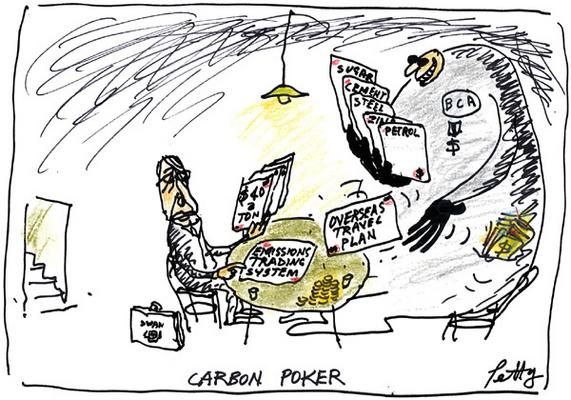 Bruce Petty
There is even utilitarian talk from the Howard-huggers in the coal fields that the costs of business as usual---accepting global warming and continuing with coal -fired power stations without cutting emissions -----would be cheaper than the cost of cutting emissions.
Posted by Gary Sauer-Thompson at 9:19 AM | Comments (2) | TrackBack
the big stick approach
I heard on Radio National Breakfast this morning that Gillard and Macklin are planning to continue the policy of mutual obligation. Centrelink will trial quarantining welfare payments for those parents whose kids don't go to school for up to 13 weeks in eight areas in the Northern Territory. Parents are required to give Centrelink evidence that their children are enrolled in school, and if not, they have to work with the school in lifting the child's attendance. If not their welfare payments are suspended.
The assumption, as Larissa Behrendt points out in an op-ed in The Age. In Rethinking indigenous policy she says that the assumption is that the root cause of the problems in the Aboriginal community can be found in the behaviour problems of Aboriginal people and that forcing change through a stick approach is the way to fix things. The failure of children to attend school is simply explained by bad parenting. She adds that:
The Halls Creek School trialled a voluntary program that linked welfare payments to school attendance in 2008 and the evaluation, undertaken by Professor Robyn Penman, found that school attendance of the children did not improve over the course of the trial. The quality of teaching and the culture at the school were as significant as parental attitudes, and overcrowding in houses makes it more difficult to provide an environment in which families can be "school ready" or a culture of learning can be created
She adds that placing a punitive measure on families to ensure their children come to school is hypocritical from any government that neglects the same children by failing to provide adequate funding for a teacher and a classroom.
This is one example of Australia lagging behind in investment in people and communities over the part decade across education, skills building and active labour market programs, despite the rhetoric about investing in human capital to ensure a fully engaged and productive workforce.
Posted by Gary Sauer-Thompson at 7:58 AM | Comments (9) | TrackBack
August 25, 2008
Turnbull on telly
With any luck tonight's Four Corners will give the Liberal leadership nonsense a gentle nudge towards something, anything, even a tiny gesture at resolution of some kind.
As usual when Four Corners does a political story, bits and pieces have been leaking out during the day, presumably by way of promo. A bit on Packer and Fairfax, a little of Julie bishop and Tony Abbott.
From the Four Corners promo:
In this unauthorised profile, Four Corners hands the microphone to allies and adversaries who have seen the very best and very worst of Malcolm Turnbull at close range. Four Corners explores Turnbull's meteoric career and tempestuous character to gain a glimpse of the promise and pitfalls of a Turnbull leadership.
Ooh er. Unauthorised.
Are the coalition – and the country – ready for Malcolm Turnbull?
Maybe, maybe not. The more entertaining question is whether Costello's spruikers are ready. Who would they have left to love if Turnbull got up?
Posted by Lyn Calcutt at 1:20 PM | Comments (18) | TrackBack
US Presidential election
The American presidential election is starting to warm up with Barack Obama selecting Senator Joe Biden as his running mate to attract the blue collar vote, overcome Obama being a foreign policy lightweight and enable the Obamacamp to take the argument to John McCain on national security policy. The Democrats have seen to be weak on national security and it is their greatest vulnerability.
The convention fortnight begins with the opinion polls making it a statistical dead heat between the two men. Obama's earlier higher ratings over McCain have evaporated and his his road to the White House is laid with Republican landmines.
Is that the end of the Clintons as power brokers as distinct from celebrity politicians? Do they still need their day in the sun? It sure looks like it since about 20% of Clinton's voters still say they're planning to vote for McCain! Obama has yet to find support from older white voters, especially when these voters are men and when they don't have a college education. Many live in the southern states and are not overly keen on a black President.
Presidential campaigns are usually about which side has launched the more effective attacks and bumper sticker slogans Who has the better healthcare or energy policy is largely irrelevant. What is relevant is the Rove dark side of lies, smears and innuendo that act to paint their Democratic opponents as alien to a majority of the American people; as someone too threatening, too different, too unAmerican to put in the White House.
On the other hand, the Republicans base in 2008 is small, their brand is damaged---Republican incompetence and failure have generated tremendous mistrust in the conservative foreign policy approach---- and McCain is definitely not a base mobilizing evangelical conservative. So they are left with attack and negativity at a time when the fundamentals -- the economy, Bush etc -- are against McCain.
Posted by Gary Sauer-Thompson at 7:42 AM | Comments (4) | TrackBack
August 24, 2008
university reform
In 1988 John Dawkins transformed the university sector when he merged a multitude of colleges of advanced education with universities and introduced the Higher Education Contribution Scheme ending the notion of free university education in Australia by forcing students to pay back some of the costs of their degree.
Since then little changed, save for the Coalition allowing universities to charge students higher HECS fees for their degrees in order to top up their dwindling revenues. The current system seeks to fund all universities broadly at the expense of high-class research and specialisation and it underfunds the university sector. The quality of the sector as a whole continues to decline and the universities just ask for more money. Hence the Bradley Review.
 There have been suggestions for more market reform in the form of student-centred voucher funding especially for the vocational education and training sector. Something needs to be done to the largely neglected VET sector, if the ALP is to address the nation's skills crisis and provide opportunities for future blue-collar workers.
Some argue the assumption that everyone should get qualified is flawed because unless we are willing to dumb down standards not everyone can get qualified. Low ability students do not benefit from more education. They may gain nothing from the experience and may in fact be disadvantaged by it.
That may be true. But it is a hardly an argument against ensuring that students have the necessary qualifications to take advantage of the opportunities to participate in the knowledge economy, if they so desire.
All the signs are that university reform under the ALP will mean a more market-driven system. On the other hand, the ALP Labor is less inclined than the Coalition to shift more of the burden on to students, and so it is more likely to require structural reform and increased performance from institutions themselves in exchange for more taxpayer funds. Hopefully that will happen as the universities' do not see the need to reform themselves.
If so, then the firewall between TAFE and university needs to be broken down, since the universities also provide vocational education for white collar professionals, and they have done so since colonial times.The stark status distinction between the two sectors is unwarranted.
Posted by Gary Sauer-Thompson at 7:03 PM | Comments (15) | TrackBack
August 23, 2008
The Australian attacks bloggers again
I'm slow to pick up on Christian Kerr's piece in The Australian attacking bloggers because I'm in the bush back of Clare. I cannot say I'm not surprised by another attack on bloggers from The Australian. But I am surprised that it took so long since the last one and that it is so poor in terms of arguments.
Kerr asks whether the internet is the greatest tool for the sharing of ideas or an instrument for reinforcing prejudice? Big question isn't it. The lightweight pundit answers in the negative:
The internet is narrowcasting to narrow minds, with some of the narrowest dwelling in the echo chamber world of the blogs ....The offenders here are discussion blogs. They would like to see themselves as the common rooms and salons of the online world. But they are intolerant and, worse, often incorrect .... In the world of the blogs there is so much righteous indignation, so much sneering superiority, so little analysis and so little humility in the search for balance, or even for further information that may enrich or enhance the views expressed ... Bloggers have discovered that proffering conspiracy theories is a very good way of looking wise to the ways of the world while being utterly ignorant. There's plenty of [paranoia] on the blogs; paranoia about certain journalists, certain newspapers, paranoia about certain pollsters, paranoia about Catholics taking over civil society, paranoia about (yes) Zionists and paranoia about US government conspiracies.
From these comments Kerr clearly has leftwing blogs in mind. He adds that the blogger's pet hate is the mainstream media and then comments that the mainstream media offer two crucial elements missing from the world of the blogs--- balance and fact.
Kerr therefore implies with a straight face that The Australian (its online) and the tabloids of News Ltd (also online) stand for balance and fact, and so do not have any conservative prejudice, bigotry and speculation. That is myth making.
Does Kerr himself offers balance and fact in his commentary on the internet as an instrument that reinforces prejudice? Not really he reduces the internet to blogs and sees the blogs in negative terms. Isn't Kerr offering sneering superiority with little analysis in answering his question? Sneer and bigotry was his trademark when writing for Crikey on green issues. It was his trademark style. Little has changed since apart from the bloggers being the new enemy.
Posted by Gary Sauer-Thompson at 7:40 PM | Comments (11) | TrackBack
August 22, 2008
business as usual
So big business is still playing chicken little with the proposed emissions trading scheme. Anything close to a 10% cut in emissions by 2020 will devastate many industries, force the closure of big companies and disrupt electricity supplies due to generators closing, says the Business Council of Australia.
All that Australia can realistically afford, along with big compensation and lots of free emission permits, is a low carbon tax---no emissions cap--- until a global scheme is in place. Oh, and the renewable energy target scheme needs to be dumped along with retail price caps.
Pretty much nothing is left. Nothing about making the shift to a lower carbon economy. Nothing about innovation. Nothing about new investment in emission free energy generation. It's all about the end is nigh. No mention about the investment in new cleaner sources of energy (gas and geothermal) that is already taking place.
Other than nuclear power that is, say the Energy Users Association of Australia. Only nuclear power can provide the base load power (no mention of geothermal). A nuclear industry is necessary to ensure Australia's energy security, along with maximising uranium exports to newly developing nations. So there needs to be a removal of the ban on mining in WA, Queensland, NSW and Victoria. Ideology has to be pushed aside so a proper debate about energy can take place.
It's business as usual isn't it. So predictable. The same old lines repeated again and again. The Liberal Party is now singing from the same song sheet. Surprise, surprise.
Similarly for the Rudd Government. It's rhetoric creates an image of decisive action while in reality it plans to do very little on greenhouse. There are plenty of climate change sceptics in its ranks (eg.,Martin Ferguson) , many are running scared of the electoral consequences of harming carbon-based industries (eg.,Joel Fitzgibbon) and the unions (eg., Australian Workers Union) are playing a spoiling role of soft pedalling on greenhouse policy.
It's mostly spin and symbolism on this issue ---just like it is with water. The Business Council seems to have reached its dire conclusions by assuming its businesses have no scope to pass to customers the cost of the emission permits they'll need to buy, no scope to eliminate wastefulness in their use of fossil fuels and no scope to reduce the need for permits by improving their technology. Strange assumptions.
Posted by Gary Sauer-Thompson at 9:16 AM | Comments (14) | TrackBack
August 21, 2008
Babcock + Brown's fall
So the global credit crunch has seen another Australian company hit the wall. This time it is the fund manager plus investment bank Babcock and Brown, who ride to fame and fortune on the back of cheap. Now they find that debt ($50 billion across the separate entities) is expensive and their asset value of their satellite companies are falling. So is their share price----Babcock and Brown's own share price has fallen by 90% this year.
Babcock's strategy was to buy more and more assets at top dollar using ever larger chunks of equity and deb, then sell them to investors at a premium. This brought big fees through the door, but like Allco Finance Group and Centro Properties, it has been hit hard by the crunch in global credit marrkets. Michael West in The Age says:
Babcock exploited public market money to forge a quickfire empire. We all own shares in Babcock satellites via the super funds. That was the point. Babcock simply mimicked Macquarie, rolling out stapled securities because trusts, as opposed to companies, are permitted to pay distributions out of capital _ that is, the money your investors have just given you, or debt you have just raised from the banks using the money which stockmarket investors have just given you.
The writedowns have begun, corporate finance has been axed, the dividend is gone, 400 staff sacked and a fire sale of assets is now on. It looks like a salvage operation to me. Will they be able to retain key staff? Or attract new investors?
They need to reduce debt and restore value to the ailing satellites---- such as Babcock and Brown Power--- whilst they are at the mercy of the market. So where were the regulators? Why weren't the contentious management agreements-----the 25 year management contracts that prevent Babcock and Brown from being sacked disclosed?
Posted by Gary Sauer-Thompson at 9:15 PM | Comments (1) | TrackBack
Queensland irrigators
So know we know what we'd always suspected about the lack of flow into the lower lakes of the River Murray this year. Queensland irrigators took record amounts of water from the Murray-Darling Basin over the past year, as other state governments wound back irrigator allocations to combat the worsening crisis in the system. And the Bligh Labor Government in Queensland supports Queensland's extraction of water on the grounds that their irrigators were simply taking advantage of the increased water supply and the ability to store water.
This is a state government that refuses to cap the water allocations in the state, effectively its nose at the rest of the Basin, and so sidesteps its Murray-Darling Basin commitments. The federal Agriculture Minister Tony Burke acknowledges that Queensland irrigators are taking vast amounts of water out of the Murray-Darling river system.
So why no action? Why isn't the Federal's Government's $400m water buyback money being spent acquiring the water allocations of the Queensland irrigators? Why just more talk when properties are on the market?
What we have is this kind of talk by Burke:
The critical problem in the Murray-Darling basin is one that no government can easily fix. In an age of climate change and during a prolonged drought, we simply have less water in the basin....The nature of the water system is that the further south you go, the tougher people tend to be doing it, right through until you reach the end of the system in South Australia. So I can absolutely understand the frustration that so many farmers feel and the water that they know would produce a profitable crop in a properly irrigated area simply isn't available on zero allocations.That is the reason why we are looking at the buyback and why so much of it is geared towards the northern end of the system.
The use of climate change here is increasingly looking like a cover for inaction to address the overallocation of water licences in the Basin, and the failure to get a recalcitrant Queensland to sign up to the cap, introduce proper water management plans, and separate water licences from land titles.
Why only $400 million on buyback when $6 billion is spent on upgrading irrigator infrastructure. Why upgrade the infrastructure when many of the irrigators will have no water allocations due to less rainfall from climate change? Where is there no federal pressure on Queensland to act on its Murray-Darling Basin commitments?
Posted by Gary Sauer-Thompson at 8:14 AM | Comments (15) | TrackBack
August 20, 2008
Liberal tribulations
It would appear that the conservative movement has given up on Nelson to lead them to a well deserved victory in the next election. So there is a campaign to draft someone to prevent Turnbull. Costello weighs heavily on their mind, and they see the giant shadow Costello casts over them. They have created the shadow and it is what happens when you spend time in the wilderness with out yesterday's Leader to run the show.
 Adam Sob
What more can one say? That this political theatre is important because only the LIberals stand between us and the loss of our personal freedom from the Nanny State?That only the Liberals will dispense with the mindset of mediocrity that years of failure and embarrassment under Labor state governments have entrenched in us? That the solution to mediocrity, depression and dependence in a therapeutic culture is elitism? Only the Liberals will defend an open society.
The Liberals have to avoid looking weak don't they. They were ensnared in their own trap---I trust my Leader with unchecked power because he's Good!. They are firm believers in the omnipotence of the Leader when they were in power, and they are experiencing trauma in opposition because they are being mugged by reality. No longer can the Liberal political Establishment luse their old tricks: lie most brazenly when they want to claim that their own insulated, fringe views are shared by the common sense of the majority of "the Australian people" as distinct from the left wing base.
Posted by Gary Sauer-Thompson at 7:03 PM | Comments (9) | TrackBack
August 19, 2008
a democratic dictator?
So domestic and international pressure has finally compelled Pervez Musharraf to quit as President of Pakistan, nine years after he took power in a military coup. Though Musharraf leaves Pakistan in the hands of the same politicians that he had repeatedly denounced he had no choice. It was quit or be impeached once once both the army and the US refused to back his bid to stay in power.
 Steve Bell
Musharraf made his country a key player in the "war on terror" and made himself an indispensable component of the US's policies in the region after Pakistan abandoned its traditional Taliban allies in Afghanistan, thereby paving the way for their ouster from power in the US-led invasion of 2001. If Musharraf's exit was a part of the American game plan, then the question is whether his successor in post-Musharraf Pakistan will be any better in balancing these US needs with Pakistan's own interests.
Afghan officials have openly accused sections of Pakistan's military of backing the Taliban in Afghanistan. Nato appears to be losing the ground war in Afghanistan, where it is struggling to beat the Taliban, an irregular guerrilla force armed with hand-held rockets and rifles. Nato is losing because conventional troop formations supported by heavily armed aircraft cannot easily defeat insurgents who resort to roadside mines and suicide bombers and who have the support – willingly or not – of the local population.
There is no military solution to the conflict in Afghanistan. What is needed is an effective international civil reconstruction and aid programme to persuade Afghans there is something better than being ruled by the Taliban. That hasn't happened and the Taliban have closed in on Kabul to such an extent that it is now dangerous for troops, aid workers and civilians to travel on the routes to the south, east and west of the capital city. Presumably the Taliban aim to cut off supply routes to Kabul.
Posted by Gary Sauer-Thompson at 7:25 PM | TrackBack
August 18, 2008
the commodities boom?
Is the commodities boom dying? The prices of gold, copper, and nickel are falling and have been for a while. So have the shares of mining companies. Does that mean China's growth easing? What happens to Australia's current account deficit if it does? If mineral exports currently account for over half of Australia's export income, then the deficit will increase. Wasn't China meant to be the security blanket for the world economy?
 Spooner
The turn around in commodity prices has been so quick, as it has happened is less than a month. Does this drop reflect the slow down in global economic growth--changes in economic fundamentals, as the economists are wont to say? Or is the lessening demand in the US for commodities (and in Europe and Japan) due to the economic slowdown there?
Or is it just a market correction, and so not something to worry about? Some argue that the big rise in commodity prices was the result of speculators fleeing from the fall in the US dollar. They are now selling commodities, hence the fall in prices. So it is a consolidation rather than a dramatically sharp cyclical downswing (a bear market).
Others argue that China is far more important to world commodity markets than the US these days, and economic growth in China is slowing. Since that has significant consequences for social stability and pulling the 700 million rural Chinese out of poverty, and so the Chinese government, to ensure its own survival, needs to keep the economy buoyant and growing. This will be done through accelerated government spending, as has happened in the past, and so China's demand for raw materials (coal and iron ore) will continue to grow. Australia's future prosperity is secured.
Trouble is the Australian dollar, the world's strongest currency in the first half this year because of its commodities link, has fallen 10 per cent against the US dollar, and is retreating even against the New Zealand dollar. Doesn't that indicate that financial markets expect a slowdown in global economic growth.
Posted by Gary Sauer-Thompson at 8:53 AM | Comments (1) | TrackBack
August 17, 2008
Bracks Report
The industry review headed by Steve Bracks, the former premier of Victoria, proposes $2 billion in subsidies to the car industry over the next decade (2020) to enable it to go through a transition process in return for a planned cut in tariffs from 10 p% to 5%. What is unclear is the transition to what? The aim from what I can gather is to secure the future of the local industry. To ensure that it survives in a global world, or achieves "economic and environmental sustainability by 2020" in the words of the Bracks' report. So we have a car industry policy based on budget subsidy, and this is held to be preferable to a policy based on a tariff wall.
 Spooner
Maybe. Yet this is an industry that has spent around a third of its 60 years in intensive care under structural adjustment programmes. It seems as if it is has been on a structural adjustment program since the 1980s. Yet it still continues to lose domestic market share after two decades of structural adjustment, and it struggles to make this up in increased exports.
The car industry has a small output--not much more than the capacity of world-class new plant--and its expertise is in building large cars when consumers are switching to smaller cars as a response to higher fuel prices and emission concerns. According to Bracks the industry's future lay in being "internationally competitive, more globally integrated and greener", and Industry Minister Kim Carr wants the emphasis on skill, innovation and new forms of public assistance to ensure this. Treasurer Swan says that tariff cuts have alway been accompanied by transitional assistance.
Why not devote the $2 billion to building a renewable green manufacturing industry in Australia?The skills and knowledge gained could then be used to help India and China become more environmentally. sustainable. Carbon sequestration will take 20-30 years to be commercially viable whilst some of the the mining companies are calling for nuclear power to reduce emissions.
Posted by Gary Sauer-Thompson at 11:18 PM | Comments (4) | TrackBack
August 16, 2008
Greer: indigenous dispossession, sexuality, rage
There seems to be a failure in the responses to Germaine Greer's essay On Rage to deal with her focus on rage. That essay was about hunter gatherer violence which has a particular shape involving self-destruction, high levels of suicide but also high levels of extraordinary violence against the people closest to the perpetrator, the perpetrator's own children and the women folk in his own family. Aboriginal male rage, she argues, is a response to the appalling outrages and abuses of white settlers.
The reaction has been very critical:
 Leak
Leak
The various commentators in the media want to talk about the federal government's intervention in the NT, individual responsibility, Noel Pearson, the rights of the children etc etc. It's almost as if the commentators are uneasy at Greer's linking the dispossession of land in colonial Australia with sexuality associated with white men taking black women then dumping the women and the kids back on the aboriginal men.
Greer on ABC Lateline says:
It's strange isn't it? We apologise for taking away the children of the stolen generations but we didn't apologise for anything else. And it made us feel good. We had finally acknowledged we were at fault. We are only on the edge of what we have done to these people. We have ripped away everything, language, culture, land, self-esteem, you name any of the things that make you a human being and they have all been stripped away from Aboriginal people. It's not that they're powerless to overcome, that it's just that it's unhuman of us to expect them to do it without no assistance.
For The Australian Greer, in blaming white men for black men's anger, displayed her sexism, racism and ignorance. After effectively denying the violence of colonial history in Australia and reducing rage to anger the editorial adds:
What might come as news to Greer, however, is that the debate has moved on since she left in 1964. The views she espouses are no longer progressive but regressive...The emerging consensus, driven by the thinking of Noel Pearson and others, sees welfarism rather than colonialism, and separatism rather than assimilation, as the reasons why indigenous Australians are trapped in a cycle of disadvantage .... commentators such as Pearson and Sutton see education and employment as the way to break the destructive intergenerational welfare cycle. Greer correctly diagnoses the rage of Aboriginal men as a problem, but fails to recognise its cause - the disempowerment and loss of identity that comes with long-term unemployment and a welfare-supported existence.
The long-term unemployment and a welfare-supported existence is the result of colonial history and the way hunter gather people have been treated by settler Australia.
Posted by Gary Sauer-Thompson at 1:45 PM | Comments (15) | TrackBack
August 15, 2008
Institute of Public Affairs on liberalism
I sometimes glance through the Institute of Public Affairs quarterly Review looking for interesting material about liberalism in Australia. Often I'm disappointed as I don't learn that much about liberalism in Australia. A case in point is the editorial in the July issue of the Review by Chris Berg, the editor. Berg says that:
Liberalism's opponent today is not socialism, as it was when the IPA Review was founded in 1947; liberal philosophy now stands against an arguably more challenging adversary--soft 'market-orientated managerialism, which professes an appreciation of competition and commerce, but is in fact dedicated dedicated to limiting it.
That sounds reasonable. But who is Berg referring to when talking about liberalism's opponent? The Liberal Party that has embraced corporatism, big government and defended the entrenched interests of the big end of town? Or the ALP? Or both? We on the left would call Berg's 'market orientated managerialism' neo-liberalism, but Berg seems to imply that this is not liberalism. It is todays left.
Of course. Silly me. How could I forget. But then I thought that today's left had given up socialism for liberalism. Aren't we all liberals today----conservatives excepted, of course? Berg explains:
Today's left do not carry utopian Marxist tracts that contain fully elaborated plans for revolutionary government. But now the left clutches cherry picked studies from fields of psychology and behavioural economics. We are told that markets are irredeemably irrational, that we need to increase taxed in order to fully count for 'social costs;' and externalities, and that only a Nanny State can look after us. The left has replaced the socialist objective with a rigid utilitarianism that has no interest in any philosophical or moral discussion about the appropriate limits of government action.Dear me. That dastardly left. Who are they? Social liberals? The left--eg.,the ALP-- are Australian liberals because utilitarianism is a classic form of liberalism (Jeremy Bentham, John Stuart Mill and all that), and utilitarian liberalism has been Australia's public philosophy since the 1860s or so. As an aside utilitarianism is a moral philosophy as its criteria to judge the right action is the greatest happiness for the greatest number.
I can only infer that what Berg is saying is that todays left must have embraced a false liberalism as opposed to a true liberalism. Why then, is utilitarian liberalism a false liberalism? Berg informs us thus:
They [the left] are nonchalant about the impact their policy prescriptions will have on individual freedom. And they are positively hostile to the concept of personal responsibility---people are too irrational to take responsibility for their own actions, and if they did, there would be too many 'social costs' for the government to possibly tolerate. The need for a liberal of liberalism in 2008 is just as strong as it was in 1947.
Isn't neo-liberalism--- Berg's 'market orientated managerialism'--- all about individual responsibility and rolling back the welfare state of social democracy? Berg, it seems to me, is fighting a family feud within liberalism. The argument is that some form of liberalism (free market liberalism) is good whilst other forms (utilitarian liberalism) is bad.
Update
The core philosophical issue here is: 'what is the philosophical basis or justification for Berg's good liberalism, if it is not utilitarianism? Why should we choose his good (libertarian) liberalism as opposed to the bad liberalism of today's left? Presumably, the account would be along the lines that it gives us greater individual freedom, understood in a negative sense of freedom from state regulation and coercion. So why is greater negative freedom better? Because.......?
The IPA owe us an account here, since, on my reading of their publications, they reject both social liberalism and rights based (a natural rights doctrine) liberalism. Is there another form of liberalism? Or is the IPA crowd closet utilitarians? I've interpreted the IPA as working within the ‘Austrian school’ of economists, (Ludwig von Mises and Friedrich von Hayek); a tradition that is more concerned with the ultimate aggregate benefits of free markets and with the need to counter the state's inherent tendencies to expansion and inefficiency. This school is consequentialist in orientation and so utilitarian.
if this interpretation is plausible, then Berg's argument against today's left for being utilitarian liberals no longer holds because the IPA crowd are also utilitarians. Consequently, further argument is needed to distinguish the good utilitarian liberalism of the IPA from the bad utilitarian liberalism of today's left (Rudd Labor). The word 'rigid' is not enough to do the work required.
Posted by Gary Sauer-Thompson at 8:44 AM | Comments (29) | TrackBack
August 14, 2008
gross mismanagement of water
It looks as if the calls for restoration of environmental flows to the River Murray through buying up properties along the Barwon-Darling River and releasing water stored in the Medindie Lakes will go unheeded, despite the growing political pressure about the years of inaction by state governments, who have been captured by irrigator interests in the Basin.
If it is true that 80% of the water released upstream would be lost to evaporation because conditions are so dry, then the finger can be pointed at state and federal governments for not buying back water licences to reduce the overallocation of water to irrigators. There has been a marked failure since the 1990s to restore environmental flows in the Murray-Darling river system.
Inaction has been the norm. Well, we do have a new new, independent Murray-Darling Basin Authority. Whoopie!. The stalling tactics adopted by irrigator interests,and they managed to ensure that the Murray-Darling Basin Commission bowed to these stalling tactics, as well as senior bureaucrats in state and federal governments.
As John Quiggin points out in todays Australian Financial Review:
The restoration of some environmental flows would not have prevented low flows in the current drought. But it would avoid the situation where low flows are the norm, and an extended drought is sufficient to push the whole system over the edge. At this point, calls for the compulsory purchase of irrigator's rights are growing louder. Unless there are are significant inflows of water soon, it is hard to see how the voluntary, market-based approach can be sustained.
Gross mismanagement in the past, and the continual refusal by the 'duck and weave' Rudd Government, to move on buyback has resulted in the current triage operation being applied to iconic sites of the Murray. If Queensland, NSW and Victoria are acting to ensure that South Australia will bear the brunt of the crisis, then the Rudd Government is not even working within the market since it is not even buying properties of irrigators will to sell up.
The Chowilla and Corrong wetlands along with the irrigators in the lower Murray are being sacrificed to protect Queensland, NSW and Victorian irrigators. It is unclear which vital ecosystems will be saved in the River Murray and it is unclear that the new Murray-Darling Basin Authority will be the power to do anything more than work towards another agreement to develop yet another plan to fix the Murray Darling Basin until 2011. After all, that is all that CoAG does, and so the state and federal bureaucrats are in no hurry to do anything more than develop another plan.
Update
The Rudd Government's latest cabinet meeting took place in Adelaide. After the meeting Rudd announced an independent audit of the water storage in the Basin; extended a buyback of water rights to include purchasing entire properties in northern NSW and Queensland and the federal Government would co-fund a doubling of the capacity of a planned desalination plant for South Australia.
They need to do something as Nick Xenophon has refused to rule out using the Murray River as a bargaining chip as the Government seeks to push contentious measures through the Senate. He has said:
Any government that doesn't do anything that can be done, that should be done, to save the Murray, to save irrigators, will stand condemned. South Australia shouldn't bear the brunt of environmental policy failures upstream. We shouldn't wear the brunt of failed policies, of failing to do things that should have been done many years ago. Water policy in this country has been an abject failure ... and now South Australia is seeing the sharp end of that. It's not just in South Australia's interest, it's in the national interest not to let an ecosystem die, not to allow one of the most water-efficient food bowls in the country, the Riverland, to wither and perish because we haven't got our act together.
So Rudd bowed to political pressure in South Australia and made some modest concessions. An audit only tells us how much water is there; it does not tell us what water is available to save the Corrong wetlands and lower lakes. Secondly, though buying farms and not just licences is a move in the right direction none will be bought in Victoria and nothing is being said or done about the illegal irrigation on the Paroo River in Queensland.
Posted by Gary Sauer-Thompson at 9:02 AM | Comments (13) | TrackBack
Georgian blowup
It is clear that the crisis in the Southern Caucasus that has arisen from Georgia's invasion of South Ossetia is caught up in the strategic conflict between the US and Russia in the post Cold War era that undercuts the spin about the Russian bear bullying democratic Georgia. That spin downplays the history of the region, Georgian provocation in recovering lost territory, Russian national interests and an anti-Russian media bubble.
M K Bhadrakumar in Asia Times Online says:
Georgia and the southern Caucasus constitute a critically important region for the US since it straddles a busy transportation route for energy - like the Indian Ocean or the Persian Gulf. It can be used as a choke point. Simply put, keeping it under control as a sphere of influence is highly advantageous for the pursuit of US geopolitical interests in the Eurasian region. A rollback of Russian influence therefore becomes a desirable objective. The geopolitics of energy lies at the core of the conflict in the Caucasus.
Bhadrakumar says the US has suffered a series of major reverses in the past two years in the great game over Caspian energy.
Bhadrakumar says:
Moscow's success in getting Turkmenistan to virtually commit its entire gas production to Russian energy giant Gazprom for export has been a stunning blow to US energy diplomacy. Similarly, the US has failed to get Kazakhstan to jettison its close ties with Russia, especially the arrangement to route its oil exports primarily through Russian pipelines.
Ghia Nodia in Open Democracy says that Russia is making a preventive strike against Nato, which happens to take place on Georgian territory. Moscow wants to teach Georgia a lesson for Tbilisi's open and defiant wish to become part of the west; it wants to send a message to the United States and Europe that it will not tolerate further encroachment on its zone of influence; and it wants to make clear to other countries in its neighbourhood (Ukraine first of all) that they are in Russia's backyard and should behave accordingly.
Thus, on the global scale, this war poses serious questions to the west and to Georgia: for the west, whether it will accept its strategic retreat vis-à-vis Russia, and concede that the former Soviet Union is a territory where Russia can effectively dominate without formally restoring its erstwhile empire; for Georgia, whether it retains de facto sovereignty and effective statehood. The Russian calculation appears to be that Georgia will descend into chaos as its people express anger at their government for starting a wrong war and wrongly relying on the west, leaving Georgians with but one option: to embrace a new government that will be formally independent but effectively a Russian satellite.
So much for the end of nationalism that would happen as the whole world gets online and starts clicking.
.
Posted by Gary Sauer-Thompson at 8:00 AM | Comments (4) | TrackBack
August 13, 2008
she would say that, wouldn't she?
It comes as no great surprise to find Janet Albrechtsen getting stuck into Clive Hamilton. Clive is a lefty, so it logically follows that he hates private property and anybody who has any. It's your standard Janet Albrechtsen Experience (apologies to the Hendrix estate). Except it's not anymore.
Stephen Mayne's piece in yesterday's Crikey describing Janet's familial connections with the world of banking came as news to me. Mayne points out that Janet neglected to inform her readers of her conflict of interest in an article criticising the Rudd government's attitude towards banks: "The onus here should be on disclosure, although the News Ltd press doesn't seem to believe in it."
Janet might argue that her husband's recent move to Credit Suisse makes such a disclosure redundant, but it all swings on whether the family has retained its large investment in Australia's banking cartel because she is clearly articulating a policy of shafting consumers to maximise profits.
True, her views on the banking sector wouldn't be nearly as convincing with disclosure, whether the shares have been sold or not, but neither would her views on Clive.
Clive Hamilton's made his name partly by arguing that our endless accumulations of stuff don't make us happy, that instead we should be concentrating more on our personal relationships. That's all very well and good Clive, but how is anybody supposed to rake in massive profits on the back of the personal debt of others if people don't buy stuff they don't need, using credit they can't afford? If you'd argued that our debt levels are making us unhappy it might have been different.
And if someone had pointed out where Janet's personal interest in the topic lie her article on Clive might have been different, or not written at all.
Janet:
His books have a repetitive theme, bemoaning the empty consumerism of modern society where people are depicted as drones, buying larger houses “filled with furnishings, appliances, carpets and curtains”, a big car in the driveway and a “super barbecue” on the lawn as a symbol of our vacuous lives.
We who aspire to bigger houses, a barbecue that can “roast, smoke, bake and grill” and other nice stuff are the victims of what he calls the “new form of coercion”. We are settling for a “life of consumer conformity”, unable to make free choices, buying possessions under the evil influence of corporations and spivvy advertisers.
Not to mention credit card junk mail.
At the heart of the happiness philosophy is a disdain for, and distrust of, people. Old-fashioned paternalism lies at the core of Hamilton’s obsession with the “hedonic treadmill”. He fails to imagine that people can simultaneously enjoy material possessions and pursue ambitious careers - living what he derides as “the pleasant life” - while also pursuing loving and caring relationships that give our lives meaning.
At the heart of the mortgage holder's philosophy is what? A belief that banks have their customers' best interests at heart? What are the stats on family and relationship breakdown citing financial problems as a major contributing factor?
Segue:
That Hamilton is deeply unhappy living in Australia should come as no great surprise. Research confirms that those on the Left side of politics are far less happy than those who have conservative political beliefs. And I’m willing to wager my electronic multi-spark, six-burner barbecue on this: the further left one travels, the more unhappiness you find.
Following this logic, Howard's conservative aspirational battlers in the suburbs owe their current state of uncertainty and unhappiness to a newfound leftish misery, rather than their phenomenal levels of indebtedness. Good grief.
Posted by Lyn Calcutt at 12:07 PM | Comments (14) | TrackBack
solar energy + industry protection
Finally Australia is stepping out of the dark shadows cast by the coal industry's doom and gloom spin run by the Greenhouse mafia, that opposes climate change, reducing greenhouse emissions and the shift to a low carbon economy. That 'no change' spin is designed to both delay an emissions trading scheme for as long as possible, and to use the situation to develop new forms of industry protection and industry subsidy/compensation to protect the older, coal-fired polluting forms of energy.
 Spooner
Blue chip Australian companies are willing to fund a plan by engineering firm Worley Parsons to build a 25-megawatt solar power plant in Australia. They can see the obvious: the potential for solar power in Australia; that carbon will be priced in some form in the near future; the cost of solar power is reducing and will soon match wind power; that California is running hard on the building solar farms; and the Rudd Government's policy (MRET) to guarantee renewable energy at 20% of the Australia's power supply by 2020.
The plant will be built in 2011 and would be the first of 34 solar thermal power plants built across the country by 2020. So we have infrastructure innovation instead of industry resistance to change, lobbying and self-interested claims. The plant will be built in 2011 and would be the first of 34 solar thermal power plants built across the country by 2020. So we have infrastructure innovation instead of industry resistance to change, lobbying and self-interested claims.
Gary Banks, the Productivity Commission Chairman, warned about industry protection in his Colin Clark Memorial Lecture in Brisbane. The speech was mostly about the old forms of tariff protection for manufacturing and textiles,clothing and footware, the policy commitment to opening Australia’s markets over the past 20 years or so has yielded gains and the increased recognition of the central importance of innovation to industry productivity and competitiveness, which has led to a renewed focus on how government can support it. He draws attention to the new forms of protection:
Yet, as currently proposed, the ETS looks set to have its own substantial industry assistance component, with hotly debated exemptions and compensation for some industries or enterprises potentially amounting to several billion dollars. Further, some 20 per cent of the revenue from this de facto tax is to be set aside for the promotion of greenhouse-related R&D.Even by the high previous benchmark for industry support, this really is ‘real money’. Indeed, when account is taken of other policies relevant to management of
the environment, such as the large subsidies provided to water users, the implicit industry assistance stemming from such policies may, in the future, dominate other measures of business support.
As Banks points out what is good for a particular part of the economy or community need not be good for other parts — and in the case of industry assistance often isn’t. Consequently, the goal should not be to promote any particular industry or sector as an end in itself, which as This was what our old-style protectionist industry policy was about, which promoted manufacturing at considerable costs to our economy
and community. Banks adds:
The objective should be to enhance the performance of the Australian economy, so as to enable living standards and community well being to realise their potential, given the resources available to us and their alternative uses. What those industry policies that target particular industries, activities or groups need to demonstrate is how they can achieve this.
Market failure and spillover would be an example of ways to achieve this. Banks argued above that the implementation of an effective ETS would generate a market-based price for carbon emissions that should render many pre-existing emission-reduction schemes redundant. He says that stripped of this environmental rationale, schemes such as the MRET would simply become very costly industry support vehicles.
However, Banks acknowledges that:
the emerging price signals may not bring forth sufficient innovation in adaptive or low emissions technologies due to spillovers or other market failures, warranting supplementary measures ... Such measures would need to take account of the (extensive) existing support for R&D and be targeted at areas where market failures are likely to loom large — such as in basic or strategic research, rather than commercialisation of existing technologies or in picking green technology ‘winners’.
In my judgement shifting to a low carbon economy is a basic national strategy for Australia and a sound rationale for facilitating the takeup of renewable energy as opposed to giving free permits to coal fired power stations to continue to pollute.
Posted by Gary Sauer-Thompson at 8:40 AM | Comments (2) | TrackBack
August 12, 2008
silly seven
Last night's Media Watch covered the story of GetUp's Tibet ads mysterious non-appearance on Channel Seven. Apparently Seven accepted the bookings, didn't run the ads, then gave a bunch of conflicting stories about why they didn't screen. Naturally enough, GetUp is using the word 'censorship', which is understandable in the circumstances.
You'd think that the people at Channel Seven would understand how this media/publicity thing works, but maybe not. The GetUp campaign instead got a bunch of free coverage from other media keen to let us all know Seven is a horrible TV station.
The SMH got in early, saying Kerry Stokes had intervened to make sure the ad ran. Which we now know, it didn't. The Australian has "Seven at home in moral pollution in Beijing", whatever that's supposed to mean. Crikey covered the blogs, and The Age covered it as a claim, counter-claim story.
We'll probably never know why Seven pulled the ads, but it was silly to think they could do so without getting their story straight first. Maybe they thought we'd all be so captivated by the Olympics nobody would notice.
Posted by Lyn Calcutt at 3:53 PM | Comments (1) | TrackBack
Reserve Bank refocuses, somewhat
The Reserve Bank's narrative over the last year has been a simple one. Inflation needed to be squeezed by slowing economic growth. there was too much growth and too much inflation. So to slow the economy, it lifted rates four times in seven months, in an economy already heavily loaded with debt. In doing so it downplayed the US credit crisis caused by the masters of the universe and the way that the crisis kept getting deeper. The narrative said that Chinese demand for Australian resources should cushion its economy from the global downturn, and it downplayed the way that falling demand from the US would affect China's demand for Australian resources.
Now the direction for interest rates is down, even if it is unclear what the speed of the gradual reduction will be. Why so? Because, though inflation still remains high, the inflation squeeze has done its job: economic growth is slowing, especially in those states with no export coal and iron ore mines. Though they are experiencing increasing unemployment, lower consumer spending, falls in house prices, the Reserve Bank is still primarily focused on inflation.
What continues to be downplayed is the increasing probability that the global economy - not just the US - will experience a serious and protracted recession. As Nouriel Roubini points out
Macro developments in the last few weeks suggest that now all of the G7 economies (the group of the major advanced economies including US, UK, Japan, Germany, France, Italy and Canada) are already in a recession or close to tipping into one. Other advanced economies or emerging markets (the rest of the Eurozone including Spain. Ireland the the other Euro members; New Zealand, Iceland, Estonia, Latvia and some other South-East Europe economies) are also on the tip of a recessionary hard landing.
And once this group of twenty plus economies enters into a recession there will be a sharp growth slowdown in the BRICs (Brazil, Russia, India and China) and other emerging market economies and likely tip the overall global economy into a recession.
So maybe the Reserve Bank's flagging of gradual interest rate easing may be too slow and delayed and it only happens when the G7 and global recession has become entrenched. They key for Australia is the slow down in China's exports and its trade surplus. is there any evidence that this is happening, due to the exposure of China's export base to the global economy? Brad Sester says nope.
Posted by Gary Sauer-Thompson at 8:39 AM | TrackBack
August 11, 2008
Bradley Review of Higher Education
The Rudd Government has promised an education revolution but, as it is still not clear what this involves, the Government looks a bit tacky and hesitant. "Revolution" sounds over the top and what has been delivered on other issues so far is a quite different from what has been promised. The look is one of spin heavy and substance light:
 Leak
Leak
What would an "education revolution" in the higher education sector look like? Greater deregulation? Removal of perverse funding incentives? One of the mechanisms to deliver university reform is the Bradley Review of Australian higher education. Its recently released discussion paper is about reforming higher education.It is charged with considering the many issues and challenges facing the Australian higher education sector and it will inform the preparation of the Government’s policy agenda for higher education through 2009 and 2010.
It is deliberately designed to generate discussion and ideas from the sector, with a clear focus on delivering a world class higher education system for Australia. This is important as this ambition contrasts with the idea of merely focusing on building one or two world class universities.
It is neo-liberal in its focus as it states that:
Our future national prosperity must be built in the competitive, knowledge-based global economy. Australia’s capacity for innovation and adaptability in industry and society will be a key determinant of our success. We will need to make the most of our ‘human capital’ – our people – by encouraging individuals to upgrade their skills and knowledge and by providing education and training opportunities for people from all backgrounds ..... While education is at the core of any national agenda for change, it is higher education with its twin functions of teaching and research which will make a distinct difference between simply adjusting to the forces which press upon us or establishing a new economic, social and environmental order.
However, it goes on to state that higher education in a modern democracy also deepens our understanding of health and social issues, and by providing access to higher levels of learning to people from all backgrounds, it can enhance social inclusion and reduce social and economic disadvantage.It also reaffirms the traditional values, namely that higher education can transform the lives of individuals and through them their communities and the nation by engendering the love of learning for its own sake and the passion for intellectual discovery.
These are competing functions and it is difficult to see how knowledge for its sake can be reconciled with the human capital idea of education as skilling up the workforce to ensure economic growth in a knowledge intensive global economy.My interpretation is that the Review's position is education sector is identified as having responsibility for social and economic nation building, and so the review aims to provides the foundation for the potential reconstruction of the policy settings for higher education in a knowledge intensive global economy.
Putting the "redivide of the sector according to teaching and research" ( ie., teaching-only universities) back on the table maybe a gesture to more comprehensive reform of the relationship between universities and vocational education -- including the architecture of a new binary system.
Posted by Gary Sauer-Thompson at 11:44 AM | Comments (1) | TrackBack
August 10, 2008
China: the new global power
The Opening Ceremony of the Beijing Olympics successfully expressed China's arrival of the global stage as a global power. The new China made its presence felt with grandeur that is the Olympic movement's parodic symbol of excess.The excess ($40 billion of public expenditure) signified that China has successfully modernized from being a backward power a century ago.
But the rules of the game of global power are set by the West and they have been changed in the last couple of decades. Progress in the form of modernization is no longer enough.The expectation that China should be like the West, because it is getting rich like the West, is as facile as the thesis that capitalism necessarily leads to liberty.
 Martin Rowson
China, we are reminded, is a one-party state, a totalitarian regime with a poor human rights record. One account holds that Communists in China needed success in sports to highlight the people's ability to adapt to outside forces, that is, those of the market; and also for enhancing the pride of Chinese people globally. The legitimacy of the dictatorship rests on its ability to deliver ever-rising living standards now that its Marxism is dead. Environmental concerns will always be trumped by the Communist Party's survival instinct.
Chan Akya in Asia Times Online says:
The reason for the communists to want sporting success is indelibly associated with their own lack of political legitimacy. Puffing up national pride from such victories is a sure-fire way of diverting criticism of the center: in other words, the logic of "this government prepares world-class athletes, so don't blame us for bread shortages but look instead at the incompetence of your local officials". All of this is part of the game played by communist governments on their people by creating a perverse system that depends on socializing successes in the world of sport and personalizing failures in all other areas.
China hasn't changed. Change is impossible without democratic reform - which is as far away as ever. Olympic Games has not led to political liberalisation.The curbing of dissent over the Games fortnight has been strengthened and are unlikely to be eased when they are over.
Posted by Gary Sauer-Thompson at 11:43 AM | Comments (3) | TrackBack
August 8, 2008
corporate medicine
One of the changes in primary care is the rise of corporate medicine over the last 10 years. The corporates hoped that by setting up medical centres with GPs, pathology and radiology facilities and sometimes allied health-care workers, these would make money from a process of internal cross-referrals. GPs would refer their patients for pathology tests and X-rays to the in-house facilities, and some referrals could also flow the other way.
 For these medical centres to work, the corporates had to get GPs into them and money was paid, sometimes quite big sums, to lure the GPs in. For a lot of older doctors and some young ones too, this was a chance for them to pay off their mortgage and have something to put into their superannuation.
The new model medical centres are often open six or seven days a week and are usually open for extended hours every day. They all bulk-bill. A lot of them don't take appointments for their doctors. Patients therefore have to queue up and wait, and if a patient chooses to see a particular doctor rather than the first doctor available, then that obviously means an even longer wait.
The emphasis is towards encouraging loyalty to the medical centre rather than loyalty to the one doctor. Tuck Meng Soo, a Canberra GP, describes how the corporates work in The Canberra Times:
If a patient comes in for a check-up for her diabetes or to discuss the complications of her latest antidepressant medication and the consultation takes 20 minutes, the GP still gets $32.80 from Medicare. So, for a corporate to maximise income for itself and the GPs working there, they need to encourage patients with chronic and complex problems to seek health care for their conditions elsewhere and to encourage as many six-minute consultations as possible. This is precisely what the structure of the corporate medical centres does.
As more GPs are seduced into working for corporates, the non-corporatised GPs are left with an increasing caseload of patients with chronic and complex problems with the ''easy'' coughs and colds that used to leaven their day taken away. At some point, the burden of work and responsibility gets too much to bear and many non-corporatised GPs just give in and leave medicine or join the corporates.
Posted by Gary Sauer-Thompson at 3:51 PM | Comments (3) | TrackBack
August 7, 2008
business as usual
At last the Australian's We Heart Costello push seems to be petering out. Content on the topic has dwindled from saturation to Dennis Shanahan prevaricating over the thing with a gesture each way. On one hand, Pete will take the job if it's offered nicely, or he'll challenge anyone who challenges Brendan (read Malcolm), but on the other hand, the only gossip to report is that Pete's no more interested now than he's ever been. Darn. And it was all looking so promising a few days ago.
Graham Young quite rightly points out that it's all a bit late now.
If Costello takes the job now it won't make any difference to the outcome of the next election, which will be won by the Labor party. As the Liberal Party rarely rewards leaders for losing, that will see Costello off for good. So Labor gets two wins - the one they would have had, and added to that Costello is taken out for good.
And if he doesn't become leader they still win, because Nelson will probably do worse than Costello would have.
Paul Keating will probably be as disappointed as Glenn Milne to find it was all a media beat up, given the opportunities it would have provided for colourful comment:
KERRY OBRIEN: The, I noticed at the launch today you called Peter Costello a clod hopper.PAUL KEATING: Isn't he?
So now that that's pretty much out of the way, what will the highly respected heart of the nation do with itself until Brendan gets back? They can hardly spend time and space giving Malcolm Turnbull oxygen.
Back to the same old grindstone it seems, trying to recruit climate change into the culture wars domain and trashing the Enlightenment in the process. Janet enlisted the services of her favourite coloured person for the purpose, as well as Frank Furedi, who's been deploring the moral decline of The West for years now. Cue a column from Furedi explaining how this moral decline makes us all unhappy and it's the fault of education departments everywhere.
It kind of makes you wish there was some substance to the Costello thing. At least that gave them something else to do for a while.
Posted by Lyn Calcutt at 2:45 PM | Comments (21) | TrackBack
River Murray: greenwashing
The ecological state of the River Murray is now pretty dire.The condition is most noticeable in the lower lakes are near the Murray's mouth in SA, where I have been photographing this last week.
 Valdmann
Unbelievably, the Rann Government in SA is spinning the ecological disaster in the Lower Lakes of the Murray River in the form of water dreaming. It is painting a rosy future even as it plans to built a weir at Wellington to protect Adelaide's water supply. This is one issue where the state government's spin is at odds with reality. As a response to the community protests on the issue, its spin highlights its failure on water issues and its strong greenwashing. Lake Alexandrina is now 35cm below sea level, and acidification would be triggered at negative 1m, which is estimated in June 2009.
In contrast, Senator Wong, the federal Water Minister, has effectively written off the lakes, saying there was not enough water in the River Murray system to fill them:
There is not enough water in the system to bring down the sorts of quantities of water you'd need to fill the Lower Lakes.Even if we did make a decision to not give any allocations (upstream), there is insufficient water currently in storage – less the critical human needs issue – for us to viably manage the Lower Lakes with the amount of water that we have. That is extremely unfortunate and extremely difficult for the community down there.
What water there is left in NSW and Victoria--we don't know how much---has been reserved for critical human needs (drinking water) along the River Murray. A weir is quietly being built at Wellington to preserve the drinking water by preventing the sea water plume that has got beneath the Goolwa barrages from going upstream. A recent estimate by CSIRO scientist Bill Young was that up to 50% of water released from Menindee Lakes would reach the lower Murray. So how much water is reserved in NSW?
Maywald has been denying that work on the weir is underway when she has been addressing local communities in the Lower Lakes this week. She is still talking in terms of a freshwater solution and the possibility of adequate rain falling next winter. She is saying nothing about the annual 4% trading cap has already been reached on the Campaspe River in central Victoria, which flows into the Murray, and that a major water acquisition has been rejected because it will breach the cap – barely a month into the financial year.
Odd that the Rann Government is putting no public pressure on NSW or Victoria, nor even calling for a public audit of water reserves in the NSW. Their silence and spin means that they have been bought off at CoAG.
Posted by Gary Sauer-Thompson at 11:32 AM | Comments (6) | TrackBack
early bird....
The cartoonists have been a bit slow on drawing cartoons about carbon trading and an emissions trading scheme, even though these issues have dominated the media headlines in recent weeks. The headlines indicate that Australia is to be locked into fossil fuel for the next 25 years, whilst may of the big energy users still reckon it is okay to use the atmosphere to dump and disperse pollutants.

It looks as if the consequence of emission trading is a scheme in which industry can make money out of, as it appears to be a Trojan horse for general protection; rather than the reduction in greenhouse emissions through and co-generation and the decentralisation of the national power grid.
Who is talking about decentralization? Or talking about making money from clean technologies? Or energy efficiency, for that matter?Apart from The Greens, of course.
In NSW they are tearing themselves to pieces over whether the coal-fired electricity generators should be publicly owned or privatised. The Australian Financial Review writes impassioned editorials in favour of private ownership and the deregulated market. The Australian rails against emissions trading, which is but a mechanism for transfer of value. All this hot air gives everybody a warm inner glow. But what has been forgotten is the main issue: significant reductions in greenhouse emissions and the economic activity in cutting CO2 that results.
Posted by Gary Sauer-Thompson at 8:20 AM | Comments (2) | TrackBack
August 6, 2008
competition + supermarkets
So we have The competitiveness of retail prices for standard groceries report by the ACCC dumped on us. Its about a rogue industry which is not solely responsible for the soaring food prices over the past five years. The ACCC found that grocery prices have risen by 21% since 2003, but only one twentieth of that was directly attributable to expanding profit margins ar supermarket chains:
The relationship between the farm gate and the check-out is quite direct for fresh products, such as meat, fresh fruit and vegetables. Coles and Woolworths often purchase directly from farmers, bypassing wholesalers, and then organise any necessary further processing themselves. The ACCC has not found any evidence to suggest that the major supermarket chains are acting in an anti-competitive way in their dealings with suppliers of fresh products. In particular, there is no across-the-board evidence to suggest that retail prices for fresh products are going up by a greater percentage than farm-gate prices. The gross margins of Coles, Woolworths and Metcash in fresh products have as a whole not increased significantly in recent years.
The ACC says that there are some examples of relatively minor increases, as well as examples of falls. It is certainly the case that the large price increases in many fresh items over recent years cannot simply be attributed to the retailers. What then is the analysis of supermarket competitiveness?
The core argument was that competition in the grocery sector was "workably competitive"---there was competition but itwas not as strong as it could be.
Posted by Gary Sauer-Thompson at 7:50 PM | TrackBack
August 5, 2008
fear and loathing
Matthew Warren in The Australian has an article on ACIL Tasman's recent report on the impact of an emission trading scheme on Australia's electricity market designed to achieve cuts of 10 per cent in greenhouse emissions by 2020. Warren says:
A 10 per cent cut will need $30 billion worth of new-generation infrastructure, including eight to 10 new gas base load power stations and more than 2000 wind turbines in the next decade. All this to be ready in time as at least 10 power stations stop running because they simply go broke under the weight of a price on greenhouse emissions.
Isn't new investment in less polluting industry what we want? So the problem is the going broke bit. What does that mean? Don't we want these old industries to change the way they do things?
Warren says that ACIL Tasman's power station closure schedule reads as follows:
First to the wall will be the small Energy Brix brown coal power station at Morwell in Victoria, run by HRL, followed by International Power's Hazelwood and Loy Yang B power stations and TRU Energy's generator at Yallourn. Babcock & Brown Power will lose both its Playford and Northern power stations in South Australia and at Redbank in NSW. Transfield will lose its Collinsville power station in Queensland, and the Queensland Government will lose a small black coal power station.
Warren says that the lone Victorian brown coal survivor would be Loy Yang A. But, he adds, it's a hollow victory because their operating margins will be shredded, net revenues per kW hour sent out falling by more than 80 per cent.
Warren adds that it will be much the same story for the surviving government-owned coal-fired power stations in Queensland and NSW. Their operating life will be sharply curtailed, peddling hard just to break even. None of them makes a very attractive business venture under an ETS but, then, that's the idea.
So what has happened to the new investment in geo-sequestration that will ensure clean coal? Wasn't technology the answer to dirty coal's greenhouse pollution problems? Why isn't that factored in?
Posted by Gary Sauer-Thompson at 8:07 PM | TrackBack
August 4, 2008
The Australian's trash
The Australian's recent op-eds attacking climate change and global warming really are scrapping of the bottom the barrel. This commentary illustrates the poverty of the media as it is mere polemics, and bad polemics at that with no consideration of public reason addressing policy issues.
The latest effort is by Arthur Herman, an American historian, who plays off the fundamentalist strand in the Enlightenment tradition of religion versus science. According to Herman the climate change "sceptics" stand for science and reason whilst the main body of natural science stands for religion and superstition. Herman says that despite recent evidence that the earth is cooling:
believers in man-made global warming demand more and more money to combat climate change and still more drastic changes in our economic output and lifestyle.The reason is that precisely that they are believers, not scientists. No amount of empirical evidence will overturn what has become not a scientific theory but a form of religion.
Herman rolls out David Hume's essay Of Superstition and Enthusiasm to claim that this religion is a form of superstition based on fear and ignorance. So the main body of natural science is superstition that parades itself as science and has created a priesthood masquerading as the exponents of reason---- just like the Church in the Dark Ages, the Inquisition during the Reformation, or the race/eugenics theories of Nazi Germany.
Ooh isn't this so outrageous and decadent. Seriously though, The Australian is now living in a world turned upside down. Their central claims-- that the planet is not warming, that science is dogmatic and that we live in an age of unreason--are unsupported.
The reason for these claims is the claim that a (rationalist) science is anti-evidence. Yet the main body of the article does not consider the evidence accumulated by scientific research under the auspices of the UN. An example of the evidence being collected about the rapid changes in the Arctic and Antarctic. The ice is melting. The Arctic is warming at twice the average rate of the rest of the planet and the sea ice is now considered by many scientists to be a "coalmine canary" for monitoring the speed of global climate change.
What we see with Herman is the empiricist's prejudice about theory (of climate change) and the interpretation of data (--it's all just facts), an ignorance of the way that critical reasoning is build into the institution of science, and a bundle of superstitions about sustainable development and market failure.
And Herman is going to speak to The Centre of Independent Studies on the ideas of the Enlightenment in the 21st century! What we have is here is the poverty of reason.
Posted by Gary Sauer-Thompson at 10:32 AM | Comments (7) | TrackBack
August 3, 2008
goodbye Starbucks
I see that Starbucks, the global American coffee giant, has decided mostly pull out of Australia —it plans to close 61 of its 84 stores. In Melbourne, just five of the 16 stores are tipped to remain. Good riddance--they make really bad coffee: it is weak, poorly made and overly reliant on syrups. Who cares for the comfy chairs, bland music and suburban atmosphere when the coffee tastes like sludge.
Starbucks, maybe an icon of globalization, but it is the downside of globalization in that it failed to adjust to the local culture of European style coffee houses with good coffee. It just dumped what worked in America into Australia. and so failed to adjust to the local Australian culture of European style coffee houses with good coffee. They took the ideas from Italian cafes and implemented them in America. But, as we already had Italian style cafes in Australia, Starbucks offered little in the way of innovation.
Oh, they did have free wireless hotspots (run by Telstra), but that made little difference in Adelaide, which, unlike other capital cities, has a large number of free hotspots in the CBD coffee shops.
Posted by Gary Sauer-Thompson at 9:14 AM | Comments (8) | TrackBack
August 2, 2008
fat cats
The cartoon refers to massive profits and increased prices by privatised energy forms---in this case British Gas in the UK. Prices of gas have been increased by 35% whilst profits are around $1 billion in the six months. Fuel poverty has become an issue in the UK.
In Australia the reference would be to the public subsidies for the traditional energy companies and the demands for public handouts by the coal mining companies to help them adjust to a warmed up world.
 Martin Rowson
The public handouts go the name of transitional assistance to the polluters, who are demanding lots of cash and creating a lot of hot air about carbon leakage, carbon tariffs and stability of electricity supply. The Rudd Government gives every indication of going real soft on 2020 targets even though Australia is one of the highest per capita polluters in the world.
Posted by Gary Sauer-Thompson at 11:08 PM | TrackBack
August 1, 2008
Mayo by election
Will water feature strongly in the upcoming Mayo byelection? It was not even mentioned on the ABC's Q & A, which I watched last night, even though most of the programme was taken up with climate change.
The Mayo electorate includes the lower reaches of the River Murray, and Brendon Nelson was down at Lake Alexandrina campaigning for the byelection. Nelson said that he would do everything he could to force the Rudd Government to provide a $50million emergency assistance package for locals and the environment, with the money to be spent on carting water for farmers and assisting the tourism industry.

The ALP is not going to contest the seat. This is Liberal heartland. Nelson got a bit carried away as he publicly canvassed the option of forcing farmers to sell their water rights to tackle the crisis in the Murray-Darling Basin. Dr Nelson's spokesman later clarified the Opposition Leader's remarks, saying compulsory acquisitions would only be countenanced if drinking water supplies were under threat.
Posted by Gary Sauer-Thompson at 10:03 AM | Comments (7) | TrackBack