« June 2008 | Main | August 2008 »
July 31, 2008
Pacific Solution ends
Finally, some sense on immigration policy. Detention is to be used only as a last resort, and only if department officials could show the person was a security risk. If not, they would be released into society until their visa status was resolved. The processing centre at Nauru is to be closed. So the Fortress Australia of the border security conservatives, is opening a few doors and windows to refugees.
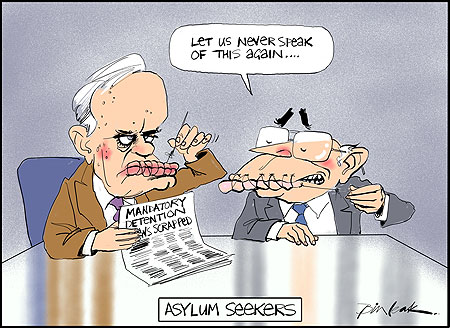 Bill Leak
However, boat people who arrive at the excised territories such as Christmas Island and Ashmore Reef, will be subject to mandatory detention and processed offshore. So the fiction that these outer islands are not part of Australia is maintained. The 800 person detention centre at Christmas Island stands empty.
Posted by Gary Sauer-Thompson at 11:22 AM | Comments (10) | TrackBack
July 30, 2008
political comedy
The Daily Show with Jon Stewart has its interpretation of Barach Obama in Europe and John McCain in the US. It is brilliant critique of the media.
What it highlights is the way that American politics as less like a college classroom full of rational truth-seekers and more like a theatrical spectacle. Symbolism and the emotion it evokes -- not facts and logic -- rule the day.
A good account of how this works in the US.
Posted by Gary Sauer-Thompson at 11:37 AM | Comments (2) | TrackBack
world economy slowing
It is now a year since the US subprime crisis went global and the repricing of risk has not resulted in the financial crisis being a brief interruption in the economic progress of the US and world economy. Contrary to th opinions of most economic commentators we have an ever deepening financial crisis and an economic slowdown coming at the end of an incredible boom.
 Ingram Pinn
The International Monetary Fund has finally got around to saying that the financial crisis that began in the US mortgage market is spreading deeper into other countries and other forms of debt - and countries that rely on foreign borrowing are vulnerable. That would include Australia, judging by the recent actions of the National Australia Bank and the ANZ in revealing larger than anticipated write-downs and bad debt provisions. Shares in Australian banks keep tumbling bringing the unprecedented three days of losses to more than $30 billion.
What we can infer from these write downs of its sub prime mortgage securities (SDO's) and write offs of problem loans is that the ANZ, NAB and other banks are being squeezed by the global credit crisis that has caused funding costs to soar, even if they have escaped the worst of the credit market turmoil. Now they talk in terms of not seeing the bottom of the credit crunch in a slowing economy. Does this outweigh the dangers of inflation?
Things look particularly gloomy on Wall Street, where the global investment bank Merrill Lynch is going down the tube as it continues its write down its CDOs in order to reduce its balance sheet exposure.The financial sector has written off hundreds of billions of dollars. yet the financial crisis has had limited impact on the rest of the economy, so far.
The US economic growth continues to slow. House prices continue to fall, the budget deficit continues to balloon, the current deficit worsens, the regional banks look increasingly shaky, and unemployment is rising as is inflation. It's a downturn, but how severely the US economy will contract is still unclear.
Washington is in retreat from laissez-faire and deregulation of financial markets because the laissez-faire, deregulatory policies have produced a world wide economic crisis. So the shift is to greater government intervention and more regulation to order the chaos. The regulators are even talking in terms of market failure!
Posted by Gary Sauer-Thompson at 6:24 AM | TrackBack
July 29, 2008
charades and other games
Are the Olympic Games really worth the trouble any more? Is there anyone left anywhere who still believes it's genuinely everything it's cracked up to be - a testament to the human spirit, an ode to healthy sportsmanship, an exercise in international peace and goodwill, a politics- corporate- and drug-free zone?
We've been through the torch relay which doubled as a celebration of happiness in Tibet. We know that 'tightened security' will protect those attending from terrorists, and those watching from adverse impressions of China, even if it means limiting the ability of networks to broadcast anything at all. Tonight's Foreign Correspondent is going to tell us about a crackdown on dissidents. Amnesty says human rights abuses have increased, not decreased, since Chinese authorities agreed to back off the citizenry as part of the deal granting them the games in the first place.
Is any of this drastically different from the systematic removal of the homeless, poor, sick, untidy or otherwise unphotogenic people all cities undertake in preparation for hosting the games? Don't all host cities go to absurd lengths to make out they've been Disneyland clones all along? Half of this country went berserk when Cathy Freeman politicised the whole show with her Aboriginal flag. Politics-free indeed.
The only corporate logos flaunted by athletes are the various national insignia and the occasional stuffed animal, but McDonalds and Coke are not the only sustenance providers allowed in the stadium simply because that's the way the crowds like it. All moments are Kodak moments and all transactions are Visa transactions. Some corporate sponsorship deals are pretty much permanent, so the ad breaks during the games coverage is more tedious than usual. There is no such thing as sport without sponsorship any more, and the Olympic Games is no exception.
There's also no such thing as sport without drugs any more, regardless of John Fahey's best efforts (assuming even those efforts are genuine, which could be a misguided assumption). As Ben Pobjie cruelly points out, they're fooling nobody. Luke Davies suggested in The Monthly that "all athletes should be rigorously tested, only so that we might know which pharmaceutical companies to send the medals to".
Maybe the problem of performance-enhancing drugs would be more easily dealt with if we just called it a form of sponsorship?
After 140-odd years of modern Olympic Games it's a bit of a stretch to believe that records are still being routinely broken when the human body hasn't evolved. It's been a while since Thomas J Hicks was done for taking strychnine and brandy to improve his performance in the 1904 marathon and all sorts of things have improved since then. Sure we're more healthy, taller, stronger, better equipped and have more sophisticated training regimes and probably better stop watches, but we've also got better drugs. We're also better informed. That swimmers all have enormous jaws and car park-size gaps between their teeth is not just a coincidence.
So what's the point of this four yearly charade? It's essentially a highly politicised promotion of sponsor products and illegal drugs. When do we get to the point where we can quit pretending it's anything else?
Posted by Lyn Calcutt at 3:58 PM | Comments (30) | TrackBack
machine politics
An interpretation of why the NSW ALP Right is the way it is. The world of Labor apparatchiks is a culture of machine politics, factionalism, control and power with a disdain for democracy and a contempt for policy.
 Moir
Moir
So it is no wonder the Iemma government drifts helplessly on the global economic flows, solely concerned with its own survival. The apparatchik culture of the NSW Right ensures this policy incompetence will happen, whilst the concern for gaining, and retaining, power at whatever cost opens the door to corruption.
What we have is the smell is a decaying government in NSW. You can smell death.
Posted by Gary Sauer-Thompson at 11:08 AM | Comments (4) | TrackBack
July 28, 2008
a marriage made in....
So the Nationals and Liberal Party in Queensland have merged. The Liberals have been taken over by the Nationals. That means a moral and social conservatism but what of the Liberals tradition of economic liberalism, which the Nationals reject in favour of agrarian socialism of socialising losses and capitalising gains? If the Nationals call the shots, then we have a new rump Liberal Party in Queensland.
 Sean Leahy
I cannot see that as a blueprint for the rest of the nation, where the Nationals are a rump country party--they have a Cabinet position in the Rann Labor Government in SA. The merger looks to be a very Queensland centric merger for all the heady rhetoric about the long march to Canberra. Even in Queensland leaving the new Liberal National Party (LNP) party is 20 seats short of the 45 it needs to have an absolute majority in Queensland's one-house parliament.
Will those in Queensland's south-east corner vote for the rebadged Nationals? Where do those who hold to the core liberal values of personal freedom, liberty and enterprise go, now that the Liberal party’s Right faction has merged with the Nationals. The National Party with a Liberal rump is not an attractive proposition for those in the south-east corner
Talk of a merger between the Liberals and the Nationals goes back a quarter of a century or more, when it became clear that the Nationals were suffering an inexorable decline driven by demographics in regional Australia. A merger at a federal level was seen as the best hope of salvaging remaining National Party influence and power and a merger meant folding the minority Nationals into the Liberals. So Queensland went alone, as Queensland has always been their real power base.
Australians are still leaving the bush for the cities in ever increasing numbers, and the Nationals are anything but national---they barely exist in SA , WA, Tasmania or the NT. They have retreated to regional Queensland, NSW and Victoria.
Posted by Gary Sauer-Thompson at 3:08 PM | Comments (2) | TrackBack
July 27, 2008
creative industries
The postmodern scene in the late 1980s was linked with the discussions about post-fordism, flexible specialisation, globalisation, the collapse of the post-war socio-political settlement of social democracy and the integration of national economies into the global economy. The academic judgement was that a new economic and social order was emerging; one organised around consumer markets for symbolic goods that in turn related to new forms of social distinction and identity.
This phenomena---capital’s ‘cultural fix’ for leftwing academics--- ’ worked particularly at the level of the City, where spectacles, festivals, shopping experiences and ethnic quarters had transformed the derelict industrial cities of the developed world into centres of up-market cultural consumption. Darling Harbor in Sydney and Docklands in Melbourne are examples.
Along with the flows of people, money, goods and information was a vast range of symbolic objects – texts, images, sounds, and experiences, which changed the position of the cultural industries vis-à-vis the rest of the economy. The growth of symbolic consumption (Apple computers?) meant that the cultural industries were no longer seen as a strange remnant of an older craft -based production system, but became the cutting edge, a template for the others to follow into a new economy of ‘signs and space’.
Creative industries are those industries which have their origin in individual creativity, skill and talent and which have the potential for wealth and job creation through the generation and exploitation of intellectual property, and thirteen creative sectors are usually identified namely: Advertising; Architecture; Art & Antiques Market; Craft; Design; Designer Fashion; Film & Video; Interactive Leisure Software; Music; Performing Arts; Publishing; Software & Computer Services; and Television and Radio. The academic discourse was structured around regional clusters, embedded networks, the ‘network society’, and the growth of key nodal points which controlled and directed global flows
Cities were now the new economic powerhouses built on the ability to process knowledge and manipulate symbols, and they were plugged into the new global infrastructure of flows, whose different currents flowed together to generate a current of reform and transformation of city life.The cultural industries policy discourse was deeply concerned with ‘the art of city making’, and it represented an model of urban transformation that drew on a European tradition rather than the real-estate driven model of the US . It stressed public space and argued for a new popular urban vision through a ‘revitalisation of the symbolic content’ of cities.
This in turn draws in state governments and city councils. The latter link these transformations with ‘ambitious public efforts of urban rehabilitation in the attempt to enhance local prestige, increase property values and attract new investments and jobs. The revitalisation of the little lanes of Melbourne are a good example.
Posted by Gary Sauer-Thompson at 4:57 PM | Comments (3) | TrackBack
July 26, 2008
learning to use a Macbook
My first attempt after leaving the PC world to upload an image using my new MacBook. It only me 3 hours to learn how to do it. Apple's web-browser, Safari, cannot download images from the internet, as far as I can see.

Bill Leak
So I turned to Firefox to save the image. That took ages, as I had to change the settings on the mouse in order to activate the right click function. Bloody hell!. Then there is no cut and past function. More bloody hell.
So I gave up trying to unlearning old habits and went and took some photos. I just needed to step away from my frustration into a different space.
Update: 27 July
I have learnt enough about the Apple operating system to to be able to function in a basic manner--ie; to be to do my weblogs, work online, and my emails. It required a new mouse and keyboard to achieve this functionality.
Posted by Gary Sauer-Thompson at 3:58 PM | Comments (8) | TrackBack
bring out your dead
There's something odd about bloggers blogging that blogs are dead. Or dying.
Social Media Queen, Laurel Papworth, says the problem is that blogs are not collaborative, and collaboration is the way of the future:
The problem with blogs is they aren't collaborative. Yes of course it's possible to have a conversation. People can leave comments on your blog - the Dine In version. Or they can comment in their own blog post, linking back to yours (Take Out or TakeAway). Or a mashup of the two, by commenting on an RSS feed about your blog. But it ain't collaborative.
Like old-style media, blogs are one-to-many, and that just doesn't cut it any more. Blogs will not loom large in the future.
Trevor Cook thinks the blogosphere is losing the old community spirit of altruism and open access, and becoming a replica of profit-focused corporate media.
The original social media vision contains a radical sense of equality with everyone able to produce and consume content that is, in turn, valued on its merits, not its branding or the celebrity status of the author. But radical equality works best in small groups and the blogosphere has already outgrown it.As social networks get bigger they lose their cosy clubbiness and can feel more like a business networking function where 'product pushers' keep crashing your conversations or snubbing you in favour of more popular attendees.
There is some truth in there. Think A-list, hit counters and various other devices for measuring 'success'.
Mainstream media blogs (flogs) get plenty of traffic and their authors get paid. Cook doesn't mention it, but the celebrity status of some op ed floggers has to be the main attraction for some readers. Look at me Mum, I'm talking to Andrew Bolt. A lot of commenting has more to do with star-frocking than discussion or debate.
Big institutions, business and government, seem to have no idea how blogs could serve their purposes. Business attempts generally fail, for various reasons, although the most obvious but least mentioned is that business operates on a whole other logic. There's no point talking with people if it won't make them buy more stuff from you. And they rarely understand the benefits of letting people publicly tell them why they're crap.
Any serious attempt by governments would have the same problem. Imagine the average response to a government blog seeking public feedback on the ETS? Or anything else for that matter. It would be troll heaven.
Personally, I don't think blogs are as dead as all that. The euphoria and utopianism has subsided, which was inevitable, and there's no way blogs will ever meet the advertising and mass communications needs of big institutions. But as we saw during last year's election, there are times when people need somewhere to talk about stuff that matters to them. Blogs aren't dead yet, just settling down and figuring out what they want to be.
Posted by Lyn Calcutt at 12:45 PM | Comments (12) | TrackBack
July 25, 2008
international justice
The surprise arrest of Radovan Karadzic, the Bosnian genocide suspect, is good news. Karadzic, who masterminded the 42-month siege of Sarajevo and is held politically responsible for the massacre of almost 8,000 Bosnian Muslims in July 1995, had reinvented himself as a bearded New Age guru and devotee of alternative medicine. He was living modestly in a Belgrade suburb and touring the country to deliver homilies on a better life.
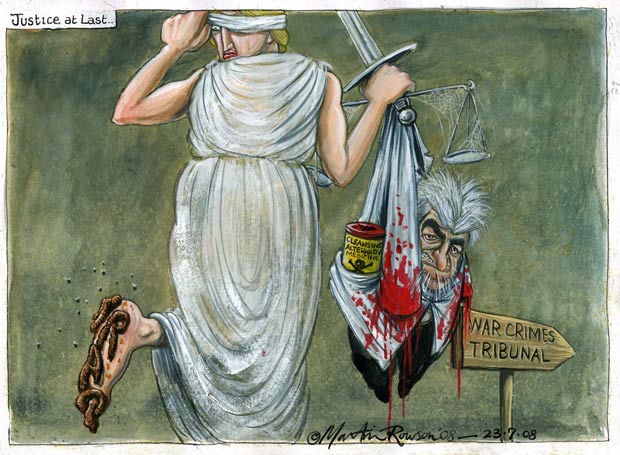 Martin Rowson
After 13 years on the run from charges of war crimes and genocide, Radovan Karadzic is being sent to The Hague where he will stand trial for war crimes. Bitter memories still linger in the settlements and villages surrounding the site of the Srebrenica massacre.
Posted by Gary Sauer-Thompson at 9:23 AM | TrackBack
Friday cartoon
A lighthearted moment for those political junkies who get a buzz from watching the indecisiveness of the Coalition, now reduced to an amateur political outfit, on climate change:
 Moir
Moir
The Minchin/Abbott/Truss wing of the Coaltion want to exploit the costs of an emissions trading scheme for short term political gain whilst the Turnbull/Hunt wing want to embrace an emissions trading scheme and construct the political debate around timing and price of carbon. Nelson, has a foot in both camps, but he is actually in the Minchin/Abbott camp.
The more sensible strategy of holding the backsliding Rudd Government accountable according to its own standards is not even a consideration. Why not? Cos the indecisiveness is a proxy for the leadership battle.
The Coalition doesn't seem to realize that their position on global warming and an emissions trading scheme hardly matters. They are not in government, and it is the Rudd Government's position that is of significance. The economic and political debate is about their scheme, not the Coalition's.
Posted by Gary Sauer-Thompson at 8:45 AM | Comments (10) | TrackBack
July 24, 2008
flippery
On Tuesday, Julie Bishop's "blog" in The Age complained that scientists with doubts about AGW are being intimidated into silence. She took the familiar culture wars approach of reframing the debate as a matter of opinion and free speech rather than one of science.
Rather than denigrate those with opposing views, it is vital that we encourage debate and respect dissenting opinions.While there is unlikely to be consensus on many major issues, we must defend the right of people to hold their opinions and allow free and open debate on the merits of those opinions.
If comments are any indication, she didn't have much luck with it.
On Wednesday, Andrew Bolt predicted a showdown between Brendan Nelson heading the Liberal deniers, and Malcolm Turnbull and Greg Hunt representing the supporters. Apparently it's pencilled in for next week.
Nelson now realises he made a mistake by caving in on Friday to demands by Turnbull and Hunt that he stick to the old policy - that the Liberals, like Labor, would bring in an ETS whatever the rest of the world did. He plans now to fight for the position he put, and yesterday promised in interviews only to “move towards” an ETS.In the shadow cabinet meeting next Tuesday and in the party room meeting on Wednesday he plans to ask his colleagues to now back him: no ETS unless gassy giants China and India commit to cuts, too.
In other words, do nothing.
Today, Kevin Andrews has confirmed the gossip, although unlike Bishop he's calling it for the internal split it really is. Michelle Grattan writes:
Opposition hardliners want Coalition leader Brendan Nelson to repudiate the present policy that he has reluctantly endorsed and which shadow treasurer Malcolm Turnbull and environment spokesman Greg Hunt have enthusiastically promoted. This says an Australian scheme should start by 2012, regardless of other countries.
The ALP's line, "I can't comment on the Opposition's climate change policy because, like them, I'm not sure what it is" seems pretty safe at this rate. Everyone with a microphone will ask whether it's a backflip, and everyone with a camera will zoom in on Turnbull's visible discomfort if he ends up having to toe the party line. Turnbull would be the ideal opponent in poker, poor sod.
Tim Watts is appalled by Nelson's weakness, while Mark Bahnisch notes another little wobble from Nelson trying to turn a showdown into 'negotiations' while slouching towards denialism.
The Liberals are once again looking like a clueless rabble, and they may well find that getting fulsome praise from Andrew Bolt is no substitute for adopting a responsible stance, or a plausible imitation thereof, in the court of public opinion.
That's generously assuming that the public is paying that much attention. It's true we're suckers for novelty, but a policy cycle of sometimes less than 24 hours is stretching the notion of novelty a little far.
Posted by Lyn Calcutt at 12:42 PM | Comments (6) | TrackBack
poor planning
It is a fair judgement to say that the state Labor Governments have been poor long-term planners on major issues such as water, energy and transport.They have been slow in coming to grips with these issues and they have only made a few hesitant steps in addressing the way these issues have been impacted by climate change. If they have plans there there is little by way of outcome, as they are more concerned with governance as administration than the required structural reform.
 Spooner
It is mostly business as usual with lots of spin about how great they are in being on top of issues. Meanwhile public transport cannot cope with the extra numbers as people leave their cars behind to get to work; water shortages for critical human needs become ever closer.
The reason?
The long years, beholden to, and obsessed with neo-liberal economics budget surpluses, cost cutting of public services (health and education) no infrastructure investment because that meant debt, and hiding behind the nostrums of the global market.
Posted by Gary Sauer-Thompson at 12:34 PM | Comments (6) | TrackBack
July 23, 2008
Cossie, why?
World Youth Day is possibly one of the greatest misnomers of our times. It didn't cater to world youth, but to a small minority. It wasn't a day, but more than a week, and felt like a decade. It's all over now though, so Sydney can get back to its gridlock, crap public transport and other Iemma-induced brokenness and the rest of us can settle back into the daily news routine to which we'd grown accustomed, supplemented by the Rudd Government's fluffy new ad campaign. It shouldn't take long to settle back in, since nothing much has changed.
Given a whole week to tinker with, the Opposition could conceivably have come up with something new and tantalising to astound the public and confound the ALP, but it wasn't to be. Instead, Costello's media fan base appear to have spent World Youth Decade spit polishing their adjective collections and gathering whatever scant evidence available to justify the launch of a Pete remix. It's essentially the same story - anyone but Turnbull.
In the middle of dissecting poor Malcolm Colless, Andrew Elder suggests that Cossie's magnificent handling of the economy isn't the glowing set of credentials it's cracked up to be.
Colless:But Rudd's decision to throw down the gauntlet of economic management in fact provides former treasurer Peter Costello with the opportunity to re-enter the political debate instead of twiddling his thumbs on the backbench while he polishes off his memoirs.
Elder:
Because writing is hardly work at all, is it Malcolm? You'd know. It might provide the opportunity, but will Costello take it? It's silly to raise a question and then dodge it. If you were a press gallery journalist, a Canberra observer, you'd have those answers.Colless:
There would be no shortage of forums for Costello to deliver a major speech responding to Rudd's challenge on economic management. This would send a signal to the electorate and the party that he was back in the game.Elder:
There are no such shortages and nor have there been for the past nine months, Malcolm. Anyway, what game are we playing at here? Costello has remained silent while Labor has blamed the Coalition for putting the country in an economic mess. Costello said and did nothing on carbon abatement. Labor have Costello's measure.
Costello has stopped being a politician and when it's Mr Elder saying that's because Labor have his measure, it's worth believing.
On the branding side of things, Possum notes that Cossie fans can dredge up all the Paleolithic Age stats they want, but none of it will alter the primary public perception of Pete as smug, snide, a weasel or a creep. Those perceptions are partly the result of the media's fascination with Costello's theatrical performances, back when he was a member of the Abbott and Costello forward pack under Howard and his main responsibility was being nasty on telly.
But when Joe Public sees 5 and 10 second grabs year after year of Costello’s politicking in QT, far from seeing Parliament as theater or the making of copy for newspaper columns – they see a smug, aggressive boofhead throwing the type of shit that would get his lights punched out in any self-respecting watering hole around the country.
It's just too hard to imagine said boofhead sitting in the gutter at 3am with homeless kids, or helping working families wrestle the wheelchair into the back of the Tarago. Sneering and smirking at our failure to produce excess children, yes, giving a hoot what happens to us otherwise, no. The only time I can recall Costello coming across as remotely human was when he said his Mum told him to always tell the truth, which isn't exactly a leaderly thing to say. Especially considering he slunk off into Howard's shadow shortly after.
There are very few reasons to think Costello would make a terribly good leader, let alone an appealing Prime Minister who's not Kevin Rudd. But considering the alternatives, the question Liberal supporters are asking themselves must be, why not?
Posted by Lyn Calcutt at 2:27 PM | Comments (7) | TrackBack
reducing the political costs of reform
The dust is settling on the Rudd/Wong Green paper on emissions trading and Big Business continues its campaign to ensure that the approach is softly softly with bundles of compensation. We can see more clearly no that the whole Rudd/Wong exercise has been primarily aimed to reduce the political cost of reform on greenhouse emissions. However, I cannot for the life of me see the economic reason why the coal-fired power generating companies need compensation, when they knew all along what was coming since Kyoto in 1997.
Neither can Peter Martin. He says:
Never once on the countless occasions that Australian governments have restricted the sale of tobacco have they felt compelled to compensate the manufacturers for ''significant reductions in their profitability''.Why would they? The cigarette manufacturers knew what was coming (and had decided to invest anyway) and were blessed with rusted-on customers.
As Ross Garnaut had observed there there is no tradition in Australia for compensating capital for losses associated with economic reforms. Australian businesses have not been compensated were the floating of the dollar, the introduction of the goods and services tax and the massive tariff cuts in the 1980s.
In the case of emissions trading, businesses had been aware of the risks of carbon pricing for many years and many had sought to re-engineer their production processes to reduce their reliance on emissions.
So Rudd and Wong's softly softly is about buying off the political opposition to emissions trading. It's about politics not economics.
Posted by Gary Sauer-Thompson at 9:06 AM | Comments (2) | TrackBack
July 22, 2008
a coal fired Queensland
Queensland, during Peter Beattie's premiership, marketed itself as the Smart State. Under Anna Bligh it is the Resource State. Queensland's mining boom is a coal boom: coal is dug up in the Bowen Basin in Central Queensland exported to China and India, with McKay as the epicentre of the coal boom. Coal is the Queensland government's biggest export earner, and the mining talk is of a never ending boom with little in the way of wealth trickle down to the regional towns. This is a long way from recession times in America, where consumer's purses are snapping shut as house prices continue to fall and unemployment increases.
It is one indication of the way that Australia has reverted back to Quarry Australia, how state governments are hostages of Quarry Australia, and why they drag their heels on emissions trading. So they use weasel words to demonstrate their concern for reform while fudging commitments and pandering to special interests. The whole mode of governance is designed to reduce the political costs of any reform to business as usual.
Declining growth in the US and UK and boom in Australia, China and India highlight the contradictions in the world economy; contradictions that point to a general slow down in the world economy. What of the ecological consequences of China's breakneck industrialization that produces boom times in Queensland?
I'm not just thinking of the coral of the Great Barrier Ree, or the air thick with pollutants in cities such as Chongging or Peking, which turn the cities ' mists into pea-soup fogs. There is also China's surging emissions of carbon dioxide, with China overtaking the US as the world's biggest annual emitter of CO2.
Posted by Gary Sauer-Thompson at 8:41 AM | Comments (1) | TrackBack
July 21, 2008
a time of renewal
I guess Benedict XVI, in attacking has attacked the spreading "spiritual desert" of the modern secular world, and calling for a new religious age of faith and redemption, has given the Liberals a new message.
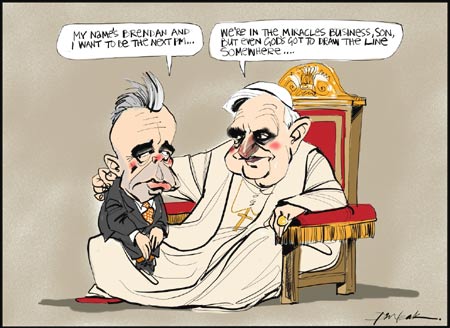 Bill Leak
They can begin to talk in terms of for a new age in which hope liberates us from the shallowness, apathy and self-absorption which deaden our souls and poison our relationships. Nelson can say that the world needs this renewal, and only conservatives can deliver it. Trust us.
Of course, they may need to temper their enthusiasm for wealth creation and prosperity a bit and talk a bit more in terms of moral absolutes. They would have to go easy on the idea that we live in a world of mere appearances, a kind of husk of reality where we grasp after shadows, though. And on the embrace of poverty and a life of self-denial.
Posted by Gary Sauer-Thompson at 7:39 AM | Comments (3) | TrackBack
July 20, 2008
Washington's "war on terror"
It would appear that the central front in Washington's "war on terror" has moved eastwards about 1,800 kilometers from Iraq to Afghanistan and the frontier regions of Pakistan. This war is marked by the increasing insurgence of the Taliban, Islamabad's alleged failure to prevent the Sunni Taliban forces, both Afghan and Pakistani, from infiltrating into Afghanistan from parts of the North-West Frontier Province and the deterioration in Afghanistan and Pakistan.
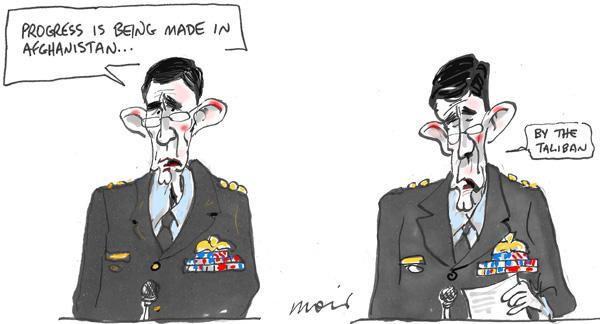 Moir
Moir
The Bush White House has become seriously uneasily about Pakistan after Benazir Bhutto was assassinated. They've been treading water while watching things go from bad to worse in both Pakistan's domestic political chaos and in the border areas with Afghanistan. The US doesn't have more troops to put in, and even if there were a few more brigades were sent there from Iraq the military isn't going to solve the problem in Afghanistan.
Posted by Gary Sauer-Thompson at 9:17 AM | TrackBack
July 19, 2008
The Australian speaks
The editorial in The Weekend Australian is on climate change, the issue of the day. It is worthwhile reading to see where The Australian now stands on an issue that it has historically opposed because it thinks the science sucks. The editorial's argument starts thus:
By taking the soft approach, Labor has intentionally cut itself free from the Greens and environment groups, which have dealt themselves out of the debate by demanding much tougher measures, particularly against the coal industry. This is the right approach for Labor to take. It is much better to be cautious than to risk Australia's prosperity for an uncertain result.
Well if it is going to happen then lets do it softly, softly, and ensure that The Greens are defined as the extreme fringe. The core issue is economic prosperity, after all, not the need to shift to a low carbon economy. That is a shift to neo-Arcadian future. What does softly softly mean then?The editorial continues:
To really punch above its weight, Australia should focus on developing clean coal technology and boosting uranium exports, which have the potential to save billions of tonnes of carbon emissions. By electing the carbon cap-and-trade route instead, the Government faces a big job attempting to address legitimate concerns of trade-exposed industries.
There really is no need for an emissions trading scheme. Why so? Presumably there is no need for one since the core concern is prosperity in a warmed up world. But if we are to have one then we need to keep on an eye on Rudd Government because it is the Labor Party that has the control of the Treasury benches. Why so?
There is always a danger that as the election cycle moves on, Labor will become more obsessed with recycling carbon revenue for social policy and electoral purposes. If it does, it will be a repeat of the classic left-wing mistake of being too eager to cut up the economic pie and distribute it rather than grow the size of the pie.This is standard practice in social democracy, which is all about high taxing big spending statist governments---and it is bad because it restricts the economy. Thankfully, an economic conservative Rudd Government appears unwilling to risk jobs to satisfy those people calling for a neo-Arcadian future.
The mood for change that resulted in the election of the Rudd Government in 2007 cannot be allowed to get out of hand. Democracy must give way to wealth creation in the economy. So not much has really changed at The Australian.
Posted by Gary Sauer-Thompson at 9:55 AM | Comments (2) | TrackBack
July 18, 2008
softly, softly
The greenhouse mafia in action and the commonwealth government's response:
 Moir
Moir
So it is easy to see what the politics of emissions trading is all about. The Green paper may say all the right things about the urgency of the climate change problem, but The Rudd Government's politics is basically about industry protection and selling out to the heavy polluters. It's more of less an embrace of the Shergold position under the Howard regime.
That position was primarily about cushioning the effects of the carbon price on industry to delay the desired change in behaviour to reduce emissions and shift to a low-carbon economy. The big changes would be put off way into the future.
The next step in backflipping comes with the targets . The Rudd Government is still talking in terms of a 60% reduction in carbon emissions by 2050. So what will it be for 2020? A 10% reduction? The assumption here is that carbon capture and storage will be economic because renewables such as solar, geothermal power and wind are far too expensive. To prevent the latter from falling in price rapidly, and so making carbon capture and storage uneconomic, the price of carbon needs to be kept low, so that the renewables remain uneconomic.
Coal must rule. Hence all the threats to cut investment, abolish jobs, shift plants offshore, etc etc.
Posted by Gary Sauer-Thompson at 8:55 AM | Comments (8) | TrackBack
July 17, 2008
a question
Why should polluting electricity generators be compensated? Cash handouts for asset write downs and some free permits. These energy companies will pass the cost of permits onto consumers regardless of how they get them. Isn't free permits for coal fired generators to continue to pollute allowing them a windfall profit, given the estimated 16 per cent increase in electricity prices (assuming the price of carbon dioxide emissions is $20 a tonne)? And these domestic free riders want Australia to be a free rider in a global emissions trading scheme.

It sure looks as if the pressure from the emissions-intensive industries to block the full operation of an emissions trading scheme in 2010 has succeeded. And they have ensured the burden on business is eased. The actuality of special benefits for special interests and the watered down objectives is a long way from all the tough rhetoric about the greatest moral challenge likely to face humanity this century.
Even the Australian Financial Review says that the disappointment with the Green paper lies in the 'caution which seem excessive.' Some call this caution political realism---a measured transition. I would call it lacking political courage, given the generous allocation of permits covering 90% of the energy-intensive trade exposed industries and the open ended nature of the transition scheme to whittle emissions down. The date is 2025 or even latter.
There is little discussion of incentives to boost domestic and industrial energy efficiency whilst the five year cap on the carbon price effectively breaches the emissions trading scheme as it prevents the market from using price to effect behavioural change.
My interpretation of the compensation for coal-fired generators for curbing their pollution that causes global warming has little to do with 'safeguarding investment in industry' and more to do with succumbing to pressure from state Labor Governments in Queensland, NSW, SA and Victoria to protect their dirty coal fired power stations.
Posted by Gary Sauer-Thompson at 8:09 AM | Comments (17) | TrackBack
July 16, 2008
Rudd wimps
The leaked reports say that the Rudd Government's Green paper (the white paper comes later) on emissions trading scheme, which is to be released today, will shield motorists from petrol price rises for at least the first three years of Australia's emissions trading scheme. It will offset resulting price increases with corresponding cuts in fuel excise. For every cent petrol rises due to emissions trading, a cent will be knocked off excise - for a minimum of three years after the scheme is launched. After that, the policy of a three-year moratorium on petrol price increases will be reviewed. The debate moves on.
So the ALP has embraced the Liberals policy whilst belting them over the head for being wimps. They argued that if transport is left out of emissions trading in the long term, everything else, including power, will cost more. So a pattern has emerged: the Rudd Government is strong on rhetoric about moving the economy from a high-carbon-polluting economy to a low-carbon-polluting economy and weak on the politics.
Professor Garnaut argued cutting a deal on petrol would blunt the message, which was to use price signals to encourage people away from high carbon energy. Protecting motorists from the effects of an emissions trading scheme will undermine the scheme's primary purpose - to discourage the burning of fossil fuels such as petrol, and to facilitate a shift to more efficient hybrid cars and public transport.
So Rudd Labor is ensuring it's re-election in 2010 by buying off the opposition. Business continues to cry out for more time and to question the implementation timetable. Doubts do arise. The allocation of permits is an area where governments routinely fail -- whether its over-allocating water licences or maintaining the taxi licence racket. State governments love doing deals and favours -- as it’s already happened in NSW by the Iemma government indemnifying Bluescope steel against any future carbon tax. Some of the wording we have seen about the carbon cap talks about "measured", "soft", "modest" targets. The problem with a soft or moderate target is, is that it probably not going to drive the right sort of investment. But we await Treasury's modelling.
The other area of concern is that the introduction of an emissions trading scheme with soft targets also requires renewable energy targets and energy efficiency targets. An emissions trading scheme is not the silver bullet, as we still need development in renewable energy technology as well as energy efficiency measures to curtail energy consumption. There has been reduced investment in renewable energy under the Rudd Government, and little talk about energy efficiency targets. The states of course (Queensland, Victoria and NSW) continue to invest in coal, pinning their hopes on clean coal technology to reduce the carbon footprint.
Posted by Gary Sauer-Thompson at 7:57 AM | Comments (19) | TrackBack
July 15, 2008
development in Adelaide
The South Australian Government's decision is to put an independent assessment body in charge of all city projects worth more than $10 million. The Adelaide City Council's recent rejection of a $180 million building development in Franklin Street/Bentham Street in the CBD is given as one reason for the Rann Government's decision to move to keep Adelaide City Council out of planning decisions involving any development worth more than $10 million.
I do not know why the Adelaide City Council rejected the development proposal for the Franklin Street high rise apartments. I understand that the Development Assessment Commission recently rejected a multi-million-dollar office project for the corner of Franklin and Bentham Street in the city, known locally as Post Office Square, because it did not fit the publicly agreed planning guidelines.
The Council has been very pro development under Mayor Harbison, so I don't know why the State Government needs to make life easier for those developers who push the envelop by breaching the development rules that govern development in the city of Adelaide. The antiquated anti-development rhetoric of the Property Council makes little sense.
This City Council's record undercuts the claim by Paul Holloway, the Minister for Urban Development and Planning, that the Adelaide City Council wants to keep the City of Adelaide as a 19th century back water, and that such a position reflects the views of a few hundred voters. Holloway is spinning.He comes across as saying that any development is good because it is development.
It looks like a power grab to me; one based on knobbling local government (cut and dice is the phrase reportedly used by Holloway when addressing the Property Council) as it was done without any consultation or negotiation with the Adelaide City Council. The Rann Government comes across as becoming increasingly intolerant of democratic opposition and countervailing centres of power, rather than engaging in a public debate about what sort of city Adelaide should become with globalization and climate change.
Posted by Gary Sauer-Thompson at 7:52 PM | Comments (7) | TrackBack
more stuff coming
The optimistic view that the worst is over in the global financial crisis is undercut by the need for the US mortgage giants Fannie Ma and Freddie Mac to be bailed out by the US Treasury. They are private companies with an implicit government guarantee in a free market economy (that's socialism for Wall Street) and they have been reporting losses all year.
Paul Krugman says that Fannie and Freddie are:
government-sponsored enterprises” established by federal law, which means that they receive special privileges. The most important of these privileges is implicit: it’s the belief of investors that if Fannie and Freddie are threatened with failure, the federal government will come to their rescue. This implicit guarantee means that profits are privatized but losses are socialized. If Fannie and Freddie do well, their stockholders reap the benefits, but if things go badly, Washington picks up the tab. Heads they win, tails we lose.
As their role in the housing market is a stablising one their prospects are central to an overall market recovery since private capital fled the mortgage loan market. Fannie and Freddie are effectively insolvent and are essentially unable to raise capital without government help. The US Treasury’s plan is to bolster the two mortgage giants with extra liquidity and the pledge to buy a stake if needed.What else could they do? Fannie and Freddie are to big to let them go bust. So much for the faith in market fundamentalism that lets entrepreneurs succeed or fail on their own with regulation seen as heresy.
This scenario, coupled with the collapse of the California-based mortgage lender IndyMac Bancorp, indicates that a number of regional banks in the US are at risk because of their heavy exposure to real estate lending. The value of their stocks plunged. Wall Street's free market rhetoric, in the face of stress the financial system is under, has changed to one of bail us out, bail us out!” To hell with moral hazard.
Wall Street heroically maintains that this is not socialism for Wall Street. It does not distort to the efficient functioning of markets, they say. That is said without a hint of irony, even though on Wall Street's own terms, it is socialism for the rich and the well connected.
There is more stress to come in the mortgage market as the value of the McMansions continues to decline. and householder insolvency increases. Nouriel Roubini says that
these MacMansions and the broader sprawl of suburbian/exurban housing are now worth much less... not only because of the housing bust and the fall in home prices but also because: a) the high oil and energy prices makes it outrageously expensive to heat those excessively big homes; b) households living in suburbian and exurban homes that are far from centers of work, business and production that are not served by public transportation are burdened with transportation costs that are becoming unsustainable given the high price of gasoline. So on top of the housing bust that will reduce home values by an average of 30% relative to peak high oil/energy prices make the same large homes in the far boonies of suburbia/exurbia worth even less – probably another 10% down – because of the cost of heating palatial MacMansions and because of the cost of traveling dozens of miles to get to work in gas guzzling SUVs. Thus, it is time to stop this destruction of national income and wealth that a cockamamie decades long policy of subsidizing the accumulation of wasteful and unproductive housing capital has caused.
Will this kind of subsidy---in the form of tax benefits, tax-deductibility of interest on mortgages, use of the FHA, massive role of Fannie and Freddie, role of the Federal Home Loan Bank system, and a host of other legislative and regulatory measures---continue? Or will it be wound back as the financial system is slowly reconfigured through crisis management?
In a booming Australia house prices are falling and the reason there are cheaper houses is that fewer people can afford to buy them because credit is becoming so expensive.The fall in house prices is likely to continue partly because prices became extraordinarily high and partly because credit to the market has dried up. That means it is more difficult for households to extract the equity in their houses and it also brings down housing-related economic activity – eg., the construction and improvement of houses, the purchase of durables by households, and the activity of selling by the real estate industry.
Posted by Gary Sauer-Thompson at 8:06 AM | Comments (8) | TrackBack
July 14, 2008
World Youth Day
I do not understand the purpose of World Youth Day. What are the Catholic pilgrims coming for? There are no sacred sites in Sydney. The media go on about sex abuse in the Catholic Church, the organizers talk in terms of numbers, and the NSW Government thinks in terms of major events and tourist dollars. What is the Church trying to achieve with World Youth Day in terms of needing God and combating religious indifference and disenchantment?
 Petty
Petty
The Catholic youth on Radio National Breakfast talk in terms of expressing their living faith, yet we have a church that reckons the only Christian Church is that of Rome. Sinners can be absolved of their sins with penance indulgences if they attend the traveling journey of the cross, yet the Church deals with dissent in its own ranks (eg., that of liberal Catholicism) with a heavy repressive hand.
That implies the Catholic Church has a narrow kind of religious awakening in Australia in mind in this historical moment, when the signs are interpreted by Benedict as faith and belief returning and taking new forms in a secular liberal society.
I hope that we will be spared the sermons from an authoritarian leadership about the spiritually dead, the soulless, secular uncaring, of a liberal Australia society violating the sacredness of life etc etc, as well as the repeat of the attacks on Islam and Muslim-Australians for undermining western civilization. The recent messages from Australian bishops and Benedict have been about an aggressive "new secularism" that aspires to deny religion by shrinking it to a strictly private affair.
Can I suggest a theme? Sermons on reconciliation with a liberal Australia and secular humanism instead of ones on a heartless and godless liberalism that the seeks to establish atheism as the de facto established religion. It is about time the Catholic Conservatives started some sort of reconciling process with liberal Australia, rather than seeing political liberalism as an attitude of rebellion against the confinements and restraints of the traditions and power of the established authorities.
The history of conservative Catholicism is that democracy is a challenge to be overcome, rather than a plausible form of politics for the City of Man; and that they saw fascism, as a necessary evil to save Catholicism from Communism. It was only in 1963 with Pacem in Terris that the Church finally acknowledged the plausibility of political democracy.
One way to begin this process is through the principles of subsidiarity, which is the Catholic Church's understanding of federalism. This principle is usually unpacked in term of the best government is that which is closest to the people---that is, central government should delegate as much power as possible to local authorities who are clearly more aware of local needs and conditions.
Therefore, the leviathan size and continual growth of the national government in Canberra should be decried by conservatives, because this is in direct contradiction with the principle of subsidiarity as taught by Catholic social teaching. We rarely hear that kind of argument from Catholic conservatives. What we get is a narrative about beleaguered Christian religion, which the very foundation of western civilization, being under siege from an intolerant new secularism.
Posted by Gary Sauer-Thompson at 8:14 AM | Comments (24) | TrackBack
July 13, 2008
death of a river
When Professor Ross Garnaut launched his draft climate change report he was sketching the River Murray's future . The numbers in the Garnaut review-commissioned basin study found that if nothing is done about global warming, irrigated farming there will face a 92% decline by 2100.
 Matt Davidson
This scenario fits with the work of scientists at the South Eastern Australian Climate Initiative. This body has recently become more certain that climate change is the culprit behind the stubborn band of high pressure that has hovered for a decade over the basin's southern part — and Melbourne — making the natural drought hotter and drier.
The fact that the opening the sea barrages to Lake Albert and Lake Alexandrina is now under consideration illustrates the depth of the crisis engulfing the Murray's lower reaches that also threatens the Coorong wetlands at the river mouth.
Of course, that means the end of farming communities, reliant on the lakes water for irrigation, stock and domestic use for generations. There are no guarantees that the lakes would return to freshwater in a warmed up world with reduced flows in the Basin and a period of drying across the Murray-Darling basin.
The Murray-Darling Basin Commission has put together options to save the lower lakes but these have not been made public. Calls by green groups for an emergency meeting to consider these secret proposals have fallen on deaf ears. So the status quo remains---more irrigation infrastructure is to be built. The assumption is that if we build it - it will rain.
As Melissa Fyfe in The Age sums up the current situation when she says:
Climate change and drought have exposed the basin's fundamental problem: overallocation. Irrigators have taken too much water and the pool of available water is shrinking. A major resetting of the system is needed. We know the environmental cost is already high. But the human cost is also, right now, high — and will continue to be.Governments privately acknowledge the need for "structural adjustment" — this is public service speak that means many farmers will be forced to leave the land or stop irrigated farming and switch to something else. Hard-nosed economists say well, bad luck, you are unsustainable.
The Victorian Government knows this scenario, so it is embarking on a $1 billion Foodbowl Modernisation irrigation infrastructure project in northern Victoria. Water savings, it is argued, will come from increased infrastructure investment in pipes, line channels, new meters, and an automated system. But how does more irrigated agriculture square with the realities of less rain, the drying out of the basin, structural adjustment, and the buying back of over-allocated water licences?
It doesn't. The farmers with their modernised irrigation systems will eventually sell up and walk off the degraded land. Many want to sell now but the cap on trade prevents them from doing so. Fyre poses the right questions:
So we've got John with his pipes on the one side, Penny with her cash on the other, and a disconnect in between. Where's the deep thinking on how to really cushion the social blows of these massive changes? Where are the ideas to make these regional communities robust and sustainable economies with healthy environments?
The new ideas aren't coming from state governments. They are so beholden to the past and irrigated agriculture that they are incapable of speaking openly and honestly about the future of the basin. So they hide behind closed doors, keep the information hidden away in the bureaucracy and rave on about CoAG.
Update: July 14
An estimated 3000 people turned out for a rally at Goolwa near the Murray's mouth yesterday, where low water levels have almost crippled tourism. Councils and communities around the lower lakes are demanding release of water held in Menindee Lakes in NSW to top up Lake Alexandrina and Lake Albert. That option is deemed better than the seawater option as it allows their irrigation to continue.
Will NSW come the party? The history of the basin suggests that it is highly unlikely. Self-interest rules in basin politics, despite the states having made a huge mess out of basin management by over-allocating water licences. Yet doing nothing is not an option. as it would lead to the total destruction of the lower lakes.
Posted by Gary Sauer-Thompson at 5:05 PM | Comments (7) | TrackBack
July 12, 2008
Nelson on climate change
Brendon Nelson says that his position on climate change is that the Coalition is unified in strongly in support of an ETS. However, he argues the case by undermining his stated position. Consider this:
Of course, it is prudent to reduce our carbon footprint, but we should do so in a way that is practical and responsible, not economically ruinous and socially destructive. Because of Australia’s natural abundance of fossil fuels, our prosperity is threatened if the Rudd Government hastily embarks on a misguided approach to climate change. It is the job of a responsible Opposition to help the Government move in the right direction....The Rudd Government’s approach to an ETS has all the hallmarks of a giant revenue grab and centralist redistribution. In contrast, we believe Australian motorists should be protected with no new net taxes on petrol....
There are lots of boo words in that paragraph: "economically ruinous and socially destructive"; a "giant revenue grab"; centralist redistribution". There is not one positive. Still the Coalition fully supports an emissions trading scheme says Nelson. Well his op-ed doesn't read like that at all.
The Coalition 's position hasn't really changed. It fully supports the coal industry and the big energy users antagonism to an emissions trading scheme and their desire to be free riders. That is how the boo words in that paragraph reads. And, then we have this, which strengthens this interpretation:
Design implementation in such circumstances (the developing world's reluctance to do much to sign up to targets ) is critical. We would need to start with a low carbon price and a near flat trajectory. Unless the nations responsible for the biggest emissions commit to effective plans to reduce them, Australian unilateral action would inflict collateral damage on the wider economy in lower growth and higher prices up and down the energy chain. It would lead to the export of our energy-intensive jobs to those nations that do not take action to reduce carbon emissions, thus worsening the emissions problem. And it would reduce the competitiveness of Australia industry and lead to lower living standards.
It's all negatives. It could have been written by the Greenhouse mafia. Still the Coalition fully supports an emission trading scheme. Though not Garnaut's cap and trade model. Which one then? Well there are lots of them to choose from. Such as? Nelson doesn't say.
Posted by Gary Sauer-Thompson at 1:36 AM | Comments (7) | TrackBack
July 11, 2008
ABC comedy
Fandom and media convergence academic Henry Jenkins is pleased to have discovered a few of the ABC's comedy series and thinks Americans could acquire a taste for them.
I've fallen under the spell of programs from the Australian Broadcasting Company during my many previous trips to the country. And I've long believed that these quirky, unexpected, and highly original series would gain wider popularity in the American context if they were more widely available in this country. Australia has been producing compelling films since the Silent Era yet for most of that time, it has had difficulty getting its content seen in other parts of the world...Early on, it was cost prohibitive to ship heavy film canisters from the South to the North, or so it was claimed, while others saw the content as too nationally specific to be understood in a broader context. So far, some Americans have learned to love Neighbors, Prisoner in Cell Block H, Bananas in Pajamas, and Crocodile Hunter, but for the most part, we've never given a chance to sample the best of what this country producers. Yet, as digital distribution begins to remove some of the barriers to entry, I've long predicted that Australia would begin to compete for eyeballs across the English speaking world and beyond.
I guess if your TV diet consists of American comedy The Chaser, Summer Heights High, The Librarians, and Frontline would have to be acquired tastes. Surely they'd be more likely to gain cult followings in the US, because they'd be nothing but disappointing for American Steve Irwin fans.
Rather than wait around for tastes to be acquired, Jane Turner and Gina Riley are playing directly to the US market with a Kath and Kim makeover. If the comments at YouTube are any indication, Australian fans are not impressed with what they've seen in the trailer, all 53 seconds of it.
Commenters said:
wtf, this looks like pure shitthat is so lame its just been americanisd. it definatly not as good why cudnt they just air the real kath and kim in the states?????
True I havnt seen da show
but aussie kath&kim is way better!!
dis one makes kath&kim look rich and almost snobby!
its an aussie show for a very good reason!
Others wanted to know why Kim doesn't have a muffin top and why Kath says 'You can come in if you're sexy' instead of 'You can come in if you're good looking'.
It's odd to see the show promoted with the line 'Apparently, you can go home again', which was almost beside the point in the Australian version, but maybe Americans are less critical of the aspirational lifestyle than Australians.
Jenkins says of The Chaser
There are so many clips from the show on YouTube in part because the ABC and the Chasers have made a conscious decision to use the platform to generate visibility, hoping, in part, to break into the global media marketplace.
Assuming that the American Kath and Kim managed to establish a fan base keen enough to hunt down the original series, it would be interesting to know what they thought. Would they find it insulting or appropriate that an Australian series has to be remade just for them? After all, we managed to get our heads around M.A.S.H., I Love Lucy, Happy Days, The Beverly Hillbillies and The Simpsons without needing an interpreter.
Posted by Lyn Calcutt at 5:19 PM | Comments (5) | TrackBack
Abbott on conservatism
I heard that Tony Abbott is going to write a book to show how conservatism is relevant to 21st life in Australia. Someone needs to do it. Will the conservatism be different from the embrace of the free market? How will it be distinguished from libertarianism and social democracy? Will it be reduced to religious conservatism?
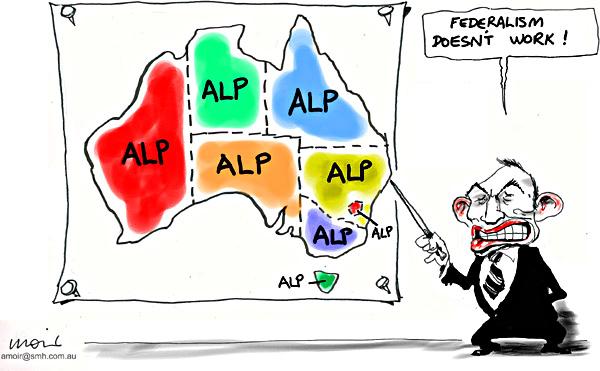 Alan Moir
Abbott has a strong tendency to engage in polemics. He often claim that only religion provides the basis for ethics and that seculiarsm is ethically vacuous, thereby ignoring utilitarian and rights based liberalism.
Posted by Gary Sauer-Thompson at 8:42 AM | Comments (13) | TrackBack
July 10, 2008
missing the point of blogs
Some clever people at the University of Sydney reckon they've invented something that could speed up the internet by 6000 percent. That would come in really handy when you want to watch stuff like this.
It's an hour-long video of the first panel at the Microsoft Politics and Technology Forum a couple of weeks ago discussing Blogging, Social Networks, Political Movements and the Media. Annabel Crabb, Matt Bai from New York Times magazine, Peter Black and Mark Textor form the panel.
If it's worth watching at all, it's to get some idea of how badly misunderstood the independent blogosphere can be, and perhaps how poorly the blogosphere has articulated what it actually does, or can do given the opportunity.
Mark Textor seems to have a good handle on where independent blogs fit into election campaigns, which is odd considering he must have been associated with Howard's disastrous adventures on YouTube. He argues that blogs, media and various websites are among the many sources people use when they're deciding an issue. But being Textor, he seems to see the blogosphere as one big unexplored opportunity for would-be exploiters.
Black had a go at representing the so-called political blogosphere, but didn't seem to have anticipated having to defend it. Asked why an amateur blogger's opinion should be considered as worthy as a media insider's opinion, he could reasonably have asked why, in a democracy, is a single journalist's opinion more worthy than anyone else's? Or he could have pointed out that, unlike columnists, opining is only one of many things bloggers do.
Crabb makes the usual them vs us arguments about bloggers not being real journalists, despite thinking of them as competition at the same time. Bloggers being mainstream media leeches but they're untrustworthy because you don't know where they get their info from, without noticing the contradiction there. In one snort-worthy comment she says
"Isn't transparency about the last thing you get in the blogosphere?...You don't know who half the people are"
I guess that would be as opposed to the totally objective reporting we get from mainstream media who are pristine and blameless when it comes to partisanship or influence from advertiser's interests.
Despite these unimaginative and hackneyed arguments though, Crabb seems a tad conflicted between preserving her authorial authority and finding independent blogs useful in her own life for the things they do that mainstream media doesn't. She describes a blog she likes where commenters contribute different points of view and bring new bits of information to an issue, transforming a set piece into a dynamic.
Someone from the floor, didn't catch the name, said she was working for government on how to engage people and get them participating in a proposed government blog following the public submissions to the Australian Government Consultation Blog Discussion Paper. They didn't receive as many submissions as they'd hoped, but followed blog discussions on the issue and incorporated ideas from those into their data anyway. The proposed consultation blog is supposed to be in the interests of transparency, which is what detonated Crabb's minor explosion about not knowing who bloggers are.
After watching The Hollowmen last night it's probably best not to get too hopeful about such things, but in the meantime it's gratifying to think that it's at least possible that this government is possibly, maybe, perhaps, hopefully, vaguely aware of the differences between real blogs, and the simplistic and misleading ways they're described by so many in traditional media.
Posted by Lyn Calcutt at 3:34 PM | Comments (13) | TrackBack
G8
The G8 doesn't do much in terms of governing the world economy does it? They just get together once in a while to have a bit of a chat and then issue vague comments on the issues they find most pressing.
 Steve Bell
Sure, after years of US intransigence, President George Bush finally signed up to a G8 statement vowing to "consider and adopt" a target of at least a 50% reduction in carbon emissions by 2050. Such an agreement was described as "major progress". Major progress to 'consider and adopt'? Why the need for consider? Is this really a major step on from last year when the G8 agreed to "seriously consider" a goal of halving emissions by mid-century. I guess 'adopt' is the big new word that signifies a step forward.
It all sounds like an "elaborate smokescreen" to try to fool the world that the G8 are showing international leadership on global warming, doesn't it.The reality is that the global economy more or less governs itself, with the G8 only pretending they govern. They then use cigar smoke and champagne bubbles to disguise this pretense. The reality is the G8’s impotence to deal with energy, climate change and financial crisis.
As an editorial in the Financial Times acidly observes:
For proof that the G8 has outlived its usefulness, one need look no further than the inability of the world’s richest democracies to forge an agreed global strategy for tackling climate change. The refusal by China and India to endorse its proposed cuts in carbon dioxide emissions renders this week’s G8 summit in Japan pointless. Any notion a club of eight nations could run the world – never plausible – is now so discredited as to call into question the value of all its declarations... The G8’s problem is that it has become so divided and poorly led that its annual summits have deteriorated into little more than photo opportunities and exercises in drafting bland communiqués.
Surely it is time to bring in India and China? How can you discuss climate change without them? Rudd's contribution on this was that rich countries adopt binding targets to cut emissions. Poor countries accept something called "measurable and verifiable actions" to achieve the same result. What does "measurable and verifiable actions" actually mean for countries that reject targets, are caught up in an economic boom to get on with here, and are trying to lift a whole generation out of poverty.
Posted by Gary Sauer-Thompson at 8:28 AM | Comments (8) | TrackBack
July 9, 2008
the community voice of reason
We can see the common sense voice of community reason in action in Carbrook, Queensland, as it responds to Dennis Ferguson, a convicted child molester or paedophile--- living in their midst on a government-owned rural property with police protection and under police guard and surveillance 24 hours a day, seven days a week. He will be moved once court proceedings against him are finalised.
Ferguson is there whilst the Queensland Government appeals District Court Judge Hugh Botting's decision to dismiss the sex charges against Ferguson on the grounds that Ferguson could not get a fair trial in Queensland.
Dennis Ferguson's location is set to get noisier, with protesters using megaphones, horns and sirens from the fenceline, as well as burning effigies, to force him out. It looks like there is a lynch mob in formation with people waving nooses. There have been a number of threats against Ferguson's life and that's why he has been given police protection.
So what happens to those who look like Dennis Ferguson? Presumably, they will be beaten up by the enraged mothers, fathers and grandmothers protecting their kids from the devil-like monsters stalking their fair land. No doubt there will be calls and pressure from child protection advocates for convicted pedophiles moving into communities to be publicly identified. Under Megan's Law- -type legislation allows details of sex offenders, including their photographs, offences, and residential addresses to be accessed by the public – often through an internet register.
Wouldn't a register revealing the whereabouts of sex offenders lead to ex-prisoners who have served their sentences being targeted in the community by vigilantes? So we have double jeopardy, in that the sex offenders would endure additional sentencing by way of public humiliation and exclusion from employment, housing and the ability to build normal relationships.
Posted by Gary Sauer-Thompson at 8:21 PM | Comments (14) | TrackBack
financial turmoil
So the economic turmoil in financial markets continues to ripple through global markets and we now understand that we are living the capitalist cycle of boom and bust; one arising from the past policies of unrestrained credit growth and asset price inflation that was fostered by central bankers. The Greenspan legacy if you like.
The annual report of the Bank for International Settlements makes sobering reading: the centre of the global financial system might eventually prove as vulnerable as the periphery.
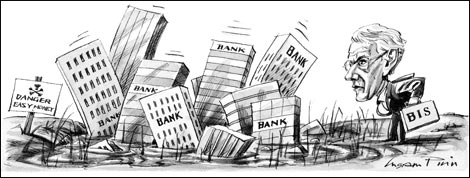 Ingram Penn
The drivers of the huge bubbles in equities and housing over the past decade were a long period of easy money, asset price inflation and rapid credit growth. Consequently, central bankers bear part of the blame. The Report says:
The current market turmoil in the world’s main financial centres is without precedent in the postwar period. With a significant risk of recession in the US, compounded by sharply rising inflation in many countries, fears are building that the global economy might be at some kind of tipping point. These fears are not groundless....the difficulties in the subprime market were a trigger for, rather than a cause of, all the disruptive events that have followed. Moreover, these facts also suggest that the magnitude of the problems yet to be faced could be much greater than many now perceive. Finally, the dominant role played by rapid monetary and credit expansion in this explanation of events is also consistent with the recent rise of global inflation and, potentially, higher inflation expectations.
The policy response by central bankers to this crisis has been flawed. Their judged that their liquidity injections would suffice to deal with what was perceived as largely a liquidity crisis. There was insufficient. Internal governance, and external oversight of financial markets were deficient.
The world economy is now poised between deflationary financial and house-price collapses in several high-income countries and an inflationary global commodity price boom.
Posted by Gary Sauer-Thompson at 7:47 AM | Comments (2) | TrackBack
July 8, 2008
the great moving right show
The Anglicans are splitting as the confessing bliblical conservatives flex their muscles in the culture wars and create a Fellowship of Confessing Anglicans (Foca); a global network for millions of Anglicans unhappy with liberal teaching on issues such as homosexuality and women priests. Australians, especially those around Peter Jensen, the Archbishop of Sydney, have played a key role in this breakaway.
 Steve Bell
This confessing movement is one indication of a rightward shift in Australian culture since the 1970s. Another is the way that the family value conservatives have rallied around a dislike of child nudity and contemporary art. The rightwing mobilizing around sexuality says that a line must be drawn in the sand here as well and supports social engineering to support marriage.
The terrain of cultural politics (especially in popular culture), provides the space for those moral concerns that constitute the meanings that express the moral inflection and the emotional weight necessary to support a trenchant opposition to the social values of Liberalism.
There is a definite sexual ideology around the sexualizaion of children, sex education and traditional heterosexuality that has taken the form of a narrative recognizable in its plotline, its themes, and its moral lessons. The narrative uses a construction of sex as dangerous to present marital sex as the only safe sex; asserts the naturalness of men’s sexual behavior as predatory; uses fear to disempower young people and to enforce a traditional heterosexual code of conduct; and woman being responsible for the consequences of sexuality.
This narrative highlights the dangers of sexual permissiveness, often illustrated by references to 1960s promiscuity, growing popularity of pornography, and concern over the sexualized nature of popular culture. The theme here is that young people are at risk, primarily from cultural forces operating in popular culture and perverts. The narrative crisis centers on the risk to our national culture if young people are not saved from these dangers. Their salvation rests on rejection of the Sexual Revolution and the self-expressive or self-actualizating current in social Liberalism.
This conservative narrative interprets pornography, teenage sexuality and abortion as signs of decadent democracy and liberalism and it places an emphasis on traditional rules and roles, conformity, and unity in thought and deed. Many conservatives hold that the constant questioning of established beliefs and authorities has set us upon a path that has anarchy as its only destination. They therefore suggest that we must repudiate the Enlightenment and reaffirm the thing against which the Enlightenment stood: organized religion.
Posted by Gary Sauer-Thompson at 9:23 AM | Comments (5) | TrackBack
alternative health care
In the 2006-2007 financial year, Medicare Australia paid out more than $23 million in rebates for patients who received acupuncture, chiropractic therapy and osteopathy. While only a small number of people qualify for the rebates – those with chronic conditions and with complex care needs – the cost to the public purse could rise dramatically if complimentary and alternative Medicine (CAM) becomes part of mainstream medicine as forecast by some within the medical fraternity.
More than $4.1 billion is spent nationally on CAM, with up to two-thirds of the Australian adult population using at least one product and one in four using complementary medicine services.The most frequent users are the better educated, higher-income earners, middle-aged women and people suffering with chronic and painful conditions that orthodox medicine manages poorly
Rose Shapiro's Suckers: How Alternative Medicine Makes Fools of Us All, argues that alternative medicine can jeopardise the health of those it claims to treat, that it leaches resources from treatments of proven efficacy, and remains largely unaccountable and unregulated. It is an industry (Included in alternative medicine are acupuncture, chiropractic therapy, homeopathy and herbal medicine) preying on human vulnerability, whose success makes fools of us all. The title casts consumers as gullible and practitioners as vampiric and we consumers spend billions each year on what amounts to little more than snake oil because our critical faculties are dulled by the pleasures of having someone listen to us.
Two things are notably lacking in dismissal texts such as these (another is Trick or Treatment: Alternative Medicine on Trial by Simon Singh and Edzard Ernst) that work the Enlightenment's science v religion duality. The first is an acknowledgement of the problems of funding adequate trials so that this health care, like medicine, becomes evidence-based, and, secondly, a discussion of the equivalent risks and inadequacies of conventional medicine. Though extensively tested, pharmaceutical drugs are scarcely devoid of side effects, and patient dissatisfaction with their treatment options is one of the many reasons why alternatives have become so popular.
The prevailing mechanistic model is not good at treating patients suffering from chronic illnesses that respond poorly to conventional treatments or from a constellation of symptoms that are not easily diagnosed or treated. These include 'headaches, heartaches, backaches, aching feet, fatigue, anxiety and those vague burning pains in your legs at night - and mechanistic medicine says that t there is no reliable cure for any of them'. So we ignorant consumers are obliged to put up with our headaches, backpain, heartaches and depression and stay unwell.
It is often argued that faith based medicine relies on obsolete or metaphysical concepts of human biology and physiology that have to be described as absurd. Obsolete here means not mechanistic, which means vitalism or organic. Secondly, it is argued that proponents of such concepts as vitalism or process philosophy will not subject their interventions to scientific scrutiny, suggesting that the mere attempt of critical evaluation is sufficient to chase the healing process away. So CAM is dumped in the dustbin market irrational.
Things are shifting. At an international CAM congress staged in Sydney earlier this year, the Federal Government announced more than $7 million in grants for the creation of new centres and research projects across the country. In Queensland, more than $660,000 was awarded to establishing a new clinic at the University of Queensland in a bid to integrate CAM with conventional medicine. Maybe research will be conducted to see develop evidence about which forms of alternative health care is effective.
Posted by Gary Sauer-Thompson at 8:45 AM | Comments (5) | TrackBack
July 7, 2008
law 'n order, SA style
South Australia's anti-bikie legislation gives the police a lower burden of proof there by making it easier to get convictions for for offenses already covered by existing laws. The ban-the-bikie lobby is very strong in South Australia, and it holds that bikie gangs have become a new kind of organized crime and that they are set up for the purpose of criminal activity and are taking over the nation's crime.
Adam Shand argued in Club Rules in the June issue of The Monthly the new laws provide that:
the state's attorney general acting on advice from the police can declare any group of people a criminal gang and then prohibit members from associating with each other, through the use of control orders. If the members meet or communicate six times in a year, they will faced up to five years in jail.There will be no review or judicial appeal, nor can the clubs or individuals gain access to the intelligence on which the control order is based.
Thus we have the extension of anti-terrorist legislation to non-terrorists. What's more the police will be able to ban the wearing of insignia in public if they deem that community safety is involved. This, as Shand points out, amounts to a legally enforceable dress code. And to enforce it , the police will only have to satisfy a "balance of probabilities", rather than prove their allegations beyond reasonable doubt.
SA is targeting clubs rather than criminals in the clubs and relying on guilt by association to this with draconian legislation.
Posted by Gary Sauer-Thompson at 5:07 PM | Comments (1) | TrackBack
ripping into the ABC
Via Trevor Cook, the people at ABC Digital Futures have understood the changing relationships between media producers and consumers, where they're reimagining the ABC as a facilitator of participation rather than just a broadcaster. I guess QandA is an attempt to put this into practice with questions from the public via email and the website incorporated into the show.
Cook comments:
The ABC should be congratulated for examining these issues, and examining them, and examining…it’s like you’re in some krudd process… but not much in the way of blurring of consumer and producer around the ABC where the empire remains in firm control
Yeah, what he said. The empire and that notorious board with it's requirement for 'balance', apparently justified on the grounds that the ABC is public media funded by taxpayers.
According to that logic all taxpayers are entitled to see their views reflected in content, so we get Tim Blair and Andrew Bolt. I wonder where they'll get their balancing panellists when they run out of News Ltd columnists? And when, in the name of fairness, will taxpaying neo-Nazis and serial killers get a say?
The ABC has plenty of other uses beyond letting us know what's going on in the world and what we, the taxpaying public, think is going on in the world. It can also be used as a weapon of empire members - ammunition against diverse enemies.
Mercurius describes the curious case of a board member utilising the privilege of a platform in one media outlet to take a shot at another. After declaring the media to be the natural owners of all debates climate change, the author proceeds to denigrate one commentator and praise another in the organisation of which she is a board member. The empire being in firm control in the context of participatory media is the least of its problems.
Commenter Adrian at LP quotes from the ABC Board Protocol:
“1.5 Unless individual Directors receive specific delegations from the Board they must refrain from participating in the day-to-day management of the organisation, making representations or agreements on its behalf, or influencing management as individuals.2.3 No Director should act in a way likely to bring discredit to the organisation.”
Two clauses of the ABC Board Protocol that make interesting reading in light of the above.
Perhaps Ms Albrechtsen is daring the government to dismiss her?
She won't be dismissed. The political ramifications of that are way too predictable. Perhaps instead she is pointing out that protocols are for lesser mortals - the kind of lumpen proles you find thinking they're entitled to participate in public debate beyond the News Ltd stratosphere.
Posted by Lyn Calcutt at 3:30 PM | Comments (6) | TrackBack
July 6, 2008
mission accomplished
Last year Alan Greenspan, the former chairman of the Federal Reserve said, "Everyone knows: the Iraq war is largely about oil." That observation has been reinforced by the Iraqi government awarding a series of key oil contracts to British and US companies including Shell, BP, Exxon Mobil, Chevron and Total.
 Steve Bell
The US attention has shifted to Iran and its challenge to Israeli hegemony in the Middle East. Of late, Israel has been escalating its threats against Iran.Israel's official argument that it faces an "existential threat" from an Islamic extremist Iranian regime determined to get nuclear weapons. The official Israeli line that Iran cannot be deterred because of its alleged apocalyptic Islamic viewpoint on war with Israel.
However, Israel, which already has as many as 200 nuclear weapons, is the dominant power in the region rather than as the weaker state in the relationship. There is a sharp imbalance of power in favor of Israel and the United States in the Middle East. In contrast, Iran's power to retaliate for a US attack on its nuclear facilities is quite limited and weak.
Posted by Gary Sauer-Thompson at 12:16 PM | Comments (2) | TrackBack
July 5, 2008
screams no yawn
This cartoon accurately describes the public reaction to the policy side of climate change. Only the policy wonks are really interested in the design of an emissions trading scheme. But the last frame is dead wrong. Industry is going to pay for their pollution, and they don't like it, even though they know that the public will bear the costs of their having to pay for their destruction of the environment from greenhouse gases.
 Moir
Moir
Hence their campaign against, even even though those generating power for the domestic market will pass their costs of emitting greenhouse in the atmosphere onto consumers. It's the loss of the asset value of their power stations that causes them to scream---'they' refers to the Victorian brown coal generators.
And the Coalition is now in retreat on supporting reform. Shaun Carrney says in the SMH that:
Politically, the Coalition's key objective on emissions trading is to inflict the maximum amount of damage on the Government. Hunt's job is to fashion an intellectual and policy package that conforms to that objective, while simultaneously giving the impression that the Coalition subscribes to the reality of climate change and the need for action.
They are anti-reform but trying to disguise it.
Posted by Gary Sauer-Thompson at 7:28 AM | Comments (4) | TrackBack
July 4, 2008
fuelwatch boo boo
Oh dear. Possum has discovered the makings of a horrible embarrassment for the Rudd government, the ACCC, or both, over the Fuelwatch scheme.
As with Newspoll, so with everything else numbery. The amateur will out.
Now it's a matter of waiting for the media to get hold of it.
Possum's broader argument, that in this day and age governments would be better off making this kind of thing accessible before they make policy decisions, resonates with the logic of blogworld. But blogworld isn't pollieworld, let alone mediaworld.
What's the more likely scenario?
Journo reads Possum's blog, cites Professor Don Harding's work with or without quote from Harding and neglects to mention blog at all. Government responds by becoming more secretive.
Journo reads Possum's blog and writes up article including reference to Possum and his arguments. Government notes Harding's paper and Possum's arguments for future consideration.
Journo reads Possum's blog, reads Harding's paper, gets quote from Harding, calls PM for response and PM appears on tonight's news thanking Harding and Possum for bringing this to his attention. Government seriously considers dropping Fuelwatch and asking Possum before they make any more decisions.
Posted by Lyn Calcutt at 2:20 PM | Comments (26) | TrackBack
assesssing the commentary on climate change
Garnaut's report on climate change, judging from the leaks, favours compensating those regions hardest hit by the new emissions trading regime. The report canvasses "structural adjustment" compensation for regions such as the La Trobe Valley in Victoria and the Hunter Valley in NSW as well as providing government funding for industries investing in clean power so as to reward them. The principle is that all compensation paid should be for actually reducing emissions rather than compensating for so-called "stranded assets".
Hence all the dire warnings from electricity generators and those state premiers supporting dirty power about black-outs, bankruptcies (Enron-type collapse) spiralling power bills, and predictions of five years of economic growth being wiped from the economy. The end is nigh.
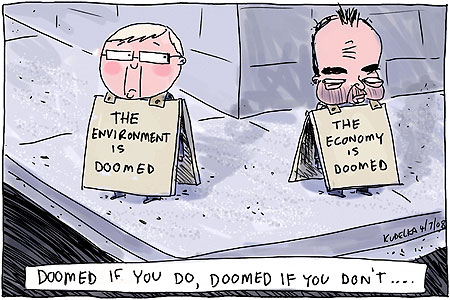 Kudelka
In A Question of Balance: Weighing the Options on Global Warming Policies William Nordhaussays that the most important concern of any policy that aims to address climate change should be how to set the most efficient "carbon price," which he defines as "the market price or penalty that would be paid by those who use fossil fuels and thereby generate CO2 emissions."
He writes:
Whether someone is serious about tackling the global-warming problem can be readily gauged by listening to what he or she says about the carbon price. Suppose you hear a public figure who speaks eloquently of the perils of global warming and proposes that the nation should move urgently to slow climate change. Suppose that person proposes regulating the fuel efficiency of cars, or requiring high-efficiency lightbulbs, or subsidizing ethanol, or providing research support for solar power—but nowhere does the proposal raise the price of carbon. You should conclude that the proposal is not really serious and does not recognize the central economic message about how to slow climate change. To a first approximation, raising the price of carbon is a necessary and sufficient step for tackling global warming. The rest is at best rhetoric and may actually be harmful in inducing economic inefficiencies.
On this criteria most of the business commentary in The Australian and that from the NSW and Victorian state government's are not serious.
Posted by Gary Sauer-Thompson at 6:39 AM | Comments (5) | TrackBack
July 3, 2008
still waiting
In the online world it's easy to get the impression that climate change denialism or scepticism is the norm and that most of the population is nervously awaiting the configuration of the emissions trading scheme as if it's the sum total of what can be done.
Clive Hamilton won't be writing for OnLine Opinion anymore because he feels it's "been 'captured' by climate change denialists", and reading the comments you can't blame him. Brawls between believers and non-believers are a kind of ritual in the blogosphere, and then there's the Bananas in Pyjamas' evil twins Blair and Bolt.
Given the expectation that the ETS will be a huge economic shift it's no surprise that the policy, economics and climate change specialists in the blogosphere have devoted so many pixels to it. But experts are not average. More than half of average people have never heard of an ETS and the majority of those who have don't understand it. The good news is that when it's explained, they approve. Out there in the real world there is enormous support for action, but disappointment that nothing seems to be happening.
Hugh Mackay had some interesting things to say about it on the 7.30 Report last night. Video is up but the transcript's not available yet.
In Mackay's opinion people are more than ready for a shift, are worried about climate change and are well aware of, and prepared to accept, higher costs of living. They're waiting for something significant to happen and Kevin's not delivering, which fits with the 'wasting political capital' theme.
Watching the interview last night, it seems that Kerry O'Brien is making the same mistake here as Rudd in assuming that the ETS is the big fix the population is waiting for, but it's not. Mackay talked about the South East Queensland water saving campaign as the kind of thing people are expecting - some kind of all round campaign that sets limits and gives people personal responsibility for their contribution to a solution. Similarly, people are expecting to be called upon to actively participate in reducing the country's carbon footprint.
Queenslanders can quite rightly take personal credit for reducing water consumption to the point where they now have more than they know what to do with. A lot of it - four minute showers, no hosing, only use the washing machine when there's a full load, buckets only for car washing - is common sense. But they needed to be told and they needed to know that freeloaders wouldn't be tolerated. Hosing the driveway is now socially unacceptable.
It wouldn't be all that hard to put together a campaign that would make excessive use of electricity and petrol socially unacceptable. It wouldn't send the country broke to let the wealthy have their solar panel rebate. It's already a standing joke in some circles, but people might like to know how to drive more fuel efficiently or what kinds of gadgets they can buy so they don't have to reach behind the entertainment unit to switch off all the stuff that eats power on standby. Swtich off the lights when you're not in the room might be common sense, but maybe we're waiting for the most popular prime minister in the world to ask us to switch them off as a kind of symbol of patriotism.
Switching off the lights for the country is a heck of a lot easier and more practical than having a third child.
Obviously the Federal Government can't send squads of ticket-writing carbon-abuse monitors out into the suburbs, but the increased costs of power that will come with the ETS could easily be treated as just desserts for freeloaders. And if you gained sufficient public support for energy saving lifestyles it would be that much harder for the greenhouse mafia to justify exemptions and subsidies.
We've assumed since 24/11 that the mood for change would be, and was, satisfied by a change of PM, but Mackay has been trying to point out that it's more than that. He's been trying to say that people are more engaged, they're paying more attention and they're ready to participate. That message is being ignored and it's being assumed that the main game is still at the inaccessible end of town, where powerful men in suits do all the important stuff. Certainly that's part of it and as far as carbon is concerned, it's a huge part. But asking people to just go about their business and trust the suits to do the right thing is a bit much. It's the equivalent of admitting nothing will change, which is not why people voted the way they did.
Posted by Lyn Calcutt at 9:13 AM | Comments (12) | TrackBack
waiting for Garnaut
Ross Garnaut's report on climate change and emissions trading scheme is due tomorrow. It is expected to find that global warming is proceeding faster than projected, and that doing nothing will be far more costly than expected. Well we know that already.
The leaks indicate that the Garnaut's final report will emphasise that there are four categories of likely damage to the economy.Today's report, a draft whose final version is due in September, will quantify only one of these, the conventional macroeconomic cost that can be estimated by economic modelling.
The second category will be the effect on particular aspects of the country. Professor Garnaut has commissioned research into the medical consequences of climate change, including deaths from heat stress.The third category will be the cost of mitigating the effects of global warming. The fourth will be a survey of how climate change affects things Australians value for more than just economic reasons - the bleaching of the Great Barrier Reef, the inundation of the Kakadu wetlands, and the loss of the West Australian karri forests.
Posted by Gary Sauer-Thompson at 7:42 AM | TrackBack
July 2, 2008
blocking water reform
The level of Lake Alexandrina, near the mouth of the River Murray is currently half a metre below sea level. If it drops to 1.2m below, as predicted if inflows to the Murray did not pick up, the exposed lake bed would become acidic. The South Australian Government has recently began pumping water from Lake Alexandrina into the smaller Lake Albert to avert that waterway reaching such a trigger point. Things are looking bad there.
Meanwhile COAG meets Thursday this week and the River Murray is on the agenda among other items once again. The Federal Government is proposing to lift the 4% cap on the amount of water that can be traded out of the irrigation district to speed up the process of returning water to to the Murray Darling. Victorian irrigators oppose this, as they fear that this will depopulate or even close down towns in their state. The Nationals repeat the message.
The Victorian Government, of course, stands behind its irrigators in resisting any reform, towards a market based approach despite its free market and can do rhetoric. Command and control is the governance style of the parochial, state based approach of the Victorian Farmers Federation when it comes to water. It's their water and no one else can have it is their position. So the Brumby Labor Government is aligned with the Nationals to block an increased role for the market in the Basin. It is concerned to get the best possible deal for Victorian irrigators and to hell with the river.
The core goal is to protect the productive irrigation industry at all costs. In the face of Victoria's recalcitrance towards market reform, Canberra should use its previous commitment of up to $1 billion towards the second stage of the Foodbowl Modernisation Project as a way to force Victoria's hand. CoAG is a test of both cooperative federalism and the process of reform under Rudd Labor.
Update: 3 July.
The Council of Australian Governments (COAG) meeting has signed off on the Intergovernmental Agreement (IGA) on $3.7 billion of projects to restore the health of the Murray River and it is being heralded as creating the vehicle for the long-term reform of the much challenged Murray-Darling Basin system. There is mention of lifting the 4% cap on water trading to 6% so that water can be traded to where it is needed. But that increase will take place a year from now.
If the IGA is the vehicle for long term reform in the Basin then the $3.7billion funding on water projects is about looking after irrigators: a $100 million in extra funding for irrigation projects in Victoria's Sunraysia area; $600 million for water projects in SA that are about basically building a pipeline from Tailem Bend to get irrigatrors in the lower Murray much higher quality water; and NSW?
How is this a success in restoring health to the river? Under the Murray-Darling basin agreement, only $170 million of the $3.1 billion in water buy-backs is scheduled for the 2008-09 financial year.
Update: 4 July
An editorial in The Age puts it well:
COAG's deferral of the Wong plan could be catastrophic for the lower lakes in particular. If there are insufficient flows of fresh water to flush out the increasingly saline lakes, Senator Wong and her state counterparts may have no alternative but to open the barrages that regulate tidal flows, and allow the sea to claim the lakes.In other words, at this COAG the states did not in fact put their conflicting interests aside in order to allow concerted action that would keep alive the lower reaches of Australia's only great river system.
It goes on to say that since COAG chose not to heed the urgent warnings in the scientific reports about the Murray-Darling Basin [in the wake of the South Australia's Murray-Darling Basin Natural Resource Management Board's advice, the Murray-Darling Commission's audit of the 23 rivers in the basin gave all but three of them poor or very poor ecological report cards], the leaders of Australia's governments could at least have shed the spin cloaking yesterday's official statements.
Posted by Gary Sauer-Thompson at 7:01 AM | Comments (31) | TrackBack
July 1, 2008
vile people
Australians must be some of the most disgusting, untrustworthy people around.
We're a nation of booze soaked binge drinkers, wobbling around the streets in the wee hours guzzling our alcopops like there's no tomorrow and indulging in alcohol-fuelled violence.
We're obese, fat, lardy, chubby fast food gobblers whose only exercise consists of raising an arm to point the remote at the TV to avoid health warnings.
We're so nicotine addicted that authorities have been forced to ban smoking just about everywhere and frighten us with vivid and gory TV ads and cigarette packet graphics.
And we're so keen on vilifying other people for their religious beliefs that the NSW govt has been forced to give police new (supposedly temporary) powers in case we irritate attendees at World Youth Day. The good people of Camden will be outraged.
Until the end of July it will be illegal to "cause annoyance" to Catholics. Perhaps working on the assumption that the population of Cronulla are busily circulating text messages.
EXTRAORDINARY new powers will allow police to arrest and fine people for "causing annoyance" to World Youth Day participants and permit partial strip searches at hundreds of Sydney sites, beginning today.The laws, which operate until the end of July, have the potential to make a crime of wearing a T-shirt with a message on it, undertaking a Chaser-style stunt, handing out condoms at protests, riding a skateboard or even playing music, critics say.
The playing music is understandable. After all, music can lead to dancing.
Police and volunteers from the State Emergency Service and Rural Fire Service will be able to direct people to cease engaging in conduct that "causes annoyance or inconvenience to participants in a World Youth Day event".People who fail to comply will be subject to a $5500 fine.
$5500 for being annoying? $5500 for trolling?
More than 500 schools across Sydney and 35 train and bus stations have also been listed as "declared areas". People entering them will be subject to vehicle and baggage searches that require them to remove jackets, gloves, shoes and headwear if requested. "Reasonable force may be used to effect the person's exclusion" if they do not permit the search, the regulations stipulate.
Underwear isn't mentioned, so at least people will still be able to preserve their modesty. Just as well - the last thing you'd want on World Youth Day is a city full of fat, smoking, pissed, naked people roaming the streets.
Headwear eh? I wonder what that's all about?
Posted by Lyn Calcutt at 1:45 PM | Comments (5) | TrackBack
and so it begins
The serious business on a national emissions trading scheme has started. The green zealots are coming scream the conservatives. That's Henry Ergas in The Australian, and he is referring to a national emissions trading scheme. Reducing emissions is not an act in a morality place, he adds, but a decision that has to be made by trading off benefits and sacrifices. He's played around with his utilitarian calculus and the sacrifices are big and the benefits few. Wealth creation is going to be drastically reduced because the zealots, nay fanatics, act as if the emission targets had come from God.
The coal fired power generator companies in Victoria and SA have realized that their assets are going to be devalued as a consequence of the scheme and will force them to exit the market before they had recovered the costs of their capital. They reckon that the value on their emissions-intensive brown coal generators will devalue by up to 90%, and are they painting a lights out scenario in the national energy market by December 31. Unless they are compensated, of course, big time.
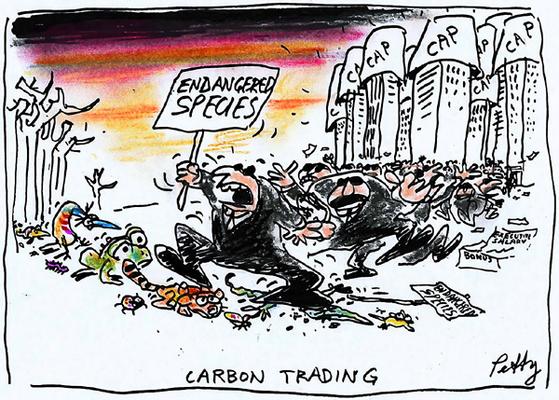 Petty
Petty
Naturally the trade exposed energy intensive industries also have their hand out for compensation for losing the public subsidy of cheap electricity. NSW wants to dump the mandatory renewable target scheme as it is the silent assassin of NSW and Australian manufacturing. If this doesn't happen the jobs will go offshore.
The Labor States, which were long supportive of a national emissions trading scheme, had set up a taskforce to develop a model during the decade long Howard regime. That taskforce has proposed giving free allocation of permits to adversely affected electricity generators. What is the point of such an emissions trading scheme then? The generators, well the Australian Industry Greenhouse Network, want free permits to emit greenhouse gases until 2025, when they reckon the new technology for carbon capture and storage will be in place.
Really? Suck the tit until the cow dies?
Why not provide transitional assistance to invest in the new technologies needed to offset greenhouse emissions? Isn't that more economically rational, given that the reforms are about the transition to a carbon free economy and not protection of an old industry that is becoming a historical relic of a bygone age? What we are seeing is a conga line of special pleaders wanting to suck on the tit of their nanny state to ease the pain of the emissions trading.
For once the AFR makes sense. It's editorial says:
The case against bending over backwards to accommodate them [the power industry and the trade-exposed energy intensive industries] is that doing so will more likely delay the transition to lower emissions generating plant , which must begin soon. They have also had plenty of warning about an emissions trading scheme, and arguably, should have started getting their house in order before now. Given they still don't know the details of the actual scheme they'll face---and won't know until latter this year---some "transitional arrangements' seem inevitable. The only question is what they will look like.
A decade of going softly softly---what Malcolm Turnbull is advocating--- is going to take too long to change behaviour. And changing behaviour is the whole point of green governance.
Posted by Gary Sauer-Thompson at 9:07 AM | Comments (4) | TrackBack
so far this week
Gippsland one day, the nation the next. Newspoll via Possum says 55 - 45, back to the 10 points off primaries at 44 - 39. At last, the honeymoon is over, the chickens have come home to roost, the electorate has woken from its slumber and the narrowing is narrowing. Kevin's down from 68 to 64 and Brendan has gained a whopping 2 points at 15.
Which news item will take the lead, the poll result or Alexander Downer's retirement? Janet Albrechtson got the interview and produced one of her more cringe-worthy pieces, strewing roses and waxing lyrical about the great man. He's cross because State governments won't let him smoke in pubs. He does have a point though - given the choice between a government that actually does stuff and one the contents itself with pointing out how fat, alcoholic, nicotine addicted and generally horrible we all are, take the one that does stuff.
Downer also had a parting shot for his friends:
“The Liberal Party has to explain why there is a role for government in any particular form of activity, in practical terms, not in terms of Left and Right,” he says. “Just in practical terms.“What they need to do, which they have not done very well so far, is develop a better narrative: both a negative narrative about the Rudd Labor Government and a positive narrative about the Liberal Party. They need to build policies around that narrative. It is one thing to start barking on about reducing fuel excise about 5c, but what’s your point? Why would you want to do that? The Liberal Party does not have a story to tell at the moment. Just a bunch of ad hoc comments.”
Turnbull also rubbished the 5 cents on Lateline last night
The point of the 5 cent cut that Brendan Nelson announced in his budget reply was that it really showed up the hypocrisy of Kevin Rudd.I mean the political message was very important, was in fact even more important than the 5 cents, because Kevin Rudd had gotten elected last year saying, or leading people to believe, that he would bring down the price of petrol.
Ah, so the 5 cents wasn't about feeling our pain at all, but a clever piece of politics. You've got to feel sorry for Turnbull, having to spruik nonsense he clearly doesn't believe in.
My personal favourite so far this week was Opposition education spokesman Tony Smith on the computers in schools business.
"All the way long we've said there wasn't enough money to make the computers work in schools," he said."Principals have been screaming from the roof tops for seven months, the Labor states have been saying at each COAG meeting since December there weren't the funds to actually make the computers work and without them the computers would simply be sitting at boxes in schools."
How's this for an idea: Assemble the students, back up a truck full of computers, and let the kids show you how to make them work.
Posted by Lyn Calcutt at 8:53 AM | Comments (8) | TrackBack
couldn't resist
It is such a classic image of the ALP's NSW Right isn't it. Their understanding of politics is about power corrupted.
Their threat to scuttle Kevin Rudd's computers-in-schools program unless they got handouts to pay for broadband infrastructure costs and ongoing costs of running and maintaining the computers shines a light on their bully boy behaviour, their corporate developer friends and utter indifference to making a better world for citizens.
 Moir
Moir
This episode also highlights the systematic failure of the state government to invest in public education so that kids have the capability to be able to participate in the information economy and the knowledge society. That is a huge indictment. Surely this is a government that is in its death throes?
Conservative commentators, such as Malcolm Colless in The Australian use the computer episode to attack Rudd. Colless says "And the fiasco around his promise to give computers to high school students across the country is quickly emerging as another case of all froth and no bubble", even though Colless acknowledges the mismanagement of public services under the scandal-wracked ALP government. For Colless the computer episode is just another example to underpin the conservative narrative about growing resentment in the community at Rudd's failure to deliver on the expectations he has created and that the this particular emperor has no clothes.
The reality is that Gillard is delivering the computers and it is the states who are blocking the way as they are unwilling to do their bit to invest in broadband infrastructure for their schools.
Posted by Gary Sauer-Thompson at 8:13 AM | Comments (2) | TrackBack