|
July 4, 2008
Garnaut's report on climate change, judging from the leaks, favours compensating those regions hardest hit by the new emissions trading regime. The report canvasses "structural adjustment" compensation for regions such as the La Trobe Valley in Victoria and the Hunter Valley in NSW as well as providing government funding for industries investing in clean power so as to reward them. The principle is that all compensation paid should be for actually reducing emissions rather than compensating for so-called "stranded assets".
Hence all the dire warnings from electricity generators and those state premiers supporting dirty power about black-outs, bankruptcies (Enron-type collapse) spiralling power bills, and predictions of five years of economic growth being wiped from the economy. The end is nigh.
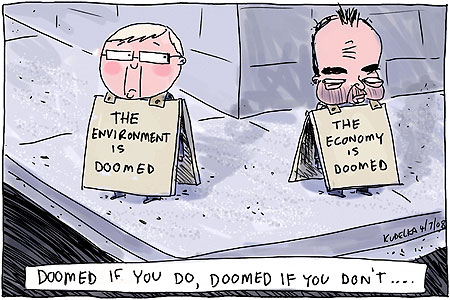 Kudelka
In A Question of Balance: Weighing the Options on Global Warming Policies William Nordhaussays that the most important concern of any policy that aims to address climate change should be how to set the most efficient "carbon price," which he defines as "the market price or penalty that would be paid by those who use fossil fuels and thereby generate CO2 emissions."
He writes:
Whether someone is serious about tackling the global-warming problem can be readily gauged by listening to what he or she says about the carbon price. Suppose you hear a public figure who speaks eloquently of the perils of global warming and proposes that the nation should move urgently to slow climate change. Suppose that person proposes regulating the fuel efficiency of cars, or requiring high-efficiency lightbulbs, or subsidizing ethanol, or providing research support for solar power—but nowhere does the proposal raise the price of carbon. You should conclude that the proposal is not really serious and does not recognize the central economic message about how to slow climate change. To a first approximation, raising the price of carbon is a necessary and sufficient step for tackling global warming. The rest is at best rhetoric and may actually be harmful in inducing economic inefficiencies.
On this criteria most of the business commentary in The Australian and that from the NSW and Victorian state government's are not serious.
|





Gary,
Freeman Dyson, in the above link to his review in the New York Review of Books has a strange understanding of environmentalism:
Ethics is religion? Environmentalism as religion is the standard view of those, like Dyson, who reckon that the "fuss about global warming is grossly exaggerated" and who talk in terms of the true believers spreading the gospel of global warming