« April 2011 | Main | June 2011 »
May 31, 2011
Garnaut Review 2011
In his final report ---Garnaut Review 2011--- Ross Garnaut says that an historic choice confronts Australia in its goal to reduce greenhouse gas emissions. So what domestic policy response should we take? It's an important question because Australia's trajectory to 2020 is now for its emissions to grow to 24 per cent beyond 2000 levels.
Unfortunately, the political debate in Canberra has not been about this as it has been built around a populist scare campaign by vested business interests backed by the Coalition. Garnaut says that there are two basic approaches to achieving the required emissions reduction: a market-based approach, built around putting a price on carbon emissions; and a regulatory approach, or direct action.
In the market-based approach, carbon can be priced in two ways. Fixed-price schemes, or carbon taxes, set the price and the market decides how much it will reduce the quantity of emissions. Floating price schemes set the quantity of emissions and permits to emit are issued up to that amount. The permits are tradeable between businesses and so the market sets the price. There are various hybrid approaches that combine fixed prices for a period with floating later on, and floating prices at some price levels with a price floor or a price ceiling or both.In the alternative route, regulation or direct action, there are many ways that government can intervene to direct firms and households to go about their business and their lives.
Garnaut argues for a three-year fixed carbon price followed by a carbon trading scheme with a floating price. This is Australia's best path forward towards full and effective participation in the efforts by the world of nations to reduce the dangers of climate change without damaging Australian prosperity.
Garnaut adds that:
As soon as the parameters of the scheme are settled, business will focus on making money within the new rules, rather than on securing rules that make them money. That makes it essential that the rules really are settled. The governance arrangements proposed for the carbon pricing scheme are the key to establishing settled rules: the independent carbon bank to regulate the scheme; the independent climate committee to advise on targets and the transition to a floating price regime; and the independent agency to advise on assistance to trade-exposed industries
This governance advice takes the issue out of the hands of the politicians. That makes it more difficult for the lobbying from those in the old political culture, such as the brown-coal generators and trade exposed industries who demand ever bigger handouts and protection as Australia’s biggest emitters continue with their virulent scare-mongering; from the free riding mining industry and the Business Council of Australia that is deeply opposed to structural reform.
This is a political culture that is unwilling to adapt to a world of climate change. You can see this in the way the Gillard Government has made it clear that its preferred starting point is the compensation arrangements proposed to accompany the Carbon Pollution Reduction Scheme (CPRS).
As Richard Denniss from the Australia Institute points out the the final version of the CPRS also included generous compensation to:
Emission intensive trade exposed industries (EITEs) who would receive up to 94.5 per cent of the pollution permits they required for free
Coal-fired power stations with particularly high levels of emissions were to be eligible for the Electricity Sector Assistance Scheme (ESAS) which would have provided an estimated $7.3 billion worth of free permits to Australia's dirtiest coal-fired power stations
Coal mines with particularly high levels of methane emissions were to be eligible for the Coal Sector Assistance Scheme (CSAS) worth $1.5 billion
Medium and large manufacturing and mining firms were eligible for $1.1 billion through the Transitional Electricity Cost Assistance Program.
This was a low point in public policy making. It indicates that the corporations that have it over a barrel and it gave rise to a a sense of deep frustration with a state that it could not solve this political/economic/environmental problem.
Posted by Gary Sauer-Thompson at 11:20 AM | Comments (9) | TrackBack
May 30, 2011
side show alley
My judgement is that climate change is now the central public policy issue that needs to be addressed by the current Parliament. It looks simple on the surface doesn't it: both Labor and the Coalition claim a reduction target of 5 per cent from 2000 levels by 2020 and that they are simply arguing about the best mechanism to get there. It's either carbon tax leading to an emissions trading scheme, or direct action funded out of the budget.
Dig beneath the surface and it gets more complicated. Many in the Coalition are still deeply opposed to the IPCC's evidence of man-made warming, have adopted an anti-science position and demand that their personal opinion be taken as seriously as the objective evidence from scientific research.

The anti-science noise is from the carnival barkers at the seedy-looking sideshow in a tacky fairground full of astrofurfers. The main game is in the public policy arena and it is the negotiations taking place within the Multi Party Committee on Climate Change (MPCCC).
Here the debate is about a carbon price mechanism that could commence with a fixed price (through the issuance of fixed price units within an emissions trading scheme) before converting to a cap-and-trade emissions trading scheme. The last meeting issued a number of working papers, which I cannot find online.
The negotiations appear to be between the Gillard Government and Big business groups with the latter, as expected pushing for a very low starting price for carbon. The proposal would be something along the lines of a fixed price for three to five years followed by a floating price. If a low starting price is what is agreed to, then that means a step trajectory in the price of carbon to meet the 5 per cent from 2000 levels by 2020.
Of course, Big Business has no intention of trying to meet that target, nor the goal of preventing a temperature rise of more than 2 degrees Celsius – which scientists say is the threshold for potentially "dangerous climate change". Australia's emissions levels keep on increasing, the electricity generators and coal industry are talking in terms of an anti-carbon tax campaign and they want more coal fired stations to be built.
The hard reality is that Australia's seconomy runs on energy, and since most of that power continues to comes from coal, oil and gas, GDP and carbon emissions will be bound together in an economic growth lockstep---Australia's economy is expanding again and belching out more carbon.
Update
In his final report ---Garnaut Review 2011--- Garnaut recommend polluters pay a carbon price of $26 a tonne, raising $11.5 billion in the first year of a carbon tax. Garnaut says 55 per cent of the revenue should go to households and 35 per cent to the polluting businesses as compensation.The remainder will go towards innovation and carbon farming, which will be offset by existing spending. The move to a full floating-price emissions trading scheme should be made in 2015
I await the howls of outrage from the special interests opposed to reform. They are unwilling to pay for the real cost of their carbon pollution--- ie., charging for CO2 emissions--- and are unwilling to invest in clean technology options. Their politics is one of continuing to not to pay a price for continuing to pollute. The Liberal Party supports them.
Posted by Gary Sauer-Thompson at 9:53 AM | Comments (22) | TrackBack
May 29, 2011
US: economic woes
Since the global financial crisis the Obama administration has been good to Wall Street and big business. It bailed out the Street. It saved GM, Chrysler, and AIG. And most government spending improves the profits of big businesses – military contractors, big agriculture, giant health-care insurers, Big Pharma, large construction companies. The White House are holding their breath, hoping the recovery catches fire next year before Election Day.
In Making Things in America in the New York Times Paul Krugman says that manufacturing is one of the bright spots of a generally disappointing recovery:
America’s industrial heartland is now leading the economic recovery.... I don’t want to suggest that everything is wonderful about U.S. manufacturing. So far, the job gains are modest, and many new manufacturing jobs don’t offer good pay or benefits. The manufacturing revival isn’t going to make health reform unnecessary or obviate the need for a strong social safety net.Still, better to have those jobs than none at all.
Krugman says that what is primarily driving the turnaround in the US's manufacturing trade is that the U.S. dollar has fallen against other currencies, helping give U.S.-based manufacturing a cost advantage.
Krugman's 'generally disappointing recovery' refers to the combination of high unemployment and high home foreclosures that assures a deeply depressed economy. The US economy, like so many others, is caught in serious stagnation.
Richard Wolff observes:
In reality, the US is fast becoming more and more like so many countries where a rich, cosmopolitan elite occupies major cities with a vast hinterland of people struggling to make ends meet. The vaunted US "middle class" – so celebrated after the second world war even as it slowly shrank – is now fast evaporating, as the economic crisis and the government's "austerity" response both favour the top 10% of the population at the expense of everyone else.
It isn't looking good for many Americans at the moment. The technocrats at the Federal Reserve are running the US economy because the political arms of government—Congress and the Administration—largely abdicated responsibility for managing the economy to the Federal Reserve.
This has basically worked out to the benefit of the rich (people with lots of assets) as opposed to the poor (people with few or no assets). The Federal Reserve's economic policy is essentially a tradeoff between inflation and unemployment, and it gives greater priority to the former over the latter.
Posted by Gary Sauer-Thompson at 12:31 PM | Comments (7) | TrackBack
May 28, 2011
playing the cards badly
I watched Question Time in the House of Representatives last week and discerned a bit of shift in the flow of the conflict. The Gillard Government was less on the defensive fending off the assaults from the Coalition and more on attack.
The shift was partly due to the Coalition's attacks lacking punch. However, the shift was largely due to Nicola Roxon, the Health Minister, successfully taunting and tarnishing the Coalition as supporting Big Tobacco (British American Tobacco or Phillip Morris). The perception she was able to create is that the Coalition is in the pocket of Big Tobacco. Perception is everything in politics.

Roxon was able to harm the Coalition. The plain cigarette packaging legislation will pass the House of Representatives with the support of the crossbenchers and will it go to the Senate after July 1 when the Greens will have the balance of power. So the bill, which has widespread public support, will be enacted this year.
Yet the Coalition continues to oppose plain packaging -- which means that its opposition for oppositions sake results in the Coalition opposing good public health policy aimed at harm minimization, stopping people from starting to smoke, and reducing the health costs due to the harm caused by smoking. The nanny-statism around this rhetoric around the National Preventive Health Strategy looks empty on this issue--this is a toxic product; it is lethal.
This issue highlights the problem with Abbott's saying no to everything and slogans--stop the boats, cut the taxes, pay back the debt---strategy. The sky won't a fall in when the carbon tax is passed and Abbott will begin to look more naked.
Posted by Gary Sauer-Thompson at 10:57 AM | TrackBack
May 27, 2011
the chicken hawks
I see that some of the neocons in Australia who love a long war fighting the big enemy in the name of the war on terrorism are starting to run away from the AfPak war. Isn't this a 'cut and run' to use their own phrase?
Afghanistan has become more and more like the quagmire of Vietnam--a civil war that will not be resolved by a military victory by the Americans. It will be resolved by politics----ie., cutting a deal with the Taliban. The neo-cons have overstate threats.
 Martin Rowson
These chicken hawks can see which way the winds is blowing and it is slowly dawning on the neo-cons that the US faces no existential great power threats. It is slowly seeping in that the US cannot fight a couple of costly wars, experience a major global financial meltdown, and spend nearly a decade cutting taxes, and still expect to have lots of money to throw at national security. The US needs to get its house in order.
In doing so these neocons have dumped their former postiion: If we aren't fighting them in Kandahar, flying drones in Pakistan, helping rebel forces in Libya, providing aid and advice in Colombia, then we'll face rising dangers closer to home.
Will the revisionist neocons is ask themselves 'how did the US get into this mess in the first place? (Australia just followed the US) I won't hold my breathe. The neocons just rushed in blindly, guns blazing in the media at 'the enemy within', supporting torture and increased surveillance of their own citizens in their defence of empire and the national security state.
Posted by Gary Sauer-Thompson at 10:53 AM | Comments (1) | TrackBack
May 26, 2011
Murray-Darling basin: water reform?
I've been going through my photographic archives and I'm starting to upload some of the images I took of the River Murray around 2004 when the drought was deeply entrenched, water reform was beginning to make some headway in Canberra, and the water wars were in full swing.
Today we can see what the reform has amounted to. In Water wars: the battle between public and private Ian Douglas states it succinctly:
The unbundling of water rights from land title has been the lynchpin of water reform, enabling water entitlements to be leased, treated as equity, bequeathed or permanently traded...Australian water is now effectively commoditised: allocated to whoever is willing to pay the going price. The market cares not whether you intend to drip-irrigate vegetables, cultivate cotton by flood irrigation, water golf courses - or merely hold your allocation as an investment for a rainy, or not so rainy, day. We are told that water trading will promote the allocation of water to “high value” uses, but the concept of “value” is far from precise.
Those who benefit are the ones with deep pockets--- the large-scale agribusiness enterprises--whilst those who will lose out in the long rum are the small farmers. That is how capitalism works--it becomes ever more concentrated.
It was pretty clear by around 2004-6 that the Murray-Darling Basin Commission did not have the power to act in the national interest---it was unable to restore the environmental flows the ecology of the basin needed. Big Ag ensured that. It did the same with the Commission successor-- the Murray-Darling Basin Authority. The latter has been forced to reduce the proposed environmental allocation to 2,800 gigalitre increase rather than the nearly 4000 litres previously recommended as a lower limit.
The decrease comes from a political fix premised on the reality that the Murray-Darling river system exists primarily for development by the water extraction industries. That is why politics trumps science. What next? Dumping voluntary water buybacks to reduce the over allocation of water entitlements? A return to increased efficiency of the extraction of water through the ongoing public subsidy of Big AG?
The long term strategy of Big Ag in an era of climate change is to ensure that more water for them is extracted.
Posted by Gary Sauer-Thompson at 8:22 PM | Comments (8) | TrackBack
May 25, 2011
on modern politics
Karl Bitar is everything that is wrong with modern politics. Whilst in charge of the NSW Labor machine ( he was General Secretary for the NSW branch from December 2007 to October 2008,) then the federal secretary his right wing politics was one of focus groups, identifying the electorate with western Sydney, opposition to climate change, and sacking leaders to restore Labor's credibility. It was all politics no policy for Bitar.
His legacy was one of defeat, division and despondency.

After resigning from the job of National Secretary of federal Labor machine because of running a disastrous campaign in 2010, he becomes a hired gun for James Packer's casino gambling industry with an explicit brief to sabotage Labor's forthcoming reforms of the Australian gaming industry.
Bitar will be able to use his network of Labor contacts, and his intimate knowledge of how this particular government responds to pressure from third-party interests, to lobby on behalf of Crown to block pokies reform.
Jonathan Green outlines what this says about Australian politics:
the Karl Bitars of this world - and they are legion - would presumably be unimpeded ...by anything so professionally debilitating as personal belief.And there lies a sobering truth of modern politics: it's simply a professional game played by people with no allegiance other than to the outcome required by the moment. It is a game of influence, opinion control and issue management, a sophisticated lark for the dispassionate professional. It is certainly no place for deeply held conviction...Could it be that this is a product of the increasing professionalism of the political operative, people with broad skills that can be applied to any side of what is essentially a communications problem? They don't need to believe a thing. Better in fact if they don't. Government? Casino? Whichever.
The answer is easy. Politics is a game that is played by professionals motivated by self-interest. It has little to do with public policy. Or political philosophy.
Bitar's actions is an example of what Republican political philosophy calls corruption. It's a trashing of the public good, civic virtue and freedom from domination by big business.
Posted by Gary Sauer-Thompson at 2:05 PM | Comments (10) | TrackBack
May 24, 2011
a semblance of action
Have you noticed how the opponents to climate change reform are now singing from the same hymn sheet in that their talking points are the same. They hide their climate change denialism, behind the public policy talking point that Australia must guard against moving too far ahead in carbon abatement and risking economic hardship for no environmental gain. So they appear to grant that the science has it right without explicitly saying so.

Behind these words is the position that doing nothing is best. Since China has no intention of reducing its greenhouse emissions it's madness to sacrifice ourselves for nothing.
What is most important is a prosperous economy and working to break up the Labor/Green alliance. The latter provides the opening for the culture war waged by the anti-science 'angries' in the denial-o-sphere.
The core argument is that any carbon policy has to maintain economic growth, international competitiveness and a viable electricity sector. It is then self-evident that Australia should act in tandem with international action, not ahead of it. Specifically and further, policy should ensure that the advantages arising from our relatively cost-competitive energy industry (ie., coal) are not diminished without commensurate environmental benefits. In this context, only significant and ongoing reductions by major emitting nations would over time materially reduce the risks of environmental damage to Australia.
The Business Council of Australia, for instance, has stated that it would support policies to reduce Australia's greenhouse gas emissions where the environmental benefit was clear; the competitiveness of Australia's exporters was not diminished; and the transition to less emissions-intensive electricity followed a planned approach that did not prematurely close plants without adequate compensation, and the risk of generators breaching their debt covenants was removed.
The bottom line is that Australia should act in tandem with international action, not ahead of it. The inference is that the proposed 5 per cent cut in emissions would be utterly pointless in "environmental terms" since it would reduce global emissions by a miniscule amount whilst China alone would increase global emissions by hundreds of times that if not thousands of times. Australia acting alone will shut down Australia as a modern industrialised economy say the trolls.
Behind the rhetoric of being in favour of addressing greenhouse emissions is resistance in the form of a fear campaign that ignores Europe’s six-year-old emissions trading scheme; China’s pledge to cut emissions; and the UK’s decision to cut emissions by 50 per cent by 2025 (which it is already half way towards). Australia is not acting alone. Other nations are leaving the dirty old economy behind and are starting to build a stable, sustainable green economy.
So what we have from those opposing reform is a claim that they believe in climate change and that doing little or nothing about it is a sufficient response. So the opponents do not really believe that continual greenhouse emission is a bad that harms the public good; nor that economic prosperity can come from green growth--ie., shifting to a low carbon economy. The opponents cannot even bring themselves to advocate for an investment bank that is able to use its power to create a clean, green economy; nor to reform our reforming our national energy market to properly reward future clean energy.
Posted by Gary Sauer-Thompson at 10:02 AM | Comments (12) | TrackBack
May 23, 2011
The Critical Decade
Australia's Climate Commission has just released its The Critical Decade is an update on what natural science is now telling us about climate change, and with regard to the underpinning it provides for the formulation of policy and the risks of a changing climate to Australia.

As Alan Kohler points out a key problem that Australia must solve is the use of brown coal in generating electricity. Around 79 per cent of the power sold into the National Electricity Market comes from burning coal and 27 per cent from brown coal. The brown coal alone produces 72 million tonnes of carbon dioxide, which is 13 per cent of the nation's emissions. At the barest minimum brown coal power generation needs to be phrased out.
My interest in the risks of a changing climate to Australia is with the rising sea levels. The report estimates these to rise to 2100 from 2000 to be 0.5 to 1.0 m, though it acknowledges there is significant uncertainty here due to the dynamics of large polar ice sheets, which are currently not well understood.
However, the report states that:
the impacts of rising sea-level are experienced through “high sea-level events” when a combination of sea-level rise, a high tide and a storm surge or excessive run-off trigger an inundation event. Very modest rises in sea-level, for example, 50 cm, can lead to very high multiplying factors – sometimes 100 times or more – in the frequency of occurrence of high sea-level events.
High sea level events are defined as high tides and storm surges and the risks are greater for inundation events, which damage human settlements and infrastructure in low-lying coastal areas, and can lead to erosion of sandy beaches and soft coastlines.
Various scenarios have been modelled by the Department of Climate Change and Efficiency.
Posted by Gary Sauer-Thompson at 9:05 AM | Comments (25) | TrackBack
May 22, 2011
the National Security and Surveillance State
In The Secret Sharer Is Thomas Drake an enemy of the state? in the New Yorker details the Obama administration's unprecedented campaign to preserve official secrets and to prosecute leakers and whistleblowers.
She says:
When President Barack Obama took office, in 2009, he championed the cause of government transparency, and spoke admiringly of whistle-blowers, whom he described as “often the best source of information about waste, fraud, and abuse in government.” But the Obama Administration has pursued leak prosecutions with a surprising relentlessness. Including the Drake case, it has been using the Espionage Act to press criminal charges in five alleged instances of national-security leaks—more such prosecutions than have occurred in all previous Administrations combined. The Drake case is one of two that Obama’s Justice Department has carried over from the Bush years.
Thge zealous leak prosecutions are consonant with other political shifts since 9/11: the emergence of a vast new security bureaucracy, in which at least two and a half million people hold confidential, secret, or top-secret clearances; huge expenditures on electronic monitoring, along with a reinterpretation of the law in order to sanction it; and corporate partnerships with the government that have transformed the counterterrorism industry into a powerful lobbying force.
Posted by Gary Sauer-Thompson at 10:33 PM | Comments (2) | TrackBack
May 21, 2011
the new urbanism
Have we hit the limits in car use in the city in that car use per capita is beginning to trend down? Is it that our cities--- eg., Sydney--- are grinding to halt in their traffic flows, and we are beginning to think about transport differently? Are we shifting to a greater reliance on public transport? A shift away from suburban sprawl?
 Gary Sauer-Thompson, Holden, near Victor Harbor, South Australia
If there is a limit in cart usage, then our cites, which were increasingly designed around cars (the ever expanding suburbs), are starting to be designed around people. One of the reasons for less car use in our aging cities is that older folk often move back into inner city from the suburbs and so are less car dependent.
This is the new urbanism; one that promotes the reform of the design of the built environment, that aims to create and restore of diverse, walkable, compact, vibrant, mixed-use communities.
These new inner city communities contain housing, work places, shops, entertainment, schools, parks, and civic facilities essential to the daily lives of the residents, all within easy walking distance of each other.In many ways New Urbanism is a movement that promotes neo-traditional neighbourhood-based urban design” (with an emphasis on a pedestrian based town centre and on sustainability. It was initially a reaction to sprawl and is now a basis for addressing physical health and social well-being and for sustainable urban growth and smart growth.
The basic element is of a walkable neighbourhood which, besides a variety of housing choices, can consist of a corner store, child care centre, post box, bus stop and several small businesses which provide a walkable focus for the local community . Generally, the neighbourhood has a 400 metres walkable radius and its design provides for chance meetings and privacy. This is usually dismissed as tediously nostalgic.
New urbanism can be seen as a tangible response to the failed Modernist planning that has resulted in unchecked suburban sprawl, dependence on the automobile, and the abandonment and decay of our inner cities. The excesses of American-style suburban development and its low-density "anonymous" subdivisions, and disenchantment with Corbusier-inspired large-scale high-rise housing blocks opens the door to the new urbanism.
As cheap energy winds down the car-dependent lifestyle of the Australian suburbia middle class will start to change as aging boomers are torn from their cars. Then the drifting wreck of suburbia will require salvage work. This is the great design challenge of the 21st century.
Posted by Gary Sauer-Thompson at 3:26 PM | Comments (3) | TrackBack
May 20, 2011
Turnbull on climate change
It appears that the Gillard Government believes that a carbon price alone is enough for deploying renewable energy at scale that would shift the Australian economy to a low carbon one. It is doubtful that a large amount of the proposed carbon price revenue will be allocated to clean technology projects as well as for household compensation.
The debate on how to reduce greenhouse emissions from coal fired power energy generation is starting to become serious. It is starting moving beyond the slogans, deception and handouts in a context where the Liberals smell a big victory at the next election.

Policy issues are coming to the fore and the political party's policies to address the greenhouse emission issue are starting to be publicly evaluated. For instance, on Lateline Malcolm Turnbull described the Coalition's position on reducing emissions with offsets (such as biofuels, soil treatments and reforestation) rather than restricting Australia's carbon emissions with clarity. He then critically assessed it.
Turnbull said:
the Coalition, as you know, no longer supports an emissions trading scheme or a - what you would call a market-based mechanism for putting a price on carbon. ...The Coalition's policy, as laid out by Tony Abbott and Greg Hunt, involves spending taxpayers' money, taking out of the budget, so many billions of dollars, to pay farmer in particular ...the way it works is that the taxpayer - the taxpayers' money would be used to buy carbon offsets from farmers, so that as industry pollutes, the Government would then spend taxpayers' dollars to buy carbon offsets to offset that pollution...It is a policy where... the Government does pick winners, there's no doubt about that, where the Government does spend taxpayers' money to pay for investments to offset the emissions by industry.
Turnbull, in his imitable style, then went onto comment on the politics of the Coalition's policy, in a way that could be called telling the truth. He outlined the advantages and disadvantages in a way that would not enthuse his Liberal party colleagues.
He says that:
as a long-term mechanism of cutting carbon emissions, in a very substantial way to the levels that the scientists are telling us we need to do by mid-century to avoid dangerous climate change, then a direct action policy where the Government - where industry was able to freely pollute, if you like, and the Government was just spending more and more taxpayers' money to offset it, that would become a very expensive charge on the budget in the years ahead.
However, the scheme has two virtues from the point of view of Tony Abbott and Greg Hunt:
One is that it can be easily terminated. If in fact climate change is proved to be not real, which some people obviously believe - I don't. If you believe climate change is going to be proved to be unreal, then a scheme like that can be brought to an end... Or if you believe that there is not going to be any global action and that the rest of the world will just say, "It's all too hard and we'll just let the planet get hotter and hotter," and, you know, heaven help our future generations - if you take that rather grim, fatalistic view of the future and you want to abandon all activity, a scheme like that is easier to stop.
Turnbull's commentary is a pretty effective in showing the limitations of the Coalition's climate change policy. The limitations are so great that Turnbull has repudiated the policy.
Where to now then? Is pricing carbon all that is needed to help shift the Australian economy to a low carbon one? In the interview Turnbull talked about the coming technological revolution which is going to be similar to the information or the industrial revolution. That means big investments in clean energy. How do we achieve that?
Posted by Gary Sauer-Thompson at 10:17 AM | Comments (9) | TrackBack
May 19, 2011
the decline of journalism
Annabel Crabb in her Finding a coin for the journalistic juke box at The Drum refers to the ongoing decline of quality journalism from falling sales of metropolitan newspapers and advertising revenue.
The standard corporate response has been cost cutting and restructuring to cover the media corporation's costs of production. The inference is that there simply will be less journalism created by professional journalists and the slide of much of contemporary journalism into banality will continue.
Crabb says that:
The internet has corroded so many of the structural basics of the journalistic transaction. Our monopoly over basic source information is significantly undermined, seeing as anyone can now watch parliament, or press conferences, or go through company reports online or tinker around with the websites of government departments. Our monopoly over the dissemination of information is damaged too, seeing as anyone can now set up a cheap publishing platform.
She adds that a journalist's main professional advantage over a blogger, increasingly, is that they have the luxury of being paid for what they do, and the privilege of some years' experience of this pleasant arrangement.
It's only the former difference that counts here, since many bloggers also have had several years of experience and they also have intellectual property rights.
What she doesn't say is what Tim Dunlop highlights: that politics cannot be understood separately from the way in which it is reported and that journalists don’t like criticism. On the latter point:
From day one, bloggers were attacked and caricatured, dismissed as ne’er do wells who talk nonsense and who had nothing to teach the seasoned professionals of the mainstream. And each new technological development - comments sections, Facebook, Twitter, whatever - has been similarly dismissed as worthy of little more than contempt.
Dunlop says---and this is the core argument of his article--- that what journalists have not done is to engage with the criticisms of how the Canberra Press Gallery practice political journalism. He adds:
It is hard to think of an industry more entrapped by what it considers the untouchable verities of its craft, or one that thinks it can so blithely ignore complaints from its customers. In fact, there is a sense that journalists see criticism as an indication that they are doing something right, not something wrong, and it produces a bunker mentality that makes them all the more determined to continue on the same course.
The bunker mentality basically says that the decline of journalism is not the journalists fault. Roy Greenslade concurs. The bunker mentality is 'we are the victims.'
Now the criticisms of political journalism are substantive --it is now less about enlightening democratic citizens about debates around policy issues that matter to the public, and more trivia and spin, gotcha politics and partisan deception.
There are, as Jonathan Holmes points out in The ten commandments of journalism?, journalists who win Gold Walkeys for expose those in power who are trying to change our world for the worse. They sustain the tradition of independent, serious-minded journalism, especially investigative journalism and their work is the first draft of history.
However, they are a small minority, compared to those whose work consists of trivia and spin, gotcha politics and partisan deception. This is why we can say that decline of journalism is the journalists’ fault. We can add that journalists need to take responsibility for the infortainment trash they write.
Posted by Gary Sauer-Thompson at 1:48 PM | Comments (10) | TrackBack
May 18, 2011
Liberals side with Big Tobacco?
The Liberal's election strategy of saying no, stoking the fear in the electorate, and blaming the carbon tax for everything to do with the cost of living has been effective. It is Abbot's agenda that is centre stage. Labor has lost confidence and looks punch drunk. The consensus amongst the Canberra Press Gallery is that Gillard Labor is finished. We are watching the death throes.
But there are limits to this kind of relentless negativity. This can be seen around the issue of preventative health care, most notably the policy attempts to reduce smoking. The latest government policy is cigarettes in plain packages (plain cigarette packs will become a mandatory olive brown on July 1, 2011). This is designed to reduce the effectiveness of the branding (wealth, cool, sophisticated) of cigarettes by Big Tobacco.
The rationale is to reduce smoking amongst the population as this continues to be Australia's largest preventable cause of death and disease.(eg., excess risk of premature birth, cardiovascular disease, respiratory disease and cancers of the respiratory, digestive and reproductive organs).

Big Tobacco is outraged. They are threatening legal action and to flood the market with cheap cigarettes. The appear to be fighting to defend a type of intellectual property called package branding.
Tony Abbot's strategy of saying no to everything has led him to support Big Tobacco and to oppose preventative health care. The line that Abbott is running is close to Big Tobacco's song sheet --that there was no proof plain packaging would reduce smoking rates, and that it would be counter productive because counterfeiters and organized crime will have a field day mass-producing packets to smuggle into Australia.
Abbott has sided with an industry that has historically shown no interest in people's health or wellbeing. It's product is toxic and Big Tobacco which has a long history of legislative challenges eg., the health warnings on packages. He is tacitly supporting the immorality of marketing a deadly product.
The history of tobacco control in Australia shows that smoking in the population as a whole will not reduce without vigorous and consistent action by governments and health organisations through Increases in the costliness of cigarettes, and large increases in media campaigns and the strong push towards smoke-free environments. They do so to because the diseases caused by smoking help drive exponential growth in spending on hospital, medical and pharmaceutical treatments in Australia.
Tobacco control in Australia has seen a 30% decline of smoking between 1975 and 1995. This has prevented over 400,000 premature deaths and saved costs of over $8.4 billion. 17% of Australians smoke. The evidence that half of them will die from doing so is no longer contested, even by the tobacco companies.
That comes to about 15,000 Australians every year who die from smoking-related diseases.
Yet Abbott sides with Big Tobacco! That is where the relentless attack Gillard and her government on everything they do has lead him. So where is the political advantage in being seen to side with Big Tobacco?
Posted by Gary Sauer-Thompson at 9:20 AM | Comments (18) | TrackBack
May 17, 2011
poor Greece
European governments are wrestling with the prospect of a fresh bailout for Greece a year after they committed €110bn to Athens, under pressure from Washington and Beijing to calm the markets, stabilise the euro and ensure the capital flows in global financial system. Greece is insolvent.
It is deeply indebted (nearing 166% of GDP) to the European (German, French) banks and the markets are demanding that Greece take a big haircut (ie. tackle its fiscal deficit and ramp up its privatisations). That means more Greeks lose their jobs ---currently, unemployment is near 14% and amongst young Greeks it is 35%.
 Martin Rowson
Far from the bailout improving its access to the financial markets, Greece faces record borrowing costs, as it can only tap into the capital markets on prohibitively expensive terms. Greece has huge budget deficits, low economic growth, depressed demand, and is unable to generate exports to offset the effects of continued austerity. This is a sovereign debt crisis.
Greece is dependent on foreign borrowing to bridge the gap between its spending and revenue. The conviction in financial markets that Greece's debts are unsustainable and will ultimately have to be restructured. However, eurozone ministers appear determined to top up last year's €110bn rescue package while forcing the beleaguered country into an ever tighter fiscal squeeze.
As with Argentina in 2001 Greek debt restructuring appears to be inevitable, as piling on more debt (through another bailout) on top of unsustainable levels makes little sense. The European banks will just have to absorb the losses--- debt write-downs of 50 per cent or more.
In How to ease the eurozone’s solvency crisis in the Financial Times Paul Achleitner says that the Greek crisis indicates that:
It is clear that private capital is not willing to fund some sovereign issuers on acceptable and sustainable terms. The uncertainty about a potential default is simply too high. To defuse the sovereign debt crisis, eurozone governments have set up joint funding mechanisms – the European financial stability facility and European stability mechanism – that act as surrogate capital pools. That was crucial to stabilise the situation. But these are emergency safety nets meant to address liquidity problems, not fundamental solvency issues.
Like Ireland and Portugal Greece is in a pickle. Something has to give. Will Greece be the first country on the EU periphery to leave the single currency--the Euro?
Posted by Gary Sauer-Thompson at 10:44 AM | Comments (5) | TrackBack
May 16, 2011
Pakistan's tightrope
In this article in Foreign Policy Shuja Nawaz advises the US post the assassination of Osama bin Laden to treat the Pakistani military as a friend, despite the latter's Pakistan's duplicity in the face of terror--ie., its links to the Taliban and al Qaeda.
The reason? The overlap between Washington's and Islamabad's interests in the region, from a stable Afghanistan and Pakistan to normalization of Pakistan's relations with India. It's not that simple, given the strategic tensions in US-Pakistan relations.

George Friedman at Stratfor gives us the strategic background in U.S.-Pakistani Relations Beyond Bin Laden. He says that after 9/11: Washington demanded that the Pakistanis aid the United States in its war against al Qaeda and the Taliban.
For Pakistan, this represented a profound crisis. On the one hand, Pakistan badly needed the United States to support it against what it saw as its existential enemy, India. On the other hand, Islamabad found it difficult to rupture or control the intimate relationships, ideological and personal, that had developed between the ISI and the Taliban, and by extension with al Qaeda to some extent. In Pakistani thinking, breaking with the United States could lead to strategic disaster with India. However, accommodating the United States could lead to unrest, potential civil war and even collapse by energizing elements of the ISI and supporters of Taliban and radical Islamism in Pakistan.
The Pakistani solution was to appear to be doing everything possible to support the United States in Afghanistan, with a quiet limit on what that support would entail.
Friedman adds:
That limit on support set by Islamabad was largely defined as avoiding actions that would trigger a major uprising in Pakistan that could threaten the regime. Pakistanis were prepared to accept a degree of unrest in supporting the war but not to push things to the point of endangering the regime....The Americans were, of course, completely aware of the Pakistani limits and did not ultimately object to this arrangement. The United States did not want a coup in Islamabad, nor did it want massive civil unrest. The United States needed Pakistan on whatever terms the Pakistanis could provide help.
The Americans accepted the principle of Pakistani duplicity, but drew a line at al Qaeda.
The United States is now looking for an exit from Afghanistan and no withdrawal strategy is conceivable without a viable Pakistan helping to stabilize Afghanistan and to contain Taliban sanctuaries in Pakistan.
Posted by Gary Sauer-Thompson at 12:45 PM | Comments (7) | TrackBack
May 15, 2011
"Stop the boats"
One of the most entrenched positions amongst Australian conservatives is "Border security". The backlash amongst the conservative white population to asylum seekers coming from Afghanistan (eg., Hazaras fleeing the Taliban in Afghanistan) and other places takes the form of the "Stop the boats" slogan, as if Australia’s survival and suburban way of life were at stake.
That populist backlash is part of xenophobia as a political discourse, a set of ideological parameters within which solutions to our pressing problems are being conceived. We are being invaded by illegal immigrants who are a threat to national stability, our social services, and the very fabric of our society.
Three streams of refugees arrive on our shores: those chosen by us in UN refugee camps, those who arrive by plane and boat people. Boat people are the smallest group. The latter are the target of hostility (demonized) and they are also the only people that Australia locks up for an indefinite time. Therein lies the politics of fear--the “deluge” of illegals is responsible for the current crime wave, rising unemployment and even the spread of diseases’.
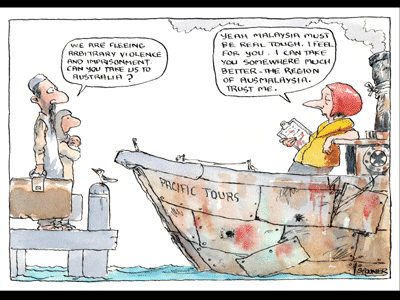
For Australian conservatives "national security" means controlling migration and a Fortress Australia with narrow portals whilst downplaying the right to seek asylum. For them the 1951 Refugee Convention is an inadequate instrument for dealing with the “global people movement”, mass refugee outflows or migratory movements, or “forced migration”.
As John Howard put it, “We have the right to decide who comes to this country, and the circumstances in which they come.” The obligations to help refugees under the 1951 Refugee Convention is seen as a substantial inroad on national sovereignty” and that is therefore unacceptable to conservative Australia.
Australia is built on immigration--ie., planned settler intake--- and its humanitarian intake is premised on a public expectation of a quid pro quo that the Government should and will control illegal migration. The Convention provides the sole legal basis for the protection of refugees worldwide. It codifies as a fundamental human right the right to seek asylum from persecution.
What appears to be happening since the 1990s is that Australia's asylum system has come under increasing strain through its use as a migration channel; and that the objectives of 'tightening up' and 'speeding up' processing determination of status procedures sufficiently to prevent asylum systems being a draw for migrants have not worked.
Maye, just maybe, the yet to be finalized refugee deal with Malaysia and Thailand may lead to the formation of a regional solution. At the moment it looks to be a quick political fix---political posturing as with the East Timor solution--- as it still has to be bedded down. It is a faint 'may' that Australia could take a leading role in pushing for the reform of the international asylum system.
Australia, like other Western governments, has been squeezed, between the pressures of a largely hostile public on the one hand, and their Convention obligations on the other, into awkward positions. Lip service is paid to honouring the 1951 Refugee Convention obligations and the right to seek asylum, while increasingly large amounts of money are spent on keeping asylum seekers out. The Convention has no mechanism for preventing mass migration outflows primarily caused by civil wars and ethnic, tribal and religious violence.
Currently, it is the countries in the developing world that have the bulk of the world's refugees. Australia could recommit to a sizeable annual offshore humanitarian refugee intake; and redirect resources currently spent on its onshore detention system to assist with the assessment of refugees in the camps within those developing countries (Malaysia and Thailand) who are the points of first asylum and transit centres.
Posted by Gary Sauer-Thompson at 7:27 PM | Comments (11) | TrackBack
May 14, 2011
Religious instruction in public schools
I have to agree with this position that education in Australia's public schools should remain ''free, compulsory and secular''. That means no religious education in state run public schools.
Unfortunately, the various state governments around Australia impose religious instruction on their public schools, and the religious right are determined to get God into the public schools in order to roll back humanism and secularism as more school children elect not to attend religious scripture classes in public schools.
Currently, religious education (ie., scripture classes) is Christian in orientation, despite Australia being a multicultural society, is more proselytizing than education and reflects the desires of a minority of parents. If the latter want a Christian education for their children, then they should go to a private school or find classes outside school hours (a Sunday school class.)
Religious "education" is a cover for religious instruction that has existed since 1950. The usual situation is that once a week someone comes in from outside the school and teaches the children about Jesus (creationism, fear of devils, hellfire and punishment etc). Those pupils not participating can go and sit by themselves in another room. So why cannot they have an education in ethics?
Australia is not a Christian country. Section 116 of the Australian Constitution states:
Commonwealth not to legislate in respect of religion:
The Commonwealth shall not make any law for establishing any religion, or for imposing any religious observance, or for prohibiting the free exercise of any religion, and no religious test shall be required as a qualification for any office or public trust under the Commonwealth
Despite this, we have evangelizing in public schools by Access Ministries, an organization which trains Chaplains for Christian scripture classes in public schools. The CEO of Access Ministries, Evonne Paddison, has publicly advocated using the opportunity given by the Chaplains in Schools program to convert children to Christianity.
The religious classes, which are not education about religions but education into a particular religion that are funded by the state, need to be replaced with education on the major forms of religious thought and expression characteristic of Australian society; on different ethical traditions; and they need to be taught by trained teachers rather than volunteers.
It comes as no surprise that the Churches and religious groups are strongly against any ethics education in moral reasoning for those children who opt out of the religious "education" class. They argument is that it undermine religious education in public schools. If ethics is confined to religion, then ethics would apply only to religious people. But ethics applies as much to the behavior of the atheist as to that of the Christian.
Posted by Gary Sauer-Thompson at 11:01 AM | Comments (7) | TrackBack
May 13, 2011
destabilising the elected government
Tony Abbott, the Coalition opposition leader, is on one long election campaign to discredit the minority Gillard Government and undermine the Independents support for it. He wants an election now--which he would win easily on current polling--- but does not have the power to call one. Abbott does not control the Senate.
So his strategy is to create an atmosphere of chaos, uncertainty and unease. He uses anything that he can lay his hands on to discredit the Gillard Government, and to demand an early election through de-legitimising the Government in the eyes of the public.

Abbott's budget-in-reply speech was a campaign speech and he was very effective in placing the Gillard Government on the defensive and hurting the front bench ministers. They have not got his measure and they are not happy about Abbott the brawler putting them on the ropes and being way ahead on points in his war of attrition against the Government.
The Liberals core constituency will really love his core populist philosophy to "stop the boats"; do away with waste and mismanagement; dump the carbon tax and the mining tax, which are to blame for everything that causes families to struggle in the the "lived economy"; defend middle class welfare; slash $50 billion from the budget in 12 months, restore small government; and have a strong government with real authority to make the tough decisions needed to build a stronger Australia and help Australians get ahead.
The stark contradictions in the policy area don't matter, as we are dealing with slogans, soundbites and one-liners strung together. What matters is in the war of attrition is to destabilize the Gillard Government.
Posted by Gary Sauer-Thompson at 11:32 AM | Comments (22) | TrackBack
May 12, 2011
BHP Billiton: lets go nuclear
Electricity prices continue to rise to pay for the investment needed to replace the old and neglected infrastructure. The Gillard Government continues to cut deep into its funding of renewable energy whilst talking about a carbon tax and saying that it will be the greenest government ever.
The Coalition says that subsidising "green" energy is just foolish as we plunge deeper into debt which our grandchildren will be repaying forever. Their concept of sustainable development is hot air.

There was a golden chance to use the damaged caused by the global financial crisis to begin to build a greener, cleaner and more sustainable economy, creating jobs and tackling climate change. We had the Gillard Labor, a new type of minority government, promising a new politics of a low carbon economy.
But the old politics and the old economics still have a stranglehold on energy policy. This goes beyond duplicity, resisting reforms to bring about a low carbon economy, or defending the commercial interests of the polluters.
BHP Billiton has thrown its weight behind nuclear power in Australia and said that Australia needs to go slow on a carbon tax. Australia should not penalise its trade-exposed industries--ie., the big miners.
Apparently, BHP Billiton reckons that it would be smart for Australia to add nuclear power to its energy mix in spite of the Chernobyl poisoned landscape at Chernobyl and the disaster at Fukushima.
The lights will go out without nuclear. There was no mention of the nuclear waste issue or the need for a big public subsidy to get the nuclear industry up and running. No mention of increased use of natural gas. Nothing about more research needed into sea tide or wave electricity generation. No mention of geothermal either. It's go nuclear.
I guess that is predictable, given that BHP plans to quadruple production of uranium at its Olympic Dam mine in South Australia, at a cost of $30 billion.This is a company whose corporate power is so great that that is exempt from some of our most important environmental and indigenous rights legislation. BHP Billiton must find a home for the additional uranium it will produce with its planned n expansion of the Olympic Dam copper/uranium/gold mine.
Apparently, it is not possible for Australia to cut its carbon emissions and keep the lights on without building nuclear power stations. Yet Japan has backed away from expanding its nuclear power industry in light of the Fukushima crisis in favour of renewables. Likewise Germany, which has also closed a number of older nuclear facilities”. For the nuclear power industry, this is a sign of weak leadership.
In Australia it seems public subsidy is for really for nuclear power and coal-fired power stations.
Update
Germany's energy turn shows what can be done. The share of renewable electricity in Germany has jumped from 5 percent in the 1990s to 17 percent today, and its big bet is environmental technology will be one of Germany's most important sources of income. Already, the country's share in the green-tech world market is 16 percent, which means billions of Euros in business. Renewable energy has generated 300,000 'green collar' new jobs in the past decade.
Posted by Gary Sauer-Thompson at 9:44 AM | Comments (4) | TrackBack
May 11, 2011
social democracy: on the defensive
An interesting article in The Guardian by Olaf Cramme and Patrick Diamond based on research for the annual Progressive Governance Conference on 12-13 May in Oslo. The conference theme is that social democratic parties appear to have lost the ideological, intellectual and organisational vitality which enabled them to leave such a strong imprint on the 20th century.

The context is the global financial crisis in which over 80 million jobs were lost worldwide and many cores of countries have emerged from the crisis with weakened financial systems and huge public debts. These nations may be condemned to slow growth and insufficient job creation for years to come. It's a crisis of global capitalism.
That might have been an opportunity for the centre-left, yet social democrats remain battle weary and defensive.The crisis of global capitalism has been redefined as a crisis of public debt and government deficits. It is the state – its size, role, and efficiency – that is now at the centre of political debate, not the inherent instability of markets and free, then the avenue to economic dynamism is to let capitalism be true to its atavistic, red-in-tooth-and-claw instincts. Capitalism is the survival of the fittest.
Cramme and Patrick Diamond say:
Today, voters are palpably frightened by the concentration of power in the market economy. This is mirrored by lack of faith that democratic politics can properly uphold the public interest. The unease is most visible in people's apprehensiveness about the dominance of large, multinational corporations. The overwhelming majority agree that large companies care only about profits and not about the wider community or the environment, but voters have a low estimation of government's ability to stand up to vested interests. Strikingly, most believe that who you know is usually more important for getting on in life than hard work and playing by the rules.
They add that if the moment of the global financial crisis has passed, then the centre-left must capitalise on its aftermath by framing a forward-looking agenda for shared prosperity.
This is what the Gillard ALP is failing to do: it is not framing a forward-looking agenda for shared prosperity. It is not showing how to make capitalism work best to meet the ambitions and needs of ordinary people eg.,
(1) They no longer talk about justice as fairness; that capitalism without fairness becomes toxic as it creates ever great inequality in income and wealth.
(2) They imply that that the poor largely deserve their plight because they could have chosen otherwise: they could work harder, save and show some initiative.
(3) They continue to subsidize the Big Miners with the Fuel Tax Credits scheme.
(4) there is little public investments in cleantech infrastructure to break our reliance on climate-changing fossil fuels.
(5) there is an increasing embrace of the 'no work, no rights' workfare model that originated in the United States and has spread to Australia and many other countries.
The appeal to Labor values in the Gillard Government's budget with respect to welfare to work reform disguises the underlying neo-liberalism that is pushing the vulnerable-- single mothers, those with a disability etc--into low paid insecure jobs without any opportunity for getting ahead.
Posted by Gary Sauer-Thompson at 12:27 PM | Comments (6) | TrackBack
May 10, 2011
2011: Big Picture politics
What is the ALP's big picture of Australia's future? Do they have one apart from everyone having to work long hours? Is it's big picture a work in progress? Or is it a case of week by week crisis management? Will the budget begin to fill in the details, as it charts how the Gillard Government plans to make the shift from a budget deficit of around $50 billion in 2010 to a surplus in 2012-13.
We can ignore the Coalition because what we mostly hear from them on economics is them banging on about the "massive" debts and deficits and how the Gillard Government has not been tough enough in slash and burn. Only the Coalition has the courage to do slash and burn (eg., $50 billion worth of savings). Like economists they love inflicting pain.
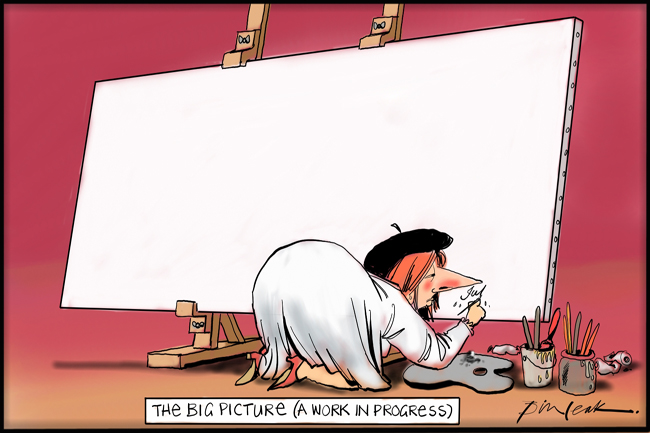
My impression is that Gillard Labor doesn't have a big picture of Australia beyond that of Quarry Australia. The emphasis appears to be on skilled migrant labour being brought into the country to ensure the continuation of the mining boom and to look after the interests of the multinational mining corporations. Yet the record mining profits are not lifting the budget into surplus, as they did in the past. The miners are not paying much tax.
The emphasis on welfare reforms and spending on education and training to increase workforce participation is for low skilled labour in a variety of Mcjobs (casual labour in the fast-food industry, cleaning, or supermarkets) because there is an increasingly large underclass that lacks the skills to become part of the middle class.
If there is a sketch, then it has something to do with keeping the Australian manufacturing industry going in a globalized world and the national broadband network. However, there is little coming out of Canberra that addresses questions such as: 'Where does Australia wish to be in a global digital economy?' 'Or does Australia want to create jobs, improve domestic productivity, increase exports and advance its competitive position in a global digital economy?'
The emphasis on education is because many of Australia's students are still stuck in a ditch. Those with just a high school education increasingly find themselves locked into the low-wage end of the labor market with little hope for better jobs. The educational attainment in many public schools has not kept pace with our strong technological advancement; nor is it anchored to student outcomes. Consequently, the quality of public education needs to be improved to prevent its decline.
There is a pervasive sense that poverty is destiny, that schools can make only a small difference, so why bother, since we’ll never fix education until we fix poverty. That ignores the differences that individual schools can make in terms of performance and innovation. It ignores that the global marketplace will be very unforgiving to a populace that doesn’t have the skills it demands. It also means obstacles to upward mobility.
The danger here is an increasing polarization of the Australian economy with increasing income inequality as the shape of the workforce increasingly looks fat on both the high and low ends and thin in the middle.
Update
Well, in Swan's fourth no-frills budget there was welfare reform, a cut back on family benefits for the middle class, $22 billion of spending cuts and increased spending on mental health in the budget, coupled to a promise to be back in the black with a $3.5 billion surplus in 2012-13.
There are no tax cuts in the budget but no structural tax reform --as suggested by the Henry review---- either. And that $22 billion of spending cuts is offset by $18.9 billion in new spending. Net savings: $2.8 billion.
Credit needs to be given to Swan's emphasis on trying to get people out of poverty traps and devising ways to prod them towards participating in the market economy. However, there was nothing to facilitate higher education to facilitate the emergence of the Clever Country in Swan's budget. I cannot see anything there that ensures the mining boom ends with something to show for it.
The mining boom, it would seem, is the limit of the Gillard Government's horizon. The horizon of the Coalition is relentless assault--- the higher-than-expected deficits are evidence of Labor's spendthrift ways and the forecasts of future surpluses are not to be believed.
Over at The Drum Mark Bahnisch says:
The truth is that this budget has missed the real opportunity to “ensure prosperity beyond the mining boom”, to invoke one of Wayne Swan and Kevin Rudd’s phrases from 2007. Short-term political fixes are substituted for long-term vision, and the investments we were once promised - the ideal of a nation where innovation and new jobs in new sectors, new sources of value both for the nation and for those who want something better than Quarry Nation - seem to have receded below the horizon. The light on that hill has gone out. Or perhaps the hill has been strip mined.
That's a great image---Labor's light on that hill has gone out because the hill has been strip mined.
Posted by Gary Sauer-Thompson at 8:53 AM | Comments (12) | TrackBack
May 9, 2011
NBN + cost benefit analyses
William K. Black in a post on formal cost benefit analyses to decide regulatory policy at New Economics. This has often been used as part of a frontal attack on Australia's national broadband network (NBN). Black says:
Benefit-cost tests are used as a device to give theoclassical economists extraordinary power to block regulations disfavored by the ruling administration. A regulation on pollution, for example, is typically shaped by scientists and engineers because they have the relevant expertise and they use that expertise and experience to reach a judgment that the policy they are recommending will benefit the nation. Economists, however, are the purported experts on formal benefit-cost analyses and they can and do use that expertise to kill rules the scientists believe to be vital. The neoclassical economists are implacably hostile to regulation, so benefit-costs reviews could serve as a “choke point” to protect their dogmas – no matter how irrational and anti-empirical those dogmas prove.
He adds that the core, defining dogma of theoclassical economists is that government is the problem, not part of the solution. They believe government is rarely necessary, that it proves a grave danger to personal liberty, and that virtually all governmental programs are economically illiterate and harm the intended beneficiaries as well as the economy.
The implicit intellectual proposition underlying this choke point is that the neo-classical economists assumption that have a universal, superior methodology for judging the desirability of public policies even in fields in which they are hopelessly ignorant. That universal, superior methodology is that economists are engaged in a value-free, objective, and scientific exercise. Hence the cost-benefit process is objective.
This is hard to accept since behind this assumption sits another one, which continually surfaces around the NBN. It is that private enterprise or the free market is the best and only way to build the NBN--in spite of the marked failure of private enterprise to do so in the past. That failure is an example of a negative externality that a competitive free market economy has produced and could not address successfully. Hence the need for government intervention with the NBN designed to create a level playing field.
What usually happens is the free market economists deny the harms caused by a broadband network that has been built by the private enterprise. They deny the negative externality; or say that if laissez-faire—that is, no government intervention—provides too little high speed broadband to regional Australia, the the straightforward solution is some form of subsidy to private enterprise, not the government production of a broadband network.
Other responses are that within a system of a system of voluntary exchange the individuals involved in these situations can always negotiate a solution that internalizes any externality. Or the traditional distinction between public goods, which must be produced collectively because of the positive externalities they create, and private goods, the production of which may be left to the market can be challenged.
Posted by Gary Sauer-Thompson at 10:08 AM | Comments (2) | TrackBack
May 8, 2011
being blue
An example of how our era when biological—and specifically, genetic—causation is taken as the preferred explanation for all human physical differences.
The announcement in February 2001 that two groups of investigators had sequenced the entire human genome was taken as the beginning of a new era in medicine, an era in which all diseases would be treated and cured by the replacement of faulty DNA.
For nearly ten years announcements of yet more genetic differences between diseased and healthy individuals were a regular occurrence in the pages of The New York Times and in leading general scientific publications like Science and Nature. There have been an increasing number of medical books analysing the concepts of health and disease from the perspective of evolutionary biology
In It’s Even Less in Your Genes in the New Review of Books Richard C. Lewontin observes that:
the search for genes underlying common causes of mortality had so far yielded virtually nothing useful. The failure to find such genes continues and it seems likely that the search for the genes causing most common diseases will go the way of the search for the genes for IQ.
The idea that emotional distress is due to an underlying organic disease downplays the effects of negative life circumstances or acute trauma and non-biomedical accounts of mental distress and disorder.
He adds that:
Experimental geneticists, however, find environmental effects a serious distraction from the study of genetic and molecular mechanisms that are at the center of their interest, so they do their best to work with cases in which environmental effects are at a minimum or in which those effects can be manipulated at will. If the machine model of organisms that underlies our entire approach to the study of biology is to work for us, we must restrict our objects of study to those in which we can observe and manipulate all the gears and levers.
The biomedical model of medicine holds that health constitutes the freedom from disease, pain, or defect, thus making the normal human condition "healthy". The model's focus on the physical processes, such as the pathology, the biochemistry and the physiology of a disease, and does not take into account the role of social factors or individual subjectivity.
This failure stems partly from three assumptions of the biomedical models: all illness has a single underlying cause; disease (pathology) is always the single cause; and removal or attenuation of the disease will result in a return to health. The assumption that a specific disease underlies all illness has led to medicalisation of commonly experienced illnesses as opposed to disease resulting from cellular abnormalities.
Posted by Gary Sauer-Thompson at 10:31 PM | Comments (1) | TrackBack
May 7, 2011
ALP: in retreat
One of the first acts of the newly elected Labor government in 2007 was to affirm its policy never to institute the discredited Pacific Solution again.In a speech delivered at the Lowy Institute on 6 July 2010, Prime Minister Gillard raised the possibility of establishing a “regional processing centre” for asylum seekers in East Timor.
Now, reports in the media say that the Gillard government is sounding out the Papua New Guinea government about reviving the Manus detention centre, thereby retreating to Howard's Pacific Solution it had previously rejected.

Labor 's argument was that it ended the Pacific Solution, the processing and detaining of asylum seekers on Pacific islands such as Manus Island, because it was costly, unsustainable and wrong as a matter of principle. Labor did not accept that Nauru or Manus Island had played any significant or any role in deterring unauthorised arrivals from trying to come to Australia. What detered people coming to Australia, it argued, was effective border protection and sensible regional arrangements with Australia's neighbours to deter secondary movements.
That was then. This is now. The centre will cater to between 400 and 600 asylum-seekers.
It would appear that it is not possible to develop sensible regional arrangements with Australia's neighbours to deter secondary movements. So we have a political fix---a “repackaged Pacific Solution”--- not a serious regional solution to the asylum-seeker problem; a political fix to address an increasingly hostile reaction in the electorate to asylum seekers.
Update
Nothing from Papua New Guinea yet. However, Australia will forcibly return 800 asylum seekers to Malaysia to be processed in return for taking 4000 declared refugees at a rate of 1000 a year over four years, increasing the annual quota from 13,750 to 14,750.
Malaysia is known for its harsh treatment of refugees and is not a signatory to the UN Convention on Refugees. Malaysia has assured Australia that it will treat asylum seekers with dignity and respect and will not be forcibly repatriated back to unsafe countries or stuck there waiting for resettlement after being assessed as refugees without being able to work.
Labor's argument against re-opening Nauru is undercut because Malaysia is not a UN human rights signatory and it gives every indication of not doing so. Malaysian law does not distinguish between refugees, asylum seekers and other irregular migrants. All are considered to be illegal and are subject to the same penalties--fines, imprisonment and caning. In Malaysia, forced migrants are frequently and arbitrarily arrested, detained and deported.
Malaysia’s sixteen immigration detention centres are already overcrowded. Inmates lack regular access to clean drinking water, appropriate medical care and proper sanitation. It is difficult to see that the 800 asylum seekers being treated any differently ie., “treated with dignity” when Australia itself has no effective ability to protect the civil and political rights of the people it transfers to Malaysia.
Posted by Gary Sauer-Thompson at 11:29 AM | Comments (12) | TrackBack
May 6, 2011
American reactions to Osama bin Laden death
The American reaction at Ground Zero to Osama Bin Laden's assassination. The ever changing White House account of the shooting of Bin Laden.
 Steve Bell
The Republicans are attempting to rehabilitate the Bush torture regime by claiming that "enhanced interrogation" did indeed play a "critically important role" in the U.S.'s ability to find bin Laden. The wingnuts love torture (waterboarding) as permanent policy.
Looking to 9/11 9/11we can see that 9/11 fortuitously provided the American right with the external enemy that allowed it to go back into business demonizing the internal enemy, liberalism. And the idea of endless war war on global terrorism enabled the right once again to smear American liberals as defeatists or appeasers, if not traitors, in a struggle on the scale of the world wars and the Cold War.
Symbols matter and bin Laden's death is the most important symbol since the Twin Towers fell. It is a big deal and it matters for the Americans--- he represented ten years of unfinished business---even if strategically it changes very little. The never ending war will continue, even if If the so-called Arab spring suggests that the momentum is with reform and modernity, not the backward-looking polity offered by the fundamentalists.
The first decade of the 21st century era is probably going to be remembered as the beginning of a long era of American decline.
Update
I have just read Osama bin Laden raped our souls by Melody Ayres-Griffith at the ABC's Unleashed a reaction to Osama bin Laden death. She says it is a response to an article by Bob Ellis.
Ayres-Griffith, who did not own a mobile phone because she saw them as an expensive, unnecessary intrusion into my personal space, says that after 9/11:
I acquired a mobile phone. For the sake of my family. Because of Osama bin Laden.This man raped our souls, and when he did so he was no longer a man, but an enemy. THE enemy.A long campaign followed, during which bin Laden was the primary target - but the might of the greatest military in the world could not find him. It was as if he was a ghost, and that only cemented his bogeyman status even more. He could be anywhere, anytime. He could bomb your shopping centre, he could take down your flight, he could send a suicide bomber to blow up your train - he was the bogeyman. Even adults feared the mere thought of him. Do you give justice to the bogeyman? Do you put the bogeyman on trial?
She adds that you don't you don't take demons alive, do you?
She adds that you don't debate whether or not the owner of a rabid dog will object to you putting that dog down after it bit you, you just take the first opportunity to put that dog down, and you worry about the rest later.
The ABC took a lot of flak in the comments to the article for publishing this piece. I interpret it as an expression of the paranoid style of thinking in American politics. Here politics is cast in apocalyptic terms as a conflict between absolute good and absolute evil. Consequently, the enemy must be sinister, ubiquitous, cruel…seeking to deflect the normal course of history in an evil way. The latest manifestation of American paranoia is the phenomenon of Islamophobia.
Posted by Gary Sauer-Thompson at 11:07 AM | Comments (8) | TrackBack
May 5, 2011
the politics of a carbon price
In The industries that cried wolf Richard Denniss argues that many of the claims being made by industry about the likely impact of a carbon price are exaggerated. The industry line ---coupled to the attacks on renewable energy as being way too expensive and merely a niche player---is endlessly repeated in the media and exaggerated by The Australian into a crisis for Labor, who are unfit to govern.
The introduction of a carbon price in Australia in July 2012 will raise more than $10 billion per year, help influence industrial and household decision making and, inevitably, increase the costs and reduce the profits of some businesses. Such increases in cost and the subsequent change in behaviour are, of course, the objective of introducing a carbon price. It is designed to shift Australia to a low carbon economy.
The response by many of the representatives of some of Australia's largest polluters are designed to leave their audience in little doubt that the introduction of a carbon price will destroy the Australian economy. Therefore tens of billions of dollars have to be transferred from taxpayers to polluters on the strength of industry claims about then losing their competitiveness.
It's a poor argument in policy terms since a carbon price will have less impact on these industries than the recent 30% rise of the Australian dollar. The dollar's rise hasn't destroyed their competitiveness.
The policy context for this kind of politics is that companies in Australia have for many years mounted arguments that unless their demands for low wages, low taxes and generous industry assistance (to ensure competitveness) are met they will be forced to shift their operations offshore.
Dennis says that:
The meaning of competitiveness implied by those who use it most seems, however, to relate to the capacity of Australian firms to be able to 'compete' with the costs of production by firms based in other countries. In relation to the introduction of a carbon price, for example, the argument appears to be that if Australian steel makers have to pay a carbon price and foreign competitors do not then the result will be that Australian steel makers will be priced out of the market, those buying steel will turn to foreign steel makers, and, as a result there will be a reduction in Australian exports and employment for no actual reduction in worldwide greenhouse gas emissions. This transfer of pollution from Australian steel makers to foreign steel makers has become known as 'carbon leakage'.
While it is theoretically possible for such a chain of events to occur, in practice a far more likely outcome is for Australian manufacturers to continue selling steel, albeit at a slightly lower rate of profit.
Posted by Gary Sauer-Thompson at 4:24 PM | Comments (2) | TrackBack
May 4, 2011
conservative speak
One of the more noticeable contradictions in contemporary conservative discourse is the politics of austerity strand---big cuts the welfare state to reduce government deficit spending (blowout) and the debt--and the opposition to any substantial cuts to Australia's 's bloated, military budget. The military budget is quarantined from the strident calls to slash government spending because government is too big.
The reason for the quarantining is not too hard to see. Conservatives are a pro war party. Their discourse is one of unending war ---its now the never ending war on global terrorism--- and so Australia must be ready to fight the next war and the next one etc etc. They love wars, flags, uniforms, big ships and big strong government. Their love of war is articulated in the wrapping of patriotism and nationalism.
The austerity politics of neo-liberal discourse is started in terms of shoring up Australia's defences against the risks of a new bout of global economic volatility. However, it's claim of the imperative need to tighten our belts has little to reducing government deficit spending and the debt, given the quarantining of the military budget from the slash and burn.
The politics of austerity is more about cutting into the welfare state because the neo-liberals are opposed to the welfare (ie., nanny) state as a matter of principle. Hence the privatising agenda and punitive welfare reform to get rid of the dole bludgers and undeserving poor.
The latter should look after themselves with little help from the government. Big business, or course, should get lots of never ending help (in the form of subsidies, light regulation, low taxes, incentives from the government. So the state bails out banks and tells the polis to tighten up, claiming that the people are too expensive to be borne through their state. They are told that they should feel shame for having wanted more than they could bear responsibility for and are told that they should take satisfaction in ratcheting down their image of the good life. The imposition of austerity involves the affective orchestration of blaming the vulnerable for feeling vulnerable.
The language of personal responsibility shapes the political discourse of ‘austerity’--eg., health paternalism is bad, individual autonomy is good. The national good requires citizens to direct their anger downwards on those who exploit the public without ‘creating wealth’: people who flout the norms through an ‘excess of dependence’, those who regard “benefits as a lifestyle choice” Their ‘shameless’ milking of state benefits allows them to live in inner city areas which low-paid workers can’t afford, and their reckless personal habits burden our cash-strapped public services.
Australian citizens are more likely to prioritize cuts in the military budget before cuts in health care or education. They are quite skeptical that free market policies, will bring about better health, greater wealth and less poverty. They see the welfare state as their defence against the excesses and negative consequences of the free market and the structural inequality of market democracy. The state says, in response that it can no longer afford this kind of protection--its an unbearable burden--so the poor must be publicly shamed.
On the other hand, the neo-liberal discourse of of shame and excess appeals to the traditional notion of a common-sense decency (morality) still to be found in the working-class heartlands that is disgusted at the people who flout the norms through an ‘excess of dependence’, There is a nostalgic appeal here to an older working class solidarity and work ethic in this demand for the people’s austerity.
Posted by Gary Sauer-Thompson at 10:41 AM | Comments (15) | TrackBack
May 3, 2011
making progress?
Osama Bin Laden had become a mythic figure in the Western imaginary and the Islamic one, even though only a minority of Muslims wants such a theocratic dictatorship advocated by Al-Qaeda--- a return to the medieval Muslim caliphate (a combination of pope and emperor). His death is being celebrated in the West as a victory in the decade long war on terrorism--it's a feeding frenzy of commentary. The Americans have their revenge and retribution. It is symbolic event; a cathartic moment.

However history has moved on in that the uprisings that have shaken the Middle East region, from Tunisia, Egypt to the ongoing protests against the Assad regime in Syria, have not involved significant Islamist activity – let alone the violent jihadi and clash of civilization between Islam and the West ideas promoted by Bin Laden, Ayman al-Zawahiri and their associates. The largely peaceful mass movements want parliamentary democracy in that they articulate their desires using categories such as the nation, the people, liberty and democracy.
So the movement Bin Laden founded has already failed: there has not been a broad fundamentalist revolution that would topple existing Arab governments and usher in a unified Islamic caliphate. Al-Qaeda has been almost completely irrelevant to the popular upheavals that have dominated regional politics.
The Australian government is quick to say that Australia will "stay the course" in Afghanistan to "get the job done" so that Afghanistan does not become a haven for terrorists again. The war on terrorism can be won say the neocons.
Yet it is Pakistan that provides the safe haven. The Inter-Services Intelligence Directorate (ISID), Pakistan's powerful security and spy agency, are effectively providing the terrorists with protection and they also support the Taliban in Afghanistan in order to block Indian influence. So the Afghan Taliban and their associates have been able to operate unimpeded from Pakistani soil. What will happen to these Afghan Taliban leaders now?
Al Qaeda isn't the real reason the US is having a hard time in Afghanistan, it has nothing to do with its difficulties with Iran and little to do with Israel and the Palestinians.The anger at various aspects of U.S. policy in the Middle East continues to drive anti-Americanism in the region, and this makes it more difficult for the US to protect its imperial interests in that part of the world. The US is not seen as a benign hegemon whose regional dominance is to be welcomed.
It looks as if the post 9/11 national security state (with its security queues and surveillance) is here to stay for quite some time, even though the NATO counterterrorism mission in Afghanistan is dissipating.
Posted by Gary Sauer-Thompson at 8:40 AM | Comments (27) | TrackBack
May 2, 2011
Britain: electoral reform
Britain is to vote on electoral reform in the form of legislation to reduce Britain's constituencies to 600 while standardising their size, overriding geographical or historical ties.Tacked on to this bill, meeting the demand of the Lib Dems, was the provision for a referendum on the alternative vote to replace first past the post so that there will be a distribution of second and third preferences until a candidate wins a genuine majority.
 Martin Rowson
This is a minor step. Australia, for instance, adopted AV 80 years ago. The aim of the reform is to increase political pluralism by giving new forces in politics a better chance for representation sooner. The Conservatives are opposed, the LIberal Democrats are in favour and Labor is fractured, with many on the Labour Right siding with the Conservatives campaign to kill alternative vote reform, even Labour's leader has campaigned for AV in the name of a fairer voting system.
To get re-elected under the alternative vote each candidate will need at least 50 per cent of the vote. Those 172 safe Conservative seats and 29 Lib Dem safe seats will no longer be so safe. It is not difficult to see how this would make life more difficult for those government MPs voting for huge public spending cuts.
First Past the Post is a system that rigs elections for the two biggest parties.The opinions of voters in "safe" seats do not register at all. Labour supporters in heavily Conservative areas are invisible and vice versa. The traditional view is that that we, the people, are unwashed dangerous xenophobes who need to be ruled by a political elite who know best. Britain has a a culture of deferential democracy. So much for liberty.
The polls say the No campaign will win, and if that happens, then the Liberal Democrats are going to suffer. They will sink further in the polls as a result of a no vote.
Update
The Liberal Democratic proposed reform--the AV referendum vote- was decisively rejected (around 68% to 32%); a British refusal to embrace electoral change. First past the post, which ensured virtual Tory hegemony for most of the last century, remains entrenched. The Liberal Democrats have been bloodied--repudiated--- and are now hostages in the Conservative led coalition, chained to the cabinet table until 2015.
Anthony Barnett at Open Democracy says that the campaign was tragically misconceived from the start.
It was positioned as non-political rather than as against the whole way our politics is currently conducted; as something that fitted in with the way we are and, most damagingly of all, as the end of the road for popular constitutional reform. In other words, as a kind of justification for the Coalition...from the get-go the campaign needed to be clear about whether it was a modest first step to deeper and wider democratisation of British politics. If it had chosen to be this it could have honestly accepted that AV was indeed the limited compromise it is. It could – and should –have then turned all guns on First Past the Post and made the status quo the focus of the referendum, campaigning against its wastefulness and dishonesty – and the fact that it gave us the Iraq War...The referendum itself should have been turned into an increase in citizen power and the beginning of more direct democracy and participation.
The role of the Lib Dem's in the Coalition is to act as protective heat for the Conservatives, itching to dump consensus for Thatcherite will.
Posted by Gary Sauer-Thompson at 10:28 AM | TrackBack
May 1, 2011
Budget politics
I guess that Gillard's speech at the Sydney Institute on April 13 set the scene for the 2011 budget. It warned us that the forthcoming budget would see a tight rein on spending to return the Budget to surplus in order to make the boom last.

Will this austerity budget in the context of revenue shortfalls counter Abbott's key message that Labor's policies are failing and that they constitute a betrayal of ordinary people?
A strong theme of Gillard's speech was welfare-dependency and extensive welfare reform, by which she meant:
Income management, improving school enrolment and attendance, tighter eligibility and smarter employment services for adults with some disability. Restructured employment services, investing more resources in those with more complex problems.
The subtext is that passive welfare is a malaise that must be tackled. Welfare reform and workforce participation go together; linked by the dignity of hard work.
In the speech Gillard claims that there are 230,000 people who have been unemployed for more than two years and 250,000 families where no adult has been working for at least one year. Gillard says:
Relying on welfare to provide opportunity is no longer the right focus for our times. Our strong economy gives us a real chance to create opportunity from the cradle to the grave.The problem of long term welfare dependency has been long discussed but the new realities of our economy create quite a different policy environment from the recovery of the 1990s or the growth of the last decade. Because we have unprecedented demand for skills and labour, this is possible. In today’s economy, inclusion through participation must be our central focus. It’s not right to leave people on welfare and deny them access to opportunity.And every Australian should pull his or her own weight. It’s not fair for taxpayers to pay for someone who can support themselves.
Will this appeal to Labor's heartland and help to stop the drift to the Abbott Liberals? Is that the politics of the 2011 Budget?
There is next to nothing in Gillard's speech about productivity, ie., working smarter rather than working harder or longer. Working smarter means better education for those whose work skills have deteriorated, or never existed in the first place.
Posted by Gary Sauer-Thompson at 11:19 PM | Comments (3) | TrackBack