|
May 4, 2011
One of the more noticeable contradictions in contemporary conservative discourse is the politics of austerity strand---big cuts the welfare state to reduce government deficit spending (blowout) and the debt--and the opposition to any substantial cuts to Australia's 's bloated, military budget. The military budget is quarantined from the strident calls to slash government spending because government is too big.
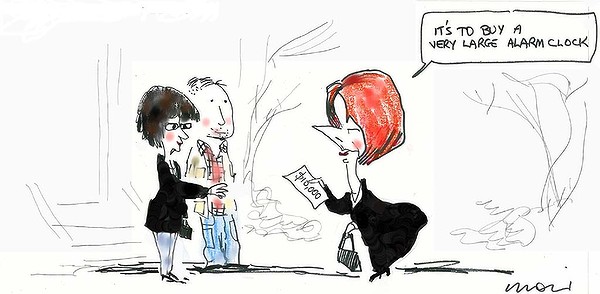
The reason for the quarantining is not too hard to see. Conservatives are a pro war party. Their discourse is one of unending war ---its now the never ending war on global terrorism--- and so Australia must be ready to fight the next war and the next one etc etc. They love wars, flags, uniforms, big ships and big strong government. Their love of war is articulated in the wrapping of patriotism and nationalism.
The austerity politics of neo-liberal discourse is started in terms of shoring up Australia's defences against the risks of a new bout of global economic volatility. However, it's claim of the imperative need to tighten our belts has little to reducing government deficit spending and the debt, given the quarantining of the military budget from the slash and burn.
The politics of austerity is more about cutting into the welfare state because the neo-liberals are opposed to the welfare (ie., nanny) state as a matter of principle. Hence the privatising agenda and punitive welfare reform to get rid of the dole bludgers and undeserving poor.
The latter should look after themselves with little help from the government. Big business, or course, should get lots of never ending help (in the form of subsidies, light regulation, low taxes, incentives from the government. So the state bails out banks and tells the polis to tighten up, claiming that the people are too expensive to be borne through their state. They are told that they should feel shame for having wanted more than they could bear responsibility for and are told that they should take satisfaction in ratcheting down their image of the good life. The imposition of austerity involves the affective orchestration of blaming the vulnerable for feeling vulnerable.
The language of personal responsibility shapes the political discourse of ‘austerity’--eg., health paternalism is bad, individual autonomy is good. The national good requires citizens to direct their anger downwards on those who exploit the public without ‘creating wealth’: people who flout the norms through an ‘excess of dependence’, those who regard “benefits as a lifestyle choice” Their ‘shameless’ milking of state benefits allows them to live in inner city areas which low-paid workers can’t afford, and their reckless personal habits burden our cash-strapped public services.
Australian citizens are more likely to prioritize cuts in the military budget before cuts in health care or education. They are quite skeptical that free market policies, will bring about better health, greater wealth and less poverty. They see the welfare state as their defence against the excesses and negative consequences of the free market and the structural inequality of market democracy. The state says, in response that it can no longer afford this kind of protection--its an unbearable burden--so the poor must be publicly shamed.
On the other hand, the neo-liberal discourse of of shame and excess appeals to the traditional notion of a common-sense decency (morality) still to be found in the working-class heartlands that is disgusted at the people who flout the norms through an ‘excess of dependence’, There is a nostalgic appeal here to an older working class solidarity and work ethic in this demand for the people’s austerity.
|





As big businesses become more global and footloose (eg., the big miners) they have less incentive to support public spending on education, health, human services or social safety nets, including unemployment benefits.
For them the unemployed become superfluous as consumers and burdensome as citizens. Cutting unemployment benefits becomes just another means of cutting losses.
These firms will continue to use globalization and the need to remain competitive as an excuse to cut public sector health and retirement benefits.