|
May 10, 2011
What is the ALP's big picture of Australia's future? Do they have one apart from everyone having to work long hours? Is it's big picture a work in progress? Or is it a case of week by week crisis management? Will the budget begin to fill in the details, as it charts how the Gillard Government plans to make the shift from a budget deficit of around $50 billion in 2010 to a surplus in 2012-13.
We can ignore the Coalition because what we mostly hear from them on economics is them banging on about the "massive" debts and deficits and how the Gillard Government has not been tough enough in slash and burn. Only the Coalition has the courage to do slash and burn (eg., $50 billion worth of savings). Like economists they love inflicting pain.
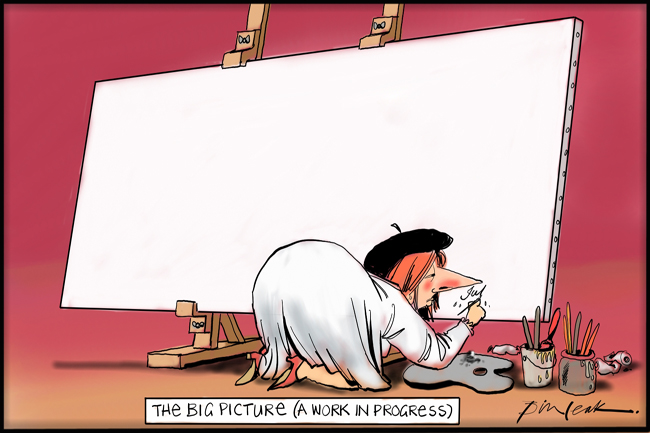
My impression is that Gillard Labor doesn't have a big picture of Australia beyond that of Quarry Australia. The emphasis appears to be on skilled migrant labour being brought into the country to ensure the continuation of the mining boom and to look after the interests of the multinational mining corporations. Yet the record mining profits are not lifting the budget into surplus, as they did in the past. The miners are not paying much tax.
The emphasis on welfare reforms and spending on education and training to increase workforce participation is for low skilled labour in a variety of Mcjobs (casual labour in the fast-food industry, cleaning, or supermarkets) because there is an increasingly large underclass that lacks the skills to become part of the middle class.
If there is a sketch, then it has something to do with keeping the Australian manufacturing industry going in a globalized world and the national broadband network. However, there is little coming out of Canberra that addresses questions such as: 'Where does Australia wish to be in a global digital economy?' 'Or does Australia want to create jobs, improve domestic productivity, increase exports and advance its competitive position in a global digital economy?'
The emphasis on education is because many of Australia's students are still stuck in a ditch. Those with just a high school education increasingly find themselves locked into the low-wage end of the labor market with little hope for better jobs. The educational attainment in many public schools has not kept pace with our strong technological advancement; nor is it anchored to student outcomes. Consequently, the quality of public education needs to be improved to prevent its decline.
There is a pervasive sense that poverty is destiny, that schools can make only a small difference, so why bother, since we’ll never fix education until we fix poverty. That ignores the differences that individual schools can make in terms of performance and innovation. It ignores that the global marketplace will be very unforgiving to a populace that doesn’t have the skills it demands. It also means obstacles to upward mobility.
The danger here is an increasing polarization of the Australian economy with increasing income inequality as the shape of the workforce increasingly looks fat on both the high and low ends and thin in the middle.
Update
Well, in Swan's fourth no-frills budget there was welfare reform, a cut back on family benefits for the middle class, $22 billion of spending cuts and increased spending on mental health in the budget, coupled to a promise to be back in the black with a $3.5 billion surplus in 2012-13.
There are no tax cuts in the budget but no structural tax reform --as suggested by the Henry review---- either. And that $22 billion of spending cuts is offset by $18.9 billion in new spending. Net savings: $2.8 billion.
Credit needs to be given to Swan's emphasis on trying to get people out of poverty traps and devising ways to prod them towards participating in the market economy. However, there was nothing to facilitate higher education to facilitate the emergence of the Clever Country in Swan's budget. I cannot see anything there that ensures the mining boom ends with something to show for it.
The mining boom, it would seem, is the limit of the Gillard Government's horizon. The horizon of the Coalition is relentless assault--- the higher-than-expected deficits are evidence of Labor's spendthrift ways and the forecasts of future surpluses are not to be believed.
Over at The Drum Mark Bahnisch says:
The truth is that this budget has missed the real opportunity to “ensure prosperity beyond the mining boom”, to invoke one of Wayne Swan and Kevin Rudd’s phrases from 2007. Short-term political fixes are substituted for long-term vision, and the investments we were once promised - the ideal of a nation where innovation and new jobs in new sectors, new sources of value both for the nation and for those who want something better than Quarry Nation - seem to have receded below the horizon. The light on that hill has gone out. Or perhaps the hill has been strip mined.
That's a great image---Labor's light on that hill has gone out because the hill has been strip mined.
|





On one hand, there's a limit to what this government can do given the numbers in the parliament.
On the other hand, they're just hopeless. So depressingly hopeless.