|
July 1, 2008
The serious business on a national emissions trading scheme has started. The green zealots are coming scream the conservatives. That's Henry Ergas in The Australian, and he is referring to a national emissions trading scheme. Reducing emissions is not an act in a morality place, he adds, but a decision that has to be made by trading off benefits and sacrifices. He's played around with his utilitarian calculus and the sacrifices are big and the benefits few. Wealth creation is going to be drastically reduced because the zealots, nay fanatics, act as if the emission targets had come from God.
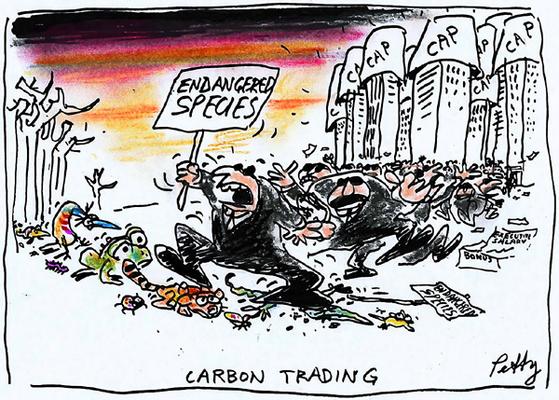
The coal fired power generator companies in Victoria and SA have realized that their assets are going to be devalued as a consequence of the scheme and will force them to exit the market before they had recovered the costs of their capital. They reckon that the value on their emissions-intensive brown coal generators will devalue by up to 90%, and are they painting a lights out scenario in the national energy market by December 31. Unless they are compensated, of course, big time.
 Petty
Petty
Naturally the trade exposed energy intensive industries also have their hand out for compensation for losing the public subsidy of cheap electricity. NSW wants to dump the mandatory renewable target scheme as it is the silent assassin of NSW and Australian manufacturing. If this doesn't happen the jobs will go offshore.
The Labor States, which were long supportive of a national emissions trading scheme, had set up a taskforce to develop a model during the decade long Howard regime. That taskforce has proposed giving free allocation of permits to adversely affected electricity generators. What is the point of such an emissions trading scheme then? The generators, well the Australian Industry Greenhouse Network, want free permits to emit greenhouse gases until 2025, when they reckon the new technology for carbon capture and storage will be in place.
Really? Suck the tit until the cow dies?
Why not provide transitional assistance to invest in the new technologies needed to offset greenhouse emissions? Isn't that more economically rational, given that the reforms are about the transition to a carbon free economy and not protection of an old industry that is becoming a historical relic of a bygone age? What we are seeing is a conga line of special pleaders wanting to suck on the tit of their nanny state to ease the pain of the emissions trading.
For once the AFR makes sense. It's editorial says:
The case against bending over backwards to accommodate them [the power industry and the trade-exposed energy intensive industries] is that doing so will more likely delay the transition to lower emissions generating plant , which must begin soon. They have also had plenty of warning about an emissions trading scheme, and arguably, should have started getting their house in order before now. Given they still don't know the details of the actual scheme they'll face---and won't know until latter this year---some "transitional arrangements' seem inevitable. The only question is what they will look like.
A decade of going softly softly---what Malcolm Turnbull is advocating--- is going to take too long to change behaviour. And changing behaviour is the whole point of green governance.
|





Business Week carried a recent story, http://www.businessweek.com/magazine/content/08_26/b4090038429655.htm, about how the rising oil price is affecting international freight costs and raising an opportunity for some manufacturing that previously went offshore to come back.
While not directly referring to Australia it quotes:
"Consider Japan's steel industry, which depends on imported iron ore and coal to create high-end metal for Japanese automakers in the U.S. In 2003 it cost $15 to ship a ton of iron ore costing $30 from Brazil to Japan. By last fall, while the ore had jumped to $80 per ton, shipping costs had risen to $90."
It will take some care to distinguish cases for just compensation from demands based simply on laziness, fear and greed.