|
September 13, 2009
Marc Lynch in a post entitled Top Ten Bloggables at Foreign Policy reckons that on the Afghanistan strategy debate:
The pro-escalation side probably has the better of the tactical argument, in terms of the best response once the U.S. decides upon the strategic necessity of combatting the Taliban "insurgency". But the anti-escalation side probably has the better of the strategic argument: U.S. vital interests in Afghanistan to justify the expense remain vague, the arguments made for the costs of "losing" the counter-insurgency war in Afghanistan are relatively far-fetched (please, no more "credibility of the West" or "flytrap" arguments), the critical "safe havens" argument suffers from the profound weakness of the availability of alternative safe havens all over the broader region, and the costs of waging such a war successfully aren't being taken sufficiently seriously.
He adds that a close argument tilts towards the status quo, and won't stop the enormous momentum already built up in the US government towards the escalation strategy.
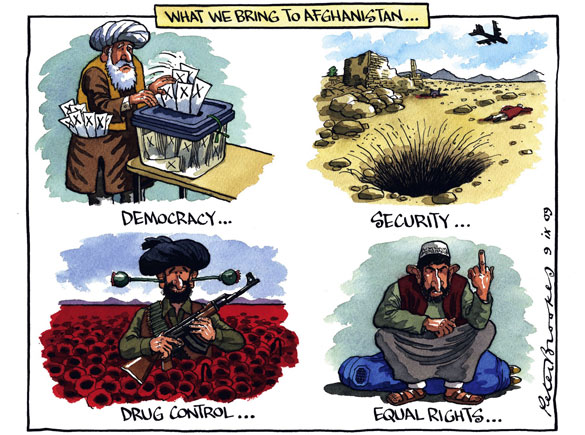 Peter Brookes
Foreign Policy run an Afpak blog for those interested in following the debate around Afghanistan and desiring more than what is offered by Australian newspapers.
In Canberra foreign policy circles it is axiomatic that, as increased Taliban control over Afghan territory would lead to new attacks in the United States, so Australia must stand by the US.There is not much critical thinking going on in Canberra about Afghanistan --even to recognizing that the Taliban and al Qaeda are distinct groupings with autonomous, though sometimes overlapping, agendas.
|





'Momentum' is the key word. Too many people in positions of authority have personal credibility at stake. The idea of admitting they have been pretty much wrong about everything so far and withdrawing would represent too much of a blow to their self-esteem. Consequently the directionless shambles will meander its weary way on interminably in the hope that something might turn up.