|
June 26, 2011
As the EU prepares to lend more billions to Greece after an initial €110bn failed to do the trick, the mood in Europe is dark. It's all about the survival and stability of the Euro in the face of Greece's financial implosion and its possible default on its debt and/or exit from the single currency.
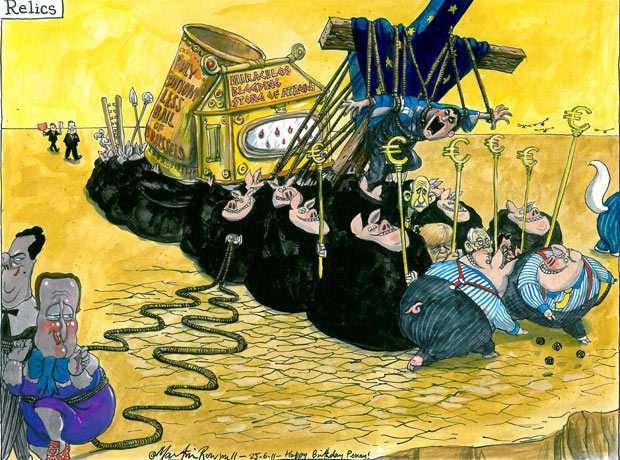 Martin Rowson
The steps from a single currency to a single economy remain a dream as the IMF, the European Commission and the European Central Bank (ECB)--the Troika--negotiate a new austerity package with the Greek government, in return for a new bailout deal. The neo-liberal austerity package--its akin to a debt hammer--- promises more suffering for the Greek people and involves the privatization of public assets--ie., sell off its water and sewer rights, ports, islands and other infrastructure.
The Greek government has already laid off 10% of its government workers, and the plan that they will vote on this Tuesday calls for layoffs of another 20%. It also provides for a total of 12% of GDP of fiscal tightening for 2011-2015, which is a recipe for never-ending recession. The whole point of the austerity package is to try to pay off an unpayable debt to bankers and bondholders.
The central concern for the Troika is that the banks must not lose money. Debts are sacrosanct--is the inference from the European Central Bank’s hard-money, anti-debt-relief rhetoric. The Greek Government under Papandreou side with the banks. The Greek people must pay up. If they resist, then the military and police are called out by the Greek Government.
As Paul Krugman says in reference to the US:
the policy prescriptions of the Pain Caucus all have one thing in common: They protect the interests of creditors, no matter the cost...the only real beneficiaries of Pain Caucus policies (aside from the Chinese government) are the rentiers: bankers and wealthy individuals with lots of bonds in their portfolios ... This is a negative-sum game, in which the attempt to protect the rentiers from any losses is inflicting much larger losses on everyone else. And the only way to get a real recovery is to stop playing that game.
Stop playing the game means Greece defaulting on the debt. Greece (and Ireland and Portugal) should be released from a substantial part of their debts since spending cuts and structural reforms alone will not enable the three countries to escape from their debt trap.
Update
Greek parliamentarians debate austerity measures imposed on them by eurozone partners. If the Greeks vote down these measures, Athens will not receive its second bailout, which could create an even worse crisis in Europe and the world. The source of the current sovereign debt crisis is the lack of political oversight over economic integration gone wrong.The Euro has made Greece (and other poorer countries) less competitive relative to richer European countries which have benefited greatly from the common currency. So there will be the a continued deterioration in Greece's trade balance -- thereby increasing Greece's indebtedness.
Update 2
The Greek Parliament has voted to pass the austerity measures to ensure the loan that it will enable it to pay its the debts that have fallen due. The MPs will vote on Thursday on laws to implement them. Greece is being pumped with cash so it can repay its debts to German and French banks.
Greece is flogging its assets in a fire sale to raise cash. The potential buyers, on the other hand, are very wary of investing in a country with a shaky political infrastructure alongside a track record of what one might call "structural hostility to business".
There is nothing in the IMF/ECB loan packages in the way of economic recovery. These packages actually destroy much of the retail sector while creating no productive activities, and focus on running a budget surplus through overtaxation simply to stabilise the European banking system. The German and French financiers are being bailed out, while the Greek economy spiral downwards into depression.
There is still the fiscal crisis of the Greek state to address, the structural problems of the real economy and democratic deficit in Greek politics.
Update 3
Membership of the euro for Greece has had tremendous costs attached to it, in terms of structural deterioration: originally seen as benefits (stronger currency, low real interest rates, higher market confidence in government bonds) these rapidly turned into weaker exports, increased imports and private sector debt, along with ill-considered increased government debt. This massive increase in consumption at both government and individual level was not matched by investment or growth in production: it was therefore completely unsustainable, inflationary and dangerous.
The cost of remaining in the euro as currently constituted is high for Greece. Greece's inability to devalue means that there is little hope of achieving economic competitiveness other than through slashing wages and overall standards of living. So the collapse of living standards is the price that Greece has to pay to stay in the euro --in the absence of any restructuring of the euro through large nett transfers to those nations on the periphery.
|





Simon Tisdall from the Centre for European Reform says that:
He adds that all three countries will eventually have to restructure their debts.
Initially, the EU will no doubt try and get away with ‘soft’ restructurings, involving a combination of longer maturities and lower interest rates.But this will not work and by 2013 there will be no viable alternative to ‘hard’ restructurings (default) comprising debt write-downs of 50 per cent or more. He adds:
Unlike Ireland, Greece will find it very hard to generate the stimulus from exports needed to offset the impact of continued austerity. Exports only account for around 25 per cent of Greek GDP – compared with well over 100 per cent in the Irish case – and Greece does little trade with countries outside the slow-growing EU