|
September 4, 2012
Gillard presses on with education reform in her response to the Gonski Review to lift teaching standards in spite of saying little about funding. The states, who are responsible for education, are close to broke and the Commonwealth has to stump up most of the 6.5 billion cash required.
Education is a core Labor issue in that the welfare state attempts to address the capitalist logic of ever increasing inequality through educational opportunity and a safety net. Schools for the well-off are better than ever; those for everyone else continue to deteriorate. It becomes self-reinforcing as the middle class continues to believe that their interests will be best served by an ever-freer market and a smaller state.
Gillard, in her speech to the National Press Club, stated that new funding will be contingent on states and systems agreeing to and delivering school improvement in the form of improving g teacher quality, including requiring more classroom experience before graduation and higher entry requirements for the profession; giving principals more power, including over budgets and staff selection; and providing more information for parents through the My School website.
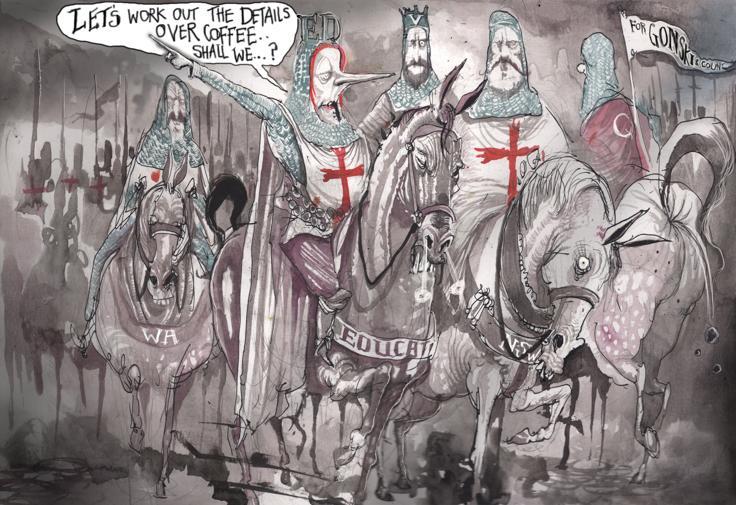 David Rowe
Gillard is opening up the negotiations with the states by mapping the field in terms of reforms aimed to achieve excellence rather than equity. On the table for negotiation are the states' share of the extra funding, the level of the basic benchmark grant under the Gonski plan (which would be topped up for needs, such as economic disadvantage), the amount of indexation and how quickly the funding is scaled up.
The states will have to scramble to avoid looking like the bad guys--as happened with the Disability Insurance scheme.---if they don't come to the table to negotiate. There is little doubt that current funding model is broken, leaving (mostly state) schools with high proportions of disadvantaged kids lacking the resources needed to ensure they get the education they need to live in a market economy. In contrast, (mostly private) schools, with more favoured clienteles, have further funding heaped on them by generous government grants.
People are now asking whether Gillard Labor is going to go into the next election with unfunded spending commitments. Will it trim middle class welfare to fund its commitments, given that the tax receipts this financial year are expected to drop 22.1 per cent of GDP to somewhere just above 21 per cent by next budget time due to falling commodity prices?
If we step back from this politics of the moment and look at what is happening at a deeper level, then we can discern the increasing inequality in our schools and society. This is what Gonski was addressing in educational terms. Philip Blond from the ResPublica thinktank says that:
While the left has tended to embrace the state as the agent of equality, the right invariably looks to the market as the agent of prosperity. And yet the left has not solved the problem of poverty through state redistribution, and the right has not delivered mass prosperity through the market. Instead, both the left and the right have presided over rapid and rising inequality and the seizure of wealth and opportunity by those at the very top of society.
His critique of the social democracy assumptions of Gillard's educational reforms would be that in the 20th century the poor represented the bottom 20%. But they have subsequently become the bottom third, and now with changes in the nature of modern capitalism in the 21st century they threaten to encapsulate the middle class itself.
It does appear that the development of technology and globalization undermines the middle class, and makes it impossible for more than a minority of citizens in an advanced society to achieve middle-class status. Francis Fukyama says that there is:
a lot of happy talk about the wonders of the knowledge economy, and how dirty, dangerous manufacturing jobs would inevitably be replaced by highly educated workers doing creative and interesting things. This was a gauzy veil placed over the hard facts of deindustrialization. It overlooked the fact that the benefits of the new order accrued disproportionately to a very small number of people in finance and high technology, interests that dominated the media and the general political conversation.
It is a reality that liberal democratic society's in the West cannot maintain a middle class without welfare support. We could add that the Australian society and economy cannot afford that kind of welfare support without increasing levels of taxation--eg., broadening the base of the GST (and cutting the corporate tax rate).
|





Labor has embarked on three ambitious spending plans within weeks of being warned it is losing around $10 billion a year in tax receipts due to commodity price falls.
We have the $6.5 billion per year Gonski reforms, that would arrive in $1 billion increments from 2014 if Labor won the next election; Labor's hefty commitment to the National Disability Insurance Scheme – between $5 billion and $8 billion a year according to the Productivity Commission – and its increases in funding for public dental care ($4 billion over six years). There is also $3 billion over four years to reopen offshore processing facilities.
Is the the budget so full of fat that it can be trimmed? Or will there be a new tax?