|
October 31, 2012
The current fetish in Canberra about the budget surplus is an expression of austerity now being “in fashion”. Governments respond to the revenue shortfalls of the global economic crisis through deficit reduction plans whilst economists blame it on the profligate spending of countries with social democratic governments.
The economists say that deficit spending is inflationary, and in any case will not help in the long run as budget deficits raise interest rates, “crowding out” business and household spending. They talk about as inflexible labor markets and “sticky prices”.
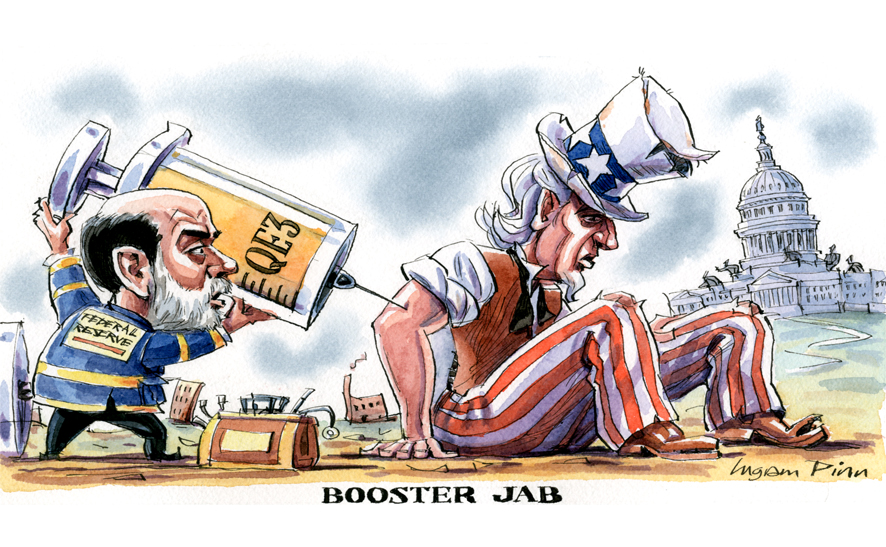 Ingram Pinn
This is the pre-Keynesian stance of the economics profession on display. The politicians reason from the analogy between the individual household and society as a whole assuming that what holds for the individual household holds also for all households together. Maxing out the credit card is bad.
Hence the need for belt-tightening. For these economists the bursting of the financial bubble and the subsequent crisis represented events that were not supposed to happen. For them ---e., their conventional macroeconomic wisdom---the economy was now free of major crisis tendencies, due to the advent of new, improved monetary policies.
There has been a shift in focus from financial crisis of 2007 to economic stagnation in the global economy; to a sense that there will be a prolonged period of stagnation, what Paul Krugman called a Third Depression (the first two being the Long Depression following the Panic of 1873 and the Great Depression of the 1930s).
The defining characteristic of such depressions was not negative economic growth, as in the trough of the business cycle, but rather protracted slow growth once economic recovery had commenced. In such a long, drawn-out recovery “episodes of improvement were never enough to undo the damage of the initial slump, and were followed by relapses.” It is a long period of anemic growth.
The logic of neoclassical economics is that rapid growth was natural under capitalism, except when outside forces, such as the state or trade unions, interfered with the smooth operation of the market. The economic reality is that global economic growth since the 1970s has been driven b;
(1) the much greater role of government spending and government deficits;
(2) the enormous growth of consumer debt, including residential mortgage debt, especially during the 1970s; a
(3) the ballooning of the financial sector of the economy with its explosion of all kinds of speculation, old and new.
A new financially driven capitalism centered in Wall Street had emerged. That financialization style of growth crashed spectacularly in 2007.
The situation now is one of financial instability and a deep economic malaise (stagnation), which has set in during the current period of financial deleveraging and the declining hegemony of the US. The hope is that China can carry the world economy on its back, and so keep the developed nations in America and Europe from what appears to be a generation of stagnation and intense political struggles over austerity politics. The big hope is that China could provide capitalism with a few decades of adequate growth and buy time for the Us and Europe to sort themselves out.
China---the new perpetual growth machine--- will act to counterbalance the tendency toward stagnation at the global level. We are now in the realm of economic illusions.
|





prof.bill mitchell,formerly of newcastle university and now at darwin university,dubunks all this neocon economic bullshit that we are constantly fed when he says that any sovereign nation that issues it's own currency can run a deficit indefinitely and over time this will correct because of the automatic stabilisers ie.increased tax revenue from a growing economy.the analogy of a household budget is wrong and misleading but it serves the rhetoric of the neocons.he advocates a jobs guarantee as a means to equity and to grow the economy.sadly our so called progressive government has sipped on the neocon cool aid and relentlessly pursue holy grail (surplus)
http://bilbo.economicoutlook.net/blog/