|
December 30, 2012
A polarized Washington needs to engage in bipartisanship and compromise if it is to avoid the fiscal cliff scenario of a series of automatic tax increases and a program of drastic spending cuts that would immediately cut the budget deficit almost in half.
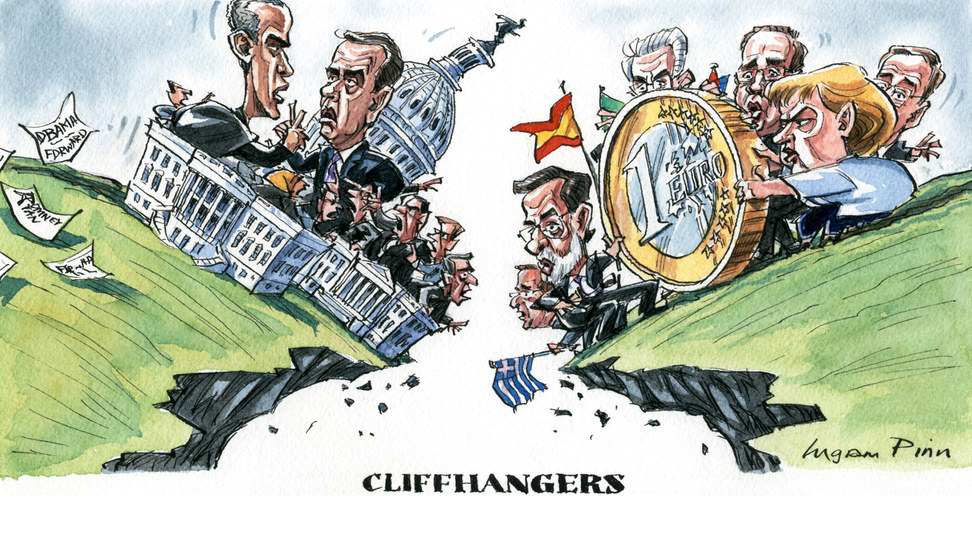 Ingram Pinn
The fiscal cliff is a creation of the US Congress, which could not agree on a yearly budget that would also help the country reduce its deficit, or long-term debt, of $1.3tn. To resolve the impasse in August 2011, the Congress decided to push the big decisions off by 17 months. Now the 1 January deadline looms, and with little sign of a grand bargain l in Washington, the automatic tax hikes and automatic spending cuts loom.
Behind the deal making is the austerity economics. Michael Hudson says about this economic ideology:
Wall Street lobbyists blame unemployment and the loss of industrial competitiveness on government spending and budget deficits – especially on social programs – and labor’s demand to share in the economy’s rising productivity. The myth (perhaps we should call it junk economics) is that (1) governments should not run deficits (at least, not by printing their own money), because (2) public money creation and high taxes (at lest on the wealthy) cause prices to rise. The cure for economic malaise (which they themselves have caused), is said to be less public spending, along with more tax cuts for the wealthy, who euphemize themselves as “job creators.” Demanding budget surpluses, bank lobbyists insist that austerity can enable private-sector debts to be paid.
Shifting the tax burden onto labor and industry is achieved most easily by cutting back public spending on the 99%. Attacking the safety net is the root of the December 2012 showdown over whether to impose the anti-deficit policies proposed by the Bowles-Simpson commission of budget cutters whom President Obama appointed in 2010.
We need to be careful here for two reasons. First, the expiration of the Bush-Obama tax cuts will, on its own, eliminate roughly half of the long-term gap between federal government revenues and expenses. Higher tax revenues will reduce the pressure to do something about entitlement spending—at least the pressure that is due to budgetary constraints, though not the pressure that is due to ideological opposition to those programs.
Secondly, the automatic sequesters mandated by the Budget Control Act of 2011 barely touch the major entitlement programs. Social Security and Medicaid are specifically exempted; most Medicare spending cuts are limited to 2 percent. That means that the rest of the government gets smaller, again reducing budgetary pressure on these crucial programs.
Update
After all the manufactured drama and political theatre a deal has been cobbled together at the last minute. The Senate has pushed the issue of the sweeping government spending cuts that were designed in 2011 off for two months.
The tax cuts now don't apply to those earning less than $450,000 threshold, which covers less than 1% of Americans. It also extends unemployment benefits for millions of Americans – at least, for another year; extends tax breaks for research and development and interest on student loans. Estate tax also rises, to 40% from 35%, but inheritances below $5m are exempted from the increase.
There is no new infrastructure spending and no continuation of the payroll tax cut.
The House Republicans expressed opposition to the bill passed by the Senate mainly over the failure of the bill to include cuts in federal spending.Right wing conservatives, backed by the Tea Party movement, are hostile.
|





Most unedifying to watch the small men of Congress swaggering around, hitching their strides whilst most people in the world watch to see what damage is inflicted on the American economy and on the European economies.
To reduce the impact of the US on the world economy commodity contracts should no longer be written in US$, write the oil contracts in Euros, Sterling or Remnimbi or Yen.