|
August 18, 2010
In Don't blame Latham for highlighting home truths in the National Times Peter Costello says that the Labor base is drifting away because it does not see this as a successful government:
Labor's primary vote is at 38 per cent. Last election it was 43.3 per cent. About 700,000 voters have left in three years. If Labor is re-elected, it will be on Green preferences. In fact the election is being fought between two coalitions - the Liberal-National one and the Labor-Green one. The Greens will deliver more votes to their coalition partners than the Nationals will to theirs.
There is is, he adds , a wider disillusion with Labor, which Mark Latham puts it down to stage-managed campaigns and "spin", eg., the way Gillard is being manufactured for the campaign. What Costello fails to mention is that the Coalition also engages in stage-managed campaigns and "spin", eg., the way Abbott is being manufactured for the campaign.
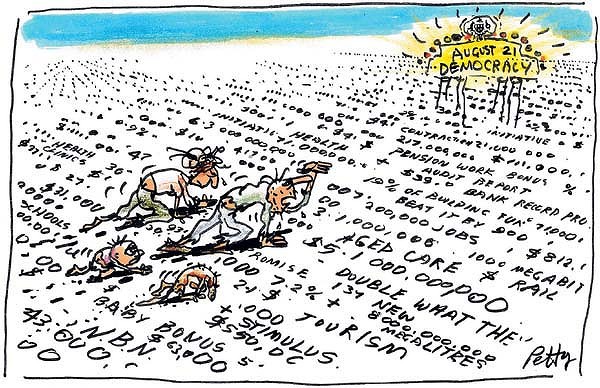
Though Costello's main point stands--- the election is being fought between two coalitions - the Liberal-National one and the Labor-Green one, and the Greens will deliver more votes to their coalition partners than the Nationals will to theirs--- he doesn't mention the lack of action on climate change. Yet the decline in Labor's fortunes began with the abandonment of the ETS.
Costello doesn't address the core issue that both the Coalition and Labor have turned away from the path to a greener economy, nor the unpopularity of their limited climate policies. As Adam Morton highlights in Sorry state of play when China leaves us for dead on climate in the National Times an:
emissions trading has been abandoned by one party and delayed by the other. Neither can guarantee they will meet even the minimum national target of a 5 per cent cut below 2000 levels by 2020. The plummet to the bottom on climate during this election campaign has only further highlighted how far Australia has fallen behind.While Prime Minister Julia Gillard talks about record levels of investment in renewable energy, she has cut hundreds of millions of dollars from solar programs - Labor had more money committed to ''harness the wind and the sun'' before she became leader. The Coalition has promised similar cuts.
Neither Gillard nor Abbott shows much sign of understanding the risks of climate change, let alone the opportunities that come with moving early. Neither understand that the crucial first step to decarbonising the economy is to curtail the current coal burning binge. Only The Greens understand.
Under both major parties Australia’s greenhouse pollution will increase, even though there is general support amongst citizens for action on climate change to reduce Australia's emissions. They major parties could stop supporting the new coal mines and coal-fired powered stations.
What does that kind of lack of action, and the gap between the political parties and citizens, mean for Australian democracy? Can we still see the ALP as a vehicle for making a genuinely better society one that attacks poverty and inequality as well as an unsustainable economy? I have my doubts. I'm sceptical.
Will we begin to see the Australian political system being placed on the table as an issue, and a debate about Australia's democratic deficit staring up?
|




It was quite amusing for me to see that while the Latham story was poo pooing the spin campaign and highlighting points in the ads they were actually running those type of ads in the break.
Are we at the point where we could say that the group that wins has the dumbest supporter base? Or will they have enough smart people to negate the percentage that voted because they believed the spin? Or should I just shut up because democracy belongs to dumb people too.