|
March 18, 2013
The Euro debt crisis has taken a turn for the worse and the financial repression of the weaker Euro-Zone members has increased.
Cyprus' banks have gone bust. They will collapse without a bailout. The Troika--the European commission, the IMF and the European Central Bank – imposed a levy on savers in Cypriot banks on the grounds that Cyprus part-finance their own bailout . Savings of over €100,000 will be subject to a 10% tax, and those under €100,000 one of 6.7%. Around half of all those higher deposits (estimates vary) are owned by Russians, many of whom allegedly use the country as a tax haven from their own domestic charges. The bail-in of Cypriot depositors to the tune of 5.8bn euros is about a third of Cyprus’ GDP.
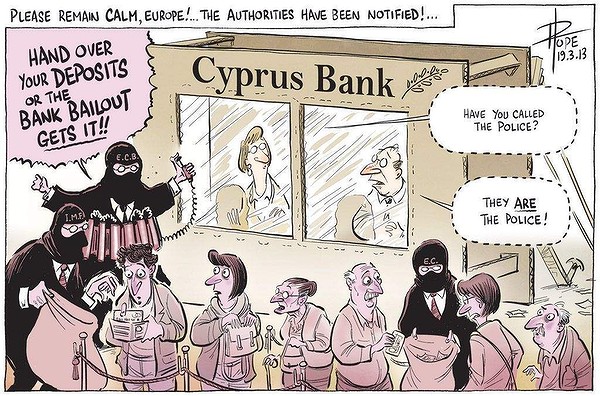 David Pope
The levy is part of a 10bn euro “bailout” of Cyprus, which does not have the money to bail out its banks. The Troika's "take it or leave it" ultimatum to the Cypriot government and means the debt burden of the banks has been transferred from the banks, where it properly belongs, to households, who had no part in their lending decisions. This marks a new turn in the European crisis.
Cyprus's banks have a problem. Its banks went on a lending spree during the good times – by 2011, they had made loans worth more than eight times the country's national output. Cypriot banks had made loans to Greece worth 160% of GDP and the losses on that high level of exposure have been rising rapidly.
Cyprus also has a problem. Greece is a key trading partner for Cyprus, so there has also been a direct negative impact on the Cypriot economy from the austerity imposed on Greece. Its debt to GDP ratio is 145% and it is bankrupt. So life is going to be grim.
Germany, Finland and the Netherlands are increasingly unwilling to support the weaker Euro-Zone members. Germany is unwilling to pay up for the bailout. As in the case of the 2012 Greek debt restructuring, the ECB and other official lenders are unwilling to take losses on their exposure to the Cypriot banks.
A "stability levy" on those under €100,000 means that overnight a widow’s life savings, carefully saved up over decades, have been gouged, simply because EU bureaucrats decided to protect hedge funds and the German surplus, and to teach the Russians a lesson.
So it is not simply a simply a wealth tax that shift taxes away from income to wealth. It is a form of confiscation and the EU and the European Central Bank (ECB) have actually spooked world financial markets.
Will the levy--or cash grab--- trigger depositors to pull money out of Cyprus at record speed as soon as they have the chance? In the event that the Italians and the Spanish get an inkling that a bailout is looming, won't they immediately withdraw all their euros immediately, triggering a bank run? Causing deposit runs sure is junk public policy
Rather than using the European Stability Mechanism to recapitalise banks, and thereby weaken the link between banks and their governments, the euro zone continues to equate bank bail-outs with sovereign bail-outs. What is not being adopted is the direction of efforts to improve banks’ liquidity position, which should be to encourage them to hold more deposits.
The bond bond holders get away unscathed. The EU, after the financial crash, has not agreed to forgive much of the debts. The Germans, are blocking debt forgiveness with the Finns, the Dutch and the Austrians and so the Cyprus rescue package favours the vested interests of the financial sector, while treating the "population at large" with disdain and contempt.
However, though the package will stave off immediate collapse it may not address Cyprus’ problem. As in Greece and Portugal, privatisation proceeds and the revenue from increased taxes may not reach targets. As with Greece, there is a risk that Cyprus will need additional assistance, entailing further write-offs in depositor’s fund, because it will not generate enough money from tax receipts to repay the loan.
|





to prevent debilitating bank runs, depositors need to be sure their holdings are safe. The worse-case scenario reaction is one of bank runs in periphery countries.