|
May 7, 2009
In his Press Club address Malcolm Turnbull argued that debt levels were soaring and that we should all be worried. He argues that when governments spend borrowed money they have to make sure they maximise the return for the taxpayer. Instead the debt burden on the taxpayer is increasing. He's creating fear about debt levels:
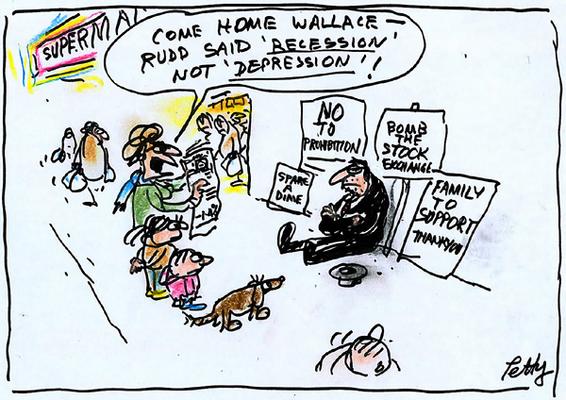 Bruce Petty
Turnbull argues thus:
At the end, after the vacation – the family that’s done that, they’re left with a debt and some snaps in the family album and some nice memories. The family, on the other hand, that borrowed the money to renovate their house is left with an improved asset and something of real value. And it’s exactly the same with nations, exactly the same with Australia. Debt which is incurred to fund investment in infrastructure that increases the productivity of Australia will, in time, pay for itself because it produces a stronger economy, it generates more jobs, more income and, therefore, more revenues to the Government.
The argument is designed to support Turnbull's position that main that implies the Rudd Government does not have are the building blocks of a strategy that is going to deliver that platform for growth that is focused on jobs, jobs, jobs .
Those building blocks are no more debt than is absolutely necessary, keeping the deficits as low as possible, having a plan to restore us to surplus and spending on infrastructure. The Rudd Government, he claims, is maxing the credit card to the tune of $300 billion, splashing the cash, and not spending on infrastructure.
One part of this is disingenuous. The so-called "cash splash"----ie., the stimulus package--- is working its way into the economy in terms of retail sales and pushing forward housing activity. It has softened the impact of the decline (ie., by propping up employment) until the "shovel-ready" infrastructure spending kicks in after next weeks budget. Turnbull is in effect claiming that stimulus package money is ill-spent --hence the phrase "cash splash"--because it is not invested in infrastructure.
Then we have the fear part about the burden of debt:
And this $300 billion means $15,000 of debt for every man, woman and child in Australia. So a family of four, it means $60,000 of debt. That’s what our children are going to be left with by the Rudd Government. It is a frightening prospect for them and it underlines the way in which this Government with its classically Labor addiction to debt has undermined our confidence as a nation, our economic confidence, and above all and worst of all impeded our capacity to recover from this downturn.
As Turnbull said on the ABC's 7.30 Report:
the problem with socialists is that at some point, as Margaret Thatcher said, you run out of other people's money. And that's the problem with the socialists running Australia at the moment: they've run out of the money that was left to them by John Howard and Peter Costello and now they've decided to max out the credit card. And if you think that that level of debt will not be a brake on our recovery, will not result in higher interest rates and higher taxes in the future, then I have to say to you that you're kidding yourself. This level of debt is a heavy burden.
Labor is reckless with money, Always has been. They are bad economic managers. Always have been. That's the Liberal Party's politics. Always has been. That is the subtext of Turnbull's message.
|





Mal and his mad Murdoch media mafia mates are looking a bit sick today after the news of a fall in unemployment.