March 16, 2011
Japan nuclear situation: fear or fact?
What we would expect from Australian scientists and academics with expertise in nuclear power, engineering and energy is to keeping us informed about the unfolding nuclear disaster in Japan. We don't expect this from partisan newspapers such as The Australian which uses its op-ed page top fight the culture wars and destroy those on the left side of politics. Anything goes for them. The scientists, in contrast, try to educate the public so that we have an informed citizenry.
I have been reading Prof. Barry Brook's (he's an environmental scientist at Adelaide University) brave new climate blog. Though Brook is a nuclear power advocate he publicly adopts a 'just the facts' approach: one that is designed to inform rather than deceive so as to facilitate a rational debate about nuclear power in Australia. This is important, given the misinformation and hyperbole flying around the internet and media about the Fukushima nuclear reactor situation.
 Martin Rowson
On his March 15 post---a summary of the situation report--- Brook's position was that the situation with respect to Fukushima Daiini, is now under control, and units are in, or approaching, cold shutdown. He adds that units 1+3 at Fukushima Daiich plant were fairly stable. Unit 4 was stable. Unit 2 was the one of most concern, but the odds are that no one will be hurt from radioactivity.
My interpretation of the analysis on his blog is that the situation is under control, there is no reason for concern as the situation is clearly (but slowly) stabilising, and that the radiation level at the site boundary is not a risk to the public.
However, an editorial note by Brook to a guest post by Ben Heard does jar:
[Ben is a relatively recent, but very welcome friend of mine, who is as passionate as I am about mitigating climate change. I really appreciate publishing his thoughts in this most difficult of times. Now, more than ever, we must stand up for what we believe is right]
What is right? Nuclear power is the solution to global warming? Australia should embrace nuclear power? Does this frame the opinion contained in the blog posts?
In his post Heard details how the deteriorating situation at the Fukushima Daiichi has led to a severity rating of INES 6. He says that this is clearly very serious and adds that the Three Mile Island Accident was a 5. Chernobyl, however, was a 7 (the highest), and is a very different league. He finishes thus:
If Japan’s nuclear power sector can withstand the worst natural calamity I hope to ever see in my life and contribute no deaths, minimal injuries and minimal environmental impact, then nuclear power must be just about the sturdiest, best designed, best managed and least dangerous infrastructure in the world. And in a world that is quickly cooking itself through climate change, nuclear power must not be allowed to suffer from the hype, headlines and hyperbole that have stemmed from this tragic event. Fear or facts. I choose facts. I hope you do too.
It's not a case of fear or fact---it's both plus an interpretation of facts. Brook's interpretation of the facts of an "ongoing crisis situation"---ie., new explosions, fires, exposure of fuel rods, containment vessel of reactor #2 being breached, the fire in unit #4 apparently released significant radiation to the environment, etc.--- is that the situation is under control. That is Heard's interpretation as well.
This strikes me as an optimistic interpretation in an unfolding, dynamic situation. A bit too rosy perhaps? If we dig deeper into Heard's post we find this statement:
The bottom line of the events at Fukushima and the nuclear power sector more broadly would appear to be as follows: ...No significant or lasting environmental impact whatsoever
How would Heard know that? The facts aren't even in as this statement refers to future events that have yet to happen. We have spin, or ignorance, in the form of speculation Nor is there any mention of people being evacuated in a 20-30k radius and workers are ordered to leave the site where they are most needed due to radiation.
Recall that Brook's holds that this is a critical time for science, engineering and facts to trump hype, fear, uncertainty and doubt. If we dig into Brook's past post--eg., that of 12 March --- we find this confident statement: "There is no credible risk of a serious accident." Events have proved otherwise, haven't they.
We now have the reactor shutdown generating heat from the hot fuel but no cooling systems. That is the same basic scenario as at Three Mile Island. The company--Tokyo Electric Power (Tepco)-- is having difficulty in bringing the plant under control.The 50 workers left are struggling to keep hundreds of gallons of seawater a minute flowing through temporary fire pumps into the three stricken reactors, Nos. 1, 2 and 3, where overheated fuel rods continued to boil away the water at a brisk pace.
Brook's "clearly (but slowly) stabilising" interpretation does need to be questioned.in the light of what is happening.
Update 1
Brook's "clearly (but slowly) stabilising" interpretation is looking increasing implausible. Surprisingly, comments to that effect on his blog posts are being deleted. At best it looks as Japan is struggling to regain control as conditions at its failing nuclear plant continue to deteriorate further.
A more pessimistic interpretation was given in a briefing on the nuclear plant crisis in Japan to the US Senate's committee on the environment and public works by Greg Jaczko, chairman of the US Nuclear Regulatory Commission Recall that Brook's position is that Unit 4 is stable. Jaczko, in contrast, says that there is no more water in spent fuel pool at No 4 reactor:
We believe at this point that Unit 4 may have lost a significant inventory, if not lost all, of its water.... There is no water in the spent fuel pool and we believe that radiation levels are extremely high, which could possibly impact the ability to take corrective measures....We believe that around the reactor site there are high levels of radiation. It would be very difficult for emergency workers to get near the reactors. The doses they could experience would potentially be lethal doses in a very short period of time."
Tokyo Electric Power are saying that they can’t get inside to check but reckon there is no problem.
Jaczko also said there was the possibility of a leak in the spent fuel pool in reactor No 3, "which could lead to a loss of water in that pool", as well as a falling water level in the spent fuel level at the No 2 reactor. The water level has been dropping in the No 5 reactor as well.
If the American analysis is accurate and emergency crews at the plant have been unable to keep the spent fuel rods at that inoperative reactor properly cooled — they need to remain covered with water at all times — radiation levels could make it difficult not only to fix the problem at reactor No. 4, but to keep servicing any of the other problem reactors at the plant.
Posted by Gary Sauer-Thompson at 10:30 AM | Comments (22) | TrackBack
March 14, 2011
Japan: nuclear crisis
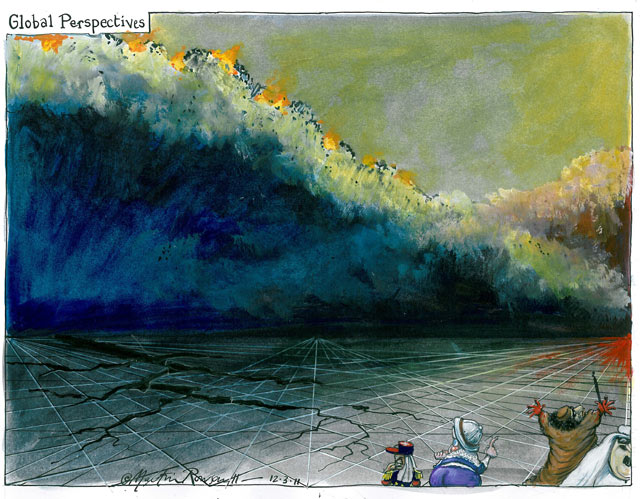
Three days after a devastating earthquake unleashed a tsunami in which at least 10,000 people are feared dead Japan faces a deepening nuclear crisis. An intense public-relations battle has already started.
 Martin Rowson
Damage has been caused to the antiquated Fukushima Daiichi nuclear complex in northern Japan from the 9.0 magnitude earthquake and subsequent tusnami. The outer containment wall was destroyed in an explosion on Saturday.
All three reactors (units 1, 2, 3) are threatening to overheat. The auxiliary buildings of the nuclear plant were destroyed by an hydrogen explosion and the plant will have to be decommissioned because seawater is corrosive.
In response to the disaster the nuclear lobby in Australia are quick to say that we don't need to worry about a thing. Nuclear power is safe.
It is emerging that the government, the power industry and the academic community had seriously underestimated the potential risks posed by major earthquakes to their nuclear plant. The designs of plants were not built to robust enough standards for serious quakes caused by the build up of tension from the movement of tectonic plates.
The threat is real but unclear. Japanese authorities are doing all they can at the moment to keep the core of units 1+2 cooled with seawater after emergency cooling systems failed to stabilise the radioactive cores. If the cooling fails, the reactors could overheat and cause a total meltdown of the radioactive fuel rods in the core. This would only lead to a major release of radiation if the reactor's containment vessel was breached.
Update
In this account it is stated that once a nuclear plant shuts down, it has two ways to get electricity, one is from the grid, and another is from emergency diesel generators that they have on site. In Japan's case:
because of the magnitude of the earthquake, the grid basically went dark, so they were operating on their diesel generators and everything was functioning as it should be. But then, based on news reports, about an hour after the earthquake and the shutdown, the tsunami hit, and flooded the plant, where the diesel generators were, and that caused them to lose their diesel generator power and reduced them to their emergency battery backup power only.
The problem is that emergency backup on the batteries gives them very limited capabilities---they are only good for a few hours--- and so they were having a very difficult time keeping the plant cool. Using sea water to cool the reactor means that they’re basically down to their last option.
Even though they must have got additional generating power onto the site to pump the sea water, it seems that they have experienced a partial core meltdown.
Update2
In The Australian Brendan O'Neill says that the response by Western reporters and experts to the explosions at the nuclear power station in Fukushima in northern Japan is seriously overblown, and that it reveals more about us and our fears than it does about the reality on the ground in Japan. He adds that this response:
has been driven not by hard evidence that there will be a devastating radioactive leak, but by a culture of fear which feverishly seeks out the worst-case scenario; by an almost pornographic apocalyptic outlook unsatisfied by the images of waves of water wiping away towns and villages - no, it needs a nuclear component to this tragedy too.
O'Neill says that many observers are now fantasising about a possible meltdown at a nuclear energy station that was badly shaken by the quake, which apparently could give rise to a radioactive holocaust that would make nature's fury look like a tea party in comparison.
The problem here is that the nuclear situation in Japan is developing rapidly. It now appears that all three nuclear reactors are likely to have suffered partial meltdowns, though this could mean just one fuel rod or nearly all of them melting within the cores. The reactors are at risk of going into meltdown because although they had shut down, the fuel rods continue to give off heat. Reactors 1 and 3 appeared stable for the time being, but that reactor 2, where fuel rods were most exposed, was still a concern.
We also know that radiation has spread from the three reactors of the Fukushima Dai-ichi nuclear complex and that the level seems high enough to damage human health.
Update 3
A large blast was heard at the No. 2 reactor at the Fukushima Daiichi Nuclear Power Station. It happened in the “pressure suppression room” in the cooling area of the reactor, raising the possibility to damage to the reactor’s containment vessel. Any damage to the steel containment vessel of a nuclear reactor is considered critical because it raises the prospect of an uncontrolled release of radioactive material and full meltdown of the nuclear fuel inside. If there is heavy melting inside the reactor, large amounts of radiation will most definitely be released.
Tokyo Electric Power Co (Tepco) is warning that "it had lost the ability to cool Fukushima Daiichi's reactor 2," and the current failure of officials to keep water levels up to cool the fuel rods has heightened the possibility of a meltdown.
Update 4
The Australian says that it stands for science and knowledge against the irrationality of environmentalism that distorts public debate. The editorial says:
It is the triumph of reason that sets humankind apart, that has freed us from superstition, enabled us to prosper, to develop wondrous cultures, to travel and explore from the depths of the oceans to the fringes of the universe.
The Australian says that they are opposed to fearmongering and hysteria over climate change that has been propagated by scientists, educators and politicians; and the fearmongering in the wake of the Japanese tsunami disaster. They say that the Japanese tsunami tragedy was caused by a shift in tectonic plates and that climate change is irrelevant to this event.
I haven't come across any commentary that links the Japanese earthquake and tsunami to climate change--it's a straw dog argument. What we have is anti-nuclear activists talking in terms of a Japanese Chernobyl occurring at Fukushima, even though the nuclear reactors are quite different.
What I have come across is commentary that critiques the optimist view of the nuclear lobby (eg., Switkowski and O'Neill) in The Australian that talks in terms of a culture of fear, that says there is little to worry about from the damage to the Fukushima Daiichi Nuclear Power Station, and that it's mostly fearmongering and mass hysteria by the "antinuclear power bandwagon" and environment groups who are opposed to the development of nuclear power in Australia.
I would consider The Australian's kind of crudity a distortion of the public debate. This video from Britain’s Channel 4 News on the deteriorating situation at the Fukushima plant is a rational voice based on knowledge rather than the voice of someone fighting the culture wars:
At Three Mile Island, there wasn’t any loss of power and the equipment functioned. The mistake was that people turned off the emergency cooling. At Fukushima there is a loss of power and the equipment malfunctioned. So the situation in each of the four troubled reactors at Fukushima Daiichi Nuclear Plant is much more serious than the Three Mile Island incident.
Posted by Gary Sauer-Thompson at 6:22 AM | Comments (25) | TrackBack
February 2, 2011
Tropical Cyclone Yasi
The Bureau of Meteorology says that Cyclone Yasi is likely to be more life-threatening than any experienced during recent generations. The cyclone is expected to cross the coast in the Innisfail area at about 10pm.
Yasi’s immense size and power will surpass that of Australia’s deadliest and most notorious tropical storm, Cyclone Tracy. Tracy hammered Darwin on Christmas Eve in 1974, all but wiping out the Northern Territory capital and killing 65 people.
Tracy was far smaller than Yasi, but the fact it made landfall on top of Darwin was the deadly blow. Yasi will make landfall south of Cairns near the coast at Innisfail.
This cyclone is a deadly event. The latest tracking map of the cyclone from the Australian Government Bureau of Meteorology

The first waves of Cyclone Yasi hit the Esplanade in Cairns around 8am this morning. Rain is now falling in Cairns. The wind is pickling up. A real time map of Yasi.
Update
Cyclone Yasi is expected to hit around midnight local time tonight. It is not expected that the cyclone will diminish in intensity. 6.6. metres waves hit Townsville this afternoon; now they are 9.6 metres. This is the latest tracking map from the Australian Government Bureau of Meteorology:

The low-lying coastal areas in Yasi's path are going to devastated with waves going through houses. Those who have not fled these homes, and who have been advised to shelter in the smallest rooms in their houses to wait out the storm, are in danger. They cannot go outside and cannot be rescued, as emergency services are in lock down.
Why are people allowed to build in these low lying areas by the local and state governments? They would have maps of areas impacted by rising sea levels caused by global warming.
Posted by Gary Sauer-Thompson at 11:51 AM | Comments (5) | TrackBack
January 28, 2011
the irony
So the Gillard Government's one off flood levy to help pay for the $5.6 billion anticipated flood damages is relatively modest, temporary and progressive. The flood levy will fall on those who can pay; people earning less than $50,000, pensioners and those who have received a disaster recovery payment will be exempt. It will raise just $1.8 billion.
Gillard will meet the shortfall by deferring $1 billion worth of infrastructure programs and finding $2.8 billion by scrapping, raiding or "re-profiling" a dozen government programs, including those that were supposed to reduce emissions. How ironic. Cutting from climate programs to fix railways needed for Queensland's coal industry. That says it all.

In fairness, some of the programs abandoned were dogs. Few will mourn the loss of cash-for-clunkers, which would have done next to nothing for the environment. This was to pay $2000 to each motorist who traded in a pre-1995 car for a more fuel efficient one.The Green Start home energy assessment program that replaced Labor's Green Loans program will itself be axed and payments of the solar hot water rebate, solar homes and communities rebate and LPG car conversion grants will be capped.
That's half a billion dollars out of solar. Yet subsidies for fossil-fuel industries remained untouched. There is no shift to feed-in tariffs and loan guarantees. What does that do for the Gillard Government's credibility on climate change? So much for the development of the cleantech industry in Australia--nascent or infant industries need support.
The indications are that a carbon price with real bite – somewhere between $50 and $100 a tonne to generate the technologies that are needed in the future---is just not going to happen under a Gillard Government.
Posted by Gary Sauer-Thompson at 2:13 PM | Comments (14) | TrackBack
January 20, 2011
flood insurance
I think that it a national disgrace that the inadequacy of insurance for floods means that many people are ruined, either because flood insurance is to expensive, the insurance companies avoid flood insurance; or they limit the coverage. It's a classic example of market failure. Many Queenslanders----40- 60 per cent-- for instance, were uninsured because they could not get the coverage where they lived.

It is an issue that needs to be addressed because people return to rebuild their homes on the flood plain that has inadequate protection from future floods. Given that the one in a hundred years flood no longer makes much sense, there is a need for some form of affordable national insurance for natural disasters (water damage, bush fires and earthquakes etc).
Such a low cost coverage scheme is what the Insurance Council opposes--in spite of the obvious market failure. What local insurers will more than likely do is use the floods to pass on double digit rises in premiums to consumers. The market will not address this issue nor will they do the necessary flood mapping (public information) or mitigation works.
This is an obvious example for government intervention into the market. Will the Gillard Labor Government have the courage to intervene?
Posted by Gary Sauer-Thompson at 10:36 AM | Comments (12) | TrackBack
January 11, 2011
Queensland floods: Living on the floodplain
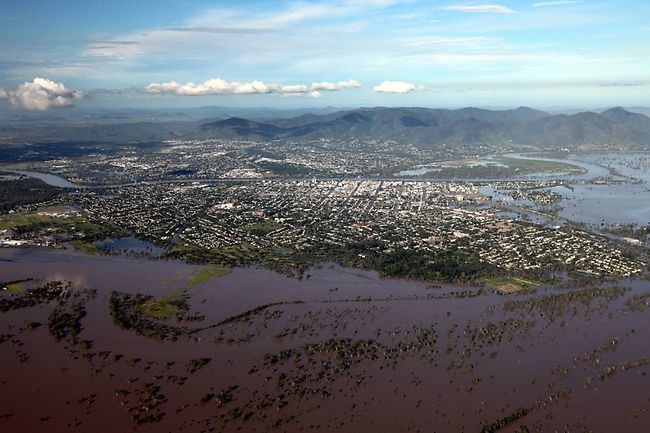
The floods that have swept through Emerald, Rockhampton, Toowoomba, the Lockyer Valley region, Ipswich and now Brisbane have seen 38 regions across Queensland being declared a natural disaster area. The floods are the result from a switch from El Niño to La Niña.
This switch is one reason why Australia has these big swings in climate from dry to wet and back again. What causes the switch is not known, but it is thought to arise from the complex interaction of ocean and atmospheric circulations.
 Rob Maccoll, Rockhampton in flood from the air, Courier-Mail, 2011
Glancing through the gallery of readers photos at the Australian indicates that the multi-billion damage caused by this flood event in Queensland is largely due to more and more people living in flood plains and farming in areas that historically have flooded.
Whitelightbringer's footage of East Creek near Chalk Drive / Chalk Lane rising and washing away lots of cars during Flash Flood in Toowoomba on Monday 10 January 2011.
So the finger can be pointed at the people who made the zoning decisions. They should not be left off the hook by the talk about building dams to capture the water flows so their storages can be used for future wealth creation by Big Ag. It's what the Nationals and their court jester( Barnaby Joyce) mean by humans taming nature.
The real problems of climate change are still ahead---the scenario for southern Australia is for warmer temperatures and less rainfall, except for north-west Australia. It is still unclear under the switch from El Niño to La Niña and back again will be effected by climate change. Will the cycle become more frequent and more intense?
Update
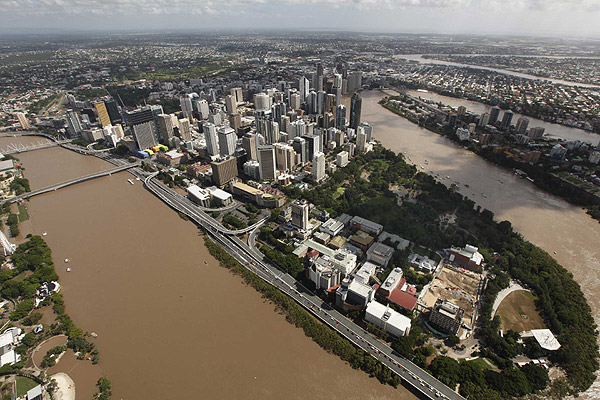
The Brisbane River has already broken its banks in parts of the city and evacuations are underway in some suburbs. The water has entirely engulfed the lower promenade at Eagle Street Pier, in the city’s entertainment precinct, flooding dozens of restaurants and threatening many more. The CBD was a virtual ghost town this morning.The power is being cut in the CBD.
This is a map of the flood modelling on the Brisbane City Council website. At this stage the flood has killed 14, while around 74 are missing. Unfortunately, more are expected.
If predictions are right, the floods starting to affect Brisbane could be worse than the 1974 floods, given the wall of water bearing down on Brisbane. The Brisbane River hasn't peaked--there's all that water still to come down from the Lockyer Valley (tomorrow morning?); water is being released from the Wivenhoe Daminto the Brisbane River and the king tides peak on Friday.
Almost 20,000 homes in Brisbane will be flooded by early tomorrow morning when the surging waters are expected to reach around 5.5 metres, which is just higher than the '74 flood. (The Brisbane River peaked this morning at 4.46 metres, more than a metre below the predicted peak of 5.5 metres.)
 Tim Wimborne, Brisbane River, Reuters, 2011
So why allow development in known flood prone areas? What happened to the investment in flood control infrastructure when the need was apparent in the lower lying suburbs of Brisbane? After all, Brisbane is a city built in a mangrove swamp on a floodplain, and it was flooded in 1974.
Update2
The torrential rain from the concentrated storm fell on already saturated ground in the region west of Brisbane. With nowhere to go, the water formed intense flash floods that ripped through the Lockyer Valley. The water then drains east, pushing several rivers past major flood stage, and eventually ends up in the sea.
So many people in Brisbane are living on a flood plain without flood insurance or proper development controls in low lying areas. They are sitting ducks. How did this happen? This looks to be a failure of local and state government.
Update3
Hedley Thomas in Alarming report on Brisbane River risks covered up in The Australian informs us of what happened in Brisbane with development in low lying areas. He says:
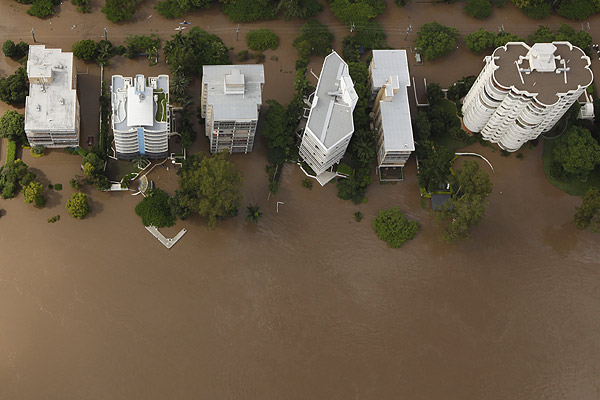
A secret report by scientific and engineering experts warned of significantly greater risks of vast destruction from Brisbane River flooding - and raised grave concerns with the Queensland government and the city's council a decade ago.But the recommendations in the report for radical changes in planning strategy, emergency plans and transparency about the true flood levels for Brisbane were rejected and the report was covered up.
That report was the comprehensive 1999 Brisbane River Flood Study. The Brisbane City Council adopted a "no change, maintain status quo" strategy -- despite its expert review advising that such a strategy was "poor".
 Tim Wimborne, Brisbane River water front Reuters, 2011
Thomas says:
the council had permitted the development of thousands of properties whose owners were led to believe they would be out of harm's way in a flood on the scale of 1974....In the debate that followed its leaking it emerged that misplaced faith by governments and residents in the flood mitigation potential of Wivenhoe Dam played into the hands of property developers, who were profitably turning low-lying swaths of Brisbane into expensive housing.
Campbell Newman, the current Mayor, campaigned against the Labor Council's secrecy over the flood study and he radically overhauled policies to warn the public of the severe risk of another major Brisbane River flood. But the developments had already happened.
Posted by Gary Sauer-Thompson at 6:10 PM | Comments (17) | TrackBack
September 23, 2009
sydney dust storm
There are some amazing visuals of the Sydney dust storm getting around. The ABC collection has been steadily growing through the morning. At other sites it's a more personalised affair. If a reporter had been on hand to get a comment from that kid, we'd know about that too.
And, naturally, it's all over Twitter.
Margaret Simons watched the spread of news of the Melbourne tremors from Twitter to media and back again:
It was interesting to look at the Tweets and see the way people were interacting with the mainstream media. Some were waiting for “confirmation” from The Age, news.com.au or the ABC, and were not prepared to believe that it had happened until they read it on an established media site.But others were sneering that it was taking Big Media so long to catch up. And the media-savvy Wolfcat was doing his own checking on the Geoscience Australia site, and updating his followers with the results. He also pointed out that when The Age did carry the story, it was not confirmation but rather simply a reporting of what had already been said on Twitter.
Consuming news has become a layered experience. Watching the nightly news on telly isn't so much about finding out what happened today, as it is about how media will tell the story, or which stories and which bits of stories they'll leave out. It's more noticeably impersonal after you've been exposed to real, live, human on the ground versions and conversations across the country. News isn't something we consume any more. It's something we do.
The sky over the Gold Coast is currently going the colour of milky coffee. At this rate we'll have a Queensland sunset to go with the Sydney sunrise.
Posted by Lyn Calcutt at 11:32 AM | Comments (10) | TrackBack
January 16, 2005
Tsunami & giving

photo wall, waves of destruction
Dear John Quiggin is offering to donate one Australian dollar for every comment on this post at his site to the Australian Red Cross tsunami appeal... Click on the hyperlink, and when there, post a comment. Please do it now as he only has 342 comments. More are needed.
Posted by Gary Sauer-Thompson at 2:14 PM | Comments (0) | TrackBack
January 12, 2005
Bush fires
It was between 40-44 degrees in South Australia yesterday with raging, hot north winds and dry air. Bush fire weather.The extreme conditions meant that yesterday was a total fire ban day across the state. Bushfires are the quintessential Australian disaster
 And it happened in the Adelaide Hills, around Adelaide and on Eyre Peninsula.
The firestorm on the lower Eyre Peninsula moved with incredible speed, up to 70km/h, fanned by winds approaching 100kmh. The 20-kilometre wall of flame jumped the containment lines, injuring many people and destroying homes, vehicles and stock.
It is the deadliest bush fire Australia has seen since Ash Wednesday 22 years ago.The death toll from the firestorm currently stands at nine, with many people burnt whilst trying to flee the fire in their cars.14 people are still missing.
At North Shields, a tiny settlement north of Port Lincoln, many people jumped off cliffs into the nearby sea to escape the flames and smoke sweeping down to the coast.What saved the towns was the wind turning. The fire is still burning in the scrubland.
The worst possible situation in a bushfire is to be caught in the open on foot. The second worst is to be in a vehicle as it offers only limited protection from radiant heat.
Posted by Gary Sauer-Thompson at 9:29 PM | Comments (1) | TrackBack
January 10, 2005
a failure to lend a hand
I've raised this issue on an earlier post.

This sentiment or opinion is reinforced by Peter Bergen's op-ed in the New York Times. He says:
While 100,000 of the victims are from Aceh, the most Islamic of Indonesia's provinces, Muslim countries are contributing a relative pittance. Oil-rich Saudi Arabia is contributing the most: a paltry $30 million, about the same as what Netherlands is giving and less than one-tenth of the United States contribution. And no Arab governments participated in the conference in Jakarta on Thursday where major donors and aid organizations conferred over reconstruction efforts.This anemic effort on the part of the richest countries is emblematic of a wider political problem in the Islamic world. For all of the invocations by Muslim leaders of the ummah, or the global community of believers, they typically do little to help their fellow Muslims in times of crisis.
An opportunity exists for oil rich Arab Gulf states like Saudi Arabia to improve their image with the world. Maybe the Arab rulers will change their emergency aid policies in south east Asia in response to the stinging public criticism in the Arab media?
Bergen finishes his piece by saying that:
The Persian Gulf countries that are reaping a bonanza from record oil prices should send a meaningful percentage of those windfall profits to their fellow Muslims devastated by the tsunami, rather than lining the pockets of their ruling families. After all, zakat, the giving of charity, is one of the five pillars of Islam.
Even self-interest says the Arab governments should give more through charity. After all, Southern Asia supplies the super rich Gulf states with much of their domestic and manual labor force.
What appears to be happening is that fundamentalist (?) Islamist preachers have cast the tsunami as a manifestation of divine wrath at the decadence, nudity, and immorality of now devastated tourist resorts as Phuket Island and Sumatra.
Posted by Gary Sauer-Thompson at 11:31 AM | Comments (0) | TrackBack
January 7, 2005
Relief for tsunami-ravaged nations
From the air Aceh looks to be worse than a war zone, so comprehensive is the scale of destruction. Greg Barton observes, if it were not for the overwhelming response of the international community, then the suffering of the Acehnese would have been many times worse than it is.
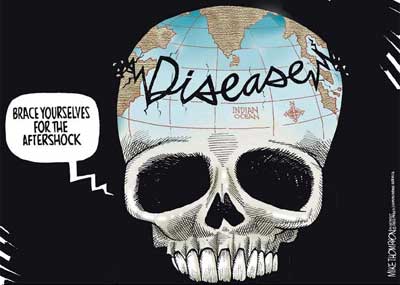
Mike Thompson, The worst is yet to come
The situation in Muslim Aceh in the absence of the international relief effort would be unspeakably bad.
In a previous post I raised the issue of the absence of the Arab states in the Middle East in the international community. The response from Muslims of Asia, where most of the world's Muslims live, and the Muslim diaspora of Europe, the US and Australia, has been to give generously and to send volunteers to pull bodies from the wreckage and to feed and treat the survivors. This is very different from the minimal response by the conspicuously silent Arab world in the Middle East.
Barton addresses this paralysis of generosity on the part of certain Arab states. He says:
"The traditionalist Muslims of Aceh, with their mystical, Sufistic approach to life and faith, are a world away from the fundamentalist Islamists of Saudi Arabia and some other Arab states. The Acehnese have never been particularly open to the bigoted "reformism" of radical Islamist groups linked to Saudi Arabia.....Perhaps it is for this reason that aid for Aceh has been so slow coming from wealthy Arab nations such as Saudi Arabia."
However, Juan Cole puts the lack of generosity into context with the generosity of the US. Maybe, but Saudi Arabia, which receives around $100 billion a year from its oil wealth, only gave $30 million. According to Abu Aardvark some Arab commentators are raising the issue of the failure of Arab states and publics to offer substantive assistance.
Greg Barton does say that these differences between Muslims over the generosity of tsunami aid undermines the conservative discourse that juxtaposes Islam and Western civilisation in a simplistic dichotomy.
Posted by Gary Sauer-Thompson at 10:48 AM | Comments (0) | TrackBack
January 5, 2005
band aids & vaccines
A bystander looks on as bodies recovered from under debris are cremated near the sea at Nagapattinam, India, one of the many places hit by the tsunami.

AP, Gurinder Osa
Whilst The Hindu offers some good advice to the Indian government America is boosting its image amongst Muslims in the south east Asia region. The US is anxious to present a generous and compassionate face.

Danziger is right. It is a bit of a show.
The Amercians are still touchy about the European stingy criticism. The Bush administration does have a track record of promising a lot in front of the cameras then not delivering when the cameras have move on.
We are still hearing a lot about the emergency aid (band-Aid) and little about development aid (the vaccine.
Where are the contributions from rich Arab gulf states? Why don't they help to ease the debt burden of the countries stricken by the tsunami? Whey are they not advocating a debt moratorium in the first instance to ease the burdens of the past, then a Marshall Plan for the future. Their silence about Aceh is puzzling.
A Marshall Plan. That is something you'd think rich Arab nations in the Middle East would run with as it is about the development of Islamic countries.
So why their silence? It is very noticeable.
Update
Someone else has noticed:
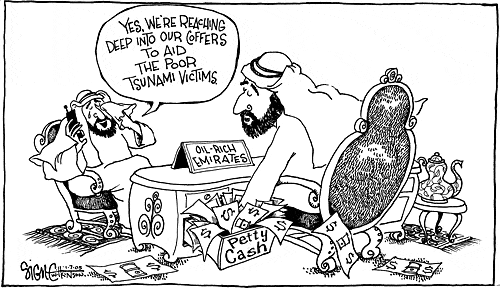
Posted by Gary Sauer-Thompson at 12:24 PM | Comments (0) | TrackBack
January 3, 2005
Tsunami#5 lending a hand
Whilst both Banda Aceh and Meulaboh in Sumatra, Indonesia will probably be reconstructed, the survivors of the destroyed towns inbetween will be evacuated.
Will the towns be rebuilt? No one is sure. That means a shift from providing emergency relief to development.
What we do know is that massive emergency aid is the content to Cox & Forkum's excellent 'lending a hand' editorial cartoon about the Indian Ocean tsunami:
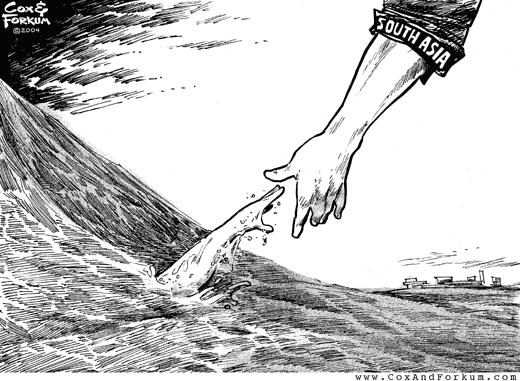
It is the international community--not just south Asia---that is lending a hand to the devastated region Australia is a part of. The tsunami narrative includes the way the US was shamed by the UN into increasing its financial support from $35m to $350 million.
As an aside, a post on Cox and Forkum's weblog consists of a cartoon and some writing about the cartoon's subject matter.This is a similar way of working to what is sometimes done here at public opinion.
Editorial cartooning is a difficult profession these days. The job of an editorial cartoonist is to reveal the awkward truth when everybody else would prefer a tactful silence. Alas local editorial cartooning is dying, and the newspaper publishers are killing it. So says Malt Priggee.
This is a pity because an editorial cartoon can say things that a photo cannot:
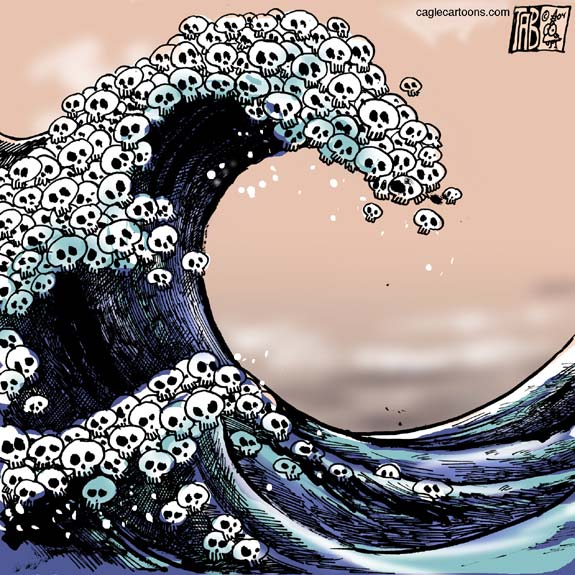
Tab (Thomas Boldt), The Calgary Sun, Alberta, Canada
What does lending a hand mean? Does it mean that development is more important than relief? Does it mean helping to rebuild affected nations. So how does international community lend a reconstructive hand beyond the immediate $2 billion in emergency relief? Aid agencies work well as emergency relief agencies, as they can operate on a more local and intimate scale than government or international institutions can reach.
And development? Here is a suggestion from the Los Angeles Times. A multibillion-dollar Marshall Plan for South Asia. The Los Angeles Times says:
"The U.S. spends a bit over one-tenth of 1% of its national income on aid, less than any other developed nation. A massive American-led Marshall Plan for South Asia would cost only a fraction of the nearly $225 billion requested so far to pay for the Iraq war.And, without a doubt, it would be a far wiser investment in the war on terror."
Sounds good advice to me. Will the neocons hear it?
I would add two things.The UN should not be sidelined on this kind of generational rebuilding. Secondly, Australia should substantially increase its direct aid to Aceh and play a leading role in re-building water supplies, roads, telecommunications, schools and hospitals. Both could help prevent the Indonesian military from playing politics with aid.
Posted by Gary Sauer-Thompson at 12:06 PM | Comments (0) | TrackBack
January 2, 2005
Tsunami#5:good news
Indonesian news reports say that cholera-like symptoms have already begun to show up among homeless people gathered in camps near the devastated provincial capital of Banda Aceh in north western Sumatra.
Along the west coast of hard-hit Aceh province many survivors, cut off from the outside world, are threatened by starvation and sickness.
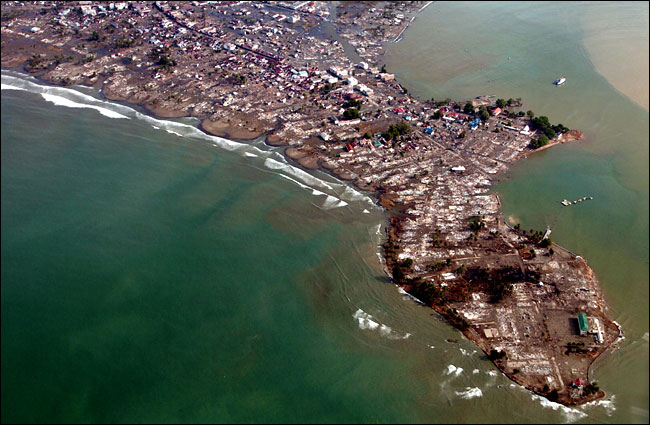
The town of Meulobah on the coast of the Aceh province in western Sumatra before the Tsunami hit.
By all accounts Meulobah is gone. An ariel image of Meulobah.
The good news is that US. Navy helicopters from the USS Abraham Lincoln aircraft carrier began arriving in Banda Aceh on Saturday. They are also beginning to run much needed missions along the west coast of the Aceh province.
It may be to late to deal with some of the infected wounds.
Posted by Gary Sauer-Thompson at 9:08 AM | Comments (1) | TrackBack
January 1, 2005
Tsunami#4 Aceh
Aceh has borne the brunt of the devastation from the undersea earthquake 160 miles south of Banda Aceh and the huge tsunami it triggered on Sunday. Around 80,000 people are now recorded as perishing in Aceh province. The number of dead victims in Aceh and North Sumatra are expected to reach 100,000. Between one and three million of those affected by the tsunami in Aceh and North Sumatra are homeless.
Basically all the villages on the coastal line are completely gone.In some coastal towns there is nothing, as even the foundations of the houses have disappeared. Entire swaths of coastline are reduced to sprawling rubbish dumps.
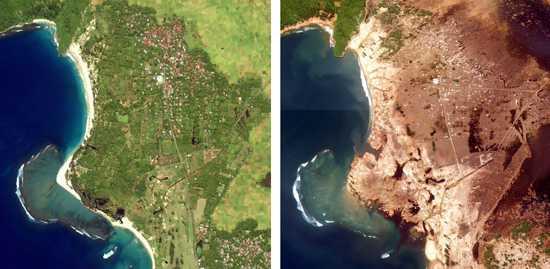
Reuters, Satellite images show Aceh on northern Sumatra, Indonesia before and after the tsunami hit on Sunday.
More satellite images of Banda Aceh before and after the tsunami can be found at junk for code and many more over at Digital Globe.
The coastal town of Meulaboh in Sumatra has been destroyed whilst Banda Aceh, the provincal capital, is a wrecked city.
As the Jarkata Post says:
"The entire southern part of Indonesia, starting from Sumatra, Java, Bali, Nusa Tenggara to Maluku and Papua and also the northeastern part of the country -- Sulawesi and North Maluku -- constitute active seismo-tectonic regions. Potential volcanic dangers exist at places along these lines.....movements on the bed of the Indian Ocean can cause tension on either side of the fault line. If the accumulation of tension and energy at the sides of the tectonic lithospheric plates or the subduction zone becomes unbearable, more fresh earthquakes may occur."
Sunday's quake in Sumatra has increased the chances for more major earthquakes there.
Aceh has become a focus point. People will judge whether the new government of Susilo Bambang Yudhoyono, can really deliver by what happens in Aceh. At the moment the Indonesian government is being rightly criticized. Four days after the tsunami struck, only 60 volunteers from the government had been deployed, bodies are still strewn all over the city and there was an acute food shortage.
From what I can make out relief supplies sent from national and foreign organizations and governments are reaching the Banda Aceh airport. In fact, supplies are piling up there. But they are not being distributed quickly to the intended targets.
According to Doctors without Borders the population of Aceh has received no international humanitarian aid at all since the disaster struck four days ago. They are the first international organization to begin working in the area.
Why the delays and disorganization in Aceh?
The politics explains some of the inaction. Aceh is a region long caught up in armed rebellion against Jakarta's oppressive authority that is justified by a strident nationalism that has been unwilling to recognize regional differences in the nation state.
This political conflict has meant that the Indonesian government initially kept the international community at bay as it debated whether to open Aceh up to foreigners. The province had been almost entirely closed to any international presence due to military operations there.
Consequently, the Indonesian government's response has been slow and uncoordinated. This is the reaction of the Indonesian press to the disaster in Aceh.
Update
Breaking news can be found at the The SEA-EAT blog,the Wilkinews and Tsunami-info.org
Video streams can be viewed at Cheese and Crackers.
For accounts of what is happening in India see Kiruba Shankar, who is blogging from Chennai in India at KirubaShankar. For Malaysia see KTemoc at Bolehtalk and Jeff Ooio over at Screenshots.
Posted by Gary Sauer-Thompson at 7:08 AM | Comments (0) | TrackBack
December 31, 2004
tsunami#3: priorities
The death toll from tsunami caused by the earthquake on Sunday continues to mount. In the devastated Aceh region of northwestern Indonesia access restrictions to the conflict zone, bureaucratic incompetence and disorganization, and a simple lack of infrastructure, transport, and resources in a poor nation continues to block the lifesaving food, water and medicine reaching many of those in need.
This needs to be said:

Moir
What is worse is that though lots of big, generous promises are made, many of them are not kept. John Quiggin has more on this side of things.
What is sad is the way the right cannot resist playing politics with this tragedy. Have a look at Gerard Baker's construction of a narrative about the Americans being blamed for the devastation caused by the Sumatran earthquake.I kid you not.
I guess the reasoning is this. You have to blame someone don't you, and, as God is dead, so it's either a cruel nature or the Americans. This then provides an excuse to have a go at the left's rabid anti-Americanism. And away Barker goes. This stuff is published in The Times and is then recycled in The Australian.
Just to show that I'm not making this up consider Gerard Baker's anti-Americanism "argument" in this paragraph:
"In the past three days I have been impressed by the originality of the latest critiques of the evil Americans. The earthquake and tsunami apparently had something to do with global warming, environmentalists say, caused of course by greedy American motorists. Then there was the rumour that the US military base at Diego Garcia was forewarned of the impending disaster and presumably because of some CIA-approved plot to undermine Islamic movements in Indonesia and Thailand did nothing about it.
To be fair, even the most animated America-hater, though, baulks at the idea of blaming George W. Bush for the destruction and death in southern Asia. But the US is blamed for not responding generously enough to help the victims of the catastrophe. A UN official this week derided Washington's contribution as stingy.
It is a label that fits the general image abroad of greedy, self-absorbed Americans. They neither know nor care much about the woes of the rest of the world, do they?....I have been sneeringly asked once or twice this week by contemptuous British friends."
Baker goes from the paranoid left, to some British friends, to the UN! Very elastic "reasoning" that. The rest of the article is then taken up with the tight "refutation" of the "argument".It ends with based on a celebration of technology that allows us to control and master nature.
QED. And the old cliches are reinforced to boot.
Amazing. Simply amazing. I read it three times. I'm still shaking my head at the elasticity parading as witty rhetoric. The tectonic plates on the seabed off Sumatra slipped and collided. Nature has real powers. It is not a construct.
It is not just the lack of reasoning that is amazing. What is astounding is that Baker misses the realpolitik politics of America's image in the region by a country mile; and he fails to engage with the substantive argument against the US. The US offer of $35 million--up from the initial $15 million---is a miserly drop in the bucket. It is less than less than half what the Republicans will spend celebrating the Bush presidential inauguration later this month.
Some would say, aw heck, it's the silly season, after all. Give the poor old righties like Gerard Baker a break. And we know the neo-con's next line about the money--it's all about the US needing a strong military to defend freedom from the evil Islamofascist terrorists who hate us for what we are.
I cannot resist a bit of fun. My guess is that The Times is still suffering from from the cheap Xmas drinks put on by its proprietor at the office party.A low budget, cost saving Xmas cheer is what you'd expect isn't it. After all, the proprietor is an American. And Baker lives in Washington does he not? Does not George Bush lives on a ranch in Texas? I meet a journalist once who told that .....The Times has gone downhill because it has been too Americanized etc etc.
See how you can do anything you want with Baker's kind of elasticity.
We should forget the nonsense in the op-ed pages in The Australian and turn to Geoffrey MG's Beyond Wallacia, which is much more informative about what is a happening on the ground in northwestern Indonesia.
Wikipedia has a very good entry on the Indian Ocean earthquake and tsunami.
Update
Wizbang takes a different political tack to Gerard Baker.The right care more about the tsunami and its devastation than the left because the latter have posted less than the right on this issue.
"Still I have to wonder... We are continually told how much more liberals care more about their fellow man than conservatives, yet 60,000 people are presumed dead and many of the liberals hardly mention it...The numbers don't seem to tell the same story."
Best to let that one about liberals lacking compassion go whizzing bye. It is an American game.
Posted by Gary Sauer-Thompson at 8:41 AM | Comments (0) | TrackBack
December 30, 2004
Tsunami disaster #2
Survivors search a photo board of the dead as they hunt for lost family and friends in Velankani beach on the outskirts of Nagapattinam, 350 km south of the southern Indian city of Madras.
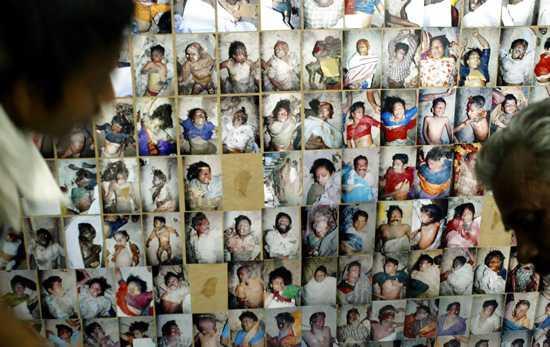
Reuters
Numerous aftershocks of magnitude 5.0 or greater have rocked the southeast Asia region since Sunday, with the most recent one, with a magnitude 5.7 struck 75 km (47 miles) west-southwest of Banda Aceh, Indonesia. These are too weak to cause additional tsunamis.
The Washington Post's map of the Indian Ocean region ravaged by the massive undersea earthquake and subsequent tsunami caused by movement amongst the tectonic plates in the Sumatra-Andaman Islands region. An impact map. The devastation in Sumatra recalls Krakatoa.

The death toll from the tsunamis and the earthquake itself may be matched by people in the devastated communities dying from communicable diseases (eg., cholera, typhoid) as from the tsunamis.
Things are not looking good in Aceh province in Indonesia. Relief is in short supply as the aid arriving at the airfield is not being distributed by the Indonesian military and government authorities. Apparently there is a policy policy of keeping all but members of the military out of the strife-torn province. The relief effort and the recovery of bodies, is only clicking into gear three days after the catastrophe struck. So survivors in Aceh face starvation.
A big failure lies with the lack of an equivalent to the Pacific Tsunami Warning Center, which is responsible for tsunami monitoring in the Pacific Basin. No such warning system exists for the Bay of Bengal where the recent disaster occurred. Can the finger be pointed at the Australian Government for this? Should it?
Update
A comment from IRant
Can the finger can be pointed at the Australian government for the lack of a warning system for Thailand, Indonesia, India etc?
"I think it is poor form to implicate the Australian government for lack of a warning system. The impetus and political will for a warning system has to come from the governments within the affected area. Indeed, such a system was proposed but due to the costs and the fact tsunamis are relatively rare occurence in the area compared to the Pacific such an idea was abandoned.
This article has some more info.I have no problem with pointing fingers when it is justified, but in this instance it is totally unwarranted."
Gary's Response
IRant Maybe. Australia could help to kick things long though.We are geographically part of the Indian Ocean,and we have more scientific resources to do this than Indonesia or Bangladesh.We should be good neighbours on issues like this. We are to turned to the Pacific.
Another, more selfish consideration.
At 1.59am on Xmas eve there was an earthquake measuring 8.1 in the sea north of Macquarie Island. It was one of the bigger earthquakes in the past 100 years and it could have triggered a tsunami, if the tectonic plates had collided rather than slipped past each other. If they had collided we could have kissed Kangaroo Island and the coastal towns along South Australia's southern coast line goodbye. The tsunami would have flooded the western suburbs of Adelaide.
And there would have been no warning.So Australia is cavalier and negligent. The example shows that tsunami's could hit this continent from any direction. Australia needs a tsunami warning system.
That warning system could be linked into one for south east Asia/ the Indian Ocean.
Update
Shaun ((IRant) replies to my response:
"Re you reponse I think Australia has and will be urging the creation of a warning system. Geoscience Australia did issue a report in September last year stating a system should be put in place for the Indian Ocean.
As for your comments re the Macqaurie Island quake, I've emailed
Geoscience Australia as it is a good question. Let you know if I get
a reply. I also found the following discussion from the 7:30 Report on the ABC."
Gary adds that Geoscience Australia is aware of the issues. So is it the federal pollies dragging their heels on this kind of security?
Posted by Gary Sauer-Thompson at 8:24 AM | Comments (0) | TrackBack
December 28, 2004
Tsunami disaster
I've been out of action and decoupled from the news for the last couple of days because of the Xmas thing. I've only just caught the news about the natural disaster in south East Asia.
A magnitude 9 earthquake, caused by a slippage in the earth's plates, struck off the west coast of the Indonesian island of Sumatra early Sunday. It then unleashed waves (tsunami's) up to 10 metres high that roared across the Bay of Bengal at 800kph, ripping into Thailand in an hour and striking Sri Lanka and India within two and a half hours. The waves raced 4,500 km to Africa, killing hundreds of people in Somalia and three in the Seychelles.
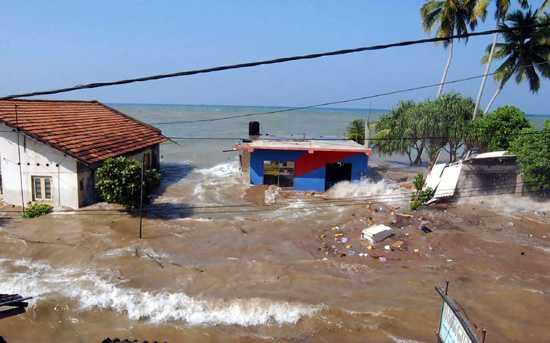
The tsunami crashes through houses at Maddampegama, Sri Lanka, AP
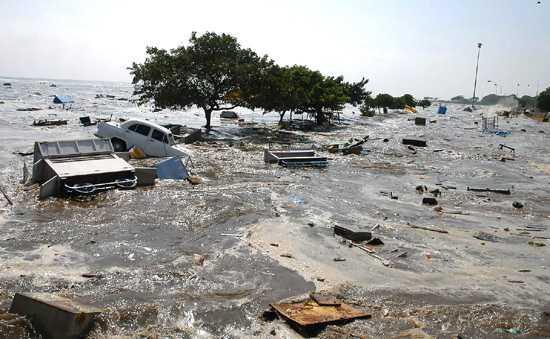
Marina beach in Madras, AFP
Thousands of kilometres of coastline from Indonesia to Somalia were battered by Sunday's deadly waves. Australia escaped.
Current estimates are that the carnage from both the Indian Ocean earthquake and tsunami will be more than 24,000 dead. The Indonesian Government is estimating that up to 25,000 people on Sumatra island alone have been killed, with most of the deaths in Indonesia in the Aceh province, on the northern tip of Sumatra Island. In Sri Lanka the toll is above 18,000; 10,000 in India and 2000 in Thailand.
Uncovered bloated and bruised bodies are everwhere in the midday sun. A lot of fishing villages have been wiped out, along with the means for earning a livelihood. It is a human tragedy.
In philosophy I01 these natural disasters are called "acts of God" rather than the awful power of Mother Nature. What the university lecturers were trying to get at is that there is no moral responsibility for this kind of evil (human tragedy), as it is not caused by human beings.Though it may create problesm for those who believe in an interventionist God.The moral finger can be pointed at the failure to establish a tsunami warning system in the Indian Ocean.
Update: 30 Dec.
One eyewitness account of the tsunami that has left millions homeless in countries from south-east Asia to Africa.
Mass graves are being dug. Bodies burned.
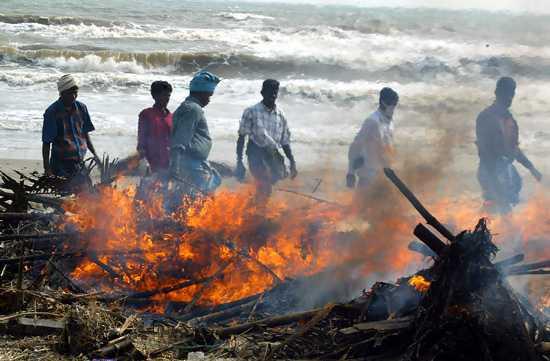
AP, Volunteers cremate bodies recovered from the debris in Nagapattinam, India
Many bodies are so bloated and fly-blown that it is impossible to tell even their sex. The stench of decomposing bodies fills the air as hungry people scavenge to find food and fresh water.
The danger is that waterborne diseases, such as cholera, could kill a lot more people due to contaminated water and food. Cholera is endemic in Sri Lanka and southern India, two of the countries worst hit by the tsunami. The bacterium is likely to be present in mangrove swamps. Outbreaks often follow flooding, when the bacterium can contaminate supplies of drinking water.
The death toll keeps climbing rapidly.The final death toll in the Indonesian province of Aceh, which bore the brunt of the Indian Ocean tsunami, could be as high as 80,000. The death toll could exceed 100,000.
This is shaping to be a major natural disaster and a human catastrophe.
Posted by Gary Sauer-Thompson at 3:41 PM | Comments (0) | TrackBack