August 30, 2003
a trail of blood
I have been following at a distance Tony Blair's difficulties about the reasons Britain went to war with Iraq. And I have been squizzing his statements to the Hutton Inquiry into the death of Dr. Kelly. I noted that John Scarlett, the chairman of the joint intelligence committee, read a scrip prepared for him by Downing Street, and accepted the blame, and all the responsibility, for a faulty government intelligence report.
What secrets lurk in Whitehall? Can they be contained? Can they be dug out?
My concern is not those events in this post. It is more to do with the traces of empire in the complex historical experience we are now living; traces of old and new political structures that shape our conduct.
This is a long bow for some as the very language of empire will cause a recoil.
Let's take the surface bit. Blair protested his innocence at the Hutton inquiry. He said that he is a man of utmost honesty, that the BBC broadcast crucially challenged his integrity and so threatened his continuation as prime minister. Blair plays the conviction politician full of sincerity well. He is forever going on about moral renewal, moral order and moral responsibilities. He assumes that good will flow from his good intentions. His carefully crafted public image is that he does not have dirty hands as he is above the bloody business of politics. He justifies his actions with good intentions. Intentions count more than outcomes.
Unfortunately, Blair comes talking about his good intentions and leaves a trail of blood behind him.
He seems to love a good war involving dropping bombs on people. He talks about peace and goes to war. He talks about us and them. Calling the French veto on Iraq at the UN 'capricious' undermines his sincerity in upholding the international legal system.
The dirt that sticks to Blair is the way that the world of dirty politics of tabloid bruisers, political bullies and spin from the media machine continually mocks his good intentions. He tries to convince us that good consequences flow from good intentions. But we see the dirty hands.
Behind the carefully rehearsed performances is the reality of power. Blair like John Howard in Australia, stood shoulder to shoulder with the Americans as junior partners assisting an imperial power in one of its wars. Both Britain and Australia had few geo-political interests in Iraq, and neither were seriously threatened by Iraq. For both of these conviction politicians American power is sacrosant. For them present-day American imperial power is a modernizing force of good in the world, as it is enlightened and altruistic.
What is left unsaid is the dark side. I have in mind the ruthless militancy of the American democracy, the demonology of the American nation state; the vast publicity machine that convinced around 50% of Americans that Saddam Hussein was directly involved in September 11; the severe onstraints on the discussion of the role of Israel in the Middle East; and the role of the media outlets of the Christian Coaltion and Israel lobby in fostering a hatred of Arabs and Muslims and equating them with evil.
Yet underneath the special alliance sits a conception of Britain as a global power with responsibilities East of Suez:---Britain's intervention in the Gulf has been continuous since 1991. You can sense the old imperial structure at work--- order and security with Britain playing e same role that Australia did for Britain: being the loyal provider of auxiliary cohorts of soldiers.
Empire! How that word resonates in post-colonial Australia. Let me give two examples.
The first one is the way that Britain and Australia are part of the same story of Empire. The great UK imperial structure may have been dismantled after 1945, along with the other empires that ruled Asia, but the effects of the imperial divide between colonizer and colonised can still be felt. Multicultural liberal Australia stands in opposition to the racist colonialism of the recent past, with its unspoken racist hierarchy. High culture in the UK (Mathew Arnold's sweetness and light) functioned to cover up and disguise the inhumane events in the Australian colonies. Reading for the unstated colonial assumptions is one way to read the Western cultural canon of Mathew Arnold, S. T. Coleridge and John Stuart Mill that spoke in terms of a civilising mission.
Today, there is a colonial reassessment going on about the destructiveness wrought by colonialism in Australia in terms of suffering and dispossession. This discourse says that the past is over and the time has come for the Aboriginal Australia to own up to its self-inflicted wounds. Those liberals who support the claim for a treaty are befuddled romantics. And aboriginal Australia cannot keep on blaming white colonial Australia for everything bad. The rhetoric of blame and guilt has to go.
But empire is not something in the past. Today we have the US empire. The US has mn moved from hegemony in the Middle East to empire. And we live the effect of this empire engaged in a civilising mission. Resistance to the US empire in the Arab/Muslim world is said to bred a barbarious and xenophobic anti-westernism--called Islamofascism that is out to destroy Anglo-American civilization. This mental grid covers over and obscures the diversity of the Arab diasporia in South-East Asia with its very different histories and cultures. The cultural grid that is locking into place constructs Arabs as deceptive, cunning and untrustworthy.
Australia has signed up as loyal allies who will provide troops to support an imperial war against any part of the Arab/Muslim world that defies the US and Israel. Iran is one with its nuclear weapons program. Both America and Israel will go to war to prevent Iran from acquiring nuclear weapons. Though we are part of the empire, our cities are far from being protected from destruction by "barbarian" counterattacks. Within the empire we stand vulnerable.
Those are the two traces of empire. They mark overlapping territories and intertwined histories. Whether we like it or not, our fortunes as Australians are now tied to a neocon imperial America that is supported by a wounded nationalism. And the rebellion in Iraq to the US occupation of that country threatens to become a nasty circle of terrorism and war.
August 24, 2003
private/public
This resource is courtesy of Lawrence Solum. What caught my eye was this paper on Richard Rorty.
Why so? Well, I have been thinking about the way "political" blogs act to loosen up the entrenched public/private distinction. I mentioned this briefly in this response to Ken Parish's recent paper on bloggers as monitorial citizens. By this he meant that bloggers act as fire alarms in the public sphere. Tis a long way from republican citizens. I want to use this post to show that blogging opens up a world of different kinds of intellectual practice.
Ken does not mention the sexblogs that transgress the sexual conventions in public life as political ones. He concentrates on a narrow understanding of 'political' blog, and so he does not consider the challenges to the normalizing routines of liberal society in the name of self-expression, self-creation and self-exploration. This is a different kind of politics, and it is obscured by Ken's tacit use of the liberal private/public distinction. Many blogs challenge this distinction and this opens up ways for bloggers to be more than fire alarms. There is a lot of subversion going on in those challenges to the sexual conventions that are taken for granted in the public sphere.
I want to introduce Rorty in order to open up Ken's limited idea of bloggers as fire alarms. Rorty is useful/relevant to this issue of private/public. He endeavours to reconcile the political liberalism in the public sphere with personal self-expression in the private sphere through a pragmatic public/private distinction. I have considered Rorty's views on this distinction before, especially in this post. A postmodern liberal society (one without foundations) is one in which change and improvement is achieved by reform and persuasion through the free and open encounters of linguistic practices within the marketplace of ideas. The aim is to create a decent liberal society in which public institutions do not humiliate and which allows a romantic sense of self-creation.
The public /private distinction allows this. Hence its strength. In our private lives we can be as self-creative, irrationalistic and aestheticist as we like:--we can explore the world S/M bondage of a Robert Mapplethorpe if we so desire. Or we can trangress sexual taboos, if we hold that these activities are important to the self-perfection of our subjectivities.
It is not a free for all. Rorty would draw the line at some forms of irrationality --being a sexual slave---as these cause harm to others, but that would then involve some sort of argument about consent. On Rorety;s We do need to be sensitive to whether self-creation leads to cruelty, or whether the sexual domination/submission (D/M)acting out involves us creating a character indifferent to the cruelty towards, and humiliation of, others
Now these D/M activities that are done in our private time are incompatible with justice and solidarity in the public sphere, as this romantic form of self-creation through the transgression of sexual taboos involves inflicting pain and humiliation on others. So Bataille's ethos redemption through mutilation and ecstasy may bne okay for the private sphere, but not for the public sphere. Hence we have different vocabularies for the private and public sphere. For Roty we need to avoid fusing them into one vocabulary and allow them to exist side by side.
It's a radical public private split. The logic of Rorty's position allows an incommensurability of vocabularies with their different understanding of right and wrong, good and evil. This is being a liberal ironist. As such, we recognize that the strong poets and creators in the private sphere can provide us with new vocabularies that spill over into the rest of society. Robert Mapplethorpe is a good example.
All of this amounts to Rorty more or less redescribing John Stuart Mill for a post modern society. Mill, remember, divided human activities into the private ('self-regarding') and the public ('other-regarding'). He argued that only the latter are properly subject to legal attention, and deployed the harm principle', to argue that the law should not be used to prohibit harmless immorality.
But what does that mean? Is Mill saying that some activities are private and therefore harmless, or that some activities are harmless and therefore private? I have assumed the former interpretation in that "private", "self-regarding" and consensual conduct---such as adult homosexuality, pornography/ obscenity, prostitution, blasphemy, gambling, drug use, suicide, etc--- for liberals is the realms of private subjectivity and autonomy and so must must be freed from the "overreach" of criminal sanction and law. The emphasis here is a libertarian one as it is on protecting private self-creation from the dictates of pubic morality.
Not everyone is comfortable with Rorty's reworking of the liberal private-public. Critics have launched a variety of criticisms on the degree/extent of Rorty's separation of the private morality public morality divide. The divide is not as stark as he makes out.
One problem is that Rorty overlooks the interrelation between the two spheres that is so evident with sexuality, such as safe sex and AIDS. Or with the recent censorship of depictions of sexuality in films such as Ken Park on the ground that they cause offence in the public sphere. As the editorial of Senses of the Cinema points out, the Board of Review and the Office of Film and Literature Classification Board imposed a Refused Classification on:
"Ken Park a critically praised 'art film' that has already been shown in many countries – for its supposedly non-simulated scenes of underage sex. Ken Park's RC status raises important questions concerning classification processes, how censorship legislation is defined and interpreted, and the overall conservatism of the classifiers, as well as the current guidelines regarding what can and cannot be shown at Australian film festivals."
When it comes to sexuality the private public distinction is looks pretty fuzzy.
Another line of criticism displaces the libertarian side of the equation to focus on private self-creation over flowing into the public. It holds that the private public distinction is undermined because some groups---ie., young men--do not want to keep their mode of fulfillment private. And what used to be written for women's is now being written for public consumption.
Another criticism is along the lines of poetic self-creation being less a withdrawal from politics and more a masculine, individual self-assertion that overflows into the public sphere. A private life lived in opposition to public sexual taboos is a direct challenge to the public morality. The danger here is that the particular private fantasies of men can involve the public humiliation of women and so undermine liberal public morality. Some of the stuff on public porn site sites is dam brutal as it is all about power being exercised over women by men full of hate and payback.
I have not explicitly stated these criticism in terms of moral conservatism that holds that pornography is dangerous, in that it causes people to do really bad things that they wouldn’t have done otherwise. Nor have I specifically mentioned feminism. Feminist arguments highlight the way the liberal public/private distinction within liberalismis not just a domain of individual freedom. The private realm, can and is, one of oppressive power relations for women, and so we have the whole area of domestic violence being opened up. Rorty's liberalism serves to obscure the reality and pervasiveness of the "gendered harms" affecting women.
But I have done enough to fuzz up the liberal private /public distinction and throw it into question. Now, to be fair to Rorty, the very point of making the private public distinction is to block the ironic romantic self-creation going public and becoming a public sexual politics. D/S performances, S/M routines or being a sexual slave should remain domesticated and only be a part of our private life. Desire is contained. But, for Rorty there is nothing wrong with being the way we are; in fact we should go on with our self-creation and becoming autonomous.
Rorty would add, individual self-fulfilment is not necessarily connected to public morality; individual good is not necessarily related to the public good. The use of 'necessarily' here means that there is both a flow of desire between the two spheres, and some sort of a filtering going on rather than the construction of a wall. Filtering is necessary because there is some nasty stuff out there on the Internet; stuff based on intrinsic harm being done to the participants under the guise of being sexual stimulation for individual pleasure.
If you want to put it starkly liberty needs to be caged. So how do romantic individuals engaged in sexual trangression of public moralities and conventions as a form of self-fulfillment filter the nasties? What sort of filter can be used?
Dirty Whore Online explores the private public filter. She says:
"It makes me confused when people draw a direct cause and effect correlation between someone having pornography and committing a sex crime. The porn may have provided additional stimulus or reinforced feelings, but it did not cause the crime. The pedophile did not fondle the little boy because of his collection of kiddie porn – he had the collection of kiddie porn because he was interested in fondling little boys… and eventually did so. Ignoring the interest wouldn’t have made it go away."
She goes on:
"...porn... can make the lines between acceptable and unacceptable behavior fuzzy. For example, some relatively mainstream porn has tended toward misogyny lately...I have mixed feelings about those. Humiliation and rough sex turn me on, so I find some portions arousing. On the other hand, these attitudes are growing too prevalent for my taste and I don’t like what that says about our society. Call me a snob, but there’s a very wide chasm between a smart woman with strong self esteem [submiting] to rough treatment because it turns her on, and a silly, insecure girl who doesn’t think she deserves anything better, just as the feminist, sweet man who sometimes lets his dark side come to the surface during sex is the antithesis of the abusive lout who hates women."
Rorty's reason for arguing for the private/public distinction is because he wants to defend the claim that liberal society is the best kind of society for achieving individual liberty and autonomy. Hence it is an argument to block the left's criticism of liberal society.
So what has all this to do with blogging, citizenshipand fire alarms? Well, it reinforces Tim Dunlop's point that we need to shift away from considering bloggers as public intellectuals to viewing the
"... the practice of blogging...as one that allows for a different understanding of what we traditionally understand as the category of "the" intellectual or the "public" intellectual."
Our understanding of citizenship is being opened up with blogging. Bloggers are deciding what the public issues that concern them are. As the example I've used here----sexuality----indicates, what is a matters of public concern is quite different to what is decided upon by our newspapers. So new issues are being put on the table; new ways of writing are being worked out; and new ways of challenging the blocked media arteries of the public sphere are being thrown up. New kinds of cyber citizens are in formation.
August 22, 2003
blogging and democracy
I see that Ken Parish has an article on blogging that is a response to the one by Tim Dunlop. For my comments on Tim's article see here and here
Ken is more sceptical about blogging than Tim, as he argues that the role of blogging is more akin to functioning as fire alarms rather than as public intellectuals. He sets out his case clearly:
"Tim Dunlop makes a less than compelling case for blogging public intellectuals as agents for a truly informed citizenry. Schudson suggests that the entire project may actually be unattainable: 'Political theorists are eloquent about public life, the role of public intellectuals, the necessity of a public sphere, and the virtues of the common good, but there is a time also to think further on the private life ... on the joys of appreciating a sunset, humming a tune, or listening to the quiet breathing of a sleeping child ...'"
Public versus private. That old liberal duality once again. It should really be called into question rather than taken for granted, since many weblogs are about making public the private lifeof webloggers whilst those that are about public life introduce a lot of webloggers private life.
On a first read, what struck me about Ken's piece was the emphasis on numbers of readers of a weblog, rather than the blockages to the circulation of ideas in the public sphere. I thought that it read just like media analysts talking about circulation numbers of newspapers as a criteria for a viability. Hell, it won't be long before there is talk about advertising on weblogs and bloggers as small business people decrying attempts at regulation of their activiities.
On first impressions I interpreted Ken as reading the diverse weblogs through the eyes of journalism. His duality is light hearted tabloidism versus serious broadsheets, and he connects audience size to a populist writing style and subject matter.
If you view weblogging from the public intellectual perspective, then the concern is with the circulation of ideas. As McKenzie Wark puts it:
"Its a public intellectual's job to debunk intellectual fads and fashions. But it is also part of the job to broker new ideas from the margins into the mainstream. Its on this score that all too many of our overpaid newspaper pundits are failing both their readers -- and their editors. None of which would matter were it not for the stranglehold on some key editorial gatekeeping and intellectual brokering functions presently held by folks who actually seem proud of their own ignorance."
Debunk means criticism. Wark maintains that criticism is dead, finished, kaput. That leaves us with the brokering of ideas.
The public sphere in Australia is in pretty poor state in terms of the exchange of ideas. What is highlighted by this approach is the gatekeeping functions that moderate the degree of openness or closure in each of the media vectors where a sense of public life might occur. McKenzie Wark describes this closure quite well:
"I don't know which is worse, old cold warriors looking for new enemies-of-the-people to pretend are under the bed, or what I would call the curse of the Whitlam ascendancy. You know who I mean: people who by 1970s standards were enlightened, informed and forward thinking, but by 1990s standards are ignorant, obsolete and out of touch. One has to admit that the collective utterances of these two old cohorts makes for some great unintentional comedy. Howlingly stupid, ill-informed, incoherent ranting about postmodernism, poststructuralism, feminism, political correctness and all the rest.... some once revered names have spent the last few years depreciating their own reputations, speaking about books they haven't read, concepts they haven't mastered, spectres that haunt only their own impoverished imaginations."
This afflicts the blogosphere in Australia. Blogging does need to be contextualised as it is but one part of the diverse media that constitutes the public sphere. On this account we come back to distinquishing between some of those spaces that are open enough to renewal to be thriving and those that are not.
So what is Ken saying on this? The implication he draws is that it is necessary to go tabloid to keep the readers interested. He has some good arguments for this position.
Ken redescribes Tim Dunlop's republican conception of citizen self-rule and participation into an ideal, and then contrasts it with the actuality of modern western democracies where there is little or no inclination towards increased civic or political participation by citizens. We have a void between republican rhetoric and democratic actuality. The central criticism of the republican conception of informed and active citizen is that this tradition demands too much of citizens, as it expects citizens to follow public affairs in all of their particulars. It is just not possible for us as citizens do this.
Ken's response to the void in democratic rhetoric and theory is to adopt Michael Schudson's idea of the "monitorial citizen." Rather than try to follow and being informed about everything, the monitorial citizen scans the environment for events that require responses. For many purposes, merely scanning the headlines is sufficient. So:
"...political bloggers are best seen as self-selected monitorial citizens, keeping the bastards honest on behalf of the silent, politically disinterested majority."
Hmmm. I'm willing to accept the monitoring. I monitor what is happening and and select the bits of news that sit with the concerns of public opinion. But I do not accept the "silent, politically disinterested majority" bit, as my fellow citizens are also monitoring the news in variety of diverse ways from a wide variety of media. I write about it. Many don't. Some do not have the time. Others do not have the training. But many other citizens in civil society do engage in intellectuals in and around their work.
What does need to be displaced is the universal intellectual speaking on behalf of humanity on public issues within a common culture. It is all much more situated and particularized than that, since we all monitor from our particular perspectives and in the light of our specific concerns. The common public world forms out of differnt groups of people bringing their particular and different perceptions, stories, interests, passions and modes of reasoning to bear on common objects, events or concerns. There are many public spheres with their overlapping circles.
So what follows from bloggers being self-selected monitorial citizens? For Ken it is this:
"... to the extent that bloggers aspire to be cyberspace fire alarms or monitorial citizens who affect society and the political process in however small a way, they can't help but come to terms with Zaller's observation that the quickest and most potent way of doing so is to adopt some of the familiar techniques of tabloid journalism: racecourse journalism; infotainment; sensationalised, beat-up controversies and all the rest."
That says learn from Rupert Murdoch. Okay. Fair point. So what does that mean? For Ken it means this:
"If occasional outbreaks of tabloid sensationalism are the price that must be paid for bloggers to attract a large enough general audience to fulfil a meaningful monitorial citizen role, perhaps it's a price worth paying. As long as the bread and circuses stunts are interspersed with more meaty analytical posts, intellectual depth and rigour need not be sacrificed."
What else does Murdoch tell us about intellectual practices? That television, not newspapers, is the central media today. And television is a visual culture not a literary one. So why not experiment with a visually orientated weblog. Why not follow the visual style and practice of women's magazines? What not explore different and more experimental ways of writing?
This suggests that we bloggers do more than monitor issues and act as fire alarms. As Mackenzie Wark puts it, we are also "in the business of opening vectors of communication to different kinds and instances of speech and finding ways to negotiate their irreconcilable qualities." We bloggers are in that business because of the hardening of the arteries of a gentrified mainstream 'public sphere' along the major dividing lines by which public things are organised. But there are also little imperceptible cracks in the edifice of things along which change will come.
August 20, 2003
a libertarian tale of confusions
Aah. At last. We have the beginnings of a debate about conservatism and liberalism in Australia. About time too. What debate there has been on this topic has been pretty poor in terms of quality. It's been pretty much soapbox polemics that ignores what people actually write.
It was kicked off by the confusions about neo-liberalism and neo-conservative in this article by Wilson de Silva in the Sydney Morning Herald about the public philosophy of Centre for Independent Studies (CIS). That article sparked initial responses by Jason Soon over at Cataxally Files and Gary over public opinion; then Andrew Norton responded here and John Quiggin replied here.
The most substantial and considered response is by Andrew Norton and so this post will be centred around what he has to say. John Quiggin says that Andrew's piece is "both informative and accurate", though he makes a qualification about what Andrew has to say about liberalism, which I concur with. And Ken Parish concurs with Norton's suggestion that the "neocon" label is inaccurate and even misleading in an Australian context. Unlike John and Ken I find the Norton piece quite misleading.
Though Andrew is talking about CIS he also talking about Australian conservatism and liberalism in terms of foreign and domestic policy. I will deal with Andrew's argument in foreign policy first, then I will turn to domestic policy. The post is an unpacking exercise is open the ground on which different people stand. Hence it is seeking to avoid closure.
Andrew's first point is that it is misleading to represent the CIS as advocating a neocon foreign policy. He argues that CIS does not favour the vigorous use of the military power of the nation state to actively promote democracy and free market capitalism abroad, through preemptive strike if need be. Iraq is the first example of a necon foreign policy. To make his argument Andrew points to Owen Harris at the CIS who argues against the neocon foreign policy in favour of prudence and restraint. And rightly so. The reasonableness of this depends on whether Owen Harris stands for the CIS views on foreign policy.
Then Andrew turns to the relationship between Australian conservatism and the neo-cons. What he says here is more controversial. He says:
"Nor is there much else in Australian conservatism that justifies the neo prefix. Only a handful of conservative commentators, Keith Windschuttle, Christopher Pearson and Michael Duffy, started out on the Left, and only Windschuttle was prominent before his conversion. They are too few to count as a movement."
Andrew reinforces this here when he says that neo-con is an American term that has little relevance to Australia.
Ken Parish concurs with this. Andrew has nailed the ideological label. Ken says:
'John Howard committed Australian troops to the Iraq "coalition of the willing", but he fairly clearly did so predominantly because of US alliance considerations, rather than any deeply-held conviction about the desirability of aggressively spreading American values throughout the world.'
I beg to differ on this. Andrew has underplayed the broad conservative current that is in favour of Australia adopting a neo-con foreign policy.That has less to do with spreading US values across the globe and more to do with Australia being a global player. On this account an Australian neo-con would argue that Australia now has the economic strength and muscle to act on the global stage, is a global power with a global role and global responsibilities, and so the US and Australia stand together against the international terrorists and break new ground in freedom's defence. Let us call this neocon foreign policy agenda Australia is the Deputy Sheriff to the US as global cop. It is held by Alexander Downer,Australia's foreign minister --- so by the Howard Government; and is actively promoted by Greg Sheridan writing in The Australian.
Now the neo-con conception of Australia striding across the world stage with a global role and global responsibilities is a long way from the prudence and restraint of an Owen Harris. In fact, it is the very view that an Owen Harris would argue against. In saying that neo-conservatism is positively confusing in the Australian context, Andrew has underplayed the neo-conservatism of the Australian Government. This Deputy Sheriff view is not imposed on Australia by the Bush Administration; it is the foreign policy hawks in the Howard Government who are making the policy. And Alexander Downer is leading the charge on this.
Andrew then turns his attention to conservativism and liberalism in terms of the domestic policy within the nation state. Though he is more accurate in his interpretations here, he still leaves offers misleading accounts.
On Australian conservatism Andrew makes two point. The first is this:
"The highest profile self-confessed conservative is the Prime Minister. His conservatism, too, seems evolved from past conservative beliefs, not something new or striking. The old conservative concern with social cohesion is there, but no longer the view, once held by both parties, that racial purity is necessary for that goal. Experience has shown otherwise."
Fair enough. What does it mean? What is the significance of the point? That conservatism does not exist? We need to ask: 'what has replaced race to ensure social cohesion in the nation state ? It is integration in the form of assimilation. Nor is there any mention of nationalism of the national security state that has become a fortress with its guns and instrrumnets of surveillance trained on all movements outside and around its borders. Freedom of movement of peoples as held by libertarians--ie., open borders----is firmly rejected in the name of the threatening Other.
Now, as a good libertarian Andrew, cannot say that the Howard government is libertarian through and through. Howard, for instance, wears his conservatism as if it were a badge of honour, and he is willing to use the power of the state to protect iand prop up industries. So how does Norton understand this conservatism? The second point that Andrew makes articulates this in terms of social conservatism:
"If there is anything novel in the Prime Minister's political stance, it is his combination of market economics and mild social conservatism. Historically, conservatives have often been sceptical of the market, fearing that its dynamism would create too-rapid change and disrupt the social order."
No memtion is made of the political conservatism that asserts the power of the state or poltical authority?A conservatiim that accepts inequality, the rule of elites, keeping the subordinated clases firmly in their place, or allowing the subordinated classes an education appropriate to their station in the social hierarchy?
What Norton wants to do is brush away conservatism into non-existence and leave us with liberalism. This is how he does it:
"Is this combination of market economics and social conservatism a new form of conservatism? Or is it a new form of liberalism, given that Howard's social conservatism is so muted compared with Australia's past or conservative parties in other Western countries? In view of Howard's insistence that his thought includes conservative and liberal elements, we are probably best off describing it as not one or the other but as conservative liberalism."
Having made conservatism disappear into thin air Norton then turns his attention to neo-liberalism. Andrew is not alone in this. Consider this understanding of conservatism It's conservatism as classical Lockean liberalism that is interpreted in terms of a laissez-faire society of social and economic freedom. It's hardly Edmund Burke or David Hume. It makes nonsense of a Tony Abbottor what is usually called the toryism of a Robert Menzies.
Having done away with conservatism Norton then proceeds to mix things up. He brings conservatism back in through the side door. He says:
"For those who mix liberalism and conservatism, conservative liberal or liberal conservative should suffice. Which word is the adjective and which the noun will depend on which philosophy is emphasised."
This implies there is a difference between conservative and liberal philosophies as indeed there are. Conservatives, for instsance, have little time for libertarians because of what they see as unbridled individualism and the absence of authority. So what are the differences? Well it can be approached in terms of democracy along these lines. Fault lines begin to open on whether the sphere is politics is subordinate to the market or the market is subordinate to politics. Here is a suggestion as to the differences. And we can add that liberalism itself is a problem for many conservatives because it makes individual choice the cornerstone of its philosophy.
Andrew unpacks this differences indirectly by saying that Hayek--who was strongly anti-socialist--- was not a social conservative. The reason? Hayek wrote an essay called, Why I am not a Conservative, which was a postscript to the Constitution of Liberty. This is a key text because it refuses any easy identification of conservatism with liberalism despite their common opposition to socialism. According to Hayek liberalism and conservatism have different attitudes to change re the market, established authority and knowledge.
Yet Norton is misleading in dismissing da Silva's insight into Hayek's social conservatism. Hayek may be liberal in his fundamental antipathy of the state (a dead hand) and only willing to accept limited government; but he increasingly relies on tradition, is a strong critic of democracy and is more than willing to rely on authoritarian governments to sustain the market order. Things are not black and white on this.
What then of liberalism and neo-liberalism? Andrew doesn't like the label neo-liberal much and would prefer to do away with it. He says:
"In the Australian context, the neo labels don't add much...neo-liberalism implies the ideas are more neo than is the case. Many of the people described by others as neo-liberals, most of the people who write for the CIS fall into this group, prefer classical liberalism, highlighting our intellectual heritage, not our novelty."
So what is classical liberalism? is it Locke? Bentham? John Stuart Mill? None of these because Norton dates:
"...classical liberalism from its 20th-century revival, significant writers such as Friedrich Hayek, Milton Friedman and James Buchanan, all Nobel Prize winners....liberalism or classical liberalism... [describes] the free marketers who, in the old line, want to keep the government out of the bedroom as well as the boardroom."
Classical liberalism is libertarianism is liberalism. There is lots of smoke and mirrors going on here. As we have seen Hayek was not a libertarian in the sense of throwing of customary restraints and scrapping all controls and traditional restraints over immigration, drugs, sexual conduct Gone or dismissed is the collective or social liberalism (E.G. Whitlam) which Andrew Norton dismisses as statism. Hence we are playing an old game of true and false liberalism. The false liberals have not grasped the true principles of a free society. So they live in error. As Norton puts it libertarian "should be kept for describing those who want to radically shrink the state."
This is an odd way to talk about a political tradition. You can sense the dogmatism, the polemics and religious dislike of heretics just beneath the surface. Libertarianism is only one form of liberalism, which is a very broad church with many diverse currents and voices. What is going on with the talk about good and bad liberalism is the displacement of both the social liberalism of T.H. Green, Keynes and Beveridge, and the utilitarian liberalism of Benthan and Mill. They betrayed and subverted the true liberal tradition because they held that the task of government is to pursue a collective goal. They were statists.
You can understand why John Quiggin highlights the strengths of John Stuart Mill in terms of freedom of political speech and thought. It acts as a democratic counter to the authoritarian tendencies of some economic liberals (John mentions Jeff Kennett, the ex Premier of Victoria "who have made a sustained, and largely successful, efforts to intimidate and silence [their] critics. A lack of concern with freedom of speech and political thought is the main distinguishing feature of neoliberals."
Behind Norton's smoke and mirrors is the equation of classical liberalism with economic or free market liberal. This is a liberal opposed to statismm and who aims to remove the political and institutional constraints that hinder the spontaneous operation of the competitive market. Hence Norton is willing to accept the term economic rationalist:
"Economic rationalist is a term we can keep, but to describe an issue movement rather than a distinct philosophy. The economic rationalists were a pro-market policy alliance that included a social democratic Labor federal government, the Liberal Opposition and then government, export-oriented businesses, economists in the bureaucracy and academe, and the think tanks. They agreed on a reform agenda more than an underlying philosophy."
The Australian term economic rationalist is equivalent to neo-liberal. What we have here is a mode of governance that shapes the conduct of a population through the hodge podge instruments of the market. A good account of neo-liberalism by John Quiggin can be here. He says:
"Neoliberalism seeks to cut back the role of the state as much as possible while maintaining public guarantees of access to basic health, education and income security.The core of the neoliberal program is:
(i) to remove the state altogether from 'non-core' functions such as the provision of infrastructure services
(ii) to minimise the state role in core functions (health, education, income security) through contracting out, voucher schemes and so on
(iii) to reject redistribution of income except insofar as it is implied by the provision of a basic 'safety net'."
I interpret this account as a way or system of thinking about the nature or practice of government. The mode of governance account shifts the emphasis away from neo-liberalism as an ideology or philosophy to a governmental reason in which the rationality of political government is seen as an activity, rather then as an institution. So economic reason that is so often deployed in Australia should also be seen as a political reason, as it offers an account of the limits of the state in reaction to the way of governing practised by social democracy.
The mode of governance approach highlights what is often forgotten in many alternative accounts of neo-liberalism ---namely, the constitution of the self. The argument is that through self-constitution, the subject is implicated in its own governance. What is meant here is that the shaping of the conduct of a population through a variety of market instruments also involves the individual creating a subjectivity that fits within the prevailing political rationality and the liberal market order. The desired subjectivity that is to be created is an entrepreneurial one, but more generally it means a subjectivity based on freedom of choice and responsibility. It is through this constitution of our subjectivity that we become increasingly enmeshed in the power relationships of the market order.
August 18, 2003
reason and emotion in history
There is a review of John Gascoigne's The Enlightenment and the Origins of European Australia (Cambridge University Press, 2002) by Gregory Melleuish in the CIS's publication Policy Magazine (Summer 2003). This is a history text that demonstrates that the moderate Enlightenment of lowland Scotland and England, and its values of reason and progress, were a significant factor in the formative period of Australian history.
What struck me about this text and the review was the downplaying of, and the negative attitude towards, Romanticism. Melleuish says that:
"This Enlightenment moulded the way the early European settlers in Australia saw themselves and their world. Gascoigne argues, correctly I think, that they had a minimal sense of their environment in Australia as being imbued with any sense of the sacred. For them it was a ‘terra nullius’ waiting to be made through their efforts. Hence Gascoigne identifies ‘improvement’ as one of the key words in their vocabulary: the new Australian world was there to be understood and improved. It was to be classified, analysed and then made bountiful."
Hence we have an instrumental reason of science, law and economics that shapes nature for human benefit in the public sphere. Nothing is said here the way this Enlightenment tradition evolved whereby achieving progress through the use instrumental reason was conceptualized within utilitarianism as a public philosophy. Progress is the key category here, since it unites the different tensions and contradictions of modernity under the banner of development, which is seen as harmonious and continuous and as bringing betterment to everyone.
What is then rejected is the view that modernity is characteristed by deep contradictions, divisions and fragmentation; the collapse of an integrated experience of life; and the irreversible emergence of autonomy as a central value. It was this that fueled the criticism of modernity both those who celebrated being modern.
So what of the reaction to the Enlightenment in this historical account?
According to Melleuish, Gascoigne says that that the Enlightenment is only one part of the cultural inheritance of Australia. Nineteenth century Catholicism, for example, took an entirely different view of the Enlightenment. And there was Romanticism, the reaction against the rationality of the Enlightenment that emphasised feeling. Melleuish says that Gascoigne rightly argues that Romanticism had a hard time in Australia because of the lack of both a sacred landscape and an organic past with which the present could be contrasted.
This is misleading. Romanticism may have had a hard time becoming domesticated in Australia. But it was a reaction to a particular conception of science; an technologically powerful applied positivist science that stood apart from, and above nature, manipulating it to maximise utility. It was also a reaction to industralization as well as a defence of cultural nationalism against the cosmopolitan values of the Enlightenment. (read British Empire).
On the philosophical interpretation we have a crisis of reason. The Enlightenment reason into technology project is put into question. This is not just because of the social role of science, the confidence in the technological fix or the institutional structure of science. It is also because the particular conception of instrumental rationality presupposes mind/body, reason/feeling, fact/value, human/nonhuman dualities.
The ecological impulse runs strong in Romanticism, and it resurfaces in, and is reworked by, todays environmental movement, which, in Australia, started from ethical concerns to protect wilderness in Tasmania. It challenges the Enlightenment's assumptions that moral standing is strictly a human quality; that issues of right action are exclusively questions of human relations; and that it is right on utilitarian grounds to exploit wilderness (Australia's rivers and old growth native forest in Tasmania) for human use. This exploitation for wood chip is deemed to be wrong.
So romanticism in this sense is now an integral part of an Australian national culture. Melleuish acknowledges this domestication in the following way:
"There is a division between rationality and feeling within Australian culture: on the one side there is science, law and economics and on the other the arts, moral self-righteousness and emotion. This division that has become greater in recent years as areas that previously favoured rationality, such as history, have increasingly succumbed to basing their approach on feelings of moral outrage."
That division between rationality and emotion is the inheritance of the different currents of the Enlightenment and Romanticism in modernity. Now Melleuish's statement, that rationality is being displaced by "feelings of moral outrage" implies that ethics is feeling. Those who act to put a moratorium on any logging and clearing of native vegetation in areas of high conservation value have no reason.
In that phrase of moral outrage you can sense the contempt and condescension to Romanticism; to the hermeneutical ways of writing Australian history; and to non-scientific forms of rationality. Criticism of Whig narrative of the progress of modernity is dismissed as moral outrage that is grounded on nothing more than feeling.
The inference is that such criticism is dismissed as irrational. By default, what is rational is the instrumental reason of science, law and economics that shapes nature for human benefit in the public sphere. And so we have the standard duality that structures public debates in Australia. We have closure; a defensive closure around a frontier that rejects what it finds threatening. In philosophy, for instance, we do not get an engagement between 'argument' and 'text ' (or 'writing'); and so we have a grotesque simplification of the differences between and within each side.
Melleuish does not consider whether the diverse oppositions to the technocratic Enlightenment tradition geared into big industry are also forms of rationality rather than simple feelings of moral outrage. If these oppositions are a form of rationality, then what kind of rationality are they.
This is important, even if we are dealing with a book review. First, environmental issues are here to stay, given the degradation of our landscapes. Secondly, the claim that no such environmental crisis exists in Australia------its all green delusions derived from a gloom and doom scenario --- cannot be taken seriously, given the current politics of water. Thirdly, the different strands of ecological thinking have become the main opposition to business-as-usual, despite all the attempts to close environmentalism out. Fourthly it is a political opposition that now has its roots in the reworking of social democracy.
This is more lines and tracks in this alternative space (field) than Melleuish's simple "feelings of moral outrage." To think with Melleuish here is to continue with banal and cliched defence of what is deemed to be normal, and so presupposes what is being placed into question or is being disrupted. The normal ignores that the critical responses are diverse ways of thinking differently that respond to problems arising from the way we have approached the world. Thus the normal functions to block environmentalism in the name of gloom and doom, and it rejects the various currents of postmodernism because of its relativism, lack of objectivity, lack of realism (there is nothing outside the text) and irrationality.
Yet no attempt is made to engage with those romantic currents within postmodernism, such as that pushes reason, utility, law and language to the limit through pain filled with jouissance. No attempt is made to understand the texts of a Georges Bataille or to argue with Derrida. Instead we have a war; a polemically driven war between two philosophical fronts (analytic and continental philosophy) in which strategic means are adopted to defeat the enemy. Such a war is based on the rejection of the philosophy of the other side.
That exchange bnetween different ways of doing and writing philosophy as 'hostilities between two different warring sides' is not very helpful at all.
An example of this thinking differently is to displace feelings of moral outrage for 'ecological rationality'; an ecological rationality that responds to the pressing need to make our cities more sustainable. Thus Adelaide, because of its current dependence on a dying River Murray, could use its current situation as a downstream state to become a Green city. It could live up its spin as a place where innovation is a way of life to become a sustainable city: to become an ecological innovator through devising fresh initiatives for sustainable solutions and fostering green industries.
These are quite different tracks and trails in the field to the one marked by 'feelings of moral outrage.'
August 16, 2003
writing outside academia
Invisible Adjunct has an interesting post. She asks: what happens to PhDs who don't find academic employment? She says:
"That's a question I've asked more than once at this weblog (most recently, in the entry entitled PhD and Nonacademic Careers: Information Underload with some followup at Why do People Teach as Adjuncts?....One message I take from my reading of the nonacademic job search literature: working one's connections and building one's network is at least as important as figuring out how to transfer one's "skill set." Which raises the question, "what about those PhDs with no real connections?"
Some, such as Chris Cumo, find blue collar work that involves a trudge through a swamp of menial jobs including landscaping. It's a slide into junk jobs. I did them whilst putting myself through uni---working in a small goods factory and as a office cleaner in the early morning before obtaining a scholarship for a PhD and supplementing my income by teaching.
Chris Cumo does landscaping. He felt he was excluded from obtaining a full time job in academia on the grounds of class. He is working class not middle class and never would be middle class. He says the academic system shaped him and disdained him as one of the huddled masses. He tried for seven years to land a job in the academic marketplace before facing the reality that his chances for an academic job have dwindled to zero and accepted that it was no longer worthwhile to search for work in academe.
Though excluded from academia and now a landscaper gardner (a menial worker not designer) Chris also writes part-time. That writing is what is important. It indicates that there is an intellectual life in larger culture and not just in self-imposed, isolated academic world of a cadre of intellectual elites. PhD's without full time academic jobs can engage in other kinds of writing. That is what Chris is doing.
What Chris indicates for both unemployed philosophers and the philosophically trained outside academia is that there are other ways of doing philosophy that are different from, and an alternative to, academic philosophy.
One can be academically trained as a philosopher and yet not be simply philosophical through and through. Thus one can be a self-declared philosopher yet exempt oneself from from a commitment to the norms of conventional philosophical discourse.
Of course, that statement would bemuse the professional academic philosophers, especially those in the analytic tradition who seek clarity of understanding and possess a commitment to truth. They would see such a person as being outside philosophy, as a pretence philosopher---a pseudo philosopher.
You need a big pinch of salt with that reply about what constitutes proper philosophical discourse that proceeds within acceptable limits and within non- negotiable horizons or limits. Why a pinch of salt? Well, John Stuart Mill (more here) was not an academic philosopher yet he is treated as a political philosopher of note in articulating the categories of political liberalism. And Derrida, who is an academic philosopher, is dismissed as not doing philosophy. Thus philsophers in Sydney who had never read Derrida's work were moved to join protests against Derrida being awarded an honorary doctorate by the University of Cambridge in the 1990s.
The justification? Derrida's style of doing philosophy is seen as something else beyond philosophy. What is that something else? His style is usually seen to be a form of literary discourse. And a literary discourse is outside the philosophical tradition by definition. That exludes philosophy connected to art and not science. It supresses difference in the name of identity.
What is wrong with the analytic response is that is ties philosophy to an academic discipline or a convention. It does not allow for opening philosophy to diverse modes of thinking. Why not a philosophy that invents, creates, and experiments? A philosophy that takes up the challenge to transform life. Philosophy should remain open to life. Why not start from examing life just as it is?
Let me make three quick suggestions for different kinds of philosophy.
Why not start from the borders thrown up by the national security state to keep refugees out? On our border phobias and lack of hospitality towards refugess from Afganistan and Iraq.
Another possible difference. What is wrong with a philosophy that is connected to cinema?: cinema represents a new way of seeing and it allows for the possibility of transforming philosophy into something other than it just being an academic discipline.
Why not a philosophy connected to becoming--to the way that our language has changed because of computers, the Internet and weblogging?
So why should we accept conventional ways of writing philosophy? Why not begin again; why not renew; why not question; why not refuse to be the same? Why not create new kinds of writing, new images of philosophy and new ways of what it is to be and think? These are the questions Gilles Deleuze throws at us.
They are good questions as they connect philosophy with questions that should challenge the way we live our lives. They indicate a way of thinking about philosophy in terms of its possibility of what it might be able to do. Rather than think of it as a collection of texts that form a canon (analytic or continental) we can think of philosophy as a challenge to think differently by creating problems and asking questions in order to rupture a conventionally lived life.
August 15, 2003
Today's little story
I decided to pay a visit to the oracle today. Things haven't been going all that well at home, and I've been deeply disturbed by where the country is going. Things in general look a bit grim and I'm feeling down. Depressed, so to speak.
I'm also scared as well as being tangled up in blue. The pundits say that property prices are going to fall bigtime. That means we could be left owing more on the mortgage than the apartment is worth. Trapped by what happens in the US.
So I decided to go down to the stock market to consult the oracle. Since I live in the city it is little more than a popping around the corner. So it was no bg deal.
I wanted to asked the oracle about projected economic growth rates. I was concerned about my happiness. I had heard the talking heads on free-to-air television discussing it. Things sounded confused, what with the housing boom, the world economy and Greenspan spin. It was difficult to connect this to my search for happiness. There was a connection but I could not put my finger on it. I was not a professional economist.
I found the oracle in a back room of the Stock Exchange. There were no flags or ornaments in the room. Just a voice activated computer to ask the oracle questions. I wasted no time thinking about the minimal design and got straight to it. Speed is what the stock exchange is all about and I wanted to be in harmony with the spirit of capitalism.
"What is the projected increase in GDP for next year?", I asked.
A computer voice--like the ones you hear on the telephone---- said oh so sweetly that the rate of increase in GDP in the coming year was around 3.5% and that it may go to 4%. The voice said the economists differed on the figures, but they agreed that it would be within that range.
Now I'm only a philosopher with little experience of the real world. I felt a bit lost. After all, its not everyday that you consult an oracle. I felt that all I could do in these circumstances is what I had been taught. So it is best to fall back on the old custom and habit thing. I asked a naive question.
"Is 4% increase in economic growth better for the nation than 3.5%?" I was thinking as a reponsible citizen, you understand.
"Four is greater than three", the oracle replied.
Plucking up my courage I asked another question.
"Will an increase in economic growth improve my well being?".
There was silence. I could hear the sounds of the day traders cutting deals on tech stocks valued at 13 cents. Excitement was in the air. That 13 cents would be 26 cents after lunch. I could see that I was standing in the engine room of wealth creation. I could feel the throb of the machinery in my body. It felt like a power surge.
Then the oracle spoke. "It is obvious."
"What is obvious", I asked. I was feeling more confident that I could do philosophy on the floor of the stock exchange. I remembered Socrates advice in situations like this. The appropriate stance to take is that all you know is that you don't know.
"I'm unclear here. Is it obvious that more economic growth will not make me better off? That I could be unhappy even if the miralce economy delivers the goods?
The oracle replied quickly. "No economist concedes that. The relationship between GDP and wellbeing is perfectly clear. People prefer to recieve a higher income and enjoy higher expenditure. All the textbooks written by economists say so."
And that was that. The screen went blank with a seductive goodbye before I could formulate my little questions about supply side economics and its growth fetish. Then I had some really big questions about economic inequality and happiness.
I wandered slowly home through the city streets passing the bookshops, cafes and music stores by. I did not spend even though I was tempted. I felt flat and retail therapy would pick me up. My consumer confidence was too shaky for me to be a good consumer exercising their free choice.
And I was distracted. I was thinking about the foundations of economics. I twigged that it was all built around that little word 'prefer'. What I, as an individual, prefer is what is good for me. Subjectivism, said the philosophical voice in me.
I turned the corner into my street, passing a homeless teenager sitting in the gutter sniffing petrol. Clearly, prefering to sniff petrol is not good for you. We would not measure her wellbeing by the number of sniffs she had---maximisimg her utility.
'Attaboy', said my philosophical voice. 'You've still got your philosophical quicks. And you've knocked a hole in the moral foundations of utilitarian economics.'
You know what the economists say to that. We have nothing to say about human preferences. We take them as a given. Go see a psychologist if you want to talk about human nature. We are interested in the maximisation of utility and Pareto optimality.
Yet, upon this given the theoretical edifice of economics is built.
Oh my. Such shaky foundations. No wonder people think that economics as a science is a bit suss.
August 14, 2003
the light hand
I have often wondered about the content of this old post. I have puzzled about how often free market commentators in public policy give priority to the free market at the expense of democracy. Democracy is consistently downgraded or ignored and the fre market is the toucstone of everything. I sense an anti-democratic tendency when I read their interventions into public policy, but I have never bother to unpack it. Nor have I bothered to unpack the deep hostility to green legislation that is passed to protect the environment.
Thus my memory of reading Milton Friedman is that equates democracy with freedom and then with the free market. What is left out of the picture is democracy in the sense of a broad based voter participation in the political process. See this article which reinforces my memory.
What we get from the free market economists is the spontaneous free market versus the coercive state, the policy prescription that market forces should play a central role in our lives, and that government interference with market forces should be strictly limited. What we get is libertarianism without citizenship; a libertarianism that has socialism in its sights; a socialism structured around operfect knowledge, coercive commands, particular ends, ‘social justice’, and the political will.
But it is an odd sort of libertarianism. As I read their texts and weblogs I am reminded of Robert Menzies observations on Australian liberalism:
"The sturdy individualists in the country who resent any political interference apply for it every week. There is hardly a section in the community today that doesn't in one breath protest its undying hostility to Government activity and, in the next breath, pray for it."
The picture that you get the free market economists is that the Australia economy is moving towards the "free enterprise" system where competition produces firm efficiency, dynamism and wealth creation. The Australian federal and state governments are pictured as uninvolved or unimportant in these processes. They stay out of the way of market actors, do not try and pick firms or technologies as winners and losers, and if they intervene, it is only to make sure that competition is maintained through a light regulation. I presume the dream is for market players to regulate themselves.
Of course there is much going on in Australia that slips by accounts such as this downsizing Leviathan, upgrading freedom and seeing socialism everywhere. Take the conservatism that so often comes with the free market package: a conservatism that refers to nation as distinct from the market. This talks in terms of a people unified, a dominant historical narrative, national character traits:----one continent, one nation, one people. Underneath this is a strong sense of order and authority. See this post on the unity of the nation by a Burkean conservative. What we have here is a strong state defending the nation's borders and defending the West against Islamic enemy.
What then of democracy? The liberal nation-state is not just a Leviathen solely into command and control. It is a liberal democracy. Well, the logic of the free market position is being deeply suspicious of government and political processes. THe logic of this position is to see democracy as dangerous, in the sense that the legislation of the legislatures can encroach on freedom. If democracy as the rule of the majority is a threat to liberty, then democracy is a set of procedures and institutions designed to allow the citizenry to participate in public affairs by removing and replacing certain public officials. Democracy can only ever be only a means to an end—the end being freedom. If democracy is a device to produce liberty, then it is only justified if it produces liberty: ie., individuals pursuing their own ends within their own private spheres. If democracy fails to produce liberty, then it undermines the market order.
Hence it would be appropriate to suspend democracy to protect the market order; suspend democracy in favour of a totalitarian regime that protects the market order by upholding in the institutions that uphold the market order, such as private property. Thus the whole Chile phenomenon: the free market economists from Chicago supporting Pinochet's dictatorial regime. Today it is the greens who are the enemy because they use the legislature to pass green legislation that restricts freedom.
We get stuff like this circulating through the media:
"This is why the free market systems of the West increased prosperity, and raised social and environmental standards, while the command and control systems of the communist bloc destroyed both physical and social capital and degraded the environment."
What people like Alan Oxley quickly passed over is the way the free market systems in Australia have increased prosperity and degraded the environment.
Green influenced legislatures improve the environment by fiat and the compliance with policies is secured by sanctions.
That is my reading of the logic of free market economists. It is confirmed by Alex Robson in this article in the CIS Policy magazine. Democracy for Robson "merely merely specifies that certain public officials may retain office at the pleasure of the majority of voters, and that is all." Those who see democracy as popular sovereignty are demagogues who have corrupted the true meaning of democracy--a procedure for electing political leaders. These demagogues stand for the tyranny of the majority.
What we can infer from this is that free market economists such as Friedman and Robson do not value the participation of citizens in politics as much as they value individuals participation in the market. The sphere of politics is subordinate to that of the market.
August 12, 2003
I couldn't resist
"I think there is no one who has rendered worse service to the human race than those who have learned philosophy as a mercenary trade."
Seneca.
It is a bit over the top considering that Seneca was an advisor to the emperor Nero. I was thinking of the academics when I came across this link.
The academic philosophers are paid by the state to do philosophy (teach and research) in our universities. They practice philosophy as a mecenary trade---as a way to earn a living. And these days you have to acquire a lot of qualifications to practice the trade. Without that trade certificate you are not a philosopher.
And what have the professional philosophers achieved?
They have produced an entrenched academic culture based on the professionalization of philosophy. This culture is what prevails in most philosophy departments of Western—especially Anglo-American—universities. If we look at this culture from Seneca's perspective, we see that the philosophers are pretty much locked up behind the walls of academia. They have also reduced philosophy to a frivolous and self-important play of theories and arguments, divorced from, and even subversive of, a more holistic concept of education for citizenship. The standard education concentrates on precision, care and clarity with ideas; basically it is an education that only prepares us well for teaching philosophy in the classroom. So philosophers continue to work on the key texts in their canon, and they do so within the narrow boundaries of their professional habits of thought.
They have not been educated to be able to engage with the concerns of people outside the classroom. And many show little inclination to do so, even though they are sensitive to the problem, given their affirmation of the Socratic heritage as informing philosophy's self-understanding.
If professional academic philosophy has severed living from thinking, then the task for a transformed philosophy is to reconnect living and thinking.
One way to do that is to hit the streets of public life and reinvent public philosophy; one that digs beneath the surface of everyday life of work, shopping, family functionality; digs down into the experiences and aspirations of our postmodern lives and reconnects with our desires to live a flourishing life, rather than a postmodern life of making a lot of money, driving fast cars, and endless series of one night stands and taking lots of drugs.
The desire to live a flourishing life well is what lies behind our sense that we are, and should be, doing something important; our feeling that we are making a difference to our mode of life. Often we sense that we are not really doing anything that is important; nor are we doing very much about helping to make things better. We are just keeping the wheels of work turning over. We can barely cope with the demands of work and family. Hence the sense of hollowness--that feeling that something is lacking in our everyday lives.
This is what a transformed philosophy can, and has tapped into. It can re-read the old texts from this perspective. It can produce new texts from the insights of the old.
August 10, 2003
that rough beast of futurity
It's a great phrase, 'the rough beast of futurity', isn't it. It also raises some difficult questions.
'The rough beast of futurity', comes from an article by Tom Nairn at open democracy. He says that the rough beast has appeared whilst we were all looking out for the progressive bloke promised by the liberal theoriests.
What did the liberal theoriests promise? Nairn is referring to the neo-liberals.The ones who gave us the competitive market through the instruments of deregulation, privatisation and competition policy. Nairn says:
"For two decades, the globe has heard about little but the decline of the dreary old nation-state: lowering borders, less state interference, just one market under God ... and so on. How come then, that following 11 September 2001, by far the greatest explosion of nationalism since 1945 has taken place in the United States of America – the alleged identikit for global democracy, and the motor of the globalising process itself?
Whatever became of ‘economic man’, and an increasingly prominent economic woman? They were thought to be above this kind of thing. "
Economic man/women is the innovative entrepreneur who makes things happen and ensures ongoing wealth creation.
And what did we get instead? The resurgence of nationalism in the US and Australia. A nationalism that is intimately connected to the US imperial project; a Pax Americana with its rhetoric of a moral mission to convert Middle East to a free market liberal democracy. As Eric Hobsbawm says the US:
"...is a great power based on a universalist revolution--and therefore based on the belief that the rest of the world should follow its example, or even that it should help liberate the rest of the world."
Resurgence because nationality never went away, contrary to the hopes of many liberals and international socialists. Resurgence because the liberal Anglo-American nation states feel threatened in themselves.
Nairn asks: what is that these nation states are afraid of? He answers:
"In Australia and Britain, it is national identity-loss — reduction to the ranks of ordinariness. In the US, another kind of disappearance is more acutely dreaded — internal multiculturalism, plus the utter economic dependence upon ‘globalisation’ entailed by the state’s own post-1989 success."
As an aside. That misreads Australia. Australia has always been ordinary. It's nationalsim has its roots in overcoming the colonial dependency on an imperial UK and asserting its own independence and culture. It has been comfortable in its ordinariness since the turn of the twentieth century. It is the UK and the US who have lost something; an empire for the UK and the Vietnam war for the US.
So what is this rough beast of futurity? Can we go beyond literature (Yeats) and film (Godzilla)?
Eric Hobsbawm has a crack at sketching it. He says:
"The sudden emergence of an extraordinary, ruthless, antagonistic flaunting of US power is hard to understand, all the more so since it fits neither with long-tested imperial policies developed during the cold war, nor the interests of the US economy. The policies that have recently prevailed in Washington seem to all outsiders so mad that it is difficult to understand what is really intended."
This is how many others see a very nationalistic US. Now there will be an instant recoil from that. The 'madness' bit makes it so extreme:- way out lefty stuff from dieold Marxists. So we need to make sense of it if we are to go beyond the liberal warbashing.
One way of making sense of Hobsbawm's interpretation of Nairn's rough beast of futurity is pull a postmodern switch. We can recall the national narrative of the mass media; say of Fox Television. That media acted principally as an extension of the military effort, and it celebrated America as the land of the true and brave. The television coverage of Pentagon war machine ripping through Iraq's defences with ease entered our homes throughout the world. It was a television event. This televisual history as heroic epic shaped our subjectivity, oppositionality and complicity as it created an illusion of internal consensus against an external enemy.
The Iraqi war of Fox Television, was experienced by the distant television spectator as a virtual media event; it could be believed only insofar as one was willing to enter its fictionalized televisual representation, with Saddam Hussein as a Godzilla that had to be destroyed to save the world. (I've just seen Godzilla vs the Destroyer on television. Check out movie reviews). If we avoid the mythic bit, then the two Iraqi wars as a postmodern epic, are premised on a faith in technological mastery that could avoid all the nasty human consequences.
I acknowledge that the rough beast of futurity is not how many in the US understand the way they have made the welfare of their nation-state paramount. Like Robert Purdy these Americans hold that the invasion and occupation of Iraq is both just and moral. They hold that the pursuit of American interests can be, and is, consistent with the collective interest of humanity. They hold that current Bush administration is doing the right thing for their country in Iraq.
Yet nationalism does imply that the concern with national self-interest to the exclusion of the rights of other nations. National self-interest has a track record in the Middle East: one in which America has helped to suppress democratic movements throughout the Middle East. It is a track record that suggests that American rule in the Middle East will founder on the contradiction of a 'democratisation' that ignores the Arab people.
However, the tacit assumption here, that empire is simply an extension of the nation-state, is questionable. Amercia as empire also governs through supranational bodies like the IMF, World Bank, and the World Trade Organization. So even though the US as a nation-state dominates global politics, that nation-state's power is also limited by these larger organizations. True, the US as a nation-state uses these global institutions to enforce the order of free market capitalism and it does so to ensure American national interest through laying down the rules America wants. Yet it also finds itself on the receiving of these rules in the WTO. Despite the Washington consensus there is a process of a decentring of the power of nation states as well.
Still we are left with the rough beast of futurity. We are civilians at the margins/center of the Anglo-American empire, distant from the conflict in the Middle East. But we are a part of the rough beast, given our affirmation of being citizens of the UK, US and Australian nation states. It is possible to critique the mass media representation of the war in the name of an enlightening reason. But it is difficult to adopt the comfortable oppositional mode of being against the nation state we belong to in the name of political reason. This is because it is difficult to be totally against who we are as Australians, since we are speaking from within the seeming reality of the virtualized televisual conflict of the war. And we---many of us on the left--- are haunted by that even as we resist and critique the televisual spectacle.
We are forced to acknowledge the gulf between the Iraqi who are being wounded and killed by US missiles and bombs and us Australian citizens. Our experiences of the war are so very different. The war shapes our subjectivities in different ways because 'war' not only refers to the event of the war, but also to the culture and politics of war within the various nation states. So it is easy to
point to, and critique, the paper thin justifications for the going to war with Iraq, it is much more diffcult to deal with the rough beast of futurity.
An option here is to provide/construct a counter narrative to the grand narrative of nations and empires. If so, then should we avoid seeking the guarantors through scholarly integrity and historical truth for our counter grand narrative---eg., the US is bad ---- by pretending that we stand outside the media histories in our living room. We have the truth about what happened, but the poor soldiers still in Iraq are caught up in myths and illusions. Or should avoid the grand narratives altogether by shifting to a more open ended creation of a tangle of narratives from which we must wrestle our own histories?
August 9, 2003
Beyond economics: character & citizenship
One of the tasks of philosophy.com is to provide a philosophical pathway out of the neo-liberal economics, which is now the hegemonic public philosophy in the world of public affairs. Let me sketch some.
In contrast to neo-liberalism's free market talk of consumers, prices, competition, efficiency and economic reform (eg., to create a national electricity market) and competive market solutions for public policy problems, we have the political talk of citizenship, public reason, democracy, political disagreement, the common good and the good life.
That contrast can be seen in the way we talk about the subject. For the utilitarian economist the subject is taken to be an economic one; a machine motivated by self-interest. This subject stands outside history, has no culture and is indifferent to the concerns of moral community. It's an axiomatic conception, designed to get the deductive logic machine working in terms of working up the mathematical equations to create a model of the competitive economy.
The political understanding of the subject has two pathways away from the economic one.
The first is a realistic move: the human subject is not abstract and disembodied. The political subject---the citizen---is embodied or gendered, belongs to a social class, and is a embedded in a historical and national form of ethical life (family, civil soceity and the state).
The second pathway is to concentate on the character of the historical embodied subject in a liberal society. A liberal society is only going to work if the subject has a character that upholds the values of a liberal society; has been educated in some way to acquire the liberal virtues; and has the dispositions that would enable him or her to live in a liberal society as a citizen, rather than treat the other members as objects to be robbed. This is the pathway that leads to some kind of virtue ethics.
These pathways intersect with the broad critique of the self-assertive, self-grounding autonomous subject of modern metaphysics. You could say that liberalism has a liberal conception of the good life that is grounded on a particular liberal conception of character as the good liberal citizen. This makes explicit what liberalism officially denies but tacitly affirms: namely that it is neutral between different and competing individual conceptions of the good life whilst affirming the liberal way of life as the best form of the good life. Liberalism is not truly neutral with regard to substantive theories of the good as it says it is, since it necessarily presupposes some views of the good and rule out others. It presupposes a liberal conception of the good and rules out non-liberal ones.
The implication is that the liberal state intervenes to promote or shape a substantive vision of human development for the liberal market order it is creating through economic reforms. This intervention (through competition policy privatisation, deregulation etc) qualifies the liberal state's respect for individual liberty, over and above the standard exception when the exercise of individual liberty exercise jeopardizes the rights and interests of other individuals. So the liberal state is in the business of shaping the character required for a liberal market order in a big way.
Liberalism has a tacit understanding on the sort of person the agent is in a liberal order. Though neo-liberalism works a competitive market lightly regulated with rules, it also has a conception of character. It places a big emphasis on the entrepreneur who takes advantage of the opportunities provided by the competitive marketplace to increase wealth. The good or successful entrepreneur needs to have certain characteristics or virtues to be capable of acting in the required innovative, free wheeling manner in the market order. Here the entrepreneurial character sizes up practical situation in the market order properly, and then exhibits the virtue called for by the situation.
A similar move is done by political liberalism. This place the emphasis on the character of citizen, and to say that a good citizen in a republic requires specific virtues such as autonomy/independence, critical thinking and the capacity to understand the different views of others. A good citizen, for instance, is one who is capable of balancing their self-interest with the common good of the republic; and can do so in our current multifaceted moral landscape where there are many layers of moraland political issues at stake.
This pathway of character criss-crosses with the Foucauldian emphasis on forms of governance to shape a free subject's capacity to be be a cetrtain kind of person. It criss-crosses the "postmodern"pathway carved out by Emmanuel Levinas and the ethical turn of criticism in thinkers such as Derrida, Julia Kristeva, Jean-François Lyotard, and John D. Caputo. This postmodern pathway recoils from the modern idolatry of the ego and it argues that this idolatry often involves injustice to the other. This injustice is frequently enacted in cultural practices of scapegoating, the projection of repressed instincts into the forms of demons and monsters, and the reduction of the foreign other to the same in laws of immigration.
It also criss-crosses with a virtue ethics that figures out how we can do the right thing in specific situations without the rigid following of a moral code to the letter (rule-based and duty-based ethical systems) that leaves open only one possible ethical choice. It is a practical understanding of the singular situation confronting us in the here and now; one based on a making sense of the singular situations in which life is lived by telling stories to locate them in a broader narrative.
Underpinning this emphasis on character is a virtue ethics that includes the emotions in human rationality and which holds that virtue is a character trait one needs for Eudaimonia, to flourish or live well. When this ethics is linked to the political (political conflict and political participation) one character trait is a welcoming of alterity, and an openness to the alteration of the (character of the self) through political debate and dialogue with others. This opens up into deliberative democracy.
So there are many pathways out of the neo-liberal economics that reduces politics to economics.
August 6, 2003
a moral hole
I have been reading Edward Said's article over at Counterpunch entitled 'Orientalism 25 Years Later.' I had read his book Orientalism many years ago when an undergraduate student. I was impressed by the concept of 'discourse' (which I had interpreted as Kant+Hegel as I had not read Foucault then). But I realized that it was a book that would not be part of the philosophy curriculum. It was not philosophy as the academics understood it.
I cannot recall much of the book's detail. But I remember tacitly accepting that the thesis that the West had constructed a particular conception of the Orient---a semi-mythical construct; and that historical construct was imposed on reality and became reality for us. It was the lens through which we viewed the Middle East and Asia.
I read very little of Said after that, apart from the odd article here and there. He was a literary theorist and I was in a philosophy discipline so there was little cross over between the two institutions.
Now all that was before the days before the clash of civilizations, the spectre of Islam haunted the West, and the discourse of a monolithic and violent (fundamentalist) Islam was demonized as a threat to Western civilization and to America's hegemonic power in the Middle East. The prejudice to Islam runs deep, and it is reinforced by the images of the recently bombed Marriott Hotel in Jakarta:
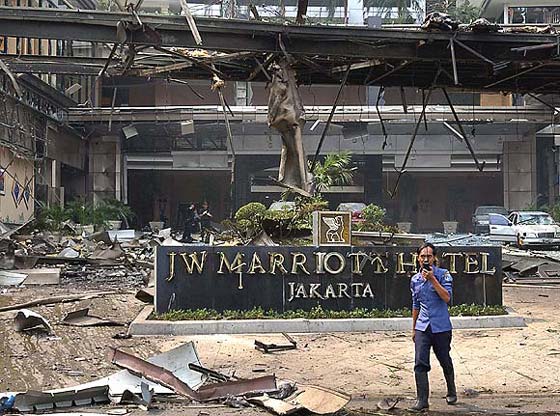
The commentators, journalists and politicians are saying that the bombing bore the hallmarks of the Indonesian terror network Jemaah Islamiah; the al-Qaeda-linked group that is fighting to install a pan-Islamic state in South-East Asia, and which has also been blamed for last October's Bali bomb attack. Seeing the images on television activates our resentment and anger. We recall Bali and September 11. They images also reinforce the tacit acceptance of the duality of the life and death battle between the pro-terrorists who hate tolerance, democracy and freedom and the pro-civilization forces who defend tolerance, democracy and freedom.
We live this duality. We do not see it as a matter of prejudice, nor as black and white cartoon thinking. It is reality. The way things really are. It cuts reality at its joints and it means that it is time to take sides. There can be no doubt about good and evil. Those people over there are not like "us" and they do not appreciate "our" values. Thus we have very core of traditional Orientalist discourse with new content.
That is the cultural and political context in which I read Said's article. Said is writing an afterword to Orientalism, He says that though it is 25 years on, little has shifted in terms of the structure of the discourse of Orientalism. He says:
"I wish I could say that general understanding of the Middle East, the Arabs and Islam in the United States has improved somewhat, but alas, it really hasn't....In the US, the hardening of attitudes, the tightening of the grip of demeaning generalization and triumphalist cliches the dominance of crude power allied with simplistic contempt for dissenters and "others" has found a fitting correlative in the looting and destruction of Iraq's libraries and museums."
An accurate description of where we are now. We are living in a new form of Orientalism as a knowledge/power, and this shapes our comportment in the world. Said then describes this discourse thus:
'What our leaders and their intellectual lackeys seem incapable of understanding is that history cannot be swept clean like a blackboard, clean so that "we" might inscribe our own future there and impose our own forms of life for these lesser people to follow....In the process the uncountable sediments of history, that include innumerable histories and a dizzying variety of peoples, languages, experiences, and cultures, all these are swept aside or ignored, relegated to the sand heap along with the treasures ground into meaningless fragments that were taken out of Baghdad.'
I have no problems with that as an account of the encultured reality we are now living. No doubt we can quibble about the details, but it is basically the cultural construct that we use to enframe events such as the reconstruction of Iraq or the bombing of Marriott Hotel. Said then makes a distinction between different forms of knowledge, and makes some tough lefty judgements.
"There is, after all, a profound difference between the will to understand for purposes of co-existence and enlargement of horizons, and the will to dominate for the purposes of control. It is surely one of the intellectual catastrophes of history that an imperialist war confected by a small group of unelected US officials was waged against a devastated Third World dictatorship on thoroughly ideological grounds having to do with world dominance, security control, and scarce resources, but disguised for its true intent, hastened, and reasoned for by Orientalists who betrayed their calling as scholars."
That paragraph and others like it will raise hackles. And they are calculated to do so. Said's rhetoric is designed to ensure that. And Norman Geras responds. So does Brad de Long. (I'm having problems with the linking.) It is the responses by Geras and Brad de Long that we need to consider. Can they dig out the weakness/flaws in Said's argument about the discourse of Orientalism?
Brad de Long makes two charges. He claims that Edward Said pledges allegiance to poverty, dictatorship, and keeping women illiterate and barefoot. Now Brad is not clear why this is the case as he offers no argument. But, I presume, it has to do with Said questioning the Enlightenment tradition. If you do that you are opposed to progress, knowledge and favour totalitariansm. You support a fundamentalist Islam in other words. Its a pretty standard charge.
Let us suppose that this is what sits behind Brad's claim. What disappoints her is that Brad makes no attempt at all to square his claim with Said's explicit commitment to the values of humanism----reflection, debate, rational argument, and moral principle based on a secular notion that human must create their own history. Some engagement is necessary to justify the claim. Nothing is forthing. There is no argument.
Secondly, Brad claims that in Said's text the only hint of agency in events, such as:
"...the failure of the Oslo peace process;....the outbreak of the second intifada;...the awful suffering of the Palestinians;...the suicide bombing phenomenon;... apocalyptic ... events of September 11 2001 and their aftermath in the wars against Afghanistan and Iraq;....the illegal occupation of Iraq by Britain and the United States..."
is laid at the door of Britain and the United States. In contrast, the other catastrophes "simply happen: Said's rhetoric tries to push them as close as possible to random catastrophes of nature rather than recognize them as the deliberate and intended actions of evil, insane, or desperate human beings."
Once again let us accept this interpretation. I suspect that what lies behind the claim is the assumption that discourse analysis is anti-humanists and anti-humanism has a passive conception of human beeings. They are but the vehicles of the discourse. This is difficult to lay on Said becuase he explictly flags his humanaissm through out the article. You would need to argue your case.
What is disappointing is that once again no attempt is made by Brad to square the passivity charge with Said's commitment to humanist notion that human beings must create their own history. Or to the way that Said talks about the sense of the density and interdependence of human life being brushed aside by simplistic categories, policies and actions. There is lots of other stuff in Said's text that is relvent: eg., the slow working together of cultures that overlap, borrow from each other, and live together in interesting ways; humanism being centered upon the agency of human individuality and subjective intuition, rather than on received ideas and approved authority; and humanism being the only and the final resistance we have against the inhuman practices and injustices that disfigure human history. These phrases give us a more active conception of human beings. But Brad ignores them.
Brad, in short, does not engage with Said. So it is hard to concur with the judgement by Abiola over at Foreign Dispatches that Brad has a withering take down of Said. Takedown? It doesn't even happen.
Let us turn to Geras. His case is different. He spots a moral hole in the Said's paragraph, which includes the phrase "an imperialist war confected by a small group of unelected US officials was waged against a devastated Third World dictatorship on thoroughly ideological grounds." Geras is very sensitive to moral holes because he holds that Marx, and the Marxist tradtion, failed to recognize its own ethical impulses and principles. Geras wants to bring this normative content fully into the open. So he is sensitive to the evasion of the ethical by the left. Does Said evade the ethical---ie., only talks politics and ends up in a morally bad place?
Geras interprets Said's above passage as "some nasty unelected confecters beating up on a poor devastated dictatorship." Fair enough. It's a bit rough but it will do, as the concern here is with moral holes. Geras then fingers the moral hole:
"The moral hole...is right there, free-standing, in that devastated dictatorship. Can this really be what Said meant? Should it not have read 'devastating dictatorship'? For this is, in truth, what the Baathist regime was. It wrecked the lives of countless Iraqis and the country as a whole. Devastated is what the dictatorship became after the military intervention of the Coalition."
You have to re-read that. Is it just a semantic point about devastated dictatorship and devastating dictatorship? No says Geras firmly. The moral hole has to do with the structure of meaning of the discourse. So what is the structure of meaning? Geras:
"Well, here's a suggestion. 'Devastated third world dictatorship' embraces, in one sweep, both the regime and the country. Calling it a dictatorship is distance taken from upfront apologia: you see, he knows. But calling it devastated, before (as a regime) it was devastated, this effects a shift from the regime to the country which it had brought to ruin. It is the standard move, a move now more than a decade old. Eliding the difference between the regime and the nation enables you to be on the side of the nation, of the people - Afghans, Iraqis, whoever - even while making yourself a would-be obstacle to terminating the power of their oppressors."
The paragraph is a bit dense. We can clear some things out of the way. There is no doubt that the Baath regime of Saddam Hussein devasted the country and was devasted (destroyed) by the Americans. There is no doubt that Said is on the side of the Iraqi (and Palestinian) people and that he sees, and is critical, of the imperial intrusion into the Middle East by western powers. There is no doubt that Said uses humanistic studies to contest both the simplified view of the world that a relative handful of Pentagon civilian elites have formulated for US policy in the entire Arab and Islamic worlds; and a media that assigns itself the role of producing so-called "experts" who validate the government's general line. And there is no doubt that Said contests this discourse through reflection, debate, rational argument,. There is doubt(ie., it is what Brad contests) that Said contents this discourse with the humanist moral principle based on a secular notion that human must create their own history.
That clears the ground around the moral hole. Do we have a moral hole based on 'devastated third world dictatorship'? Is there a collapse of the difference between regime and country? A first response is that it is totalitarianism that elides the difference between regime and country---not Said. There is no civil society in totalitarianism. Iraq is all state. The state's tentacles are everywhere, reaching into family life. Iraq was also one big welfare state.
Geras would know this. So what is Geras getting at? Where does Said slip up ethically? Geras realizes that he is only working from a phrase and that it needs a lot of digging to uncover the moral hole. So he directs us to this interview. Reading it we where find that a hole is a gap; there is a real gap in Said's thinking; a gap to be repaired. So what is the moral gap? Geras then directs us to this paragraph towards the end of the interview:
"Complementing the horizontal shift by which attention was drawn away from al-Qaida's responsibility for the crimes of September 11 to America's responsibility for them, there was also a vertical shift, to denature the war that followed. Facing west, opponents of military action would look up and see the US government. But facing east, they looked down and saw the people of Afghanistan. They were on their side and against the US government. It is a transparent game – become all too grimly familiar as a way of bracketing off certain unsavoury political 'mediations'."
So Said draws attention away from the Iraqi' regime's responsibility for the terror to its own people and direct it to America's responsibility for them. He also makes a vertical shift, to denature the war. Facing west, Said would see the imperial US government. When facing east, he saw the people of Iraq. He was on their side and against the imperial US government.
And the moral hole? The elision of the ethical?
Geras is arguing that Said sets up a rough moral equivalence between the US government and those it was actually at war with. Equivalence means that we were supposed to think that George W. Bush and what he represented, on one side, were on a level with Sadam Hussein and what he represented, on the other. The hole is that the America is not morally or politically equivalent, even approximately, to the Saddam Hussein's which is far far worse.
That is the argument. The implication is that the values of humanism and cultural tolerance are engaged on the side of anti-war viewpoint, which, if it had prevailed, would have had the torturers in Baghdad still at work today. An he wrote the essay in a country that embodies the values of humanism and cultural tolerance.
Is Said justifying the Baath regime? Does he end up here due to his hostility to the US imperialism. I will try and answer this in terms of how Said understands humanist critique to work on the discourse of Orientalism. I will do it in quotations because it is important that we actually read Said's text. How we read is crucial to Said's argument. It is going to be slow going but it is necessary as we have to remove the distortions impsoed by Geras on Said's text.
As is well known Said is deeply critical of those who help to construct the discouse of Orientalism. He says the:
"....bookstores in the US are filled with shabby screeds bearing screaming headlines about Islam and terror, Islam exposed, the Arab threat and the Muslim menace, all of them written by political polemicists pretending to knowledge imparted to them and others by experts who have supposedly penetrated to the heart of these strange Oriental peoples."
He then adds:
"Accompanying such war-mongering expertise have been CNN and Fox, plus myriad evangelical and right-wing radio hosts, innumerable tabloids and even middle-brow journals, all of them re-cycling the same unverifiable fictions and vast generalizations so as to stir up "America" against the foreign devil."
He criticises this discourse by drawing attention to the gap between the discourse and the ideals of the empire:
"Every single empire in its official discourse has said that it is not like all the others, that its circumstances are special, that it has a mission to enlighten, civilize, bring order and democracy, and that it uses force only as a last resort. And, sadder still, there always is a chorus of willing intellectuals to say calming words about benign or altruistic empires."
How does this situated criticism work? Said is quite clear:
"Therefore it would seem to be a vital necessity for independent intellectuals always to provide alternative models to the simplifying and confining ones based on mutual hostility that have prevailed in the Middle East and elsewhere for so long."
How is this to be done? Said says through the interpreting texts in a specifc way:
"Rather than alienation and hostility to another time and a different culture, philology as applied to Weltliteratur involved a profound humanistic spirit deployed with generosity and, if I may use the word, hospitality. Thus the interpreter's mind actively makes a place in it for a foreign Other. And this creative making of a place for works that are otherwise alien and distant is the most important facet of the interpreter's mission."
This requires special skills that are now being lost. But we could link to Iraqi bloggers as a start, or we could read Arab media. But Said offers us a warning as we enter the reversal of the imperial discourse: one that is called anti-Americanism. Saddam Hussein was a master of this and he used it to make himself a Arab hero standing up to the American invasion of an Arab country. Said says:
"In the Arab and Muslim countries the situation [as Roula Khalaf has argued] the region has slipped into an easy anti-Americanism that shows little understanding of what the US is really like as a society. Because the governments are relatively powerless to affect US policy toward them, they turn their energies to repressing and keeping down their own populations, with results in resentment, anger and helpless imprecations that do nothing to open up societies where secular ideas about human history and development have been overtaken by failure and frustration, as well as by an Islamism built out of rote learning and the obliteration of what are perceived to be other, competitive forms of secular knowledge."
What has been lost in the Arab world is their own tradition of skills that are crucial for the sensitive and critical humanist reading of the anti-American discourse. Said says:
"The gradual disappearance of the extraordinary tradition of Islamic ijtihad or personal interpretation has been one of the major cultural disasters of our time, with the result that critical thinking and individual wrestling with the problems of the modern world have all but disappeared."
But we are not trapped between Orientalism and its rejection. This is an important point. Geras claims that Said slides into the anti-Americanism of the Arabs and so ends up justifiying Saddam Hussein's dictatorship.Its either /or for Geras. But Said refuses to trapped in this way. He unpacks the either/or of Geras through finding other pathways. Said explicitly says there are other models on the table:
"This is not to say that the cultural world has simply regressed on one side to a belligerent neo-Orientalism and on the other to blanket rejectionism.Last year's United Nations World Summit in Johannesburg, for all its limitations, did in fact reveal a vast area of common global concern that suggests the welcome emergence of a new collective constituency that gives the often facile notion of "one world" a new urgency."
This may be pretty thin. But it is quite different to what Geras is claiming Said is doing, namely morally justifying Saddam Hussein's dictatorship by saying that it is morally equivalent to US imperialism. Said is actually providing a way for Arabs and us in the West to contest Orientalism of the West and the anti-Americanism of the Arab world. The concept of world with its "real interdependence of parts that leaves no genuine opportunity for isolation" is in a different space to Orientalism and anti-Americanism. We are standing on different ground.
Said says this alternative pathway of "one world" means that we need to:
"...concentrate on the slow working together of cultures that overlap, borrow from each other, and live together in far more interesting ways than any abridged or inauthentic mode of understanding can allow."
This middle way is no pie in the sky or a fiction. Said says that:
"The world-wide protests before the war began in Iraq would not have been possible were it not for the existence of alternative communities all across the world, informed by alternative information, and keenly aware of the environmental, human rights, and libertarian impulses that bind us together in this tiny planet."
This may be woolley cosmopolitanism to many---but, hell, let's recognize that we are a long way from what Geras is saying about Said. Geras got it badly wrong.
Geras picked the wrong target for his claim about the moral hole of the left. And he proved Said's point. Geras did not read Said''s text closely or sympathetically for the argument as a philosopher should. The humanist skills of interpretation have indeed been lost in the analytic philosophy that Geras works within.
August 5, 2003
its the same old song
I noticed this the other day. Nothing unusual at one level. It's just another academic getting into the blog thing, and getting all excited about being carried along the media flows in cyberspace. I was mildly amused about the embrace of popular culture. Philosophers are fascinated by cricket. There was many a staff meeting --when philosophy was still a discipline--- that had test cricket going on in the background. The staff meetings were more about cricket than departmental matters. But it is the content that matters on a weblog. Normblog looked a bit light--with all the cricket and personal tastes in music and film etc.
But then I realised that I knew the guy. Norman Geras was a British Marxist when I was doing undergraduate studies in philosophy at Flinders University of South Australia. I had read his early books (The Legacy of Rosa Luxemburg, London: Verso 1983; Marx and Human Nature: Refutation of a Legend, London: Verso 1985).
The more I read of Hegel the more I moved away from this British Marxism because of its conception of Marxism as a universal science of history; it being analytic philosophy; the hostility to romanticism; and the antagonism to poststructuralism based on lack of understanding and knowledge of continental philosophy. My shift away from this analytic Marxism took place between Literature of Revolution: Essays on Marxism, (London: Verso 1986) and Discourses of Extremity: Radical Ethics and Post-Marxist Extravagances, (London: Verso 1990.) I read it as a growing conservatism that was exemplied by Christopher Norris around about this time. There was much more meat in Adorno who started from the crisis of Enlightenment's scientific reason and was able to think and write dialectically. That is enough to put one off side with analytic Marxism.
British Marxism was a politics sitting on top of a conservative, realist scientific metaphysics. I suspected that the latter would transform the former. I based that judgement on my experience of that transformation in Australia. The old style revolutionaries became cultural conservatives in response to poststructuralism. The French and Germans were constructed as the enemy for the good ole Anglo-American boys. It's a familar story with a twist. Some the analytic Marxists discovered ethics and took the ethical turn.
Once I realised all this Normblog closely. I thought that it was something that I could bounce off. I duly noted this post. The issue of contention would be about the ethics. Geras, I intuited, would be saying that the left has no ethics.
Then I came across this courtesy of Abu Aardvark This is Norman Geras writing about the moral failure of the left in the Opinion Journal of the Wall Street Journal. A lefty writing in the Wall Street Journal and criticising the left. That is a long march indeed!
Clearly the 1968 lefty's long march through the institutions of liberal society has been well and truely turned around. Something has happened on the long march. This turning is just like the previous shift of being lefty in the 1930s and then being conservative in the 1950s. Like then, those who have made the turn now, help to point the guns on their old friends. There can be little common ground between friends and enemies. It was a culture war then, its a culture war now.
So what is Geras now saying about the Left? It's pretty much a case of moral failure. As I'd suspected from reading normblog. So what sort of job does he do? Since he has good philosophical skills behind him, the text is going to be an improvement on the arguments of an Anne Coulter. Abiola over at Foreign Dispatches is impressed. He says that this article:
"....is a must read for anyone who wants to think seriously about morality in the context of international politics...."
Thats a good recommendation. Abiola then asks:
"What can we take from reading this article, other than that the concept of national sovereignty cannot be elevated to the status of a supreme law rendered immune to any compromise?"
And he answers in terms of a humanitiarian obligation to help those caught up in genocide:
"I believe it also indicates that where we see inhuman actions unfolding before our eyes, and we have the power to put a stop to them at no great cost to ourselves, it is not only open to us to act, but an obligation. This means not just in Iraq, but in places like Rwanda, Liberia and even the Congo. After the Holocaust, the common cry to be heard was "Never Again!"; and yet, when faced in our own times with mass criminality, in choosing to do nothing, how are we different from those of that earlier age who we so freely condemn? They, at least, could say in their favor that they lacked the benefit of a recent historical precedent to draw upon, which we certainly cannot."
Big ethical/political issues are at stake here. The shadow of Auschwitz looms long indeed. We still live in its history.
Let's have a look at what Geras is arguing.
Geras says that the (Stalinist) left (& some liberals) paid lip service to the morally criminal attack of September 11, which slaughtered the innocents in the US. He adds that they were opposed to the U.S. in hitting back at al Qaeda and its Taliban hosts in Afghanistan; and opposed to the war to remove Saddam Hussein's regime in Iraq. This the anti-war left.
Fair enough. I'm one. I accept the 'slaughter of the innocents' but I would question 'gross moral criminality." I find it an odd way to talk about a war in the Middle East spreading out to the US homeland, but I will let it go. My unease indicates the way ethics is being approahed by Geras.
Geras then says that had:
"... this campaign succeeded in its goal and actually prevented the war it was opposed to, the life of the Baathist regime would have been prolonged, with all that that entailed: years more (how many years more?) of the rape rooms, the torture chambers, the children's jails and the mass graves recently uncovered."
Well, no. I do not accept that acount at all. This is pretty dam close to what the Howard Government and pro-war crowd were running at the time. In simply repeating it Geras is not engaging in critical, independent thinking. Why not?
The debate was about pre-emptive strike, unilateralism, implausible justification for war with respect to the threat to national interest and intervening under the UN. Saddam was a bad guy, his regime was a brutal dictatorship, millions had suffered. But he did not substantially threaten Australia's national interest. If it was shown in the court of international opinion (the UN) that the Hussein regime was a substantive threat, then we invade the sovereign country of Iraq under the flag of the UN. That was a common anti-war position in Australia and the UK. Humanitarian interventions are seen to be best handled by the UN. Bush, Blair and Howard could not convince the UN Security Council---and for good reason. The WMD case was not that plausible.
Geras then turns to the issue humanitarian intervention by outside powers under international law. The aim here is to stop a regime treating its own people with terrible brutality and massacring them. He says that the matter of internvention is disputed under the UN Charter, and adds that:
"Partly because the matter is disputed, I will not here base myself on a legal right of humanitarian intervention. I will simply say that irrespective of the state of international law, in extreme enough circumstances there is a moral right of humanitarian intervention."
So do I. So we have common ground. After all, Australians had supported the Howard Government's intervention into East Timor in the face of the terror being waged by the Indonesian army. That was done under the UN. What I would do is dispute the use of right. Humanitarian intervention can be justified without the turn to natural right. But that is another debate since there is common ground
So what does Geras say about the anti-war left? We need to be careful here because the humanitiarian case can hide a crude politics as Hesiod over at shows. We get this passage from Geras:
"It is... such realities--the brutalizing and murder by the Baathist regime of tens upon tens of thousands of its own nationals--that the recent war has brought to an end. It should have been supported for this reason, irrespective of the reasons (concerning weapons of mass destruction) that George Bush and Tony Blair put up front themselves; though it is disingenuous of the war's critics to speak now as if the humanitarian case for war formed no part of the public rationale of the Coalition, since it was clearly articulated by both the president and the prime minister more than once."
It should have been the justification, but it wasn't. John Howard,for instance, only used the humanitarian justification for war when welcoming the troops home. But it was clearly the WMD argument that was the central justification in Australia, and by all accounts the US. And also in the UK judging by all the kerfuffle. The justification for the war is a bone of political contention about the government's relationship to democracy being based on decit.
However, Geras considers that he has made his point about the humanitiarian justification. His concern is with the position of the anti-war critics. At this point he shifts gear and does a bit of moral philosophy:
'Let's now model this abstractly. You have a course of action with mixed consequences, both good consequences and bad consequences. To decide sensibly you obviously have to weigh the good against the bad. Imagine someone advising, with respect to some decision you have to make, "Let's only think about the good consequences," or, "Let's merely concentrate on the bad consequences." What?! It's a no-brainer, as the expression now is. But from beginning to end something pretty much like this has been the approach of the war's opponents.'
Hang a mo. What has happened to the language of right? How come we have shifted to moral consequences? What is this? A bit of utilitarianism? Well, lets put that aside for another debate and concentrate on the main thrust of the Geras argument: the ethics of the anti-war critics only concentrating on the bad consequences.
Geras ploughs on. The examples he mentions are Clare Short, who said that the war was not worth the loss of a single life. (I presume she is a pacifist.Does she justify it in terms of right rather than consequences?) The second example is the critics who point out all the negative things that have happened in Iraq, but fail to set this against the massive fact of the end of a regime of torture, oppression and murder since the regime fell. The third example is the antiwar interlocutor who will freely concede that that it is a good that that monster and his henchmen no longer govern Iraq; but then says that it is too stupid a point to dwell upon, for it doesn't touch on the issue dividing us, support or not for the war (on grounds of weapons of mass destruction, international law).
These 3 cases are examples of a failure to balance good and bad consequences. That onsidedness is the point where we can discern the moral failure of the left.
What is not considered by Geras is another position held by war opponents. One can oppose the war because of the lack of a substantive threat to the national interest but, now that the war is over, one can support and advocate for an Iraqi democracy.--the position of public opinion. This position is one that says that democracy enables the Iraqi people to live their own lives in a flourishing way. And the less suffering endured by the Iraqi people on the road to democracy the better. Once again the model is East Timor.
However, Geras is not interested in this, as his concern is moral failure. This is the gun that is being fired. So we then have an analysis of moral failure:
"If war opponents can't eliminate the inconvenient side of the balance[of good and bad consequences], they denature it. The liberation of Iraq from Saddam's tyranny can't have been a good, because of those who effected it and of their obviously bad foreign-policy record: Vietnam, Chile, Nicaragua and the rest. It can't therefore have been a liberation..."
It is a not a simple good because the liberation still looks like an occupation. However, the occupation/liberation issue all depends on what happens in the future. It is a case of whether the US helps the Iraqi's to get their own Iraqi democracy; or the Iraqi people have to fight the US to get their own kind of democracy.
Geras then turns the moral screw a notch:
"Last and worst ... If the balance doesn't come out how you want it to, you hope for things to change so that the balance will adjust in your favor... What these critics of the war thereby wished for was a spectacular triumph for the regime in Baghdad, since that is what a withdrawal would have been. So much for solidarity with the victims of oppression, for commitment to democratic values and basic human rights."
I'm not convinced by this description. It was less a case of Saddam winning and a brutal dictatorship remaining, than a concern to lessen the suffering of the Iraqi civilians caught up in the war. The Stalingrad scenario meant untold suffering. It was good that the dictatorial Baath regime collapsed quickly because it meant less suffering for the Iraqi people.
Geras, however, considers that he has made his case: The left has a very bad case of moral failure. That is the point of the whole argument.
So what is the significance of the bullet fired into the anti-war left's moral body? Geras sums it up thus----and it's the big one:
"Whatever the case or the combination [of moral imbalance] it has produced a calamitous compromise of the core values of socialism, or liberalism or both, on the part of thousands of people who claim attachment to them. You have to go back to the apologias for, and fellow-traveling with, the crimes of Stalinism to find as shameful a moral failure of liberal and left opinion as in the wrongheaded--and too often, in the circumstances, sickeningly smug--opposition to the freeing of the Iraqi people from one of the foulest regimes on the planet."
Wow. Its th dark nightmare of totalitarianism all over again. Equivalent to the apology for the Soviet gulag or Auschwitz. When you boil it all down the anti-war critics are apologists for the brutal dictatorship of Saddam Hussein. All that philosophy and we end up with the same script that John Howard ran about his critics. What has happened to the crtitical thinking of philosophy in the political life?
Now you can see why the Wall Street Journal would love this kind of public philsoophy. It has the right kind of politics. That big historical significance of moral failure presses all the right buttons in the culture war. When you boil all the philosophy down it is saying that left were realy apologists for a brutal totalitarian dictatorship.
It doesn't take much to draw the obvious mplication. It's the one Anne Coulter draws--treason.. Geras does not go so far. But he clears the ground for others to walk on. He is their underlabourer.
'Tis a sad day for philosophy in political life.
August 3, 2003
a certain intelletual oomph
Peter Cuthburtson over at Conservative Commentary has an interesting post on Why so many leftist bloggers lean right. It is about lefties in the media (the BBC and Guardian) thinking that their conservative opponents are ignorant and prejudiced, and so they have little understanding of conservative arguments on an issue.
Peter says:
"So as they [liberal/lefties] recognise all the reasons to support the views they hold, they have no knowledge or appreciation of the arguments on the other side, or the reasons for thinking their own standpoint might be wrong. The only logic they have been exposed to is on their side, so everyone on the other must be motivated by hate, greed, bigotry, lunacy and bloodlust."
Peter makes a general point about a phemomena I mentioned here and illustrated here. This phemonena in public debate is particular distressing for someone who has been trained in philosophy, for I just take it for granted that there are arguments on both sides of an issue, it is the arguments that are examined, and the task at hand is to take apart the argument.
I'm not sure what Peter means by conservatism as I have not explored his weblog sufficently. What has motived this weblog has been an attempt to understand Australian conservatism that sits behind the populist conservatism of the last two decades. The philosophy seemed to me to be pretty thin. (See postings here and here on Australian conservatism). Those posts were an early attempt to come to grips with Australian conservatism--it appeared to me that this conservatism lacked a common philosophical core and was little more than a series of splinters around a myriad discussions of specific policies and issues. What does give conservatism its core is the social construction of an urgent threat from a enemy---international terrorists. It is this threat makes conservatives strong and united notwithstanding their internal differences.
What I am going to do on this post is to show my lefty affinity with conservatism. Philosophy.com is a lefty webog (my roots lie in the German marxism of the Frankfurt School, and in particular Adorno---it was Aesthetic Theory that turned me on). I have a great deal sympathy with the conservative critique of liberalism (& here) and modernity. By conservatism I mean the conservativism of a Burke; or an Oakeshott or [here])or a Russell Kirk. It is seen as the traditionalist school, but it is to be distinquished from the current neo-con foreign policy doctrine of pre-emptive strike and unilateralism.
And to be distinquished from the wishy washy conservatism that is really free market liberalism and libertarianism. There are very few libertarians around who argue that liberty is valuable for its own sake irrespective of the consequences. What we have are utilitarians who are strong on individual property rights and free competitive markets. They are mostly free market economists, and from what I can gather, they assume that freedom works," in the sense of generating far greater social prosperity and individual utility than non-free or socialist societies. They do not see the need or possibility of justifying individual rights on any other basis other than market efficiency and wealth creation.
Economic prosperity is the good, and all the arguments are pretty much about utility, efficiency, economy, wealth creation and the (spontaneously evolved) liberal market order. Politics, from I can gather, means government and that is about the use of coercive power to protect life, liberty, property, and the obligation of contracts. Happiness is bundled off into the prive sphere. Happiness is an individual personal thing and reason cannot evaluate different and subjective values or ends.
On this account we citizens defend Australia from international terrorism for the sake of economic prosperity. Sitting behind this is the assumption of self-interst and self preservation. In defending Australia we are defending a way of life that amounts to little more than individual rights in self-preservation and self-interest, and so the protection of mere life and a low sort of liberty. It is pretty thin stuff, but that is what you get when you reduce society to the competitive market. Civil society, culture and political life fade away.
Back to philosophy.com and its leftylean right. I don't bother to reconcile what many would take to be deep contradications. Suffice to say that my postgraduate training was in Hegel, Nietzsche and Heidegger They are powerful thinkers on the discontents of modernity, and this gives you a certain oomph; an omph that makes me quite sympathetic to this review of Leo Strauss.
Take the following passage:
"And yet, for all its universality and global sway, the spell of modernity seems to be breaking. The western self can no longer ignore the reality that modernist forces have caused the devastation of the landscape of rationality and turned it into a wasteland of nihilism and contingency."
My response? That's dead right. I'd shrug and say it's only recycled Nietszche. Hence we have a problem with modern enlightening reason and the Enlightenment tradition. The Enlightenment project has gone off the rails.
Then the next bit from the review:
"All the works reported here attest to the presence of the anti-modern spirit that, so soon after the passing of the juggernaut of modernity, breathes over the intellectual heartland of the downtrodden traditionalist and the disillusioned modernist. The rebirth of a host of alternative discourses, both Western and non-Western, that all challenge the hegemony of the modern meta-narrative is a significant development of our times and even though it is impossible to hail every act of anti-modern insurgency as an emancipatory exploit, the dethroning of the regime of modernity can no longer be contested."
My response? Of course. No problems. What do you expect with the decay of modernity. All the bits that have been rejected, scorned and repressed for so long reappear.
And the next bit is easy as well, namely that Leo Strauss:
"...is today regarded as one of the most formidable philosophical critic of modernity... Behind Strauss's conviction about the intellectual bankruptcy of contemporary philosophy, his radical doubt about modern rationalism and his recognition of its spiritual and moral crisis lurks the giant of medieval Jewish philosophy, Moses Maimonides and his Islamic predecessors. That Strauss himself studied Muslim philosophers, and through them discovered his 'mentor' Maimonides; that one major academic enterprise for the study of medieval Islamic philosophy, that of Professor Muhsin Mahdi and his students, has been directly influenced by Strauss's ideas; that his indictment of modernity for its 'theological-political' flaws fully coheres with the Islamic judgement in this regard, count, I believe, more than adequate reasons for the Muslim interest in the work of Leo Strauss."
No problems. It's in Hegel. The whole Enlightenment project is grounded on faith. And it cannot justify its presupposed faith in reason. This gives rise to its theological-political flaws. And the stuff about the world construct of natural science? Well that's Heidegger's thesis of the scientific of the world picture of modernity.
So what is the common ground between ground between conservatism and Marism. It is one of 'lets get stuck into liberal modernity and its entrenched categories of instrumental rationality and individualist subjectivity ' folks. We need to take a hammer to these idol of the modernity---sound them out for their hollowness. And where do we do that from? Where do we stand whilst we critique liberal modernity? In the tacit, practical, ethical knowledge of our common life. It is this that enables us to confront "the terror of nothingness and meaninglessness of life"--and I would add 'in the liberal market order.'
And the differences? Whereas Strauss & Voeglin make a religious turn, I stick with an aesthetic reason concerned with embodied human suffering. In a world where an (utilitarian) economic reason is hegemonic aesthetics gives expression to human experience of suffering and lends it a hand. Aesthetics is the realm of sentiments, affections, spontaneous bodily habits customs that cohere in what is often called a common life.
The other difference with Strauss is that he stands on the ground of natural right to critique modernity whereas philosophy.com stands on the historicist ground opened up by Hegel. But that dispute is a whole other ball game.
All I wanted to show in this post is show another way a lefty can lean right.