October 31, 2003
It's crude but...
The image is crude I admit, given that politics is 99% administration.
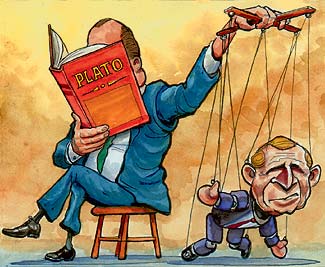
But it does capture the two levels of discourse of the Howard Government, and the way that this government has used a version of Plato's noble lie (Tampa and Iraq) to manage public opinion.
Tampa refers to asylum seekers throwing children overbroad whilst Irag refers to the threat posed by the Iraq regime.
The image is need of interpretation to avoid the conspiracy theory reading. The noble lie for Plato is a myth told to the people by the rulers to motivate them to do what is good and right. Without this religious myth they would not behave in a good fashion, even if this was what was ultimately in their best interests. It was no use explaining to them why they should behave well because they would not understand.
Under this strategy our political leaders chose their words precisely and exactly, using ellipses and rhetorical evasions to convey hidden meanings to the political elite while concealing them from the rude and undiscriminating gaze of the grubbing multitudes.
Shadia Dury describes it this example of lies in politics this way:
"Public support for the Iraq war rested on lies about Iraq posing an imminent threat to the United States – the business about weapons of mass destruction and a fictitious alliance between al-Qaida and the Iraqi regime. Now that the lies have been exposed, Paul Wolfowitz and others in the war party are denying that these were the real reasons for the war.So what were the real reasons? Reorganising the balance of power in the Middle East in favour of Israel? Expanding American hegemony in the Arab world? Possibly. But these reasons would not have been sufficient in themselves to mobilise American support for the war."
Hence the need for the noble lie by the executive deployed to mange democratic public opinion and the Parliament. The context for the usefulness of lies in politics is the slow paralysis endemic to the legislative branch in a federal nation state, which makes the function of the executive more necessary than ever in times of national crisis.
What Tampa and Iraq showed clearly is the secrecy in politics. The executive conceal their views to shape the people’s feelings and to protect the political elite from possible reprisals.
Shadia Drury argues that the neo cons in the Bush Administration engaged in this Platonic practice of the noble lie but that they learned their political philosophy from Leo Strauss.
October 29, 2003
Resignation
This is being noted. Posner argues that accept democracy as we find it. Itds all to do with balancing competing interests.
October 27, 2003
Stoic governance of anger
I mentioned in an earlier post on anger in public life that Seneca argued against the usefulness of anger to a position in which reason is the opposite of the passions. He holds that community and individual well-being means that we cannot allow reason to mingle with, and be contaminated by, the destructive passions.
This is the standard Stoic view of the extirpation of the passions (eg., fear love, grief, anger, envy, jealously etc). Stoic therapy of self-confrontation and self-scrutiny aims to ensure that the passions are eliminated from human life.
How do we make sense of this elimination? Stoics such as Seneca, start from what we can call the commonsense position. And that is?
Well the passions are seen to be a form of false judgement. They are violent upheavals in our subjectivity to be contrasted with the calmness of reason. What we noticed about the Bali bombings is that the grief was a form of emotional upheaval involving grieving for loved ones who had been killed by the bomb.
Judgement implies that the passions have a cognitive element as they involve ways of interpreting the world: eg., citizens being angry with John Howard's actions on refugees; or Australian journalists beign angry the Green Senators disrupting the US Presidency when Bush addressed the Australian Parliament; ior the Australian people with the Islamic bombers in Bali. Hence these judgements can be evaluated in terms of them being true or false.
That pretty much accords with our commonsense position today.
Evaluative here means good/bad, worthwhile/worthless, helpful/noxious etc. It presupposes a complex web of connections between self and community and a sense of fortune, or of things being outside our control. We fear being blown by a terrorist bomb, and we grieve or mourn when we hear that a friend or lover has had the misfortune to be in the wrong place at the wrong time eg. Bali.
So why hold that passions should be extirpated rather than moderated? Why is a flourishing life one lived free from anger (and fear, jealously, passionate love, intense joy etc)?
From what I can make out it is necessary because the judgments are false. Why so? There are several arguments. Externals, such as grief over the death of loved one,do not have great value given the fillness of time. I will let that argument go.
Secondly, the passions are held to be not that important in motivating ethical action. Insead of anger toward the Bali bombers we could act out of duty to defend the nation from attack. Thus in On Anger Seneca says:
'"What then?" you ask; "will the good man not be angry if his father is murdered, his mother outraged before his eyes?" No, he will not be angry, but he will avenge them, will protect them. Why, moreover, are you afraid that filial affection, even without anger, may not prove a sufficiently strong incentive for him? Or you might as well say: "What then? if a good man should see his father or his son under the knife, will he not weep, will he not faint?" ... The good man will perform his duties undisturbed and unafraid; and he will in such a way do all that is worthy of a good man as to do nothing that is unworthy of a man. My father is being murdered-I will defend him; he is slain-I will avenge him, not because I grieve, but because it is my duty.'
I've got problems with this argument. Anger and grief seems to be a more morally valuable response to terrorist murder than duty since it indicates the cares and commitments to loved ones and friends. The care and the commitment to others is what was so remarkable about the aftermath of the Bali bombings; it indicates the importance of family life and personal relationships to our conception of a good human life well lived. it is the police tracking down the terrorists who are doing their duty for the nation state.
The third argument is one that holds the passions are bad. They rae experienced as a form of emotional upheaval that cause disorder, agony and torment. Consider the way Seneca sets this image of the passions as a torrent that overwhelms us and leads to ruin:
"But you have only to behold the aspect of those possessed by anger to know that they are insane. For as the marks of a madman are unmistakable-a bold and threatening mien, a gloomy brow, a fierce expression, a hurried step, restless hands, an altered color, a quick and more violent breathing-so likewise are the marks of the angry man; his eyes blaze and sparkle, his whole face is crimson with the blood that surges from the lowest depths of the heart, his lips quiver, his teeth are clenched his hair bristles and stands on end, his breathing is forced and harsh, his joints crack from writhing, he groans and bellows, bursts out into speech with scarcely intelligible words, strikes his hands together continually, and stamps the ground with his feet; his whole body is excited and "performs great angry threats"; it is an ugly and horrible picture of distorted and swollen frenzy-you cannot tell whether this vice is more execrable or more hideous."
The passions are pathological by their very nature. They leave us weak and diseased and in need of therapy. It is over the top but can be redescribed in terms of psychoanalysis and the unconscious. Suddenly we have an argument that bites.
to be continued.
October 23, 2003
judicial activism=end of democracy?
I do not know the First Things November 1996 symposium that connected the end of democracy to the judicial usurpation of politics. Apparently, that symposium generated a lot of discussions about judicial activism, democratic legitimacy, and the intellectual framework of America's conservative movement in history.The debate has been collected in a book.
The theme resonates with recent posts at philosophy.com.
Going back to the original symposium I can see that Robert H. Bork made arguments that are very familar in Australia. The activist Supreme Court has overstepped its Constitutional authority in that "The most important moral, political, and cultural decisions affecting our lives are steadily being removed from democratic control." Bork says that in extending their powers, the judicial activists on the Supreme Court have usurped the legislative process. Hence they must be stopped through a series of legislative and cultural reforms.
The specific issues tackled by the Supreme Court in the US and the High Court in Australia are different but the conservative argument is the same: the judicial actions that add up to an entrenched pattern of government by judges that is nothing less than the usurpation of politics. The question posed by First Things in the Introduction to the Symposium is quite radical: "whether we have reached or are reaching the point where conscientious citizens can no longer give moral assent to the existing regime."That question has not been posed in Australia, as far as I know.
Personally I am sympathetic to judicial activism by the High Court in Australia in terms of discerning implied rights to free speech implied in the Australian Constitution and the laying to rest the myth of terra nullius in the Mabo case. These accord with my lefty politics.
However, my republican understanding of politics is similar to that articulated by First Things. They say:
"Politics, Aristotle teaches, is free persons deliberating the question, How ought we to order our life together? Democratic politics means that "the people" deliberate and decide that question. In the American constitutional order the people do that through debate, elections, and representative political institutions. But is that true today? Has it been true for, say, the last fifty years? Is it not in fact the judiciary that deliberates and answers the really important questions entailed in the question, How ought we to order our life together? Again and again, questions that are properly political are legalized, and even speciously constitutionalized. This symposium is an urgent call for the repoliticizing of the American regime."
I can only but occur. As I do with the federalism as devised by the founders of the Constitution:
"The democracy they devised was a republican system of limited government, with checks and balances, including judicial review, and representative means for the expression of the voice of the people. But always the principle was clear: legitimate government is government by the consent of the governed."
Same situation in Australia.
So I have a problem on my hands.
I am going to have to work through this debate in the different issues of First Things.
October 22, 2003
Seneca on anger
Can philosophy help human beings in overcoming the conflicts that cause us to suffer so much pain? Anger is one such emotion in public and private lives, where it largely takes the form of the desire to repay past suffering caused by others. The task for a therapeutic philosophy would be to help us deal with anger.
What advice do Stoics like Seneca offer us? How can a Stoic therapeutic philosophy help us?
Sencea regarded anger as a form of madness. He describes this emotion as follows. He says that it is:
"...wholly violent and has its being in an onrush of resentment, raging with a most inhuman lust for weapons, blood, and punishment, giving no thought to itself if only it can hurt another, hurling itself upon the very point of the dagger, and eager for revenge though it may drag down the avenger along with it....it is equally devoid of self-control, forgetful of decency, unmindful of ties, persistent and diligent in whatever it begins, closed to reason and counsel, excited by trifling causes, unfit to discern the right and true-the very counterpart of a ruin that is shattered in pieces where it overwhelms."
So what can be done about this form of madness? Can we control it through it reason and so limit its destructiveness? Aristotle thought so since he held that a life of virtue was one built on moderating the passions. That is pretty much my own view, even though I adopt a more psychoanalytic approach of anger and revenge having their roots in the unconscious.
Seneca argues against this approach. Anger is more properly viewed as an enemy of a life based on reason. He says that:
".. ..The enemy, I repeat, must be stopped at the very frontier; for if he has passed it, and advanced within the city-gates, he will not respect any bounds set by his captives."
Here we have a familar picture: reason is the opposite of the passions. We cannot, says Sencea, allow reason to mingle with, and be contaminated by, the passions. Hence he argues against the usefulness of anger.
Seneca says that "there is nothing useful in anger, nor does it kindle the mind to warlike deeds; for virtue, being self-sufficient, never needs the help of vice.
Secondly, reason will never call to its help blind and violent impulses over which it will itself have no control, which it can never crush save by setting against them equally powerful and similar impulses, as fear against anger, anger against sloth, greed against fear.
Seneca, then deals with an objection that states that against the enemy anger is necessary. Anger, in other words is necessary for politics and warfare. Seneca responds:
"...what use is anger when the same end may be accomplished by reason? Anger is not expedient even in battle or in war; for it is prone to rashness, and while it seeks to bring about danger, does not guard against it."
And so it goes on. There is no need for something as base and destructive as anger. Reason rules and the passions are extirpated.
October 20, 2003
anger
I've little time this week to write as I am painting the holiday shack at Victor Harbor. I'm pretty tired in the evening.
But I have noticed a lot of anger in public life in Australia amongst the political elite. It mostly takes the form of revenge and payback for past wrongs, defeats and humilitations.
You hear about the anger in Tasmania where those in the forestry industry are consumed by anger towards the greens.
These examples of anger in public life reminded me of Seneca. He wrote about it.
This is his essay On Anger.
Why Seneca? Two reasons. First, I just happening to be glancing through Alain de Botton's The Consolations of Philosophy between the breaks in painting.
Secondly, I'm full of anger in my personal life. It is eating away at me, turning me into a different kind of person.
And De Botton? It is easygoing, well written, easily understood, peppered with illustrations and pleasant to read. From what I can make out consolation is about soothing our spiritual aches. It is a kind of like those self-help books about achieving happiness that are touted on daytime TV.
He's a doctor of the soul who deals with life's emotional problem. Hence his text is working within the tradition of philosophy as a way of life.
Can he help us to deal with anger in our personal and public lives?
October 19, 2003
free market + democratic deliberation
The theme that I have been exploring is the tension between the free market and democratic deliberation. My argument is that the embrace of the free market has meant putting a lid on democratic deliberation. I have called this 'putting the lid on' the conservative moment that nestles inside the libertarian market liberalism.
You can see the squashing of democratic deliberation most clearly around environmentalism because of the latter's critique of the values of economic growth that underpins neo-liberalism. Crudely put, the neo-liberalsim say that global marketplace reigns supreme. There is a lot of money to be made in biotech, in irrigated agriculture and in generating greenhouse gases. Even if those activities turn our inner and outer worlds upside down it does not matter. Money does. Case closed.
The afterword by those who make this case is that Governments should show leadership. By this is usually meant compressing democracy deliberation, constraining democratic institutions, governing through the free market, putting a lid on dissent and pushing on with reform. The job of the reforms is to ensure that the market rules supreme and that society is shaped, or adpated, to the tendencies of the global market.
It's crude I know. But that was what I had in the back of my mind when I was lookig at Chief Justice Murray Gleesons' Boyer Lectures. If the High Court was the defender of the constitution, then did that mean that the High Court was also defending democracy? The answer that I came away with was no. The High Court would defend federalism. That is not the same thing because you can have a federalism in which democracy is being hollowed out by the pressures of the global market.
Coming to that judgement made me very sad.
October 16, 2003
philosophy in Australia
I find this quite interesting and suggestive. It argues that America is, or has become, a philosophical society.
I concur with that judgement.
Then I ask: is Australia a philosophical society?
It too was once dismissed an intellectual wasteland by those working from a European perspective. A utilitarian Australia is generally seen as practical and on-the-go; as deeply anti-intellectual; as importing ideas from overseas; and as not being able to generate its own ideas. For the practical business man philosophy is seen as speculative, useless and akin to daydreaming.
But what if we adopt the perspective developed on this weblog in which philosophy is reconnected with its rhetorical roots?
Does that disclose something other?
It is something to mull over.
Citizenship: there and gone
The sixth and last Boyer lecture given by Chief Justice Murray Gleeson is concerned with the independence of the judiciary, its accountability, and its role in upholding the Constitution.
In this lecture citizenship makes a belated appearance. Gleeson says:
"The rule of law depends upon the impartial administration of justice according to law. Citizens, in the last resort, look to courts to uphold their rights, and to enforce their lawful claims against other citizens, or against governments. Governments look to the courts to enforce the obligations of citizens, and to restrain - and, where necessary, punish- unlawful behaviour. In a nation with a written Constitution, the courts have an additional function, which is to uphold the Constitution."
There one moment gone the next. Gleeson turns his attention to law making and so picks up on, and addresses, concerns about the politics of the High Court and conservative criticisms about judges making policy.
to be continued.
October 14, 2003
tight judicial logic?
The arguments that we have been considering by Chief Justice Murray Gleeson in his Boyer Lectures establish a key point. That it is a constitutional rule which is the foundation of the legal system, and not the unlimited power of the sovereign (ie Parliament in liberal democracy). That constitutional rule is then accepted----federalism--- in the practice of the legal system, with this practice emboding an obligation to deploy its criteria.
Yet the High Court carries a lot of baggage because it has played an integral part in the nation-building of the twentieth century--eg.,the Communist Party Dissolution Case.
A key figure in this story here is Sir Owen Dixon, who is often celebrated as one of Australia's finest High Court Judges and he is best known for his espousal of a ‘strict and complete legalism’ as the only safe guide to resolution of disputes. And the philosophical presuppositions that sit behind the tight judicial logic? What about them?
Consider these remarks by Sir Owen Dixon:
"We regard our country as a southern stronghold of the white race—a thing for which it is well fitted; and our population is European. The aboriginal native has retreated before the advance of civilisation, contact with which he apparently cannot survive. The analogy in this country is the Red Indian, but the Australian Aboriginal is of a much lower state of development. He belongs to the Stone Age and no success has attended efforts to incorporate him in civilised society."
It's not a cheap political shot. Remember that Australian Aborigines were denied citizenship until the late 1960s. Those remarks can be interpreted as providing a justification for why indigenous Australians should not be granted citizenship.
The above remark is a reminder that we need to pay attention to the social and political preconceptions behind the reverence for tight judicial logic. The High Court is a political institution in liberal democracy, it is involved in the political debates of the time, and its reasoning is part of liberal political reason.
At a more sophisticated level, the appeal to the rule of law, does need to distinquish legal authority from the exercise of arbitrary political power. So what makes the legal authority of the High Court legitimate? It is more than tight judical logic, professional credibility (the respect and confidence of the other judges and legal profession) or the fundamental rules involved in the law making procedure. It also involves the moral constraints on legal authority that distinquish its conduct from the exercise of arbitrary political power.
October 13, 2003
Democracy & the High Court of Australia
The fifth Boyer lecture by Chief Justice Murray Gleeson is concerned with the role of High Court of Australia in a federal polity. The argument is that the High Court is both a final court of appeal and a constitutional court.
So what does the Court do? What is the role of the High Court of Australia? Should it defend democracy and citizenship? I am becoming increasingly disturbed by Gleeson's Boyer lectures due to the non-appearance of democracy. My unease arises from the High Court defending federalism but not a democratic federalism.
Gleeson says that the role of the High Court as a constitutional court is closely bound up with the nature of federalism. He then restates what he means for federalism. Presumably he keeps restating the obvious for all those who naively think that federalism is not embodied in the Australian constitution.
"The essence of a federal system of government is an agreed division of powers and authority between the political entities which make up the federation: in Australia, the Commonwealth and the States. Inevitably, disputes will arise from time to time, either between governments, or between citizens and governments, over the limits of the powers defined by the Constitution. Resolving such disagreements is, ultimately, the task of the High Court."
What then is this role? It is more than a judicial review of legislation and the rule of law in which judges play a central role. Gleeson's answer would probably startle those politicians who tacitly presuppose the supremacy of Parliament. He says:
"In the last resort, it is for the judiciary to determine the powers of the Parliament and of the executive. When federalism was first established in the United States, this was not seen as inevitable. Thomas Jefferson, for one, had a different opinion. But long before the Australian federation came into being, the principle of the judiciary as the body which resolved disputes about the powers of the other branches of government was established. The precedent was followed here, virtually without question."
It is a good principle. The judiciary resolves the disputes over the exeriise of power in a federal Australia in terms of the rule of law. Gleeson then adds:
"The responsibility of ruling upon the validity of laws enacted by democratically elected parliaments is thus cast upon a group of unelected lawyers. The fact that they are unelected means that they have no need to seek popularity, and should be uninfluenced by public or political opinion. The fact that they are lawyers reflects two considerations. The first is that the Constitution is itself a basic law, and constitutional disputes raise issues concerning the interpretation of a written legal document. The second is that the members of the Court are expected to approach their task by the application of what Sir Owen Dixon described as 'a strict and complete legalism'".
I have grave doubts about Dixon's strict and complete legalism as a sufficient judicial method to resolve political disputes. The constituion, as a written legal document, contains issues about which we all as citizens have an opinion; and that they are issues which are not seen as necessarily the province of only the legally trained.
Gleeson's remarks make the High Court a very powerful institution. It both unifies the common law in Australia and is the ultimate interpreter and guardian of the Constitution. Hence it is the keystone of the federal arch. It holds federalism together.
The Antipodean legal positivists, with their deep dislike of judicial activism, would not welcome that! The High Court is not only the centre and crown of the whole set of State judicial systems it is the centre and crown of federal jurisdiction as well. Both the Prime Minister and the Attorney General, who have been very critical of the judiciary in the past, passed up criticizing the High Court in their speeches to the Centenary High Court Sitting and Australia Centenary Conference. They were fulsome in their praise.
Well I have a criticism. The architectural image of the High Court as the keystone of the federal arch sees the federalism as a building in which the polity operates. A building has a purpose---it enables us to dwell and it offers a better kind of life. So the democratic polity would work better for citizens with the federalism. Though citizenhip makes a belated appearance in Gleeson's Boyer Lectures, democracy barely gets a mention. So the High Court, as the ultimate interpreter and guardian of the Constitution, highlights federalism but not democracy.
Surely the a central purpose of federalism is to protect and deepen democracy. Federalism, as a form of government that unites separate political entities/states within a single national system, but which allows each political entity/state to retain its independence, ensures the spreading of political power and connecting political institutions to citizens. The house of federalism in which we live ensures that government remains close to citizens; encourages development of the nation in a decentralised and regional manner; and provides a barrier to the dominance of the majority. But the purpose of federalism is to ensure justice, limit injustice and facilitate the good life.
I appreciate that we have a conservative High Court and that Justice Murray Gleeson considers the ethos of the High Court to be one of restraint, economy, prudence, respect for other agencies of decision reasoned judgment and fidelity to the law. But the silence on democracy and citizenship from the interpreter and guardian of the Constitution comes as a shock. I discern indifference in the undernourishment of democracy by the High Court.
I sense that Gleeson's defence of federalism as a way to constrain power is a constraint of democratic power exercised by citizens. The rule of law is a cover for the rule of law over democracy at a time when citizens are losing control over political power that they can use to enable them to live a more flourishing lives.
October 9, 2003
Politics and the High Court
I see that week-long celebrations to mark the 100th anniversary of the High Court began on Monday with a special ceremonial sitting of the full bench of the High Court in Melbourne. It had been appointed by the Judicary Act of 1903.
My interest was caught because of the politics involved. At one level the poltiics is embedded in the history of the High Court. The High Court is shifting away from an almost exclusive reliance on British and Australian law and judgements by British and Australian courts to embrace more international law, especially human rights law. It is an evolutionary shift and one associated with globalization but it opens up political tensions. These can be seen in the next level of politics of the anniversary celebrations.
The celebration was marked by a critique of Philip Ruddock, Australia's newest Attorney General for his earlier criticisms of judges, judgments and courts when he was Immigration Minister.
The criticism came from two sources. The first, was former Chief Justice Sir Gerard Brennan. He said that Ruddock's history of attacking the integrrity of the judicial process was inconsistent with the function of the attorney general. Brennan said that the attorney general's role was to defend the integrity of the judiciary against his ministerial colleagues.
The second criticism came from the Victorian Attorney-General, Rob Hulls, who was representing all state and territory attorney generals. He said that as Attorney-General Philip Ruddock had to put his criticism's behind him and become a defender of the judicary.
Earlier in the week Justice Michael Kirby had written that:
"Recent attacks on the court and on individual judges by people who should have known better undermine the rule of law. The lack of proper media coverage of the court's work, including informed criticism, is a depressing feature of the superficial world of infotainment. Yet it can still be said that the High Court has fulfilled its national role beyond the expectations of those who created it."
That national role, says Kirby, includes defending the constitution and establishing a single common law for Australia both in economic and social terms.
Hence we the politics surrounding the High Court. What is going on here? As I understand it most of the conservative criticism of the High Court has been directed at its judicial activism. A good example is the Quadrant speech given by John Dyson Heydon, before he was appointed justice of the High Court.
Judicial activism in Australia does not mean judges overturning laws on constitutional grounds. Nor does it mean judges on the High Court making controversial decisions which don’t necessarily reflect the views of the government of the day. It means interfering in politics.
Does not the High Court have a long history of judicial activism in this sense? There was Henry Higgins in the early part of the century; the development of a centralized federalism; the close alliance between a conservative High Court and the property classes; judges have gone on strike over their wages and work conditions; the Barwick's Court supported for tax avoiders; the discovery of implied freedom of speech in the Constitution; and Mabo and Wik.
Interfering into politics in what way? Through judicial progressivism. Such activism is at:
"...odds with the fundamentals of democracy... [since] seven un-elected judges should never be allowed to usurp the legislative power of elected Australian Parliaments. Legislative (and executive) power, according to the basics of liberal democracy, should be exercised by those whose authority is derived ultimately from the people. There can be no justification, legally or morally, for any form of judicial amendment to our constitution."
The politics is to prevent prevent the High Court from usurping parliamentary control of ministerial decisions and causing the breaking down of the separation of powers doctrine. This is the key to understanding what is meant by judicial activism.
More neutrally, judicial activism refers to the politics of the High Court involved in importing a doctrine of Lockean rights that is missing from our Constitution under the cloak of interpretation.
Update
An example of the conservative criticism of judicial activism is provided by Janet Albrechtsen's Leave policy to the law-makers. She is criticising Jane Stapleton's view that her "hope is that in contrast to our past, the next 100 years will deliver the promise of our existing legal system to be a 'living instrument', to be inclusive, address disadvantage, cherish difference and confront historical wrongs".
Albrechtsen responds that this makes judges policy makers.
"Stapleton's vision represents the worst kind of rule by personal conscience. Some judges love it because, with a flourish of the judicial pen, they get to play grand policy-maker. But judges are ill equipped for the role. Their expertise in the law and sifting through evidence does not translate into expertise in formulating policy. Unlike politicians, they are not tested by an opposition; on the contrary, they are usually surrounded by sycophants. Neither do they have experts on hand to advise them about economics and cost-benefit analyses. So, when they make policy, they often botch it."
With conscience-driven judicial decision-making judges become social engineers. Hence the importance of checks and balances on judges who play policy-maker. The most obvious check is criticism of judges by politicians and the media who should be taking an informed fight to the judiciary when it oversteps the mark. Without sensible but vigilant criticism, judicial activism will result in a profound alteration to the separation of powers.
October 6, 2003
Citizenship: a belated appearance
The fourth Boyer lecture by Chief Justice Murray Gleeson examines some of the issues involved in the debate over whether or not a Bill of Rights would benefit our society. He also addresses concerns in the community about the judiciary, its seeming encroachment on public policy and the assertion that judges, being unelected, are unrepresentative and unresponsive to public opinion. It can be interpreted as a defence of the role of the High Court in a federal polity; a defence that is continued here by Justice Kirby.
Gleeson starts off well by contrasting the US and Australian constitutions. He says:
"The Australian Constitution, as a plan of government for a federal union, is largely concerned with pragmatism rather than ideology. It does not take the form of a Bill of Rights. Yet it would be a mistake to think that it does not contain guarantees of rights, freedoms and immunities.The establishment of representative parliamentary democracy as the method of government for our Federation has been held to carry implications for freedom of political debate and comment."
What is left unsaid is who carries on this political debate and comment. The silence around who speaks is disturbing. Perhaps that will come up latter. Chief Justice Gleeson does begin to give a sketch of the terrain. He implies that there are many voices from the principle of federalism:
"The structure of the Constitution reflects the principle of the separation of legislative, executive and judicial powers.... It has major consequences because it denies complete power to any one arm of government. One of the most effective restraints upon power is a division of authority, so a constitution is important not only for the power it gives, but also for the power it does not. A constitution that vests legislative, executive and judicial power in different organs of government, and makes them institutionally separate, builds into the system a constraint on power."
Gleeson also implies that these voices within a federal system of government in Australia presupposes the principle of equality:
"Some members of the High Court have discerned in the Constitution implications of equality and, in particular, equality before the law...most Australians share a belief that all people are equal - and they are right. This is because the proposition that people are equal is not a statement about a fact; it is an expression of an ethical principle. It reflects a value, not an observation...Whatever the source [of equality] the value of equality before the law is deeply ingrained in our legal system, and in the Constitution. As with other such values, it is imperfectly realised, and its practical implications may lead to legitimate disagreement."
This brings us to the interface between political and judicial power. It is here that the subject who speaks in a democracy---citizens--makes a belated appearance. However, it is a very quick appearance. There is little connection to republican ideas of citizenship, civic virtue and popular sovereignty since the focus is on constitutionalism, or the limitation of government power by a set of constitutional law.
At this point in the lecture Gleeson is considering judicial power that is established in the Constitution. (s. 71) He says:
"...the judicial power of the Commonwealth is to be vested in the High Court of Australia...[and other federal & state courts]... This means that a citizen cannot be subjected to the exercise of Commonwealth judicial power except by a court. This, coupled with the principle of separation of powers, and the independence of the judiciary, denies to Parliament and the executive government the capacity to administer civil or criminal justice. It is an assurance of due process. It means, for example, that a citizen cannot be tried and punished for an offence by an officer of a government department. It means that disputes about civil rights and obligations, including disputes between citizen and government, can be conclusively determined only by an independent judiciary."
Citizenship is crucial because there is a big difference between being a "subject of the Queen" in the British empire that was used instead of "citizen" in the Australian Constitution; and being a citizen of Australia which implies that Australia is a separate nation-state with its own membership and identity.
What then are the roles, rights and responsibilities of citizens in a democratic Australia. The Constitution is silent. What is bequeathed to us is an unresolved matter of the meaning of citizenship in our legal system. Now Gleeson implies that Australian citizen is a legally recognised concept; but was not so in the Constitution which only recognized Australians as the subjects of the Queen. So how did we become citizens? When was being the subject of the Queen abolished? What is the substantive nature of citizenship in a federal Australia?
Given the silence of the constitution one presumes that Parliament introduces the category of citizen into our legal political discourse. How is this done?
Gleeson does not address the unresolved matter of citizenship. He is more concerned with judicial power. He points out that judicial power is important because in a federal system, such as Australia's, there is no sovereign Parliament. He says that the law-making power of Australian parliaments, Federal and State, is limited by the Constitution and that, if there is a dispute about those limits, then it is determined by the courts, in particular by the High Court. Presumably democracy----as majority rule ---is also constrained by the Constitution. No one is above the law.
What is disappointing is that when Gleeson come to talk about rights and the Constitution the language of citizens drops away to be replaced by individuals and minorities. Gleeson says that the electoral process is designed to ensure that governments are responsive to the wishes of the majority; but since majorities cannot always be relied upon to be sensitive to the interests and the legitimate concerns of minorities so human rights are needed to institutionalise the protection of legitimate minority interests.
Gleeson sees the law as a constraint upon power of individuals or corporations or governments. The restriction on that power that comes from the law as a powerful civilising influence. There is nothing here about the rule of law enabling citizens to execise their capacities as citizens between the elections. There is a silence about about the rights and responsibilities flowing from citizenship.
What can we infer from all this? That the problem of citizenship in the Constitution is a problem today. It is a faultline.
previous next
nihilism approaches?
The conception of the classical Enlightenment in this paper is about right. It also rightly depicts American liberals, such as John Rawls, as working within this Enlightenment tradition, however much they have modified it with their idea of public reason as democratic deliberation. But Smith argues that there is a decay in this tradition which has become the culture of western liberal democracies.
That decay is what Nietzsche called nihilism.
The classical Enlightenment was concerned with liberating truth from culture---it sought Absolute truth. And we live with the historicist reaction today--that reason is a part of our culture and we cannot escape from our history or get outside our language to see the world as it really is in itself.
The danger is that reason becomes an instrumental reason---a means to achieve pre-given ends---and so it is unable to evaluate competing ends, or to provide justifications for the values that underpin the nation's constitution. What it pushes into the background is the whole process of evaluating and choose competing value ends.
So we are left with reason just endorsing the given values of the nation, and being unable to provide justifications for the values and committments as a response to those who do not accept them. Hence we have a dogmatic liberal reason built around a national consensus that repudiates and excludes dissent in the name of reason and smuggles in its value commitments to liberal constitutionalism. Dissent is excluded because it is unable from an overlapping consensus.
Smith argues that this leads to a culture of manipulation, suspicion and willfulness----nihilism---under the guise of civility and reasonableness. Such a deeply skeptical culture then leads to the political attacks on the High Court for its activism and political interventions.
Hence we need a revaluation of our values. The Enlightenment culture which replaced the decayed Christian one is in the process of being hollowed out. Smith is right in this. His finger is on the pulse, he gives a good account of the process of decay and he is able to articulate a public sense of unease about this decay and the self-deception about the hollowing out of our highest values. Hence we are entering a period of a long dark night of Enlightenment.
October 1, 2003
Australian Constitution & citizenship
The third lecture in Chief Justice Murray Gleeson's Boyer lectures deals with federalism and adapting the Australian Constitution to changing times.These would be suitable themes for recover the silence about citizenship in the Constitution despite the emergence of a democratic public that supported federation.
In contrast to those who understand the Australian polity in terms of it being just a Westminster system of responsible government, Gleeson rightly places an emphasis on federalism. He says:
"The union to which the people of what were formerly self-governing colonies agreed was a federal union, and the colonies became States of the new federation.1 Each State retained its own Constitution and its own organs of government: legislative, executive and judicial. This division of power between a central government and the governments of the State or provinces is the essence of a federation."
The US provided the model of federation as it assigned specified powers to the central government and left the remaining powers to the States. Gleeson says that there were two principal features that distinquished the United States Constitution from the Australian one.
First, the United States was a republic. Even though there was some republican sentiment in Australia at the time, most of the people in the Australian colonies regarded themselves as British, and their loyalty was to the Empire which, in turn, offered them protection in a potentially threatening international environment. Second, the United States did not have the Westminster system of responsible government under which the executive was responsible to parliament, and in which Ministers were ordinarily members of Parliament, holding office only as long as they enjoyed the confidence of Parliament or, more precisely, of the popularly elected house of the parliament, which, in Australia, was to be the House of Representatives. Australia was to have a monarch, not an elected President and-although the formal head of the Federal Executive was to be the Governor-General as the representative of the monarch-it was contemplated that, as in the United Kingdom, practical executive power would rest with a Prime Minister and a Cabinet made up of members of Parliament. The Governor-General, like the monarch he or she represented, would exercise formal powers and functions upon the advice of Ministers responsible to Parliament.
Gleeson lets republicanism glide out the door without mentioning the republican conception of active citizenship as a shared identity in which we, as citizens, are united in the pursuit of the common good of a just and sustainable society.
So what has happened to the democracy bit in the Constitution? Democracy does not seem to be an issue in terms of Gleeson's reflection on the Constitution. It is not a considered part of the political education provided by Gleeson.
His attention is tuned to a conceptual problem that troubled some of those involved in the negotiations for Federation, and in drafting the federal compact, was how to reconcile the Westminster system of responsible government with federalism. He asks:
"What exactly was the problem? It had to do with the power of the Senate, representing the States in the Federal Parliament, which were seen as essential to securing agreement on federalism. There was a major difficulty in relating this, conceptually, to a system of responsible government. Since their executive government was not responsible to parliament, the difficulty did not arise in the United States. They saw a potential inconsistency between the power of the Senate, demanded by federalism, and the power of the House of Representatives, demanded by responsible government."
He says that no one found a neat solution to the problem. The Constitution does not contain any clear formulation of the principle of responsible government, any more than it contains any comprehensive expression of the content of representative democracy. The problem was left for posterity to sort out, this being an area in which convention and practical politics would be as influential as legal prescription.
Gleeson then mentions effect of party politics upon the role of the Senate and the substantial increase in Commonwealth power at the expense of the power of the States. No mention of citizenship. Thus we are tacitly left with passive citizenship primarily expressed in the activity of voting. This conception of citizenship starts with a form of equal standing in politics underwritten by institutional guarantees of a set of rights and entitlements. For those whose conception of citizenship stops here, the main purpose of these rights and entitlements are to allow people to pursue their private ends. The forms of participation is voting at regular elections and law abidingness. This passive conception of citizenship is fundamentally about upholding the character of political institutions rather than being about changing citizens' relationships with other citizens.
Glesson then turns the need for a Constitution to address and adapt to changed circumstances and says that its language has to respond to altered historical conditions and require interpretation accordingly. He then touches a theme close to our hearts--the silences in the Constitutional text.
Gleeson argues that Australians are controlled, not only by what the founders said in their written document, but also, and perhaps even more comprehensively, by what they did not say.
"In a sense, a good deal of argument about the scope for interpretation is relatively marginal. Silence, whether deliberate or not, binds us conclusively. Concern about how much importance attaches to what the founders meant to say may be trivial compared to the importance of the subjects that they left untouched."
He then asks: How is the (national? political?) community to respond to this?
In terms of our concerns this means: How do we respond to the passive conception of citizenship and the silence about more active forms of political and civic engagement?
Gleeson disappoints here. He talks about contitutional change through the mechanism of referendum rather than the active interpretations of the High Court.
So Gleeson leaves us with the predominance of the private realm, the retreat of the public realm, consumerism and the extension of the reach of the market. Since the main form of public interaction between Australians is now through the market, the scope for the exercise of public reason and public justification is limited. So, for most us, it is consumer identity that is more constitutive of how we see ourselves than citizenship. We are active consumers and passive citizens.
As a public reason legal reason is letting us down with respect to what goes into a democratic mode of governance. We seem to have forgotten the five core elements of a democratic social order: a public, unified by a common civic identity, engaging in self-governance by citizens making informed decisions based on easily accessible information.