November 29, 2003
a note on the Third Way
One of the ways that social democracy has attempted to renew itself in a modern open market economy set within a competitive global market has been in terms of The Third Way. The Third Way in Australia attempts to graft traditional concerns for equality and social justice on a free market economy. It is seen as the way to adapt social democracy to a world that has changed fundamentally over the last three decades due to globalization.
I mention this because Mark Latham, one of the current contenders for the Leader of the Federal Australian Labor Party, is a strong advocate of Third Way policies. Latham's conception of the stakeholder society for aspirational suburban voters is seen by the Canberra Press gallery as an advocate of a right wing brand of Labour.
The Third Way discourse is about social capital, social entrepreneurs, public-private partnerships and the enabling state. Social capital is seen as the key to wininng the war against social exclusion arising from poverty and unemployment. It is held that social capital is best achieved by mobilising the skills of social entrepreneurs who forge new connections between people, business practices to encourage risk taking and creativity in poor neighbourhoods. Social entrepreneurs are community brokers who promote social capital.
I guess the good thing about the Third Way is that it does attempt to address the long term unemployment (amongst young people and older workers). This has arisen from the state creating a modern open market economy set within a competitive global market and it has a cycle of downsizing, unemployment, retraining then redundancy. The Third Way focus is on the social exclusion at the 'bottom' of the economy, and on how the unemployed might be enabled to overcome their exclusion from a self-regulating market.
This does point to special training schemes to help people get back into work; into the casual employment of supermarket checkout counters or call centres.
The Third Way is more promising than the older approaches to unemployment through government expenditure on public infrastructure and social services to be funded through taxation increases. That way has been closed off. Taxation increases are a political no no these days.
Another solution is to use deficit spending to fund government expenditure on public infrastructure and social services. Public sector job creation will reduce unemployment. Again this solution has been closed off by the emphasis of small government, balanced budgets and cutting back the public service.
Two comments here. There is a strong neo-liberal emphasis on top-down, inflexible bureaucracies as a the source of problems and hence the need to downsize the government. Secondly, the emphasis on community, social capital and social entrepreneurs is limited to the extent that it takes the existing dynamics and limits of economic life as a given. What is not adequately addressed is the failures of the market---poverty, inequality and unsustainability in the information economy.
This gives us a very familar neo-liberal script of the market is inherently good and government intervention is bad; a dismissal of old style social democracy as hopelessly utopian; and an acceptance of market strictures on the state. This leads to an interpretation that the Third Way advocates accept the inevitability of free market capitalism and then ask whether and how a shrunken state should use its residual powers to ameliorate the worst effects of that system. So we have the enabling state that nurtures social entrepreneurs.
Alternatively, the Third Way can be seen as opening up a political space in which new thoughts and ideas about what the social democratic project might be in a globalised world, and how it can be carried through in a nation-state criss crossed by global economic flows. Yet there is more if you dig around. Thus Mark Latham wants the disadvantaged in the outer suburbs helped to build power through accumulating assets. This shift away from addressing inequality through the public ownership of essential services acknowledges the reality of the power relations built into the very structure of the free market.
November 28, 2003
anti-globalization
The previous post about local urban communities emphasised the local response to the deterritorializing forces of gloablization. These local communities are defending the importance of their place as a way of dealing with the impact that economic globalization is having on their daily lives. The 'place' of local communities is the 'location' in the global economy for global capital.
What then is the global context of this resistance? it is not just free trade. There is a global context for local communities since these communities are not isolated islands. They are linked to other groups and form part of a virtual movement in a network society.
Roughly speaking we can say that those who oppose, or resist the negative effects of corporate form of globalization that is fostered by the World Trade Organization, the International Monetary Fund and the World Bank on their local communities are usually characterised as the 'anti-globalization movement'. This movement is usually seen as defensive: as defending local communities, the heritage of particular places and national traditions against the global market. This makes this resistance susceptible to attack as 'protectionist' and 'globaphobic.'
In Australia this movement has reservations about the benefits of free trade. It is sceptical of the economist's arguments that mutual gains are to be realized through comparative advantage; highlights the social losses from increased unemployment and the loss of hard won work conditions; and points to the undermining of protectonist environmental regulations and the social democratic welfare state safety net.
The movement defends civil society against the global market, and it has developed a global presence and linkage. It has used the Internet to create a new electronically connected civil society, a virtual community and a public space. The diverse and headless global movement---what Bataille would call acephalous--- has a political impact because of the impact of negative public opinion on the ongoing market reform process.
Three events have fostered this. The environmental strand of ant-globalization movement was shocked by the way the rulings of the WTO in the 1990s opened the doorway to overturning protective domestic environmental legislation because it represented a barrier to free trade. This lead mainstream environmental groups to adopt a negative stance towards corporate globalization.
The second event was the way NiKe and Reebook produced their athletic gear in sweatshop conditions in Asia. This highlighted the consequences of footlose corporate capital shifting its production facilities to low-wage developing countries.
The third event was the Asian financial crisis in which the IMF ws seen to protect investors in the North America over the liveihoods of citizens in Sotuth Eastern Asian countries. The IMF, World Bank and the WTO were seen to have less regard for the well-being of people in the developing world than for international financial stability.
Whilst the antiglobalization movement drifts away from its environmentalism towards the social justice concerns of the growing North South economic inequality, it also puts pressure on the social democratic state within Australia to preserve the social safety net and enhance environmental protection. that socail safety net is important given the persistance of unemployment and the incapacity of the state to do somethign about it.
That then is the global context of local communities such as Fitzroy Melbourne, as described in Milkbar.com.au
November 27, 2003
Cartoons & rhetoric
Cartoons play a very important part in political life of Australia. The engagement with a serious political issue in the form of a readable and visual immediate cartoon reaches a wide variety of people in the electorate. It has far more effect than the editorial column or journalist/opinion piece. Cartoons also enable politicians to laugh at themselves when the same criticisms in print would get their backs up and place them on a war footing. Cartoonists, more so than journalists, are seen as standard-bearer for integrity and truth that expose the politically powerful as having no clothes.
But there is a tradition that reaches into everyday life. One that has it roots in the graphic art of Honore Daumier:
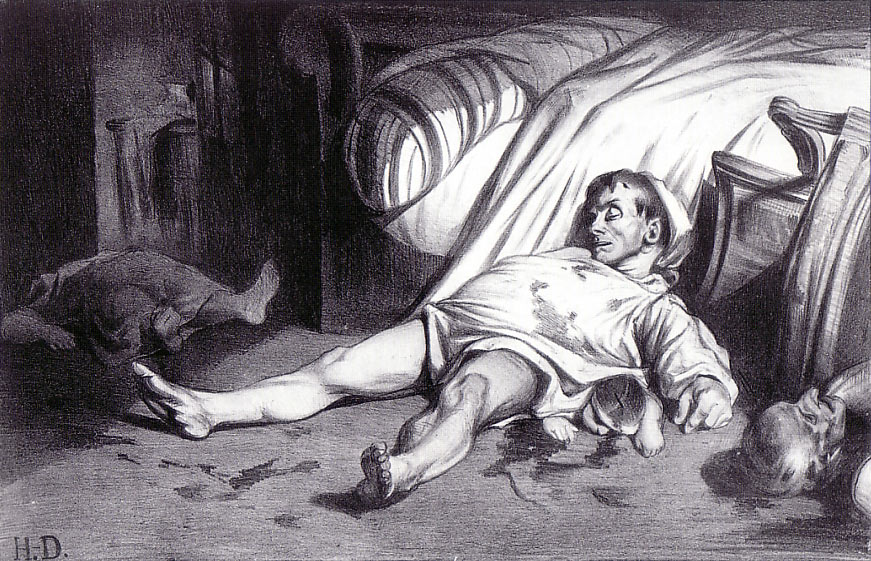
Rue Transnonain, 1834, Lithograph
Leunig is an Australian cartoonist with a philosophical sensibility. That sensibility informs his insightful social commentary that takes him beyond being one of your everyday political cartoonists. Leunig steps into the flows and rhythms of everyday life and he starts asking questions that disturb:
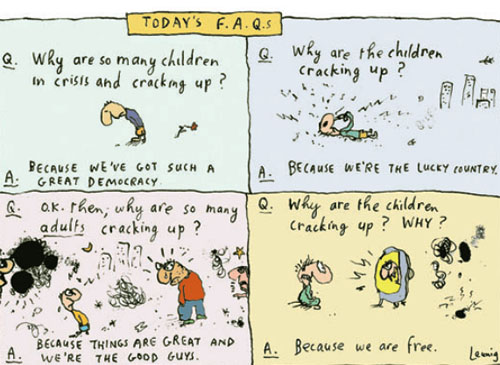
Leunig
Good huh. The cliches of political life are exposed for what they are.
It show the hollowness at the heart of our political culture--the way our highest political values have been hollowed out.
Wait, there is more of this fine example of the modern mode of Socratic questioning that scratches where it irritates:

Leunig
Leunig's cartoons appear about four times weekly in the Melbourne Age He is a much loved Australian cartoonist whose philosophical explorations, and questioning of the dissonances of everyday life have become a template for a critical reflection on Australian culture.
That template is a laconic, poetic, ironic mode of questioning.
November 25, 2003
Globalization & local communities
In my search for material on the negative impact that globalization is having on local/regional communities in Australia I came across Craig Bellamy's milkbar.com.au
Let us say that by globalization we understand the process in which national economies throughout the world are becoming globally interdependent. This push to interdependency, currently through Free Trade Agreements, is introducing a new form of relationship between economy, state, and society has been called the information economy or the networked society. This period of transformation that we are living through is a period of dramatic social change that is as great a transformation as the earlier period of industrialization.
So how does it affect local communites that we live in? We know the impact it has on regional Australia and the political expression of this negativity with Pauline Hanson, One Nation populism and the constraints on social democracy. What has been the impact of local communities in our cities? that is where most of us live. Can we distinquish between the steady gentrification of the inner city suburbs and the effects of globalization?
Milkbar.com.au explores the impact of globalization of the inner Melbourne suburb of Fitzroy. Craig says:
"If there is such as thing as globalisation then it has developed as the direct result of strategic choices by governments and corporations in the past thirty years. In Australia, our engagement with the dominant form of globalisation was exacerbated by the Hawke/Keating Labor governments (1984-1996) who deregulated large portions of the economy, floated our currency and embraced the all-trade-is-good mantra of global economic policy."
The mantra from the reformers in both the Labor and Liberal Government's in the 1980s and 1990's was that globalization was irreversible and that it was good for all Australians. Those who disagreed with globalization being a positive force wanted to economicially and socially isolate Australia from international trade and the international community. They offered a bleak future. Economic liberalism offered the only true path to the future.
So how does a local community fit into this big picture? Since the 1980s inner city Australian communities have experienced rapid gentrification, closing factories, rising rents and property values, and the appropriation of the working class culture that originally defined the suburbs. This is forcing out many of the long-term residents in favour of an eclectic mix of wealth distribution, lifestyles, and cultures. Fitzroy Melbourne is a good example of this change. Craig says:
"The suburb of Fitzroy may not be one of the most significant nodes in the globalised world but in a similar way to other inner city districts of Melbourne and elsewhere it does have significant symbolic engagements with the world...."
Fitzroy fits into the globalized world in terms of post industrialism. Craig says:
"Post-Industrialism has emerged in the past three decades and is understood as a decline of labour-intensive manufacturing operations that has altered the workforce demography and re-shaped communities, families and individuals everywhere. Popularly it is branded the ‘information economy’ or even the ‘new economy’ and is typified by a prevailing service sector and an expansion of industries that employ most citizens in knowledge production and consumption."
This is what happened to Fitzroy. It de-industrialized. Craig say:
"Fitzroy suggests a post-industrial landscape partly because (quite visibly) nearly all the manufacturing industries in the district have disappeared. The local labour intensive textile industries have been replaced by a strip of factory outlets that sell clothes manufactured in China and Indonesia. The warehouses where confectionary and garments used to be made are now the apartments of the new middle classes. For many of Fitzroy’s newest residents, Fitzroy is arguably a brand name with a purchasable lifestyle; for many of its older residents, it has developed into an expensive and less interesting place to live."
It was not just those in the country regions who were left behind by progress measured in terms of the embrace of globalization. Those in the inner suburbs found themselves being displaced. Graig says:
The inner cities are for better or worse the post-industrial frontiers of our country; a country that is fragmenting along lines of income distribution, employment, and lifestyle. Australia, like most Western countries, has moved from protecting the national industries of the ‘old economy’ to the ‘competitive’ economies of the post-industrial world."
The old categories of globaphiles and globaphones used by the Howard Government is too crude: it misses the transformations that have taken place in the inner city localities and suburbs. It is what is missed by the categories of the economic enlightenment that is crucial.
November 24, 2003
Globalization and social democracy
Over the last two decades the increasing shift by the liberal state to economic policies as a response to the effects of globalization has involved a double pronged strategy.
There is the economic strategy to open up the Australian market to the world economy.This has been coercive change that has broken down Australia's historical protectionist institutions to allow the market to regulate the allocation of resources and place constraints on public policy.
Then there was the political strategy to lower citizen's expectations about the role of the state and to establish public acceptance of the need for continual adjustment to the world political economy. This policy of persuasion has tried to establish an ethos of self-regulating adjustment to the global market.
The increasing shift to economic policies in response to the effects of globalization show the real constraints upon social democratic states to govern in the traditional manner. Thus greater trade openness and increased capital mobility have made life difficult for a social democracy that is based around intervention in economic life. The power of world's financial markets has increased, and social democratic states in response have retreated towards shaping society and domestic markets so that they conform to the neo-liberal international economic order.
Hence the Hawke/Keating Labor Government in Australia embraced privatisation, deregulation, public sector cuts, opened public utilities up to market forces, linked welfare benefits to compulsory training and job seeking for the unemployed and allowed a major redistribution of income that produced one of the highest levels of inequality in the developed capitalist world. The priority was the market rather than full employment.
Despite this policy shift to the right in the 1980s and 1990s the ethos of social democracy is still relevant. Markets are not self-constituting, they are not always maximally efficient and they often fail. Hence the need for social justice in the form of the welfare state. Alas the conception of democracy was technocratic, centralized and bureaucratic.
Social democracy is in crisis. It is finding it difficult to marry social justice to economic efficiency as well as make the policy shift to ecological sustainability. It finds itself squeezed by neo-liberalism on the right and the left libertarianism of the Australian Greens. Egalitarian policies can crash into a wall of global finance. Social democracy is on the defensive and many of its old instruments of governance (long-term planning and public ownership) have been dumped, and it has retreated from from its goal of equality.
November 22, 2003
In defence of the Senate
Australia has both federal and Westminster institutions of government. In this amalgam of federalism and responsible government the emphasis of the former is on diversity and difference, whilst the emphasis of the latter is on unity and efficiency.
The Westminster system of parliamentary democracy is one a majoritarian democracy in which cabinet as the executive controls the lower house through strong party discipline. It controls the numbers in the lower house and it is responsible and accountable to the legislature for the actions and activities of the government. This effectively makes the bureaucracy subservient to the legislature and to the executive.
Those calling for a further round of market reforms highlight the Westminister side of government in Australia. They see federalism as a block to efficient government, which the reformers model on a business or corporate model of the executive. Federalism, for them, primarily means a powerful Senate that constrains the power of the executive to implement its legislative program. This power was deliberately conferred on the Senate by the constitutional framers, but the Senate has evolved within this constitutional framework to redefine its role and place in Australian politics.
Hence the calls for reforming the Senate to make it subservient to the executive. The criticism is that the Senate is a relic of the pre-1911 parliamentary order when undemocratic upper houses held co-ordinate power with lower houses. This is misleading since the Senate in Australia is elected through proportional representation(established in 1948). The senate increasingly represents minority interests ignored by the two party system as the votes for the two major parties continues to drop.
Though it often fails to represent its state territory's due to the two party system, the Senate has widespread democratic legitimacy. The Senate's relative independence from the executive means that it is able to introduce through its powerful committee system a degree of delay, questioning and revision of government legislation. Thus the Senate is able to hold partisan governments to account, and it has a genuine opportunity to influence public policy. Consequently, the Australian Senate is one of the most powerful upper houses in Westminister-derived parliamentary systems.
It is no suprise that it is the executive that is the least satisfied with the activity of a powerful Senate, whilst public opinion has acted as its protector. Public opinion fears the despotism of the unchecked power of the executive that is based on the rule and whip of party members in the lower houses. The Senate has institutional credibility and public trust judging by the public submissions to its Senate committees and participation by citizens in public hearings.
Doing something about the Senate nearly always means reducing the Senate's independence from executive control and this is always framed in terms of the Senate delaying and frustrating their legislative programes due to the presence and disruptive potential of the minor parties. The justification for the reform of the Senate is the government's popular mandate to govern (ie., pass its legislation) even though voter support for minor parties and independents is steadily growing.
Australian citizens express their distrust of the increasing power of centralized government in two ways. First, by the tactical use of the Senate to check the power of the political executive and, secondly, by consistently voting down proposals for the constitutional reform of the Senate (only 8 of the 44 proposals have been successful).
The power of the Australian Senate is too substantial for it to seen as a second chamber, an upper House (eg., the House of Lords) or a House of Review. It's power makes it a co-ordinate authority that shares legislative power with the House of Representatives. If the history of the House of Representatives can be interpreted as one of decline of its power vi-a-vis the executive, then that of the Senate if one of increasing power that is open to the ethos of political equality.
November 19, 2003
governing the global economy
A suggestion.
Why not scale back the role of the International Monetary Fund (IMF) to short term emergency lending for nation-state threatened by balance of payments problems and allow the private finance sector to step in and provide finance to poorer countries?
That is one way to reform the IMF. Cut back on the set of additional policy instruments and responsibilites that it has required over the last 20 years. Cut back on its expanded role of economic policy making. Returning the IMF to its basics would be one way to begin to reform international economic governance.
A scaled back IMF would return to its core function: to look after the public good of the international economy by counteracting movements in foreign exchange markets thst result in impect information and coordination among lenders, and which borrower countries are powerless to remedy themselves. Hence we have the standard policy conditions attached to such loans: cut backs in public expenditure, central bank borrowing and devaluation.
A scaled back IMF is not my suggestion. It is that of the US Treasury. It was made by one Lawrence Summers, the US Secretary to the Treasury back in December 1999.
It is not one I support for pragmatic reasons Shock therapy, or fast adjustment, means imposing stablization measures that create social tensions and conflicts within the nation state (Indonesia). These, in turn, undermine the government's ability to cope with them. That indicates that the short term corrective perspective is also a medium term one. So the IMF really has a broader role by default.
So why raise the Summer's proposal? Just to suggest that the IMF, as a part of the international financial architecture, is an instrument of global governance that was designed to open up other economies, their resources, labor and markets to US capital. Today, in the era of globalization, it helps to facilitate the internationalization of financial capital through removing impediments to its free and rapid movements around the globe.
Why so? Here is some crude thinking. The US economy was in recession for some time---going through a long downturn for the last couple of decades. Stagnation and declining profitability meant that the US State used its control of the institutions of governance to ease the movement of excess capital to seek profits wherever they could be found. That policy, called the Washington Consensus, involved a variety of measures to make troubled economies vulnerable to the pressures of US-led global capital.
Why mention this? Well, the proposed Free Trade Agreement (FTA) between Australia and the US is a similar instrument of governance. It means the opening of a subordinate economy (Australia) to US imperial capital, whilst the imperial economy (the US) remains sheltered as much as possible from the obverse effects (eg. dismantling its domestic forms of protection)
Globalization , in short, is about the careful control of trading conditions in the interests of imperial capital.
As I said, its crude thinking. Somehow it makes sense.
November 17, 2003
the borderless world of globalised finance
In a previous post I briefly mentioned the need to begin to think against the self-regulating market, and then linked to an interview with Joseph Stiglitz as a first step in doing this.
I have been thinking about this recently, given that the current Labor Government in my home state of South Australia seens to be obssessed with dancing to the tune of the international financial market and pleasing the international credit agencies. So it runs budget surpluses and cuts back on welfare spending on its hospitals, schools and environmental repair. There is no money for welfare because we need to have larger and larger budget surpluses. So the public schools and hospitals are run down and lurch from crisis to crisis. The international money market and mobile private capital shape the way we live in South Australia. Spending on hospitals, schools and the environment has to be put on hold indefinitely. First we must gain private international capital acceptance of the way the regional economy is run.
Given the spillover effects of various financial crises that arose from a variety of debt problems, we need to think critically about a world economy dominated by flexible exchange rates and large and volatile private capital flows.
On way to think differently is in terms of the instruments that have been put into put in place to help govern the world economy. One of the instruments is the IMF which is concerned with the short run, the balance of payments, the demand side, the moentary sector, and programme support. It plays a role in adjustment re balance of payments deficits and as a financing institution.
Thinking differently is acting as a critic of the way IMF does its job. Why be critical? Well, the IMF did a poor job in relation to the Asian financial crisis of the late 1990s. It failed to see the crisis coming; it mis-diagnosed the nature of the crisis; it operated in terms of one model fits all in relation to conditionality; it was incompetent and it was closed to criticism. Moreover, the conventional policy of fiscal contraction was inappropriate; the move towards capital liberalisation was premature; the overly contractory programs supported by the Fund encouraged further capital outflow and so made the situation worse; the crisis and IMF conditionality was used to further the interests of US-based private capital and transnational companies; and the IMF bypassed and overrode domestic political processes and interferred with the jurisdiction of sovereign governments.
These criticisms suggest that the role played by the IMF can, and should be questioned. They also suggest that the IMF needs to be reformed, in that it's operations should be more transparent and that it should be more accountable. They disclose that the global market lacks a global institutional framework to regulate international capital inflows.
Raising these concerns in a summary fashion opens up a space to adopt a critical eye towards the hyper mobility of capital, the increased vulnerability of speculative attack on a nation state's currencies, or a sudden reversal of capital inflow due to sudden changes in market sentiment. The free cross-border flow of capital also results in reduced policy control of nation states; eg., its capacity to address issues of internal imbalance that have been caused by the influx of short term capital, which then leads to asset price bubble, the bubble bursting and rapid capital outflow.
Should we not begin to question the idea of free capital mobility and think in terms of imposing capital controls?
Now there is a heretical idea. Borders. That is the second step in thinking against the self-regulating market.
November 13, 2003
in passing & taking note
One of the common themes that comes out of Canberra these days is the idea that the key to sustainable growth lies in exporting education, new technology and the retraining of those shed from low-skilled jobs. You all the know the message as it is repeated everywhere: "We must develop technologies from new ideas applied to traditional commodities as well as new and emerging industries." It's all part of being innovative in the information economy that is everywhere.
Australia's pre-eminent place in the 21st century depends on higher education being geared to the wealth of nations, say some of the politicians. In education lies the defence of the nation, says another, who never forgets to quote Thomas Jefferson. At the moment we are caught between tradition and progress. Tradition covers up the deep fear of change that leads to fundamentalist intolerance and ignorance says another. We must embrace change if we are to become modern. Education is the pathway to protect ourselves from fear of change, intolerance and ignorance.
Let me come at this from a left of field position. Consider this paragraph from 'Professor at Big State U' over at Invisible Adjunct. He is referring to the US situation:
"No governor or legislator would ever admit it, but Big State U. is not an educational institution; fundamentally, it's not even an institution dedicated to perfecting an 'educational product.' Big State U. is a credentialing institution. Its mission is not to 'perform groundbreaking research,' let alone 'promote arts and culture'; Big State U.'s mission is to confer the baccalaureate so that the state's residents (voters) can enter the workforce with a college degree on their resume (and a corresponding bump in their paycheck). Education is a byproduct, something that occassionally happily happens because faculty and staff give a damn anyway. Higher tuition and fees defeat the purpose of credentialing if they mean said residents/voters enter the workforce (and the economy) saddled with student loans.....The credentialing engine will continue to grimly churn and grind long after budget cuts and tuition caps have removed all possibility of education."
Invisible Adjunct comments on this paragraph by saying that 'at the risk of sounding cynical, I think "Prof at Big State U." has a point.'
My comment. The professor from Big State U is dead right. The scholars of old are now dead men (and women) walking.
Invisible Adjunct then draws the inference for the work conditions of academics when she says: "if credentialing is the name of the game, then it doesn't much matter who is teaching the courses and for what kind of pay and under what sort of conditions."
She has a point, you know. One we in South Australia should take very seriously.
Why? This is just a step along the pathway to the future.
Why so?
Because Phoenix is the model of education for the business people in South Australia. It's cheap and flexible you see. They don't understand all that academic tradition stuff. Nor do they want. It's not how business is done.
Trust me, I heard it from the horses mouth. My mouth dropped. Well it woudl woudln't it cos I'm an ex-academic from the old school who thought that universities, properly called, taught students to be intellectually autonomous and to think critically as citizens.
Today it is argued that there is nothing wrong with a dose of inequality in education. Excellance (of the few) is a good tradeoff for inequality. Equality is what is wrong, say free marketeers like Andrew Norton. Writing in The Financial Review (subscription required, 12, Nov. 03, p. 71) Norton says that equality is behind the State's control over education and the ferocious opposition to university reform. Hence equality is bad, because state control over individual freedom is bad.
Now there's an argument to practice a bit of critical thinking on.
November 12, 2003
resisting the Stoics on anger
I have a deep resistance to the Stoic extirpation of the passions in public life. I think that anger is perfectly justified, but that it should be moderated. Let me give an example from this post.
In South Australia, when the Olsen Liberal Government fought a state election, it stated very clearly that it had no intention of privatising the publicly owned electricity utility. It was duly re-elected (the Australia Labor Party was still on the nose). Then it set about privatising the publicly owned electricity infrastructure. After a lot of political fighting it suceeded in passing the necessary legislation through the Upper House (the Legislative Council) when the Labor members split, fractured and crossed the floor.
The consequences of that privatisation, and the embrace of the national electricity market, is that consumers are worse off. Our power bills are 25% higher than they were, and they likely to remain so. This is the new order of things. Its all a bit like the saga in California.
As a citizen I'm justifiably angry. The Liberal Government lied to get re-elected and it spun lies about how entering the national electricity market would result in reduced prices consumers. It said that we would be better off, even though it knew that prices for electricity would increase dramatically.
If you like, I"m very angry about being on the receiving end of Plato's noble lie. It is a similar situation with many Americans over the deceitful neo-con justifications for going to war with Iraq.
To his credit Seneca engages with this position that anger is an important part of self-respecting public response to political deceit, cunning and nastiness. His text On Anger affirms the common ground, before it moves on to argue that anger is a bad motivational force compared to virtue and duty.
This is then coupled to the argument from excess. If we rely on anger as a motivational force then it can exceed the boundaries set by reason: soldiers wiping out a whole village in Vietnam. In such situations we are out of control because of the anger, and are unable to stop. Anger is double edged and is capable of turning back on us.
True. These are good points. Anger can be and is linked to excess and being out of control However, the example of citizens being angry about deceitful politicians, (including Prime Ministers and Presidents) indicates that a deliberate wrong has been done and that this is important to me. The judgement is that there ought to be some punishment for the wrong-doing politician. These, I would hold, are good judgements as they offend values of the Australian polity that are deemed to be important: honesty and trust. The judgement is that politics need not be conducted in this deceitful way.
This throws the ball back into the Stoic court.
November 10, 2003
the future is global
It is difficult to restrain my anger as a citizen when I read about this. It appears that Australia's proposed Free Trade Agreement (FTA) with the US will require Australia making lots of concessions in exchange for no real benefits. It looks like a replay of the Canada-US FTA in which Canada lost jobs, factories, a balance of payments surplus and gained unemployment and increased numbers on welfare. The blankcheque that will probably leave regional Australia bleeding is covered over by the promise of production for a world market and the old fantasy of endless growth through free trade.
However, the macho free traders have more on their agenda than just opening up new opportunities for big business to expand and become global. The proposed Free Trade Agreement is seen as an instrument of social engineering by the liberal state to reshape society to ensure that it harmonizes with the dynamics of free market. Those reforms are the real point of Australia making lots of concessions to US capital, so that Australia's farmers a given a promise of future access to the US market down the track.
The rhetoric from the AFR is that the way our liberal society is organized continues to bind the economy and frustrate the free workings of the self-orgnazing market. So society (ie., welfare, education, health, wages,) has to be reformed quick smart. This is the pathway of modernization and progress. Anything else is becoming a basket case. That, in a nutshell, is the argument of the Australian Financial Review. (subscription required, 7, 11 03, pp.1 & 80-81) It speaks in the patronizing elite voice of the economic universalism of the global market, and scorns the foolish opposition who cannot take the white heat of reform.
From the perspective of an angry citizen more of the short term pain for the long term gain means more for citizens and more gains for Australian business; it means selling your birthright for a mess of potage; it means cutting one's throat to become more competitive. I'm angry because, as a citizen, I'm going to have no say in the decision-making, even though my everyday life is going to be deeply effected.
The finger of my anger can be pointed at the homogenizing and rationalizing bureaucratic centralism of the liberal state. This centralized bureaucracy is now beholden to the executive, and both act to undermine liberal democracy as a viable political system. Executive dominance gives rise to a conflict between liberalism and democracy, with the conflict continually being resolved at the expense of democracy.
As we know from a previous round of reforms, the liberal state's progressive reforms to give free reign to the self-organizing market results in the negative social-economc consequences. The instrument used by the Hawke-Keating Labor government was 'opening up the Australian market to the global one, and then using national competition policy to make the market more competitive. The cultural particularism of Hansonite populism was the political sign of that fallout from the previous round of big economic reforms. Often dismissed as racist and repellent by social democratic liberals, this Hansonite populism tried to put a brake on progress, by calling for a return to the idealized protectionist past.
It sought to go beyond a knee-jerk protectionism by pointing the finger at the democratic deficit in liberal democracy, and highlighting the deep lack of trust between government and citizens. In defending a threatened regional lifestyle it ended up reproducing within its own ranks all the pathologies of the national culture (racism) and those they sought to cure (authoritarianism). This regional populism never shook off its garden-variety expression of provincialism, ethnocentrism and cultural feelings of inferiority.
This insurgent populism was successfully redescribed and incorporated into John Howard's conservatism. He adopted policies of work-for-the-dole, tough border protection and extensive help for regional Australia. He then integrated this regional populism into the political unconcious of the national security state, adopted the populist language of the ordinary people versus the elites and the insurgency collapsed.
So progress in the 1980s meant the bureaucracies' social engineering of an often recalcitrant and angry population, who knew in their bones that the politics of economic reforms was directed against them. The progress of modernizing economic reforms to create an open economy meant unemployment, withdrawal of public services, community disintegration, psychological dysfunction, and a deteriorating quality of life for the squeezed middle and working classes. The sign of this is Snowtown.
To put it in philosophical terms (of the Critical Theory of the Frankfurt School) we are currently living the destructive dialectic of enlightenment. It hurts. The spin from Canberra during the 1980s was all about persuading citizens to accept policies that were not in their interest.
Australian citizens did succeed in retarding the destruction of social life in Australia, because their political voices had not been stifled. For all the political talk of unity and cohesion during the 1980s and 1990s by a clever political liberal democratic elite, the Australian social democratic regime was, and is, a crisis-ridden regime.
That is the historical background to the proposed Free Trade Agreement.
Today the FTA is a means for legitimating more economic reforms using the same lethal logic of modernity as the only viable option. As the Australian Financial Review (subscription required, 7 Nov. 03, pp.1 & 80-81) writes, 'the race is one to catch the future.' A new wave of reforms is needed to fuel Australia's flowering in the 21st century. The market reformers are now painting a liberal Panglossan utopia of heaven on earth, as soon as a few minor social dysfunctions (universities) are engineered out of existence and the government is kicked out of everything.
The reality is a deepening of a crisis-riden social democracy with right wing think tanks (Institute of Public Affairs) calling for a strengthening of society with some social glue. Behind that position we sense the homogenizing tendencies of the central state that is statist and managerialist.
So it is important to stand firm against the way the FTA is being used as an instrument of reforms to Australian society and to counter the old old argument of a decline in national wealth, if we do not give the US what they want. Fighting to maintain the sustainability of the natural resource base in the Murray-Darling Basin is an important plank in resistance; as is the opposition to public health and educational institutions being turned into an lean and mean corporations operating in the marketplace.
There is considerable rural unrest in the regions as regional Australia feels they are still being screwed. A poorly negotiated US free trade deal will fuel the discontent, disenchantment and resentment in the regions.
Resistance needs to become a critique of market absolutism and the anti-statist free market is of economic universalism. On insight here is that the brash entrepreneurial individualism coupled to the integration of Australian market with the US leads to a loss of economic and cultural sovereignty. The big idea here is that Australia is obsolete. Its future lies in becoming part of the North American mega state. Americanization is what current talk about a substantial homogeneity between the US and Australia means.
So we citizens should hang onto a federalism grounded in our regional places for dear life in postmodernity. It is the only political institution we have that allows us to counter the centralizing tendences of the bureaucracy and executive and have a bit of a say in what happens about our future. Federalism also offers a different model of participation (employment) to the market: it is one of democratic participation. Maybe that can be used to destructure the centralized liberal state into a loose confederation in which the states are responsible to local needs.
Why not try and transform Australia into a looser confederation?
November 9, 2003
Restraining anger?
One of the more powerful Stoic arguments against the passions (anger) in public life is that anger is not as easily controlled or moderated as is commonly made out. Anger involves the rejection of limit and restraint; it becomes wild and out of control. It is harmful to oneself and to others and it often leads to hate and to cruelty, violence and murder.
That argument has to be conceded, given the Palestinian/Israeli conflict. There anger leads to brutality and vengeance for its own sake.
But that does not mean that we should extirpate anger, does it?
Yet the connection between anger and hate is a close one. It is not easy to disentangle it.
But we should get angry when bad things take place as when our loved ones are killed by a terrorist bomb as in Bali. Anger is part of what it is to be human.
November 8, 2003
a question
I get pretty angry about the way our cities have been organized and designed for cars and not for people. We have a few parks as public spaces where one forgets the city whilst being in the city. And we have the contrast between a safe and homely house and the intrusion of a weird and alien presence when the city was turned into a metropolis.
This transformation had serious psychological consequences described by, among others, Baudelaire and Zola. The individual felt estranged in the metropolitan mass, estranged in all possible connotations of the word. The uncanny manifested itself in phenomena like agoraphobia and claustrophobia and the historical avant-garde movements tried to transfer the modern feeling of the uncanny to their public using techniques of defamiliarisation.
What also angers me is the way the core of my self in the metropolis is invaded by and controlled by the way the city is organized for the economy by town planners, by the incesant advertising everywhere and by the nose that invades my whole being.
The happenings in the urban world lacerate my self and distort my desire to live a passionate urban human life.
Hence I am subject to, and violated by, fortune----the efects of the polluted city on my body ----and this undermines my self-sufficiency and my desire for freedom from external control.
Should not a therapeutic philosophy build a wall around the self and protect it from the assaults of fortune? This appears to be the goal of Stoic philosophy.
Or should I give up seeking self-sufficiency and let go my desire for freedom from external control.
November 5, 2003
its so lonely and inhuman
There is an article in the Review Section of the Australian Financial Review (subscription required, 31 10 03, p.10) on philosophy that is of interest.
As an aside, how come the finance capitalists are interested philosophy? They are destroying the very coinditions for academic philosophy with their reorganizing the universities to ensure the commercialisaton of public research to benefit venture capitalists. Is it deemed that this part of high culture is good for entrepreneurs? Something they need to know something about? You cannot live on profit alone? Or do successful entrepreneurs need to be cultured? It do goes with the BMW, beachhouse and inner city penthouse?
Called 'The making of a philosopher' it is by Colin McGinn, who is a professor of philosophy at Rutgers University. In it he is looking back on his formation as an academic philosopher and reflecting on his life as an professional philosopher. We have met McGinn before in Tweaking the axioms.
In this article, which is from his book of the same name, McGinn makes a couple of points. One is his understanding of philosophy. He says:
"What I liked most about philosophy was its extremely non-local character. Philosophy is highly general, abstract, impersonal, and even non-factual. Not only is it about everything that is; it is about everything that might be. Physics takes in every physical object in the universe, but philosophy takes in every object - physical or nonphysical - in every possible universe. The question about objects and their properties that obsessed me at the age of 18 applies to any conceivable object of any possible type: is an object, quite generally, something made up of the collection of its properties, or is it an entity distinct from them? Such questions belong to metaphysics, the study of "being as such," as the dictionary unhelpfully says, but could just as well be called logical or conceptual questions. Philosophy is about our most general ideas and how they fit together - ideas of causality, time, space, object, property, truth, meaning, necessity, identity, existence, knowledge, self, consciousness, freedom, goodness, beauty and so on. It is not about some limited set of things; still less local historical circumstances. Philosophy tries to get to the bottom of our most basic and far-reaching categories."
That is pretty much philosophy as metaphysics. There are other kinds, most notably Deleuze and Guattari's conception of philosophy as an activity that consists in the creation or invention of concepts. In expanding on this Daniel W. Smith, in an exerpt from the translator's introduction to Deleuze's Francis Bacon: The Logic of Sensation quotes Deleuze
“One can very easily think without concepts,” Deleuze writes, “but as soon as there is a concept, there is truly philosophy.” Yet art itself is an equally creative enterprise of thought, but one whose object is to create sensible aggregates rather than concepts. Great artists are also great thinkers, but they think in terms of percepts and affects rather than concepts: painters think in terms of lines and colors, just as musicians think in sounds, filmmakers think in images, writers think in words, and so on. None of these activities has any priority over the others. Creating a concept is neither more difficult nor more abstract than creating new visual, sonorous, or verbal combinations in art; conversely, it is no easier to read an image, painting, or novel than it is to comprehend a concept. Philosophy, for Deleuze, can never be undertaken independently of art (or science); it always enters into relations of mutual resonance and exchange with these other domains, though for reasons that are always internal to philosophy itself." (Daniel S Smith, 'Deleuze on Bacon: Three Conceptual Trajectories in The Logic of Sensation")
McGinn then makes another point about the existential nature of doing philosophy:
"A reviewer of The Making of a Philosopher remarked that philosophy has been, for me, the love of my life and the bane of my existence. That is not too far off the mark. I would say, in fact, that philosophy combines these two features inextricably; indeed, it is lovely because it is baneful. Philosophy is difficult, taxing, and infuriating - and these very characteristics are an essential part of its appeal. It is because it is such a struggle that it can produce exultation. Philosophical work is demanding, lonely, enervating and inhuman - but it is secretly sublime. There is probably no time in my life when I am more certain of the meaningfulness of my existence than when I am thinking about philosophy - and no time at which I am more reminded of my own inadequacy."
This is a bit precious. It's almost akin to mythmaking
Creative writing is lonely. Philosophy is just a particular kind of writing. And poetry can be difficult, taxing, and infuriating. Each requires a discipline to learn the craft of writing. Each requires solitude to write.
Is not being alone a part of the urban condition of living in a modern metropolis dominated by the money economy. It is mode of metropolitan life that is distinquished by exchange values and the relentless cycle of production and consumption; one where our social life has been integrated into the logic of commodities. Do we not emotionally recoil from a life governed by instrumental economic reason, which makes everything calculable and quantifiable and measures everything in terms of efficiency and profit? Does not that destruction of older values cause us shocks?
That is standard sociology. But then analytic philosophers do not read sociology. So they reify the standard everyday experience of metropolitan modernity.
If it is the job of poets to record the experience of shocks, what then is the job of philosophy? Philosophy turns away to the heavens; away from the body to abstract knowledge. McGinn talks in terms of sloughing off mortality as he leaves the realm of the particular and local to live on the level of the abstract and universal as some disembodied being.
I think that Nietzsche captures this modern condition in a more accurate way in para. 377 of his The Gay Science:
'We who are homeless....in a distinctive and honorable sense....For their fate is hard, their hopes are uncertain; it is quite a feat to devise some comfort for them—but what avail? We children of the future, how could we be at home in this today? We feel disfavor for all ideals that might lead one to feel at home even in this fragile, broken time of transition; as for its "realities," we do not believe that they will last. The ice that still supports people today has become very thin; the wind that brings the thaw is blowing; we ourselves who are homeless constitute a force that breaks open ice and other all too thin "realities"....We "conserve" nothing; neither do we want to return to any past periods; we are not by any means "liberal"; we do not work for "progress"; we do not need to plug up our ears against the sirens who in the market place sing of the future'.
Philosophers are homeless. They are forced to become wanderers. That is reinforced in the more ordinary sense of philosophers being increasingly downsized from our universities and tossed onto the scrap heap of history.
Nietzsche continues in para 380:
'The "wanderer" speaks. If one would like to see our European morality for once as it looks from a distance, and if one would like to measure it against other moralities, past and future, then one has to proceed like a wanderer who wants to know how high the towers in a town are: he leaves the town.....One must have liberated oneself from many things that oppress, inhibit, hold down, and make heavy precisely us Europeans today. The human being of such a beyond who wants to behold the supreme measures of value of his time must first of all "overcome" this time in himself—this is the test of his strength—and consequently not only his time but also his prior aversion and contradiction against this time, his suffering from this time, his un-timeliness, his romanticism.'
That seems a more acccurate description of the philosopher in the metropolis modernity.
November 3, 2003
Atomised
1.
Cyberspace offers a retreat from the lonely existence of the modern metropolis. It is safe and comforting being oneline. All it takes is a click of the mouse.
Being online is a way to satisfy the yearning for human contact as a defence against despair and the wounds of a damaged life. Intense emotions can tear our being part. It is better to be online. The network of relationships in cyberspace offer the hope of belonging to a community of people bound into a nework of responsibility.
Lonely and emotionally unfulfilled lives. That is the normal life of so many people living in the inner city. Especially the older ones who've lost family, do not drive, and can feel the darkness coming in from the edges. Mutual comfort is what they lack and yearn for.
In such a life the fear of going crazy is all too present. We are consumed by painful longings, the pain from a tragic past and a deep sense of loss and regret. Many are too poor to afford a toy boy or toy girl to satisfy their need for longing.
And they know that there are not too many suprises anymore.
Death looms ever closer. You can cry too much.
Many are not ready to die even though their body aches with pain.
Cyberspace with its network of relationships and a common world gives us hope. It sustains us, keeping the chaotic fear and terror at bay. It offers something more than the soft porn in the mainstream magazines that fill the ethical vacuum in a nihilistic culture.
Cyberspace. It may be the only myth we have left that can rescue us from empty fragmentation and forge a community of solitaries.
It may be illusory. But it is preferrable to the path of Bataille: forming a secret society (Acephale) to empower myths anew through a sacrifice of its members. Putting one of its members to death would be the foundation of a myth and ensure the survival of the community.
November 2, 2003
the heavenly city of cyberspace
I was a bit bored yesterday afternoon so I wandered downtown to my bookshop looking for something to read on Bataille and literature and architecture in modernity.
I came across this book by Margaret Wertheim. The Pearly Gates of Cyberspace caught my eye because of these concerns. I then remembered that I'd read Pythagoras's Trousers. a few years ago and though that she had captured the world of fundamental physics and analytic philosophy very well.
For all the talk about physics interrogating nature and letting nature respond, there is a social and cultural history of physics. The mathematicians appropriated space. You can interpret this history of mathematical physics and physical space as being deeply religious with its Theory of Everything in both its purely reductionistic sense (there is nothing but atoms and genes ) and the end of science, the whole story or aboslute knowledge sense. Religion is buried in that theory of everything written in a few equations; religion in the theological sense of the "gods" of science aspiring to become gods, or that in the quest they believe that they are gods and have been all along.
In the Pearly Gates of CyberspaceWertheim argues that the notion of cyberspace is an attempt to create a secular Heaven on earth. The layers of meanings surrounding cyberspace involve our society's dreaming about utopia. An example of this utopian impulse is John Walker. He says that he was full of:
"....almost unbounded optimism I felt during the 1994-1999 period when public access to the Internet burgeoned and innovative new forms of communication appeared in rapid succession. In that epoch I was firmly convinced that universal access to the Internet would provide a countervailing force against the centralisation and concentration in government and the mass media which act to constrain freedom of expression and unrestricted access to information. Further, the Internet, properly used, could actually roll back government and corporate encroachment on individual freedom by allowing information to flow past the barriers erected by totalitarian or authoritarian governments and around the gatekeepers of the mainstream media."
Buried in this optimism is a cultural conception of cyberspace. Though this is an outgrowth of modern materialist science, it posits the existence of a genuine yet immaterial world and so involves particular conceptions of ourselves. Hence we can talk about the metaphysics of cyberspace.
It is a space in which people are invited to commune in a nonbodily fashion; a virtual world--- a computer generated world. Secondly, cyberspace is the escapehatch from physical space and our physical embodiment: it's techo-utopianism embodies a religious dreaming.
to be continued