December 29, 2003
This is interesting article on nationalism and cosmopolitanism.
December 27, 2003
Montaigne
I bought myself a Xmas present. Michel De Montaigne's Complete Essays. This is a book I've wanted to own for a long time. I've dipped into them before.
Writing philosophy in the form of essays to exorcize the demons strikes me as a good way to do philosophy. A way of writing that has been signposted by Seneca and Cicero. Essays are a better form than Seneca's Letters.
December 26, 2003
Social Darwinism in Australia
When I watched a video of Philip Noyce's Rabbit-Proof Fence the other night, I noted how little the film engaged with social philosophy behind assimilation as a mode of governing the aboriginal population in Australia in the 1930s.
The philosophy behind taking the half caste indigenous children away from their parents, community and country to breed the blackness out of them was Social Darwinism. That assumed struggle, competition and violence as the inevitable and necessary condition of progress. The Aborigines were beyond saving. They were doomed to extinction; as an inferior race they were stepping stones of the progress of the superior and more capable white race (the English colonists). This progress was an inexorable law of nature. There was no room for ethical considerations about the right and wrong of this because human beings were governed by the necessity of natural laws.
Should a film engage with this philosophy that viewed the aborignes as a dying race? I think that it should. It is impoverished if it does not.
What Social Darwinism was saying was that Aborigines were to primitive, too archaic, too inferior to adapt to modern society and nothing could stay the death sentence. All that could be realistically done once the frontier wars were over was to take the half castes from the desert savages and breed them with whites so they would become white skinned afer a couple of generations.
Social Darwinism was the philosophial justification for the racism of 1930's Australia.
The reality was that the Aborigines had owned the land desired by the English colonists. They had to be dispossessed and gotten rid off to ensure progress and personal enrichment. That bit never came throught the film either. Noyce failed to sketch the historical background.
December 25, 2003
Xmas day
philosophy and Santa Claus don't go together other than as a critique of a myth.
This is one way to spend Xmas day:
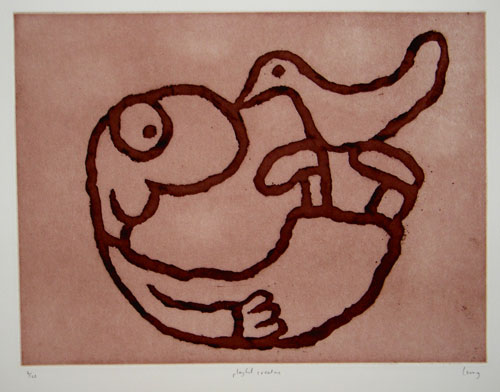
Leunig
Have a relaxing enjoyable day everyone.
December 23, 2003
Third Way = pragmatism?
We have been considering whether the Third Way has any relevance for the Indigenous people in Australia. Noel Pearson, from Cape Yorke Partnerships argues that it does, especially in relation to social problems such as substance abuse.
Pearson is quite clear about the instruments of governance needed to achieve the goals indigenous people have set for themselves. He says:
"....indigenous people are beginning our long and arduous journey towards economic and social integration, and real self-determination, [and this] requires us to first take up the battle against the social, cultural and political power of addiction.....the disturbing central fact about many remote communities with pervasive substance abuse problems: the most important immediate struggle is not in the area of education about drugs, alcohol and petrol sniffing because education and rehabilitation cannot significantly reduce the already large groups of addicts....The immediate goal is to rebuild intolerance of abusive behaviour in indigenous communities to a level where functional and responsible people, not addicts and irresponsible people, set the tone of daily life."
What then is the Third Way?
In this recent article on the Third Way by David Hayward, the director of the Institute for Social Research at Swinburne University, it is sugggested that the Third Way does not add up to a coherent philosophy. Rather, the principal characteristic of the Third Way is pragmatism, which is a willingness to use different methods of governance to achieve its aims. Drawing on the example of Tony Blair's New Labour Government in Britain Hayward says:
"All this suggests that the impression of Blair as a neo-liberal is wide of the mark. His is a moderate social democratic government - operating in post-neo-liberal times, to be sure, but with a core commitment to left-of-centre principles."
So what is Pearson's pragmatism? What is methods of governance is he willing to use to achieve his aims of economic and social integration, and real self-determination?
Pearson says:
"The immediate goal is to rebuild intolerance of abusive behaviour in indigenous communities to a level where functional and responsible people, not addicts and irresponsible people, set the tone of daily life. Polarisation and increased internal battles cannot be avoided.This is at odds with the official rhetoric about reconciliation. Convention requires that people who are engaged in reconciliation work with indigenous people. Reconciliation is generally understood to be a matter of acknowledging wrongs, giving indigenous people rights and opportunities, and fighting attitudes and opinions in mainstream society that are detrimental to the advancement of indigenous people.
Immediate enforcement of social order is necessary to achieve the long-term goals of reconciliation and integration into the mainstream economy."
By integration Pearson means economic integration not cultural (ie., Pearson is anti-assimilatonist). He then says that:
"... economic integration will require increased geographic mobility for indigenous people. We want to give young indigenous people a chance to embark on orbits in the wider world, without relinquishing their ties to their homelands altogether. They can have the best of both worlds."
Economic integration, which in turn, requires social order:
"Social order in remote indigenous communities will be critically important for geographic mobility and economic integration. Children in remote communities need peace and a good start in life, otherwise they will not be able to make the transition to education and training in urban centres."
Social order does not require prohibition of grog. It requires the banning the private importation of grog and takeaways from the community taverns, so that sly grog can be identified and confiscated. Where there is policing of the alcohol management plans, the Queensland trials have led to social improvements that could be the beginnings of reducing indigenous disadvantage.
However the opposition to this pragmatic method of governance comes from within indigenous communities. Pearson says:
"...large groups of community members still wish to ease the restrictions in ways that will jeopardise the best progress that has been seen for decades. The driving force of this opinion is not a consideration for civil rights. It is addiction that is manifesting itself as a local political force. If you want to see addiction mobilised into social, cultural and political forces, try to tackle substance abuse in any of our communities."
The enabling state o this account is a state that finds practical methods and instruments for indigenous people to over the substance abuse, and associated behaviours and the addictions that go with this real problem.
December 21, 2003
The enabling state
There is a quick post by Chris on the enabling state over at Back Pages. In Australia the 'enabling state' stands for the policies associated with Mark Latham, the current leader to the federal Opposition ALP. Chris however connects them to President Bush. The inference of Chris' post for an Australian audience is, 'look how conservative these policies are.'
I want to come at this 'enabling state" by returning to the work of Noel Pearson. These ideas make sense in terms of the passive welfare experienced by Indigneous people in Australia.
I'm going to look at another speech Pearson made, the Ben Chifley Memorial Lecture called "The Light on the Hill", which he gave a couple of years ago. In it Pearson discusses the nature and the extent of the horrendous social problems of his people in Cape York Peninsula in relation to the social welfare traditions of the ALP. This paragraph gets the heart of the problem:
"The predicament of my mob is that not only do we face the same uncertainty as all lower class Australians, but we haven't even benefited from the existence of the Welfare State. The Welfare State has meant security and an opportunity for development for many of your mob. It has been enabling. The problem of my people in Cape York Peninsula is that we have only experienced the income support that is payable to the permanently unemployed and marginalised. I call this "passive welfare" to distinguish it from the welfare proper, that is, when the working taxpayers collectively finance systems aimed at the their own and their families' security and development."
Pearson rightly says that the social democratic welfare state was a great and civilising achievement for Australian society: it produced many great benefits for the great majority of Australians. What then is the difference between the two forms of welfare? It was enabling for whites but not for blacks. Pearson says:
"The immersion of a whole region like Aboriginal Cape York Peninsula into dependence on passive welfare is different from the mainstream experience of welfare. What is the exception among white fellas - almost complete dependence on cash handouts from the government - is the rule for us. Rather than the income support safety net being a temporary solution for our people (as it was for the whitefellas who were moving between jobs when unemployment support was first devised) this safety net became a permanent destination for our people once we joined the passive welfare rolls."
Passive wefare meant that indigenous people largely did not experienced the positive features of mainstream life in the Australian welfare state - public health, education, infrastructure and other aspects which have underpinned the quality of life and the opportunities of generations of Australians. Rather passive welfare has been disastrous for indigenous people. Pearson gives a very succinct account:
"The irony of our newly won citizenship in 1967 was that after we became citizens with equal rights and the theoretical right to equal pay, we lost the meagre foothold that we had in the real economy and we became almost comprehensively dependent upon passive welfare for our livelihood. So in one sense we gained citizenship and in another sense we lost it at the same time. Because we find thirty years later that life in the safety net for three decades and two generations has produced a social disaster.......And we should not be surprised that this catastrophe was the consequence of our enrolment at the dependent bottom end of the Australian welfare state. You put any group of people in a condition of overwhelming reliance upon passive welfare support - that is support without reciprocation - and within three decades you will get the same social results that my people in Cape York Peninsula currently endure....So when I say that the indigenous experience of the Australian welfare state has been disastrous I do not thereby mean that the Australian welfare state is a bad thing. It is just that my people have experienced a marginal aspect of that welfare state: income provisioning for people dispossessed from the real economy."
Pearson's central concern is helping his own people in Cape York Peninsula, and he approaches this by askign the question:'Why has so little been done to prevent the disintegration of our Aboriginal communities?
His pathway is in terms of the reforming the welfare state by building on the commitment of the Australian people to welfare. This reform reworks the notion of enabling. Noel says:
"This consensus needs to be built on the principles of personal and family empowerment and investment and the utilisation of resources to achieve lasting change. In other words our motivation to reform welfare must be based on the principle that dependency and passivity are a scourge and must be avoided at all costs. Dependency and passivity kills people and is the surest road to social decline. Australians do not have an inalienable right to dependency, they have an inalienable right to a fair place in the real economy."
Enabling means helping unemployed Australians back into work.
to be continued.
December 19, 2003
philosophy, wedge politics, environment
There is an interesting discussion that touches on philosophy in our political life by Wendy Wedge over at Crikey.com.au. The article is on the relationship between The Australian Greens, wilderness and forests.
Lets grant Wendy's main political point: that the Australian Greens practice wedge politics on envirornmental issues. Of course they do. Wendy is right that Bob Brown plays the old gowth forests of Tasmania as symbolic politics into the hearts and minds to the left of centre electorate in the inner city suburbs of Melbourne and Sydney.
The symbol is 'wilderness' and it is successsfully deployed against the ethos of utility of an instrumental economic reason. The symbol of wilderness used to be wild rivers, such as the Gordon River in Tasmania when the fight was about dams and hydro power.
One should not express suprise by this. After all, The Australian Greens are a parliamentary party that is seeking to increase its representation in the Senate. It aims to replace the Australian Democrats in holding the balance of power. And wedge politics works--Tampa showed that. Why not appropriate the successful tactics and strategies of the enemy?
Now to the philosophical point. Wendy Wedge says that the philosophical objection to the Greens is that:
"....philosophically they discount the value of the human and claim that the interests of nature are paramount. The argument goes that without nature there won’t be humans. Except that things are a bit more complicated than that as greens with a lower case “g” are discovering. Recently they have run into problems with indigenous Australians who have objected to environmentalist hijacking the word “wilderness”. You know – as in any area to be saved “is the last vestige of wilderness in (insert relevant geographic area)”.
Now as any fule knows...our indigenous inhabitants have been managing the landscape for some tens of thousands of years. Indeed, they are insisting that the greens stop using the word wilderness and that governments give indigenous nations rights of co-management of national parks....The trouble for the greens is that if they concede that “wilderness” has and needs to be “managed” some of their other claims start to look dodgy."
Several points can be made.
First, romanticism was the first expression of the ecological impulse, and romantic currents flow strongly within the symbolic politics of preserving what is left of "wilderness." Wilderness as uninhabitated in the sense used in Tasmania does not mean untouched by himan hand. The colonial history there is one of the white colonists destroyed indigenous Tasmania society, claiming the land fot r their own, and putting it to use as a resource to make a dollar. The politics of wilderness in Tasmania is concerned to preserve the old growth native forests in the Styx Valley from the "wise management" of the utilitarian foresters. It aims to preserve both the forests and the species living within this habitat.
Secondly, 'wilderness' of the 1970s environmental movement meant a widening of the sphere of ethics to include the natural world-- a land ethic if you like. that aimed to defend the existence rights of wilderness and in precedence of over human-use rights. It argued that right behaviour was not exclusively a question of human relationships, but also involved our relationship to nature and the moral staus of non-human entities. It's ecocentrism referred to the interconnectedness of all life.
Thirdly, I'm not sure that the philosophy being the Australian Greens is simply a romantic conception of nature. The green philosophy today also has something more to do with ecological science. Thus it accepts that human beings live within ecosytems not outside them, that ecosystems underpin our economic systems, and that the policy compass should be set towards ecological sustainability.
However, Wendy Wedge is not convinced by such well known considerations. Her concerns are political not philosophical She says the Australian Green's:
"...problem is their philosophic heritage. Greenery has taken, in grossly over-simplified terms, two forms over the past two millennia. Starting with the Romans and continuing through the Brits one lot wanted to make things green by regulating and controlling things through law. On the other hand there was another lot – mainly the German romantics, who had a sort of mystical view of nature and a transcendental view of how we might all recapture some pre-lapsarian rapture. This German romanticism is also claimed, from time to time, to be a precursor of Nazism and, thus, is the basis (if not understood as such) for the claims by inept Coalition backbenchers that greens are like Nazis. Sadly the substantive historical point is overlooked in the midst of Tory hysteria and hype and the tendency of some some greens to want it all in terms of both heritages."
The importance of pinning this romantic interpretation on the Greens as a political party and a new social movement is that it provides a justification for the old duality of economics being rationality itself and the critics being irrationalists. It is then added that an [instrumental] economic rationality leads to liberalism whilst romantic irrationality (intuitive and mystical modes of knowing) leads to totalitarianism. Hence the recent 'Greens are Nazi's' charge.
This is the wedge politics of the culture wars, as it is designed to splinter the centre left attracted to the Greens but which loathes fascism.
December 16, 2003
Third Way & Indigneous Australians#2
I've been off line the last day or so because my ISP was having "minor " problems with broadband. Disconnection from the internet felt like a withering on the vine. I've lost my train of thinking. It is now like starting allover again.
In the previous post I mentioned the puzzling displacement/silencing of Noel Pearson by Indigenous Australian intellectuals in Blacklines. This is a book designed to show their perspectives and analyses as a critical mass that transgressses the previous anthologies that established them as a token, minority or peripheral presence amongst a wealth of non-Indigenous critical voices exploring genocide, trauma, guilt, shame, willful forgetting, denial in reponse to the centuries old policy of assimilation. The post colonial response has been concerned with treaties, terra nullius, land rights and the forced separation of Aboriginal children from their families.
So what is Pearson saying when he addresses the social, economic and cultural problems Indigenous Australians face as a people? In my judgement he is saying something important. I'm going to spell the argument out to counter the tacit objection that Pearson's embrace of the Third Way has meant his shift from the left to the right, and him becoming a part of the contemporary constellation neo-liberal market economics and social conservatism.
For starters Pearson does not downplay the historical importance of Mabo. In the fifth Hawke Lecture he says:
"The High Court told us on 3 June 1992 that our understanding of our legal history was incorrect. The true history, according to the High Court, was that at the moment of sovereignty in 1788 when the British Crown unilaterally assumed sovereignty over the Antipodean continent, the Aboriginal peoples in truth became subjects of the British Crown
At the moment of sovereignty, as subjects of the British Crown in occupation of their traditional homelands and entitled to the protection of the new land law brought on the shoulders of the settlers from England, the indigenous peoples became in British law no less comprehensive owners of the entire continent. Native Title existed wherever Aboriginal people held traditional connections with their homelands. The High Court told us that their dispossession of those titles occurred over the next 204 years through a process of parcel by parcel extinguishment."
Ten years on nothing much has happened to improve the lives of Indigenous Australians as a result of the Mabo decision. Pearson says:
"So those are the three limbs of Native Title Law as articulated by our High Court in this country. The whitefellas keep all that is now theirs, the blackfellas get whatever is left over, and there are some categories of land where there is coexistence and in the coexistence the Crown Title always prevails over the Native Title. That is the proposition put forward to us as Australians by our judicial elders for our consideration, to see whether as a people we would embrace those terms as a just compromise 204 years after the initial failure of recognition."
A few pages are then devoted to the importance of the economic reforms of the Hawke/Keating Labor Party. Pearson then turns to the category of triangulation. He says
"Triangulation is the political or tactical strategy that complements the Third Way as a political program or philosophy (if it can be called a political philosophy). Superficially we in Cape York appear to be disciples and evangelists for the Third Way. Many people on the left, because they associate us with Mark Latham in the Australian political scene—and with other friends in the "social entrepreneurs" movement—see us as Third Wayists. In terms of political strategy and policy thinking, there is considerable common ground between what we are trying to do and the Third Way which is associated with Tony Blair and Bill Clinton (and with Latham, who has been the only explicit advocate for the Third Way in the Australian Labor Party). But we in Cape York are not Third Wayists in the generally understood sense."
He then links this back to the old left tradition (international socialism) which is routinely displaced by the Thiird Wayists as little more than heavy handed statism. And Pearson? What does he do?
He comes at the left tradition differently. He accepts the old left account [Marxist] of a class society, the element of unjustified stratification in our society, and that many aspects of our cultural and intellectual superstructure seem to have the objective function of maintaining social inequality. He has not abandoned the defence of the welfare state, nor does he berate organised labour as he recognises the role that organised labour has played in making our society a civilised and relatively egalitarian one throughout our history.
Pearson has problems with the cultural left. He summarizes his position:
'So our position may be understood as follows: our intellectual and analytical framework is an old left analysis, but our policies and strategies must contend with our current political and cultural predicaments. In a world of ideological confusion, declining collectivism and heightening stratification, our people must pursue strategies that aim to improve our position in a society where our people reside in the most miserable underclass and there are structural reasons why this is so and there are structural impediments to our people rising out of this underclass. As one of the elders from Cape York said after we had discussed the impediments that keep our people down: "we have to zig zag past the snakes, and scramble up the ladders"'.
So what is the zig zag? Pearson addresses this in terms of the policy issues of passive welfare and substance abuse. He says:
"What has prompted my reorientation over the last years is that, as the social disintegration among my people in Cape York Peninsula accelerated, no intellectual and political response emerged among Australia's political and intellectual elites — the journalists and commentators, the anthropologists and other academics, the progressive politicians.— I literally hung out to read some insightful explanation for our deteriorating condition as a people and what we needed to do to turn things around. I waited and waited. Then I realised that we Aboriginal people had to do it ourselves."
Indigenous Australians had to do it themselves because the problem was only a lack of theory dealing with the social disintegration among Aboriginal people. However, it ws not as simple as that. The cultural (and postcolonial) left had got it wrong. Pearson identified:
"....a set of ideas that seemed to travel together in the minds of liberal and progressive Australians and form a complex of automatic responses to the indications of how bad things were. There was a tendency to always interpret substance abuse as a symptom of circumstances, in our case dispossession, rather than as a causal factor in its own right. There was a belief in the ability of welfare payments to sustain people that led to a lack of interest in the social effects of passive welfare on indigenous Australians compared to the social effects of historical factors such as dislocation and separation of people from their families. There was a tendency to think of enforcement of social order as an unsophisticated rightist approach that didn't deal with the underlying issues. There was a great interest in Land Rights and historical injustices, and a focus on lack of funding and infrastructure as the explanations for bad health, disadvantage and violence."
Instead of the focus on reconciliation as culture, rights and apologies Pearson focuses on the very practical obstacles to a better life, such as domestic violence, drug abuse and passive welfare. Social policy reform is the new policy agenda in this new millennium
December 14, 2003
The Third Way & Indigenous people
I've been thinking of the way that Third Way politics has been making an on- the-ground difference. The best that I could come with was the way it was being articulated explored and implemented by Noel Pearson and his associates at Cape Yorke to improve the conditions of life for indigeneous people.
Just by chance I happened to be reading a book called Blacklines: Contemporary Critical Writing by Indigenous Australians. This text charts critical indigneous writing since the so-called Aboriginal Renaissance of the late 1980s and early 1990s. Noel Pearson is not even mentioned! Yet this text charts critical writing by Aboriginal intellectuals beyond creative or aesthetic writing.
In a key speech Pearson outlines the problems indigenous people find themselves confronted by:
"The nature and extent of our problems are horrendous.... suffice to say that our society is in a terrible state of dysfunction.....In my consideration of the breakdown of values and relationships in our society - I have come to the view that there has been a significant change in the scale and nature of our problems over the past thirty years. Our social life has declined even as our material circumstances have improved greatly since we gained citizenship. I have also come to the view that we suffered a particular social deterioration once we became dependent on passive welfare.....our descent into passive welfare dependency has taken a decisive toll on our people, and the social problems which it has precipitated in our families and communities have had a cancerous effect on our relationships and values. Combined with our outrageous grog addiction and the large and growing drug problem amongst our youth, the effects of passive welfare have not yet steadied. Our social problems have grown worse over the course of the past thirty years. The violence in our society is of phenomenal proportion and of course there is inter-generational transmission of the debilitating effects of the social passivity which our passive economy has induced."
The emphasis on the dead end of passive social welfare is a classic Third Way perspective. In contrast, Blacklines devotes a page or so to the welfare issue under 'welfare corporatism' without going on to mention Pearson's critical response. The postcolonial authors in Blacklines are more interested in identity politics, land rights, and neo-colonial practices after the dismantling of colonialism in settler societies. They argue that colonial ways of knowing have never been dismantled, and are actively reproduced within the power dynamics of a postcolonial society such as Australia.
One can only presume that Noel Pearson does not have a critical gaze. Or that he has the wrong critical gaze in that he is not part of the Indigenous sovereignty movement and its connection to an agonist democracy. Is it that Pearson does assume that the Aboriginal polity as an enemy of the state in the contemporary liberal democracy. Or is because he is part of a Third Way politics, which seeks to obtain consensus beyond the traditional oppositions between the Left and the Right?
Or the silence a result of Pearson dealing with the wrong set of problems. Or he is approaching the social (health, welfare, domestic violence, alcoholism etc) in the wrong way. The judgment by the postmodern cultural left appears to be there is a closure of the social by the proponents of Third Way politics, as they seek to dissociate the social from the political.
December 10, 2003
The Third Way: its civil society stupid
The central question for the advocates of the Third Way is: how can the welfare state be reformed so that it can still deliver social justice within the budgetary constraints imposed by the integration of a national economy with the global one?
Those constraints mean a smaller public sector. That is what a mobile international financial capital dictates. Footloose capital means international economic competitiveness and fiscal limits on nation states.
Their central argument is that this requires a different approach to public policy.This involves rejecting the traditional role of government as state intervention and avoiding the old statist road of tax and spend.
Where to then? How do you further social democratic reform without the state?
To civil society is the answer.
How does that help? What we find there, the advocates of the Third Way is moral confusion, loss of fraternity, decline of trust and erosion of community. So politics is about rebuilding the relationships and bonds (social capital) between people. It puts the social back in social justice.
So the focus is on the middle ground between state and market that is identified as voluntary and community action. It means winding back the space occupied by the state and markets to allow civil society to thrive and flourish.
In some ways this is very disingenous. Voluntary activity in civil society has been a very strong dimension of politics in Australia during the time of social democracy. Many of the regional public hospitals were buld through volunteer activity and help. Same with Landcare and Coast Care. Same with caring for the elderly and the sick. Same with emergency services, firefighting and surf lifesaving clubs. There was always space for this kind of activityand there has been a very strong tradition of volunterism in regional and rural Australia.
December 9, 2003
a story with a moral
Time for a little philosophical story.
Once upon time, way back in the 1980s the once proud social democratic Australian Labor Party ( ALP) embraced and fostered the deregulation of the market so as to modernize Australia.Tthe symblic act was to float the Australia country. It was to save the country it was said. It saved the country, it is said today. As the 1980's rolled on, many of the ALP's lefty members fought rear guard actions against their Party's policies of on-privatisation, free trade, competition policy and deregulation of the financial sector.
Many in the ALP accepted that retrenchments and unemployment from "structural adjustment" was an inevitable consequence of economic growth and a changing product cycle. You can hear the 'econ' speak in the voices of these modernizing social democrats when they say this.
They justify it by saying that these experiences of retrenched workers are nothing new. They have been going on since the 1930s, retrenched workers have always found difficulty finding alternative employment, and those who secure new employment experience earnings loss and occupational downgrading.
Moreover, obtaining casual jobs----which is what many retrenched workers have been able to do---is a step up the rung of the ladder to full employment. And there may be an increase in job satisfaction, such as swapping the full time dirty job in the old factory for the casual job of lawn mowing. And many women are happy to work 20 hours a week. They do not want to work 40-50 hours.
Hmm.
Can this process---the Third Way--- be seen as a capitulation to the market? Many have thought so. Betrayal of the old social democratic values they cried.
The spin doctors of the modernizers, who marketed the political product offered to sceptical citizens at elections, tried to convince us otherwise. The modernizing social democrats still stood for social democracy, not just economic growth and markets of their Liberal opponents. They said they wanted to revive political engagement by creating a new vision for a better future with a new welfare strategy that would provide protection and security from social and economic risk and to promote citizenship.
A new welfare stategy? What was that? It was difficult to make out with all the noise being made by politics as marketing, media strategy and image management not substantive policy and public debate. The lack of policy was callled 'presenting a small target' by the spin-doctors.
There was lots of noise.
The conservatives in the liberal university stood for defence of tradition in the face of this onslaught of economic reform that made universities commercial institutions. They favoured the grand imagery. They depicted the economic rationalist reformers as the barbarians entering the gates of the citadels of civilization. Faced with being crushed by the onward march of a modernist economic reason they called for shutting the doors of the citadels (the universities) and hiding behind an Aristotlean ethics until economic rationalism consumed itself in a fury of self-destruction.
Meanwhile, the postmodern left in the academy were loudly calling for difference, diversity and pluralism, whilst pretending that they were way beyond social liberalism. Value pluralism was seen as a trump card as the unified nation state brokedown in the conditions of global capitalism. Foucault was deployed to say that the secular state no longer exercised sovereign power. Power was everywhere; it enmeshed in the micro networks of civil society.
Meanwhile, what was going on, as seen from the perspective of the unemployed in the Job Network was that the redistributive measures were connected to the ethic of paid work and individual responsibility. What was lacking in the economic talk was an ethic of care. That could be seen in the demonisation of the asylum seekers; the negative representation of people on benefits; the indifference to people with mental health problems or to the plight of street kids; the harshness shown toward disable people on benefits; miserable increases for pensioners benefits in the face of the GST, withdrawal of public health services and the increases in the price of energy due to privatisation.
Could there not be a political ethics of care in the face of this lack of mutual respect and equal worth? That was the question citizens were asking themselves. Could not this ethics of care underpin the new welfare state? Why cannot 'care' be a central political category? Could not social care be a part of the normative framework of obligation and responsibilities, instead of the conservative's mutual obligation and charity?
December 8, 2003
governing unemployment
As mentioned in the previous post unemployment is commonly seen as Australia's worst economic policy failure. As John Quiggin says:
"At no time since the election of the current [Howard] Government has unemployment been an issue of real concern. Second-order trivia like the GST and waterfront reform have had far more attention. And, sadly, the Australian public has become inured to chronic mass unemployment. In the absence of a severe economic downturn, the government will pay no real political price for its worst policy failure."
Addressing unemployment means seeking to reduce regional inequality as well as enhance prosperity through economic growth. Sadly this regional approach is not being taken, despite calls by some State Labor Government, such as South Australia, for a reformed migration policy that could play an important role in revitalizing depressed regions.
In terms of governance the unemployed are now steered into the Job Network. This network is usually seen as a bundle of labour market programs and labour exchange arrangments that aim to deliver specific outcomes in terms of acquiring and retaining employment. The regulator of the Job Network is Centrelink.
This neo-liberal shaping of the unemployment problem over the last 5 years centres around market liberalization and cost effectiveness to achieve much reduced government expenditure. It instruments are contracts, competition, highly regulated quasi-markets, new public management and non-profit service organizations, such as the Salvation Army and Mission Australia. The neo-liberal policy emphasis is for greater competition, more deregulation and more market-based solutions.
Several problems can be identified with Job Network:
---'parking', or the reluctance by the job assistance providers to put the effort or expense into harder-to-place clients;
----'deadweight', or the high proportion of employment outcomes that happen without assistance;
----the difficulties experienced by non-profit community/charity organizations operating on the same competitve terrain in the Job Network's regulatory framework as for-profit organizations;
---the use of breaching as an enforcement and punitive practice to discipline jobseekers not complying with their mutual obligations.
The neo-liberal mode of governing a risky population is to coerce them to govern themselves in the name of becoming a responsible individual who takes responsibility for their job seeking activities. Being successful means showing the drive and initiative to land yourself a job through using your contacts, skills and streetsmarts. That is the individual identity that needs to be acquired through being shaped by the assemblage of instruments deployed in the Job Network.
December 7, 2003
addressing unemployment
Unemployment and its management or governance remains a pressing public policy problem in Australia. Australia has continued to have high unemployment and jobless families despite a decade or more of substantial economic growth. There are many old manufacturing regions in Australia where stable, solid working class areas with full time full employment have become, over a 25 year period, areas characterised by high unemployment, job insecurity, extensive part-time or casual work and much poverty.
Unemployment in Australia means poverty since benefits are explicitly limited to discourage welfare dependency. It is the old moral Protestant discourse (Weber's Protestant ethic) of 'individuals standing on their two feet' now being expressed in the market language of economics.
Continued high unemployment represents a major failure of Australian economic policy from the perspective of public opinion. One of the most devastating indictments of current economic policy in Australia is the number of families with children under the age of 15 who have no breadwinner in the household. (It is estimated to be close to 20% of Australian children). It is the assumption of many Australian citizens that the state remains a powerful institution and a central determinant of comparative economic outcomes in a ‘globalised’ economy. Something can and should be done beyond mutual obligation of work-for-the-dole.
Howard’s Liberals and their Labor rivals tacitly agree about the broad neo-liberal direction of economic strategy, thereby leaving social issues as the only arena for partisan difference. The tacit bipartisanship on the economy means that more Australians express their disenchantment with the whole farcical spectacle of politics by turning to minor parties. The Senate provides an effective outlet for these possibilities. The finger can be pointed at the policy economists for their failure to address the hardship of families and the social fallout of fractured families. They talk in terms of frictional and structural adjustment, voluntary unemployment and trickle down growth.
The finger of indifference to unemployment can be pointed at the neo-liberal economists because their embrace of free market policies has shown a lack of concern for the professed public policy goals of equality and social harmony. Unemployment has fallen unequally across Australia, since higher rates and longer unemployment has traditionally been found amongst those with lower skills and education and in particular regions.
Do we leave the unemployed to their fate? Those neo-classical economists who have a social conscience said no. Something can be done.
In the late 1990s, for instance, 5 of them sent a public letter to the Howard Government. These 5 public policy economists had a plan to reduce unemployment from above 6% to around 5%. The 5 points of their plan were:
---a steady fiscal and monetary policy and continued micro-economic reform to ensure strong economic growth;
---a wage tax tradeoff to give tax credits for low wage earners in low income families instead of increases in the award wages safety net;
---a long-term commitment to reduce the effective marginal tax rates for low to middle income families;
---a systematic approach to labour market programs.
---upgrading the education and training system over the long term.
It would appear that the wage/tax tradeoff was seen as a key, with this proposal attracting the most attention. The idea is that a tax free credit of around 2% would be paid as a supplement to that wage of low income wage earners. How would this help? If you hold the line of minimium award wages for a period of time, then inflation would reduce the real wages, employment would be increased and unemployment would be reduced.
It's a policy designed to fit with Australia needing to be competitive in the global marketplace. The subsequent ddebates were over the numbers.
It leaves us with 5% unemployment and the tight links between poverty, increasing inequality and socially excluded from social and job networks. In particular regions of Australia this can have devasting impacts on cities and neighhoods and communites. There is little in this policy to enable those in economically depressed regions, who have been left on the sidelines and become socially excluded, regain a foothold in the labour market.
The consequences are becoming evident. Our cities are becoming more and more polarized with more and more young pepole feeling marginalized from the mainstream. Some are turning to crime as street kids. The costs of unemployment have been borne by households.
Current government policy accentuates inequality and the concentration of poverty and unemployment. Thus cuts in education and subsidies for private schooling has meant that public schools becoem disciplinary centres of disadvantage, as more affluent students go to private schools. The increasing cost of university education has also meant that the possibilities for working class students being able to use a university to secure stable employment is fast disappearing.
December 6, 2003
A definition of the political
I've always had a healthy and grudging respect for Carl Schmitt's definition of the political as an existential conflict between friends and enemies. Just as in the field of morals, the ultimate distinctions are good and evil, so the significantly political distinction is between friend and foe. In the Concept of the Political Schmitt says:
"...The political enemy need not be morally evil or aesthetically ugly; he need not appear as an economic competitor, and it may even be advantageous to engage with him in business transaction. But he is, nevertheless, the other, the stranger; and it is sufficient for his nature that he is, in a specially intense way, existentially something different and alien, so that in the extreme case conflicts with him are always possible." (p. 27)
Politicans understand that this primordial distinction is the unwritten metaphysics of politics and the constitution. They phrase it more colourfully. Politics is all about blood and gore. As Neville Wran, the former leader of the ALP Government in NSW, once said: I did not get anyway in the ALP until I had a battle plan, identified who had to be taken out and who was my tactical ally, went into the bullring and came out covered in gore and blood. Wran was a most successful ALP leader in the 1970s and 1980s. One of the new breed, so to speak.
One who intuitively understood Carl Schmitt's thesis that the most important thing of politics is to decide upon who are friends and who are enemies because it is not possible to survive politically except under the shelter of groups. The concept of friend presupposes that of enemyand Wran, like Schmitt, understood politics as enemy-making. In the state of war (politically speaking) the first thing to do is the distinction between friend and enemy. And then we make a contract with our friends.
Bill Leak's cartoon in The Australian captures this understanding of the political as a zone of struggle between friends and enemies. That is how it represents the politics of the Howard Government's assault on Mark Latham, the newly elected leader of the ALP.
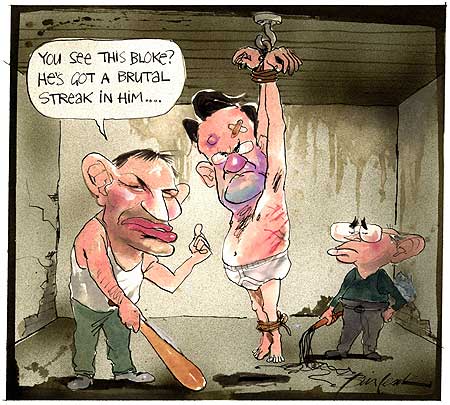
Schmitt uses this understanding of the political to undercut the liberal conception of the political as dialogue, public reason and reasoned debate.
Politics is very much about sacrifice. Simon Crean, the former leader of the ALP, was sacrificed. His two years of being the leader was one of sacrificing himself for the party. Crean is bleeding from the seeping wounds caused by the sacrifice.
The political as a conflict between friends and enemies makes sense of Schmitt's politico-legal project originally took shape, then, as a reaction to a democracy that had opened the door to threats to the established social order ranging from tax-and-spend government to a dictatorship of the proletariat. It makes sense of Bill Leak's cartoon refers to the struggle of the Howard Government to retain political power.
And it makes sense of the political project of philosophy.com, which is to resist the undermining of a social democratic Australia by the processes of corporate globlization. The existential crisis that we citizens are confronted with is the negative impact of globalization on our way of life and its domestic response in terms of 'strong state and sound economy'.
Schmitt's conservatism addressed the problem of limiting democracy to stabilize the postwar order of German society. Gopal Balakrishnan states that Schmitt's criticisms of liberalism were along the following lines:
"...classical liberalism conceived of parliament as occupying center stage in an enlightened public sphere. The influence of autonomous public opinion on legislation ensured that such legislation would be in conformity with reason—otherwise the rule of law would be little more than a cruel and empty phrase. The crisis of parliamentary government that Schmitt diagnosed was, then, a crisis of over-politicization—the collapse of consensus, under the impact of the intertwined struggles of classes, interest groups, and parties—which undermined the link between law and reasoned impartiality."
Though parliament still occupies a central center stage in an enlightened public sphere, there has been a collapse of reasoned discussion in favour of backroom deal making. Discussion takes place behind closed doors between the Government and the Senators who control the balance of power in the Senate. Authoritative decision, not the discovery of truth through amicable discussion makes law. It is also the case that, with Australia's opening up to the global markets, markets are increasingly supplanting reasoned discussion as a basis of social coordination. Few in the federal Parliament accept this critique ----the hollowing of parliamentarism---- as a challenge to reinvent a public sphere. There is a frustration with deal making, if they are excluded, but this disappears when they are able to engage in dealmaking. Deal making is generally accepted as what politics is about.
The implication of the significantly political distinction being between friend and foeis that state for Schmitt is governed by the ever-present possibility of conflict and annihilation. So it requires a sovereign who, in the face of existential uncertainties, incarnates an authority that is superior to that of the law itself. Hence, the succinct opening of his Political Theology: 'The sovereign is he who decides on the exception' This 'realistic' view of politics, follows Hobbes in subordinateing de jure authority to de facto power. The law is made by the one who has authority (i.e. power) and not the one who possesses the truth (the legitimate sovereign).
December 4, 2003
welfare-to-work strategy
The New Labour Project of Tony Blair in England and Mark Latham in Australia makes powerful claims for the innovative character of this politics. It's roots are in the Hawke/Keating Government, which melded neo-liberalism with a social democracy. This rationalised the provision of welfare (Centrelink and means testing and targeting) and regulated the activities of welfare recepients with an emphasis on waged work and a social justice concern to direct benefits towards those in greatest need.
This meant a shift in the management of unemployment from job creation schemes and employer incentives to education and training schemes. It was part of the shift by the state from occupying the commanding heights of the economy to investing in human capital in the context of the information revolution.
The central flaw in the welfare to work program is not the conception of citizenship behind it. The ethos of obligation, contribution and reciprocity means getting people back to work. This pathway makes a good deal of sense.
The problem lies in the consequences of getting the long-term unemployed back to work. The skilling level in terms of employability skills that would be required for this in an information economy is high. The cost of giving people the skills the appropriate skills to compete effectively in the job market is high and it depends on central and state government funding paid for out of taxation.
However, the government has a responsibility to ensure that work is available. Are there jobs for those equipped with the new skills. Does the state become the employer of the last resort? This is highly unlikely in a neo-liberal policy mode of governance. Will it be the funder of last resort? Again highly unlikely.
Is not the liberal state emphasizing contribution and reciprocity as a central condition of citizenship without being able to guarantee the jobs?
What is actually happening is that the state helps to give people the skills to take up economic opportunites and then relys on the market to supply such opportunities. Society is not keeping its side of the bargain because in many regions of Australia the market does not provide the economic opportunities.
So we have the social conservative shift to faith organizations and charities taking on a greater share of welfare provision. The social welfare functions performed by the social democratic state have been contracted out by church groups and private companies who, as part of the Job Network, now deal directly with the unemployed.
December 1, 2003
citizenship & welfare-to-work
Old Hegel had it pretty spot on in his Philosophy of Right when he argued that poverty, which he saw as the natural consequence of the market, was the greatest threat to a sense of social cohesion in modern society. He was troubled by the question of how economic security could be secured to individuals within a society whose economic and politics was marked by a strong conception of individualism, and by a strong sense that individuals should be as independent as possible.
I had always been impressed by this section of the Philosophy of Right and felt that it had undercut the conservative reading of Hegel.
Hegel's connections between citizenship, economic security and social integration are very much with us today because of the long-term unemployment arsing from setting a modern open market economy within a competitive global market.
The neo-liberal/conservative approach of work-for-the-dole has a tacit conception of citizenship; one based on obligation, virtue and contribution. This holds that individuals, do not, and cannot, have a right to the resources of liberal society unless they contribute to the development of society through work. Citizenship has to be earned and not seen as an unconditional right. Hence the insurance based approach as a point of difference to state assistance. It is insurance and contribution to the labour market that creates rights.
This obligation-based view of citizenship gives us a conception of the welfare state as working within the market economy in terms of improving social and human capital and not as some sort of corrective to the market as held by traditional social democrats.
These ideas of reciprociity and contribution have been used to devise a strong program of reform of welfare. We are familar with them:
dependency, whereby recepients of benefits are cut off from sociability, the labour market and the growth of knowledge and skills;
moral hazard or the acquistion of habits of mind and character that lead into poverty and dependency;
free riding by choosing to live a life on benefits paid for out of the general tax bills of citizens;
taxes should not be raised to pay the non-contributory benefits to those who are not responsible for their social obligations.
These considerations lead to the [enabling?] state placing an emphasis on the development of human and social capital (employability skills) to make the unemployed more effective in the labour market. This implies an emphasis on equality of opportunity (not outcomes) and the social capital of local communities giving the unemployed opportunities in the job market. Hence the policy focus on being active looking for a job, or doing community work.
The inference is that it is discharging general obligations (work) to society that secures the rights of citizenship. Work is the key to the ending of social exclusion and to citizenship.