January 23, 2004
lived bodies
The two weeks of being a tradesman engaged in upgrading the electronic cottage in the inner city has finally come to an end. Thank goodness.
I found the work tedious after a while, once the novelty wore off. Blogging here dropped off. I was just too tired in the evenings to think about the differences between place and space. It was too difficult to think--to organize my thoughts about the relationships between place, place and bodies at an abstract level.
Consequently, I lost the momentum in posting here about the lived body as a mediation between space and place; the role of the lived body in the constitution of place; or the momentum/movement of that body as the medium for providing access to the world.
However the labouring experience was illuminating. Through painting the electronic cottage for a couple of weeks I came to grasp how bodies inhabit a world, and how place is experienced by a lived body.
Upgrading the empty electronic cottage was a very physical time. I was on my hands and knees in an empty space scrubbing floors; climbing up and down ladders to clean and paint walls; I slowly became covered in paint as the day progressed; and then slowly delirious from the chemical and paint fumes. At the end of the day I was a wreck.
What I noticed was that the spatializing was done by the lived body. The body connected up the isolated positions within the room. It was the body that both exhibited expressive movement in the particular space, and oriented me in that space. Orientation here means a sense of fit and a knowing my way around.
Being in that space during the week of sprucing the electronic cottage up was a form of inhabitation; an active indwelling. This indwelling was different mode of dwelling from my living there. It was a plac of things-to-be-done rather than it being a space of just fitting into. I came into that place each morning with an indefinite horizon of possible action----what I could achieve that day. I had a knowledge of this place---of what needed to be done in this familar setting. I knew my way around in terms of what needed to be done.
Space becomes place.
I reckon I may take a break.
January 19, 2004
philosophy conference
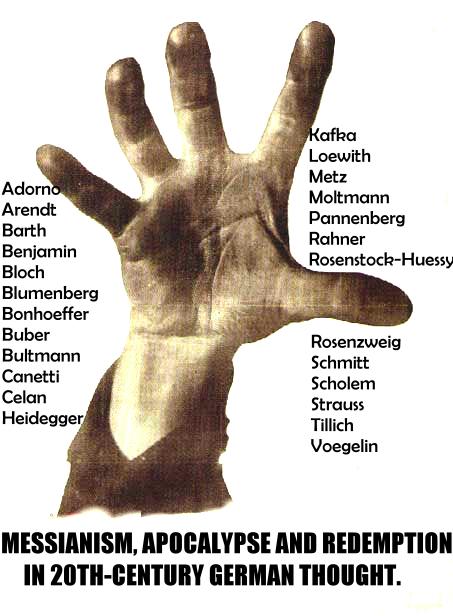
A philosophy conference is to be held at Adelaide University around the middle of 2004. Those organizing the conference are calling for expressions of interest in a conference entitled: 'Messianism, Apocalypse and Redemption: 20th-century German Thought.'
The organizers say that:
"We are interested in the persistent use of these essentially religious terms to express the hopes, forebodings and tasks of post-Nietzschean 20th century German thinkers. The widespread deployment of the images of apocalypse, redemption and messianism across different religious and secular faiths as well as different disciplines seems to have been indicative of the need felt by a large number of German thinkers to draw upon more archaic yet still vital speech to capture the moods and responses to the catastrophes of the first half of the 20th century."
The conference will be held at the University of Adelaide, South Australia, from Monday July 19 to Thursday July 22 2004.
The organizers go on to say that:
"It is anticipated that selected papers will be published in a book of the same name. Each chapter in the book will be devoted to one major German thinker and how his or her thought is informed by and contributes to the problematic of messianism, apocalypse and/or redemption."
The organizers say that they intend to inaugurate a journal along similar lines extending beyond Germany and relating it to twentieth century thought generally.
So if you know of any of your colleagues who may be interested in the conference could you please pass on this information.
The organizers are:
Dr. Wayne Cristaudo
(wayne.cristaudo@adelaide.edu.au)
Dr. Engelhard Weigl
(engelhard.weigl@adelaide.edu.au)
Rev. Mike Pietsch
(pietsch.mike@sa.lca.org.au)
It looks interesting does it not? It would be difficult to write about apocalypse and/or redemption in Australian thought. The closest that you'd get to is environmentalism.
You would find it in aboriginal writing under genocide and reconciliation.
January 18, 2004
bodies and places
There is a comment made here in passing that is of interest. It says that the economic rationalists (neo-liberals) do not understand place. It is made in reference to an antagonism to the recent nation building a transcontinental railway from Adelaide to Darwin in order to develop these regions. Economic rationalists would close these depressed regions down and shift the population to Melbourne and Sydney where there is vibrant economic activity.
On this account the market dictates, and should dictate, where people live. It is irrational to think otherwise. So everything in the market is matter of simple location. Location or site for economic activity is an abstraction of the particular qualities of place----its colour, texture, climate, luminosity, smells, sounds, etc---that the functioning human body responds to.
What is denied here is the particularity of place. Place is irrelevant. There are just various sites or locations of economic activity. What is glossed over by neo-liberal or free market economics is the connection or nexus of bodies to spaces. it is bodies that engage in economic activity. And in the critical Hegelian Marxist tradition the emphasis was on process and becoming at the expense of spatiality. Geography did not really matter for the development of capital.
This misses the lived human experiences of place that gives rise to the attachment to a particular place. So people may decide to stay in a place such as South Australia, rather than shift to the global city of Sydney.
But bodies change the idea of space as relations built up from positions, since it is through our bodies that we experience particular regions and spaces as lived places. Body is the road to place as it orientates to, and inhabits, places. There is thus is an intimate bond between body and place. The intimate bond comes from the lived body in the physical world or landscape. We live in the landscape in a personal way of being.
How do lived body and lived place connect up? Through walking.
January 13, 2004
clearing away place
Though environmentalists in Tasmania continue to talk about place as a wilderness occupied by particular ecological bodies, place talk has been replaced by space talk.
What were once places have become submerged into space.
Descartes states the reduction well in his Principles of Philosophy:
"When we say that a thing is in a given place, all we mean is that it occupies such a position relative to other things."
Place is reduced to position. Space is an order of positions. And then reduced to point.
Space triumphs over place.
Space then acquires a void like character.
We need to find a way of getting back to place.
January 12, 2004
Whilst painting the electronic cottage during the day I've been thinking about what has been happening to wilderness in Tasmania. Many Tasmanians have an empathy with place--Tasmania as a natural place.
This implies both a deep concern with the processes of life integral to the temperate rain forest and an understanding of human beings in ecological proceses.
January 9, 2004
land ethic
I've been rennovating all day this past week and I'm too tired in the evenings to do much in the way of posting.
I have been able to track the debates on wilderness and the logging of old growth forests in Tasmania.
It seems to me that what is missing in these debates a conception of wilderness as an ecosystem, a conservatist/environmental ethic that starts from a land ethic, and a land ethic based upon ecosystem integrity.
January 6, 2004
Mars: raw images
Sending humans to Mars is still a dream.
At the moment Robots go to Mars so that we can learn as much as we can about the Red Planet. So orbiters look at the planet from on high and landers sit in one spot and investigate a landing site. But rovers can be commanded to look around, move to an interesting location and examine the soil and rocks in fine detail.
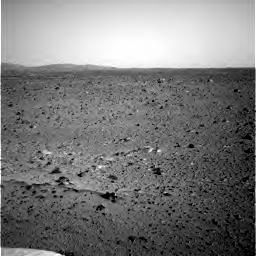
A raw image from the Mars Exploration Rover Mission:
The gallery is here. Some panoramic images are here.
When the above photo is connected to the first color panorama we have a stony plain with a range of hills in the distance. An old river bed?

The Mars exploration mission is really is about technology isn't it? The rovers become the feet, hands and eyes of explorers on Earth; a reinvented prothesis: a technology in place of our body.
There is so much faith, promise and utopian longing built into this technology. It really is about mastery human beings going to Mars.
And exploration, judging from our own earthbound history, is about colonization. Colonizing space is the dream.
Perchance I am just reading some remarks on technology made by Derrida at the Sydney Seminars when he visited Australia in 1999.
January 4, 2004
Universities: hot debate
I have just stumbled into this debate over design, philosophy and the university. It recognizes that the modern univerity fulfills many functions:
"Modern universities have many roles. They prepare citizens for life in industrial and post-industrial democracies. They train people to work in demanding jobs. They enable individuals to understand and interpret the world around them. They offer individuals the opportunity to think about fields of inquiry and study. They host research programs that create new knowledge. They establish projects to apply the knowledge that reach generates. Universities fulfill all these functions and more."
It also recognizes that the shift from medieval universities to modern research universities was a long, slow process that involved many strains and difficulties and the importance of Kant's series of essays, 'The Conflict of the Faculties' in addressing two key questions: how is knowledge to be established, and which faculty shall govern the modern research university?
to be continued
January 2, 2004
Re-thinking wilderness
The previous post on wilderness and this one over at junk for code indicate the challenge to the traditional conception of wilderness.
This is the one traditionally associated with preventing the building of the Franklin Dam in Tasmania in the 1970s and allowed Tasmania's rivers to continue to flow free. This romantic conception continues to be deployed in campaigns to save Tasmania's old growth native forests from being clear felled for wood chips for the Japanese market. It has underscored the preservation activity in Australia and the US that saw the creation of national parks, and been used to criticise the massive species extinction currently happening in Australia.
Thus the conception of wilderness is contested. We can meet the challenges by rethinking wilderness in terms of the ecosystem: wilderness is an ecosystem (an interconnected community of life) that has been minimally disrupted by the intervention of human beings. In responding to this conception of wilderness philosophy extends ethical concerns to non-human beings. It challenges the assumption that right behavior is exlusively a question of human relationships, works up an account of intrinsic value and a land ethic, and grants moral status to animals.
January 1, 2004
conflicts over wilderness
One of the criticisms that the indigenous people have directed at environmentalism is centred on the concept of wilderness. Wilderness, as a counter point to the domination of nature by instrumental reason, presupposes nature without any trace of of human interaction. This tacitly denies the very existence of Aboriginal people in the landscape and makes them invisible.
In effect the doctrine of terra nullius lives on within wilderness.
The result was that the establishment of national parks (the practical embodiment of wilderness) were established Aborigines were denied their customary inherited rights to use land for hunting gathering, building, rituals and rites.
Or, if the noble savage conception was used instead, them this presupposed idealised harmony of indigenous people in their relation to the land. They practiced the ideal model of conservationism; one that whites should aspire to. The indigenous people had the right dwelling conception and the right caring for the land ethos. Whites should learn from aborigines as noble savages.
Hence the conflict between the Aborigines and the Greens overlay the conflict between the greens and the pioneer settlers who celebrated the conquering and taming of nature as progress.