February 29, 2004
Globalization#5: the turn away
More from John Ralston Saul:
"Observant national leaders couldn't help but notice that the theories of Globalisation were failing them. The most public of these failures was the breakdown of international lending and debt mechanisms. For a short period it looked as if the IMF's punishing approach might actually work. For a dozen years most Latin American governments tried to follow instructions laid down by the IMF, Western governments and the private banks. They endured crucifixion economics, and in many cases this eventually produced apparently solid growth, even if the parallel result was a greater rich/poor gap. But in each case the recovery was followed, a few years later, by even greater collapse. It turned out that such prolonged austerity had weakened, not strengthened, the social-economic fabric. So after all of the liberalisations, privatisations and inflation-stabilisation programs, growth in Latin America in the late 1990s was a little over half what it had been before the reforms."
He goes on to say:
"In other words, Latin America no longer believes in Globalisation. Neither does Africa. Nor does a good part of Asia. Globalisation is no longer global. Indeed, most Western finance ministers have been quietly working for some time on partial reregulation of the markets. Why quietly? To avoid the ferocity of the true believers.In 1998 the governor of the Reserve Bank of Australia, Ian Macfarlane, began calling for reregulation. "More people are asking whether the international financial system as it has operated for most of the nineties is basically unstable. By now, I think the majority of observers have come to the conclusion that it is, and that some changes have to be made."
In the same year a combination of street demonstrators and distrustful ministers of finance from around the developed world killed the Multilateral Agreement on Investment negotiations, which had been aimed at a further Globalisation of finance and investment. They rejected the idea of yet more business-oriented binding treaties, with no binding political or social counterweights."
That is what needs to be emphasised. What is rejected is a particular model of globalization. The corporate one. It was rejected because it was indifferent to the old fashioned politics and social life of nation-states.
February 28, 2004
crucifying the economy
In the previous postJohn Ralston Saul made the following comment about the failure of gloablization to deliver on its priomises:
"This was the crucifixion theory of economics: you had to be killed economically and socially in order to be reborn clean and healthy."
I mentioned Indonesia as an example. But the recesssion of the early 1990s in Australia caused bythe market-orientated Hawke/Keating Labor Government is another example. They and their pointy head economic advisors from the Treasury gave us the economic revolution of opening up the economy to the global market. For them the main game of politics was about the clean lines of economic fundamentals; everything else (eg. people's happiness) was fairy floss and decoration deserving mockery and condescension.
Then interests rates went to 20%.
I remember those years well. They are seared on my memory. I was teaching philosophy as an adjunct at the time, and I had bought a cottage in the inner city of Adeliade at the end of the 1980s boom. To keep the house I had to work 5 jobs. People lost their houses, their jobs, their businesses. Marriages and relationships broke up from the stress --mine did. It was hell. I detested the hubris of Keating and his devout, free marketeer economic advisors.
I loathed Paul Keating, the then federal Treasurer, for saying that it was 'the recession Australia had to have.' That remark highlighted the callousness and coldness of neo-liberal economic theory--it was utterly indifferent to the wellbing of human beings. All that mattered was the big picture: squeezing the boom and excess out of the economy. The Hawke/Keating Labor Government was returned to office then Hawke and Keating fell out over the leadership.
So when I started reading Don Watson's 'Recollections of A Bleeding Heart', I turned to his remarks on this episode. His memories are bitter ones. He says:
"When my wife and her partner lost the business they had built over 15 years, interest rates were as high as 20 per cent. Later, when I was in the job [Keating's speech writer], I could never repress a snarl whenever Keating said that those interest rates had 'de-spived' Australia'. It was true up to a point. Entrepreneurs who had been held up to us by both sides of politics as models of the new economy in the eighties were now either going broke or going to goal. The question was, who created the spivs? And who created the economics commentators the secular priests of our time, who for a decade had told us how to think and what to expect? They were not broke becaue they had never risked a dollar of their own, or backed an idea of their own and, sadly, I sometimes thought, they couldn't be sent to goal."
The 1990s recession was an example of cruxification economics. Watson says that when he returned to Melbourne in 1991 from Tokyo he found that city to
"....stunned and deserted. Empty shopsand lease signs everywhere, quiet streetsm, not a crane in sight. There was a kind of sullen silence in the air. Of all [the] recessions in my liftetime it was the only one to make you think the Depression must have been a bit like this."
This is a good example of an economy having to be killed economically and socially in order to be reborn clean and healthy.
The free marketeers were more than economists.They were ideologists since, secreted in their language of the free market, was a world view with its sense of false consciusness, historical inevitablity, special knowledge, the new order, the purges and cleansing. The pointy heads were crucifiers. They were into sacrificing people for the efficiencies of the market.
February 27, 2004
Gloablization#4
More from John Ralston Saul. He says that there were three particularly obvious signs that corporate globalisation would not deliver on its promises.
"First, the leadership of a movement devoted to "real competition" was made up largely of tenured professors, consultants, and technocrats - private-sector bureaucrats - managing large joint-stock companies. Most of the changes they sought were aimed at reducing competition.Second, the idea of transnationals as new virtual nation states missed the obvious. Natural resources are fixed in place, inside nation states. And consumers live on real land in real places. These are called countries. The managers and professors who waxed enthusiastic about the new virtual corporate nations were themselves resident citizens and consumers in old-fashioned nation states. It would be only a matter of time before elected leaders noticed that their governments were far stronger than the large corporations."
The Iraq war soon reinforced the idea that we citizens continue to live in nation states and nation states were not about to be consigned to the dustbin of history by the global market.
It is the third sign that interests me in the light of the Asian financial crisis in te late 1990s. Saul says:
"Finally, the new approach to debt - public versus private, First World versus Third World - revealed a fatal confusion. Those who preached Globalisation couldn't tell the difference between ethics and morality. Ethics is the measurement of the public good. Morality is the weapon of religious and social righteousness. Political and economic ideologies often decline into religious-style morality towards the end. But Globalisation had shoved ethics to the side from the beginning and insisted upon a curious sort of moral righteousness that included maximum trade, unrestrained self-interest and governments alone respecting their debts. These notions were curiously paired with something often called family values, as well as an Old Testament view of good and evil.It somehow followed that if countries were in financial trouble, they were moral transgressors. They had to discipline themselves. Wear hair shirts. Embrace denial and fasting.This was the crucifixion theory of economics: you had to be killed economically and socially in order to be reborn clean and healthy."
I read that and I think of Indonesia. They were treated roughly by the IMF. It was standover tactics.
February 25, 2004
the main game
After the neo-liberal turn to the markets in the 1970s the only reality that mattered was an economic reality. In the language of the time it was 'the main game'. You had to master the economic language to be a part of the political culture, or to be accepted as being capable of understanding reality. If you did not understand the language of economics you were excluded from the policy making that aimed to shaped reality.
'You are ignorant about economic's was the first tactic employed to demolish the critic's case that the free market was not all it was cracked up to be. It meant that you did not understand 'the story' of how we got to be at this point of requiring ongoing micro-economic reform.
It was like what happens in a war situation. In Australia those who did not adopt the government free market line were treated as the enemy. Addressing the political fallout from the economic reforms was dismissed as pandering to populism. That was politics. Politics was bad.
Hence the words were used by the pointy heads as a means of control. Their narrative could not be questioned.
In these times institutions had to be on message, have a strategy, be concerned with outcomes, be accountable, devise mission statements, conduct reviews, market their product, differentiate their product mix and so on. It was corporate speak.
It's a dead language disconnected from the political language of citizenship, civil society, democracy, emotion and the public good. That political language becomes yesterday's language. The language of the dunghill, tribalism and ethnic nationalism.
The pointy heads in concentrating on the main game said they were defending the future from the past. Economic reform at home (eg., financial deregulation, lowered tariff walls and a free floating dollar) went hand and hand with the emerging global economy.
Pity about the economy going bust, the monetary brakes being applied and the skyrocketing current deficit. The new economic narrative about opening the economy to the world with its manifold opportunities for wealth creation did not meet with much enthusiasm. The new suddenly sounded old.
February 24, 2004
Globalization#3: Form and content
More from John Ralston Saul on the neo-liberal turn to free markets in the 1970s. The following passage captures the rhetoric of the neo-liberal globalization at the time. He says:
"As for the new force or ideology that came forward to fill the vacuum [of the 1970s] it involved an all-inclusive strategy called Globalisation - an approach that contained the answer to every one of our problems. It was delightfully seductive. It contained simple, sweeping solutions and... it lodged ultimate responsibility in invisible untouchable hands. Thus Globalisation required no one to take responsibility for anything.This transcendent vision quickly filled the vacuum...[it held that]....great global, indeed inevitable, forces were at work. There was therefore little that [one] could do. Nation states were powerless.This was the beginning of the mania for public declarations of impotence by democratically elected leaders. Globalisation became their excuse for not dealing with difficult issues, for not using their levers of power and larger budgets to effect. They made the force of inevitability credible."
Behind the rhetoric of inevitability---there is no other way---stood a particular philosophy about method. Saul says:
"Globalisation had brilliant proponents .....And their basic theory was - is - that modern methodology is universal. What's more, these methods are preferable to the untidy business of democratic argument and personal will, whether that is a matter of personal opinion or personal choice. In other words, they were engaged in the classic struggle to promote method over opinion; that is, form over content."
Saul does not say what the partuicular form was. I've previously identified it as free market economics---in a mathematical axiomatic style. Platonism if you like.
Christopher Sheil takes a broader approach. He says that form over content means that:
"...government has abdicated from an interest in content in favour of governing according to formula. Instead of governing according to content, government has been reduced to method. What this means is that, instead of a democracy, we have a technocracy; instead of a government that really knows what things it's doing, we have one that only knows how to do things."
He gives national competition policy as an example. It is with this policy that Australian citizens are finding that governments are not at all engaged in the content that concerns them. Governments at the federal and state levels are primarily concerned with the form.
The effects of National Competition Policy are still with us today. Saul briefly refers to it in the followign passage:
"The sin of public debt was then broadened by attributing it to public utilities. Running well or not, they had to be privatised and deregulated into a global marketplace to cleanse them of public sector inefficiencies. This led in turn to the large utility-style private businesses, such as airlines, being freed of regulatory restraints to satisfy a moral version of individualism that promised, for example, the right to travel, cheaper fares, greater choice, more destinations."
In Australia the public utilities were primarily water, electricity and forestry. If they were not privatised, they became corporations whose primary goal was to make a profit and return a dividend to the government. No thought was given to ecological sustainability.
February 23, 2004
public language#4
In Death Sentence Don Watson gives a good description of the way that language is used within the friend/enemy political machinery of parliamentary politics. He writes:
"In the diabolical environment of politics, unreasoning forces forces throw up unreasoning things like red herrings and dead cats and fling them in the path of journalists. Politicians come forth willing to say anything, and without regard to ordinary civility. Their opponents are rank hypocrites, they say: they've heinous secret plans that all the outward signs disguise. And often it emerges that these outrageous accusations have some truth about them, because politics does throw up hypocrites and liars. In keeping with the evolution of such political animals, among journalists horrible cynics emerge. "
It's a reasonable account. You only have to watch a "debate" in the House of Representatives online to see this kind of low life (slimeballs) in action. And all the posturing, ranting and tirade of abuse is done with an eye to the camera on broadcast day. It's called getting your message across ; or getting your through to the electorate.
It looks so different watching it at the other end of the camera. It turns you off. If you listen to several hours of this on the computer you realize that most of them are parroting the party line to score petty political points. You know they have nothing to say when they suddenly puff themselves up, become all impassioned and go about how evil the other side is and wonderful their side is.
There is no policy making being done here.
So what are the consequences of this use of language by instrumental reason? Watson gives a good account. He says:
"For the [public] language the consequences are terrible: catchalls, cliches, and nauseating platitudes are all rolled out. Syntax is mangled. Reason goes up in smoke. The truth is less significant than the political contest. The question is not, Which is the better argument? It is Who won? Or What was the outcome? Along with reason and enlightenment language goes out the window."
The irony, of course, is that the fervent supporters of neo-liberalism, economic reform and globalization said they stood for the liberal values, reason and enlightenment. It was their old-fashioned social democratic opponents who stood for prejudice, tradition and irrationality. And yet their use of language indicated that they had no time for enlightenment, let alone understood what that cultural heritage of dialogic reason, democracy and citizenship meant.
February 22, 2004
Globalization#2
I was loaned a copy of Don Watson's big tome Recollections of a Bleeding Heart when I was in Canberra last week.
I want to read it with a question in mind. Why did the Australian Labor Party embrace the neo-liberal doctrine of globalization in such a black and white way that it attacked the electorate for its parochialism and reform fatigue, adopted such a skewed vision of history, and saw austere microeconomic reform as the main political game. How come the Canberra policy makers become so blinkered that they did not even realize that they were blinkered or tunnel visioned?
John Ralston Saul says that it arose from a geopolitical vacuum:
"Globalisation materialised in the 1970s from the sort of geopolitical vacuum or fog that appears whenever a civilisation begins to change direction, to grope its way around a corner from one era to another.In geopolitics, a vacuum is not an option. It is the period between options; an opportunity, providing you can recognise it for what it is; a brief interregnum during which individuals can maximise their influence on the direction of their civilisation."
So what caused that vacuum or void? Saul gives an interesting answer:
"Perhaps a quarter century of social reform had left the liberal elites exhausted. The need to manage a multitude of enormous new social programs that had been put in place in a democratic manner - an ad hoc manner - made it difficult for political leaders to concentrate on the main line; that is, to concentrate on a broad sense of the public good. Instead, governments were caught up in the endless and directionless details of management. Or perhaps the cause of the vacuum was the resulting reliance of those political elites on technocrats, who understood little of the debate - in fact, distrusted it - and so drew the leaders into isolation. Most Western leaders seemed confused about what to do next. They had come to the end of a chapter of social progress."
That seem right. I distinctly remember many social democrat politicians at he time saying that they had no arguments to defend social democracy from the big Hayek roll back against socialism. Their cupboard was bare. They had nothing in their tool kit. Hence they could not resist neo-liberalism and the turn to the free market.
Watson was a bleeding heart historian working for a neo-liberal politician in the last few years of the ALP's decade long rule. So I want to see if he has an answer for why the neo-liberal conception of globalization swept all before it.
Maybe I won't find what I'm looking for. As a speech writer for the Paul Keating, then the Prime Minister, Don Watson may have become a courtier in Keating's court until it all came crashing down in 1996.
February 21, 2004
the decay of globalisation
I was reading Friday's Australian Financial Review today, whilst the rain fell softly breaking the long heatwave that has baked Adelaide for over two weeks. I came across this article on globalization by John Rolston Saul.
My take on this article was different to that of Chris over at Backpages. My attention was caught by this passage:
"Grand economic theories rarely last more than a few decades. Some, if they are particularly in tune with technological or political events, may make it to half a century.....Our own Globalisation, with its technocratic and technological determinism and market idolatry, had 30 years. And now it, too, is dead."
That judgement sure resonates in Australia. The state's head was cut off and the market was put on a pedestal. Saul continues to build his case:
"... the signs of decline are clear, and since 1995 those signs have multiplied, building on one another, turning a confused situation into a collapse. We have scarcely noticed this collapse, however, because Globalisation has been asserted by its believers to be inevitable... a holy trinity of burgeoning markets, unsleeping technology and borderless managers. Opposition or criticism has been treated as little more than romantic paganism."
Romantic paganism? In Australia the critics were deemed to express irrationality and embrace an evil nationalism. Instrumental reason was identified withreason.
What then did globalization stand for? Saul continues:
"That the power of the nation state was on its way out, to be replaced by that of global markets. That in the future, economics, not politics or arms, would determine the course of human events. That freed markets would quickly establish natural international balances, impervious to the old boom-and-bust cycles. That the growth in international trade, as a result of lowering barriers, would unleash an economic-social tide that would raise all ships, whether of our Western poor or of the developing world in general. That prosperous markets would turn dictatorships into democracies. That all of this would discourage irresponsible nationalism, racism and political violence. That global economics would produce stability through the creation of ever larger corporations impervious to bankruptcy. That these transnational corporations would provide a new kind of international leadership, free of local political prejudices.That the rise of global marketplace leadership and the decline of national politics, with its tendency to deform healthy economic processes, would force the emergence of debt-free governments. By then wedding our governments to a permanent state of deficit-free public accounting, our societies would be stabilised."
This has been hurled at us citizens for thirty years as thunderbolts from on high by the economic and political elite. We were the sludge. They were the movers and the shakers. We had to be blasted out of our habits, traditions adn old ways of doing things.
Behind the new stood something old. Saul describes it thus:
"In summary, global economic forces, if left unfettered by wilful man, would protect us against the errors of local self-pride, while allowing individual self-interest to lead each individual to a better life. Together these forces and self-interest would produce prosperity and general happiness. In a society where Christian dogma had been so dominant until so recently, how could people of goodwill not be attracted by this good news - by these promises of personal redemption? And if you add to all of this a multitude of new, technocratic market methods - well, then, the cycles of history would be broken, setting us on a permanent, inevitable course."
Yep, it was the return of the old nineteenth century laissez-faire economics wearing the positivist mask of social science. l
One of the consequences of the new economic/business language was the decay of public language that Don Watson describes.
February 20, 2004
Public language#3
Another quote from Don Watson from Death Sentence on the decay of public language. He says that instrumental reason's corporate language, which has come to dominate public discourse, has:
"...no space for the light of the imagination. There is no room for a feeling properly felt. There is no room for an 'other'--- which with writing is usually the reader. You cannot tell if the author of the words is genuine or not because they have no author. They are ritual words. It is as if, like someone with schizophrenia or depression, they are not quite of the real world. They have forgotten the language the rest of us speak."
What we are losing is language that expresses character or imagination and which interests one human being in another. It is as if we are witnessing the apothesis of the psotmodern with the human subject dispensing with itself.
The world of parliamentary politics is marked by this decay of language. Inspirational independent thinking is not encouraged. Political language has been colonized by that of the corporate world. Watson says:
"Political thought and speech has been entangled with the corporate stuff for years, and unless a way is found to separate them, in a generation or two few will know that anything better once existed. We do not wait for Pericles, but we hope for something better from a politician than a poor imitation of a business consultant. "
Politicians have become managers of events. They see themselves as CEO's even if their salary is very low by executive business standards. They only know the corporate model. They conduct themselves like business executives and speak like them.
February 18, 2004
Philosophy in public life
I came across this paragraph over at Lars Iyers weblog Spurious. It is a paragraph from William Large's review of the Routledge Thinkers in Action series.
I quote in full:
"Even if these books were written for the public, who are the public anyway? Can one take philosophy to the public? Is this not a profound misunderstanding of philosophy? To take philosophy to the public: is this not to destroy everything that would be possibly philosophical about philosophy? In this instance, philosophy is perhaps quite different from the sciences. It might be possible to take science to the public by simplifying the explanations, but philosophy is not about explanations, it is about problems that cannot be explained. It’s goal, therefore, is to leave the reader or the listener absolutely perplexed and bewildered, atopos, as Socrates describes himself. How can you take this to the public? Even, let us imagine, that being bewildered and perplexed became the latest public fashion, then being bewildered or perplexed, would no longer be bewildering or perplexing. Philosophy cannot be taken to the public not because of some kind of esoteric elitism, (as an academic discipline it is like any other, sometime interesting, but mostly appalling), but because it is the relation to the unknown itself, the limit, the apolis. Does not Socrates take Phaedrus outside of the walls of the city to talk to him about philosophy? Philosophy does not take us to the public, no more than it can be taken to the public; rather it tears us away from the public, and thus the public from itself."
My immediate response is what about the Romans----Cicero, Seneca etc? S Did they not practice philosophy in public life? They argued for philosophy within the city not for a philosophy outside the city walls.
And Montaigne? Is that not philosophy within public life?
It is possible to scratch democracy where it itches from within democracy ito help foster a flourishing democratic way of life. We try out the public opinions (about public health or the market) to see whether they work.
Oh, I almost forgot. Remember John Locke in the 17th century, Adam Smith in the 18th century and Jeremy Bentham and John Stuart Mill in the 19th century.
February 17, 2004
Don Watson: Death Sentence
My attention is focused on public language at the moment. A friend loaned me a copy of Don Watson's Death Sentence The Decay of Public Language. In the introduction Watson writes:
"Public language is the language of public life: the language of political and business leaders and civil servants – official, formal, sometimes elevated language. It is the language of leaders more than the led, the managers rather than the managed. It takes very different forms: from shapely rhetoric to shapeless, enervating sludge; but in every case it is the language of power and influence. What our duties are, for whom we should vote, which mobile phone plan we should take up. In all these places the public language rules. As power and influence are pervasive so is the language: we hear and read it at the highest levels and the lowest. And while it begins with the powerful, the weak are often obliged to speak it, imitate it."
The book says a lot of what I'd noticed when I listened to politicians speak their particular kind of sludge in Parliament.
But Watson has an explanation for the contemporary sludge. In the first chapter Watson writes:
"The public realm has been in decline since governments retreated from the economy and private companies moved into take their place. The operation extends well beyond privatised public utilites in gas, water, electricity and transport. Economic revolution has transformed our institutions---colleges and universities, hospitals and medical practices, the public service itself----and transformed our relationships with them in doing so. And as the private sector has replaced the public it has found itself obliged to pick up function and responsibilites that had belonged to governments. They pick them up in different ways, and they use a different term for them: they call it investing in social capital."
Yes and no. He's right about the economic revolution. But social capital refers to community and civil society not the state.
Never mind. Those working in the world of public policy in Australia speak coporate speak these days. That is the main point. Hence words such as 'flexibility', 'internationally competitive', 'downsize', 'the triple bottom line' and 'self-regulatory'. It's a 'global' style.
It is not the language of rhetoric and persuasion.
February 15, 2004
public language#2
In the few days of last week that I spent visiting federal parliament in Canberra I listened closely to the public language of the politicians. What was the language of their rhetoric I wondered.
I realized that the public language of federal parliament is a machine language. Instrumental reason now uses a managerial language that is constrained by the opinion polls and media spin. It is focused on manipulating public opinion. It avoids the need to think about public policy in any depth.
Most of what I heard in Parliament was fog. Marketing fog. Some of it was corporate speak based on the command and control structure of politics. To participate you had to master the mind numbing style of managerial speak.
At a coffee shop I overheard a health bureaucrat talk in terms of nodes, value-added communication, networks between silos and enhancing customer choice. Everyone was customers.
There were no citizens. I wondered where they'd gone.
February 14, 2004
public language
I was not able to post whilst on the road. I had hoped to explore some of what happens in federal parliament on this weblog. But it was not possible. I was only a visitor and things in federal parliament and in the apartment were not set up for casual internet connections for visitors.
What I did notice though is the way that public language decays. That was my experience of parliament. I thought that public language had emptied out because of the media and advertising or marketing. But whilst I was watching politics in federal parliament, I realized that public language is about power and that it is designed to intimidate, threaten and manipulate.
And many journalists reprinted those political speeches about public health that were designed to deceive and manipulate with little comment. And so the media helped to hide the indifference the powerful have for the poor---
February 10, 2004
bodies in the forum
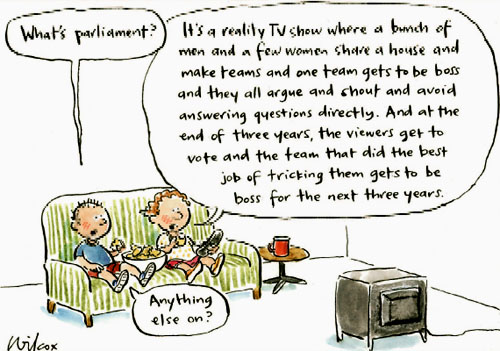
I'm on the road and so posting may be spasmodic. I was watching federal Parliament today and I started thinking of it in terms of the pre-given. It highlights the way the pre-given can be understood in terms of what is densely sedimentated of what is familar and its historicity.
Wilcox
This ignores the sedimented habitual practices, conventions and power relations of the pregiven. The pregiven of this political institution for a journalist, a lobbyist, politician or staffer one etc is strong. The sense is both one of stepping into a big powerful machine that sweeps you along and being bodily in place. Within this institutionalized forum the lived body is continually confronted and connected with the intersubjectivity in the public place.
The politics of negotiations over legislation works through the body language and the reading of its social significance.
February 7, 2004
lived being
As we have seen, Merleau-Ponty's argument is that the philosophical tradition and its successors (eg., cognitivism in psychology) had overlooked the centrality of the body in human experience. For him, bodies have their worlds, and understand their worlds in terms of lived experience. Philosophy, following Nietzsche, Husserl and Heidegger, finds its ground on lived being.
It is the body which encounters others and the world, not an abstracted mind which somehow inhabits that body. Bodies are not merely the means or instrument of the mind.
We can add to this account of body-place nexus. There is a dialectic between what is pre-given in places (what is already present to us) and what is contributed by our lived bodies.
The pre-given can be can be understood in terms of what is densely sedimentated in terms of what is familar and its historicity.
February 6, 2004
Merleau-Ponty
Why Merleau-Ponty? Why bother with a largely forgotten French philosopher of the mid-twentieth century?
The texts of this philosopher can be interpreted as an attempt in late modernity to climb out of the fly bottle of the mechanical materialist metaphsyics of modern natural science. He does this as part of the critique of the mathematization of nature in continental philosophy.
Merleau-Ponty's pathway is being-in-place, bodily movement, the lived body, place and the intertwining of body with place.
These texts opened up a space in which we understand that we get into place, move and stay there with our bodies.
This gives a materiality to Husserl's concept of the lifeworld that was developed as part of his critique of modern science and philosophy in his Crisis of European Sciences and Transcendental Phenomenology.
February 5, 2004
towards bodily empowerment.
"Phenomeology is a philosophy for which the world is always "already there" before reflection begins---as an inalienable presence; and all its efforts are concentrated upon reachieving a direct and primitive contact with the world , and endowing that contact with a philosophical status."
The Phenomenology of Perception
The historical background to the sentiments in the above quote lay in the malaise with modern philosophy and science; a sense of emptiness and breakdown; and a demand that philosophy be relevant, and speak to the concerns of everyday life.
Edmund Husserl in his, The Crisis of European Sciences and Transcendental Phenomenology, expressed it this way:
'We make our beginning with a change which set in at the turn of the past century [ie., 1900] in the general evaluation of the sciences. It concerns not the scientific character of the sciences but rather what they, or what science in general, had meant and could mean for human existence. The exclusiveness with which the total world view of modern man, in the second of the nineteenth century let itself be determined by the positive sciences and be blinded by the 'prosperity' they produced, meant an indifferent turning away from the questions which are decisive for a genuine humanity." (pp.5-6)
Husserl had a positivist science in his sights.
That feeling was present in Australia in the latter part of the 20th century--eg., with the 1968ers. But that generation lacked the philosophical tools to turn the hostility towards modern (positivist) philosophy and science to questions of the meangingfulness and meaninglessness of human existence.
What was inherited from thsi critique of positivism was social theory in the form of the Frankfurt School's critique of instrument reason and the culture industry, plus the becoming familar with the poststructuralist French theory of Derrida Foucault and Lacan.
What was missed was the philosophy behind this critical social theory and a conception of philosophy as both a critique and creative. What needed to be recovered from the digging out from the edifice of modern philosophy was philosophy as a political activity.
February 4, 2004
bodily existence
I posted on the material on Australia as a dystopia in order to provide a cultural context for the previous posts on the lived body and place. The post was meant to give an answer to why this kind of material. Why are you exploring this pathway.
I'm digging my way out of the scientific enlightenment---which has meant a reductionist natural science with a mechanistic materialist metaphysics; a way to return to the everyday world that we normally inhabit without embracing aesthetics. It is the way of lived bodily existence.
The previous post on the lived body painting the electronic cottage was meant to indicate a way to do this. The lived body activates a space and makes it a body place. We can take this insight into lived bodily existence and develop through walking a favourite beach or walking the city. This bodily existence provides us with of access to the world as we come to know the world through this bodily experience.
This is a rupture from mechanistic materialism as its natural moving body is a machine and not a lived organic body. 'Lived' is the key difference, not consciousness as most anti-physicalist philosophy has traditionally held.
The argument is that of Merleau-Ponty. It can be found in his text The Phenomenology of Perception. The argument is that the places we know are known by the bodies we live. We cannot be implaced without being embodied. And, to be embodied is to be capable of implacement.
February 3, 2004
starting over again
After my little break I started scanning the web for material to start over again. I found this passage most interesting:
"It is a commonplace that, for the most part, Australia inhabited the European Romantic imagination as the dystopia to North America's utopia. But while America had Southey, Coleridge and Blake to laud it as the next pantisocratic Jerusalem, Australia's spiritual patrons were more concerned with it's promise as a penal abyss into which a whole substrate of society might be cast and forgotten. Both were conceived in terms of "use," but the nature of this use differed radically in intention, even if it was similar in its outcomes."
That is about right from living in Australia. Pretty graphic that utopia dystopia duality. America is the sun. Australia is the land of refuse. The arse end of the world. I have been reading Bataille of late and it rubs off.
The above quote comes from p.4 of this text,which I've just stumbled across. The text makes other interesting remarks. On p. 3 it says that the history of the Western encounter with the Australian continent is one that is:
"...consistently found it to be aberrant, repellent, dystopic; the underside of the world, the Antipodes. That is to say, traumatic....In The Fatal Shore, Robert Hughes argues that, at the time of first settlement, Australia (and the Pacific basin, an "oceanic hell") functioned as a type of "geographical unconscious." The name of this dark continent at the time of "discovery" was Terra Australis Incognita: the name of the land-without-a-name."
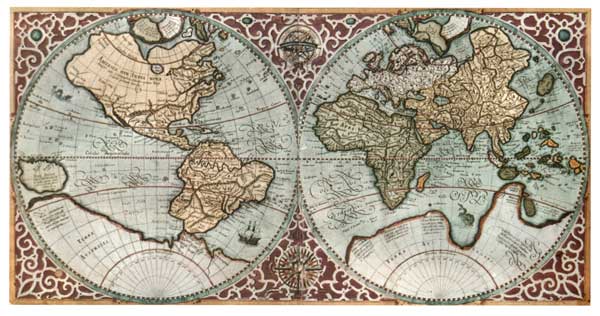
Mappamondo di Mercatore, 1587 (Londra, British Museum)
The land-without-a-name is the great unknown southern land.
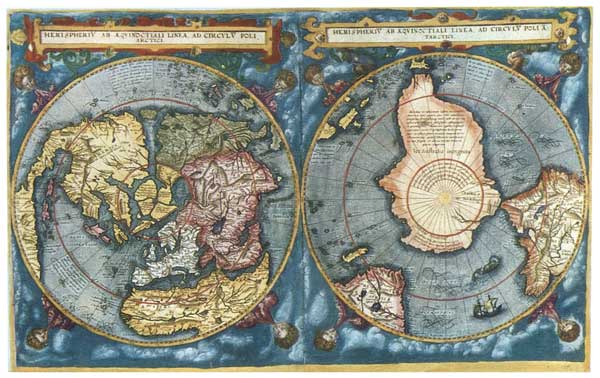
Mappamondo di Gerard De Jode, 1593
the Great Southen land as Terra Australis Incognitais clearer here:
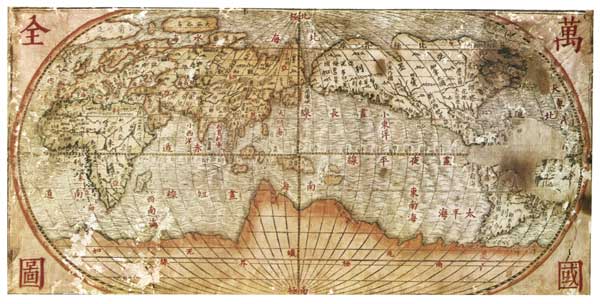
Mappamondo di padre Matteo Ricci, inizio '600 (Milano, Biblioteca Ambrosiana)
For the Dutch explorers who came down from Batavia and mapped the west coast of the Australian continent the land was an unliveable waste land. It was not a place of wealth or fortune.
The standard histories of this Eurocentric vision of the Australian continent say that it was put to rest by the voyages of James Cook. Once discovered the continent was then seen as empty.
The dark continent is spelt out in terms of Freud's unconscious. Thus Australia existed in the European imagination initially as the negative desire of an emergent scientific positivism. This "imagined country," as Hughes says, lurked beneath the rational conscious of the Enlightenment like something "infernal, its landscape that of Hell itself". Hughes says:
"Within its inscrutable otherness, every fantasy could be contained; it was the geographical unconscious. So there was a deep, ironic resonance in the way the British, having brought the Pacific at last to the realm of European consciousness, having explored and mapped it, promptly demonized Australia once more by chaining their criminals on its innocent dry coast. It was to become the continent of sin."
This Hell hole had other negative characteristics:
"Australia, it should be remembered, was first and foremost the destination of those who were considered to have insulted the law of property, it was dispossessed of those who failed to recognise (or even comprehend) the law of property, while it itself was consistently hostile to the very purpose of property– just as it has always been hostile to an aesthetics of the "proper." In this way Australia was also viewed (and often continues to be viewed) as dys-functional: the missionary work of pastoral industry, for example, being constantly undermined by the irrationality and godlessness of the place, manifested in floods, bushfires, droughts, and a native population seemingly immune to the inducements of salvation through toil. These demographic and environmental "disasters" give the appearance of a nihilistic force bent on sabotaging the efficient, serial production of pastoral industry"
Another characteristic of hell was that it was a British penal colony organized on rational lines:
"But as Hughes' comments imply, this Hell was already an operation of the rationalist spirit; it was what Foucault might have called a Hell of "discipline and punishment," a "corrective" Hell in the allegorical form of both Garten der Lüste and paysage moralisé. And in fact, in 1788, the colony of "New South Wales" was inaugurated as the largest scale prison facility in human history, and it at once become the epitome of the Sisyphean contract between labour and redemption enshrined in the Protestant work ethic of those who had instituted it.The flagrant nihilism of the penal colony extended also, to varying degrees of absurdity, to the project of continental exploration commencing in the 1820s, which most famously exhausted itself traversing one desert after another in search of a mythical ("redemptive") inland sea. In every endeavour, Australia seemed to resist assimilation to the European "idea," although this in itself seems to have been determined a priori, programmed by the "idea" that condemned it as dystopic in the first place."
Australia is definitely an other to Europe and America. It is dystopia. It is it any wonder that many Australians feel alienated from the Europen Enlightenment. The light cast by the Enlightenment that light up the darkness doesn't look all that good from inside a penal colony. It looks more like Bentham's Panopticon:
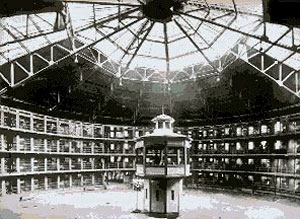
A more popular conception of Australia as a dystopia is Australia as a cultural desert; one populated by well-fed barbarians, the decendents of convict victims of social justice, basking in a radicalized tradition, and living in cultural darkness. Culture was what took happened overseas in Europe, or rather Britain. What happened in Australia was derivative and second rate. It had a dead centre which was the desert.
Europe was mind (culture) Australia was body (primitive).
An elightened liberal society along social democratic lines was forged in the 20th century but Australia as dystopia lingered on and formed a space from within which one could be critical.