June 29, 2007
a post-political utopia
In his review of Pierre Manent's A World Beyond Politics: A Defense of the Nation-State in Prospect Eric Kaufman say that Manent locates the pluralism of liberal democracy in the separation of church and state, and, within the latter, the seperation of powers between executive, judiciary, legislature, and other political institutions.This pluralism helps to contain truth and community but represses the desire for wholenss that has inspired various forms of utopian politics.
Manent's text is based on lectures delivered several years ago at Paris's Institute of Political Studies. He is concerned with the question: What does it mean to be a citizen of a present-day liberal democracy?
Kaufman indicates the Manent's understaqnding of the modern liberal world, its "theological-political vector" of Western history, in a few words. He says:
Contemporary liberalism now seeks to overcome the "separations" of democratic pluralism by denuding the political container in which its principles reside, so as to realize a society governed purely by law. This consigns politics to a fading role in a Kantian ethical sphere based on submission to a universal laws of human rights. Law replaces politics and judicial specialists elbow aside the demos, its politicians and even national constitutions.
Thus we have post-political utopia driven by commerce, human rights upheld by judges, and amorality that connects humans together as individuals and not as citizens. Manent sees this post-political trend at work in the European Union.
Manent argues that both democracy and the nation-state are under threat--from apolitical tendencies such as the cult of international commerce and attempts to replace democratic decisions with judicial procedures.
Politics longer focus on good ends as these are now considered private concerns in civil society. Instead, politics seeks to secure the best conditions to meet needs and protect rights. Men could thus busy themselves making some cash, cultivating their property, and pursuing happiness as they saw it instead of butchering one another over clashing conceptions of the good. Liberal modernity arises on "low but solid ground," as the philosopher Leo Strauss famously observed.
Consequently, the process of individualization intensifies, and thus the authority of the communities of different orders in which human beings hitherto found the meaning of their life--the nation, the family, the church--declines more and more each day,
June 28, 2007
indigenous development
Sending in the troops and police to stop alcoholism, drug abuse, domestic violence and neglect of children is not going to achieve 'the desire and capacity of Aboriginal people to put an end to their disadvantaged situation and take control of their own lives'. Anthony Smith says in Digest run by the Australian Review of Public Affairs that:
Contemporary debate about Indigenous policy (Indigenous trusteeship) has mostly focused on the destructive impacts of poverty, violence, and unemployment in many rural and remote Aboriginal communities. Because these communities have been at the forefront of state administration for three decades, the very nature of Aboriginal society and community has come under scrutiny.Thirty years ago, when the likes of Nugget Coombs and Charles Perkins wrestled with the economic and social effects of economic downturn, proposed solutions did not rely on the draconian policing methods now widely proposed, nor rural to urban migration. In fact, they sought to find ways to re-mobilise agrarian labour within the constraints of the rural economy. Compared with that approach, today’s policy response signals the end of an agrarian development policy.
Rural development was seen among the limited range of possibilities open with existing resources as offering an opportunity to soften the impact of the harsh economic realities facing indigenous communities. It initially meant land purchase in northern regions involving the transfer of pastoral stations and former Aboriginal reserves to Aboriginal management and the formation of Aboriginal enterprises.
The state today has no regional development agenda.
June 26, 2007
libertarianism + indigenous well being
As we know in many Aboriginal communities, social organisation has completely broken down. In some communities indigenous people have shown they have great difficulty in governing themselves. Some -commentators -eg., John Hirst writing in The Australian-- say that there is no point in consulting them about the creation of authority; authority has to be created for them. The reaction by Canberra has been to treat parts of the Northern Territory as a failed state. It implies the imposition of social discipline.

Geoff Pryor
John Hirst, the conservative historian, argues for this position. In The Australian he says that it is the libertarian ethos that is the reason for the the development of a white underclass.The Aborigines were liberated into a libertarian age and they will not be able to help themselves or be helped to a better life until the libertarian impulse has exhausted itself. He says:
Among the many misfortunes of Aborigines is that they were freed from civil disabilities and controls just when the libertarian wave swept through wider society. They became eligible for the dole when the dole became a right not to be interfered with. The prohibition on their drinking of alcohol was dropped just as wider society moved to make alcohol more readily available. Schools were provided for Aboriginal communities just when truant officers were deemed no longer necessary. As the missionaries went out, pornography came in.
Hirst argues that the rules of capitalist society have broken down and the habits of work do not exist any more. Consequently, indigenous people do not accept, nor have they internalised the rules of work that govern the capitalist society. Hirst has forgotten about the family, which is different from civil society.The norms, values and habits--the ethical life-- of the family have also broken down largely because of the grog and sexual abuse.
I accept that we, as individuals, workers and citizens, internalise a set of social norms, and that these shape our conduct as free subjects in a liberal polity. Wasn't libertarianism a part of consumer capitalism, rather than an alien body? Wasn't it a response to the previously strong conservative emphasis on order and traditional values? Hirst is pointing the finger at libertarianism, implying that it is a rejection of rules and norms. Is it? Isn't Hirst actually referring to social liberalism of the 1970s and its ethos of personal development? Are not social liberalism and libertarianism different strands of liberalism?
Hirst goes on to say that libertarianism has created an underclass:
The wider significance of the Government's takeover of Aboriginal communities is that it is a spectacular official announcement of how poisonous the libertarian approach has been to marginal people. It has helped to create an underclass in society where life on welfare is the norm and the single mum's latest boyfriend bashes and sexually abuses her children. There is much to be done if the Government wants to stop sexual abuse of children. Every report shows children in such households are most at risk.
Libertarinsim creates social chaos
Why is it libertarianism and not welfarism that creates an indigenous underclass? Or why was this libertarianism and not poverty? This is crucial because Noel Pearson's strategy is one of internalising revitalised social norms, which mandate personal responsibility for work, education and the welfare of children, so that they become free from dependence on passive welfare and so that child neglect and abuse cease.
Pearson addresses the social norms of the ethical life associated with people's conduct in both the family and civil society. He does not imply assimilation which is what Hirst appears to imply
June 24, 2007
Indigenous communites, social norms, welfare reform
The conference "Strong Foundations: Rebuilding Social Norms in Indigenous Communities", challenges the predominant view that the 'answer' to Indigenous disadvantage in Australia (particularly in remote communities) lies exclusively in improving service delivery. Better services are important but will only go so far in addressing entrenched socio-economic problems.
What is needed in concert with better services, is a rebuilding of the social norms which form the foundation of a healthy society. It holds that determining what social norms are necessary for a strong community and how they can be fostered are difficult questions. They raise the issue of how existing norms are tied to our identity and how Indigenous identity can be maintained while operating in mainstream Australia.
The conference is hosted by the Cape York Institute. The Institute's recent report, From Hand Out to hand Up argues that the starting point of the Cape York reform agenda is that the problems of Cape York Peninsula are interpreted not only as symptoms of dispossession and racism, but to a large extent are caused by a social norms deficit. It is significant that the deterioration of norms in Cape York Peninsula corresponds with the passive welfare era. The report contends that core of the Cape York social and historical analysis is the argument that a distinction must be made between historical explanation and policy prescription in the light of such
explanation. Historical explanation does not by itself confer or suggest a solution.
It adds that:
Epidemics of dysfunction and abuse that have historical roots may have become autocatalytic phenomena. Therefore, they probably cannot be effectively addressed through attempts to ameliorate the circumstances that originally triggered their outbreak. In fact, deeply engrained social problems may frustrate conventional programs for social and economic development. The core principles of Cape York welfare reform therefore seek to deal with dysfunction and poverty as behaviours. The three basic policies are:
• All welfare should be conditional.
• Further government investment in capability building is needed.
• Incentives need to be fundamentally changed to encourage people to engage in the real
economy.
I tis hard to argue with the aim, which is to shift people off passive welfare into employment in the real economy, o the contention that economic viability in remote communities is predicated on mobility, and viability is fundamentally a question of choice for remote communities.
How do social norms fit into this? The Report uses the metaphor of the staircase in which the foundations of progress are strong social norms. The supports underpinning the staircase are capabilities, which include for example health, education and political and economic freedoms. The third component of the metaphor is rationally aligned stairs, representing individual choice.It adds:
To rebuild social norms in the Cape York Peninsula, incentives and laws must support the values of a community. A potentially powerful mechanism for doing this is through linking welfare payments to community members acting in the best interests of children in the community. The Institute is recommending that a number of obligations be attached to all welfare payments available in the Welfare Reform communities, and that a State statutory authority consisting of a senior legal officer and local elders be empowered to enforce the obligations.
June 23, 2007
Sovereign by Exception
Carl Schmitt's definition of the sovereign is the one who can create the exception. The political is determined by the final authority found in exception. We have become used to watching emergency governance, usually where the executive states something is such an emergency that politics cannot intrude, but the irony is that by becoming emergency, governance is purely political, and in such a situation one of the first things lost is an individual's full judicial expression.
However, we had a curious situation this week where a state of exception was claimed inside the US Executive Branch.
The point of contention was over an Executive Order. The President, for all the media dominance, really only has absolute sovereignty in two areas; foreign policy and administrative process. The President is mainly an elected bureaucrat. The Executive Orders are an expression of the President's sovereignty in this area. They are self-contained within the executive and have the force of procedure in the Administration. These orders do not have the force of law.
The Office of the Vice President decided it was exempt from an Executive Order because it isn't an executive entity as the Vice President's duties straddle both executive and legislative. It is a pretty silly argument, and since the Office of the Vice President complied with the Executive Order until 2003, it suggests it was an excuse after the fact.
The interesting thing is, despite a Congressional legislator being the one highlighting this non-compliance, and giving the appearance of this being a separation of powers issue, the Office of the Vice President is repudiating the President's authority inside the executive. The personalities of both the current American President and Vice President do not handle people dismissing their authority very well; and I expected one of two outcomes. Either the Vice President is slapped down by the President for the Vice President abusing his authority, or the President backs down and makes a statement that the Executive Order was wrong.
Today we saw this media statement:
White House deputy press secretary Dana Perino said it's clear that the president's executive order never intended for the vice president's office to be treated as an "agency."
The President accepted the state of exception. If he really wanted the Office of the Vice President to be exempt, he could have written the Executive Order to exempt that office, or altered the Executive Order in 2003 when the VIce President decided his office should be exempt - after all the President has complete authority over the procedures in the Administration.
It is remarkable; we saw a state of exception claimed in the Executive Branch of the United States; and the Vice President, through accident of personality, and a state of exception, asserted the Vice President's sovereignty over the President.
I don't think this will go far. It appears that there was legislation that prompted this executive order (which dates back to the Clinton Administration and was re-issued under President George W. Bush), so once Congress becomes involved there will be the force of law, if not the full force of constitutional law brought to bear, rather than the force of procedure - the latter having no authority outside of the Executive branch.
June 22, 2007
governing indigenous people
A century ago, humanitarian arguments created remote reserves as a sanctuary for Aboriginal people not significantly affected by colonisation. But for successive modern governments, their remoteness has made it impossible to create an economy that allows people to work and participate in a functional society. The project of sustaining Aboriginal people in their own country in remote Australia, which is an experiment that really began with the Whitlam government and which has continued into the Howard era.
This has shifted under the Howard Government. Tony Abbott put a label on a shift in policy and thinking about Aboriginal issues. He called it, for want of a better term, "the new paternalism". Historian Dr Tim Rowse describes this policy thus:
The essence of it is to regard Aboriginal self-determination as a project that has failed because indigenous elites have proved to be not up to the job. It argues that the discourse of indigenous rights, which is what has empowered indigenous elites, has not provided a fix for the poverty and problems afflicting remote Aboriginal communities. That those far-flung communities are hugely expensive to service and maintain. That the social pathology within some communities has become poisonous. That they carry the remnants of a culture which is self-destructive and badly adapted to modern times — I think that is the view that the Government has acquired. It follows from that, then, that Aboriginal people's voices are not very important in the making of policy.
Rowse says that Mal Brough, the current Minister of Indigenous Affairs, is:
encouraged by a kind of command view of social policy, built on his own military experience, which says that if people are behaving in a problematic way, you create a more rigorous framework of rules and enforce that. That will guide you to better behaviour. I think that is his model, and no doubt it works in a military setting.
Will their plan work in indigenous communities?
Noel Pearson says that while Howard's plan is a necessary development, there are risks associated with the bold line of attack announced by Brough and Howard. He says that his assessment is:
* The focus on grog and policing is correct, but as well as policing there must be a strategy for building indigenous social and cultural ownership.
* Making welfare payments conditional is correct, but the Howard-Brough plan needs to be amended so responsible behaviour is encouraged. Responsible people shouldn’t just be lumped in with irresponsible people.
* The land-related measures are clumsy and ideological, but they are not an attempt at a land grab, and the problems with the land measures are nowhere near as high a priority as action for the welfare of children.
* There is a huge implementation challenge. Based on the performance of the federal and provincial bureaucracies up to now, I am not confident they are up to it. The Council of Australian Governments trials in the past five years have not delivered meaningful results.
Does this kind of intervention spell the end of decades of optimism about the capacity of local communities to run their own affairs? There is definitely a reversal of the tide of autonomy and decentralisation in northern Australia.
The intervention is not premised on a careful mix of customary indigenous arrangements norms with Canberra 's governance, whilst the possibilities of a collaborative approach with the Northern Territory Government and Indigenous community leaders is pownplayed.
June 21, 2007
Cape York Welfare Reform Project
The Cape York Welfare Reform Project advocated by The Cape York Institute for Policy and Leadership aims to develop reformed incentives and appropriate enabling supports at the community level which catalyse the restoration of social norms in the Welfare Reform communities and ultimately in the whole Cape York region. The future that the Institute envisages is one in which the people of Cape York Peninsula internalise a set of revitalised social norms, which mandate personal responsibility for work, education and the welfare of children, so that they become free from dependence on passive welfare and so that child neglect and abuse cease.
Mark Bahnisch at Larvarus Prodeo was very critical of Pearson's approach to welfare reform a couple of years ago. He wrote:
Most thinking on Indigenous disadvantage recognises the supply side issues with regard to economic opportunity and jobs in remote communities. Pearson seemingly can’t see this - the fact that many long term unemployed people lack marketable skills and that properly resourced training and labour market programmes, as well as incentives to employers who are often suspicious of candidates who are long-term unemployed, are a much better way of assisting people into the labour market than ranting about dependency and proposing punitive and grossly illiberal “solutions”.
Bahnisch is right on the employment issue. However, he continues to see Pearson's approach to the Cape York agenda as a mixture of tired Third Way rhetoric and populist authoritarianism that’s become his stock in trade. He sees Pearson's approach as sitting nicely with, the Minister of Indigenous Affairs' (Mal Brough) over-emphasis on authoritarianism and the criminal justice system.
Bahnisch is critical of Pearson's downplaying of education in favour of attacking behaviour through building social norms. But it is more complex than this as you need to repair the damage to people so that they are capability to enter entering the labour market and accept the work ethic as their own. First the work ethic then the qualifications through education.
Update: 23 June
Pearson argues in response to the Wild and Anderson Report, which revealed rampant and often unreported abuse, with children as young as three exposed to pornography and systemic alcohol fuelled abuse, that:
You can't just educate people that a twelve-year-old is not a prospective sexual partner. That's not a question of education that's a question of moral norms. It's not as if there's not enough awareness. So in some profound respects I suppose we part ways with the blueprint in the Northern Territory we believe that social cultural and moral norms have got to be rebuilt it's not just a matter of awareness people have got to be held to certain standards of respect, for their children, for other members of the community.
Is it an either or situation? We need to protect the kids from sexual abuse if they are to be able to go on and become educated.Child protection is not like poverty or educational underachievement or general socioeconomic disadvantage. We can’t rehabilitate people from alcohol or drug dependence immediately. We can’t fix the poor education immediately. We can’t fix up the poor health immediately. But it is possible to stop the suffering straight away.
Pearson says of the Howard Government's intervention plan:
I believe the Government’s proposal will make a difference in the short term. If one accepts that the proposed measures will save women and children this year, then the bottom line is this: rejecting the Government’s emergency measures equates with giving priority to some other issue before rescuing the children. Even where extremely concerted responses have been implemented, such as the new child safety regime in Queensland, which has made significant improvements to the child protection system, we are a long way from stopping the abuse. All we have now is a new system to respond to abuse. We don’t have a system to prevent the abuse. There are still about 80 child welfare notifications a month across the communities of Cape York.
We are still talking about a system that deals with abuse and neglect after it has become a problem. We are not talking about a system that prevents the abuse or neglect before it becomes a problem.
So the welfare reform measures for a family responsibilities commission to exercise powers over welfare payments have the aim of the aim of the family responsibilities commission intervening early, to hold adults to account for their behaviour and to ensure that the welfare of children is the utmost priority. It is about complementing the Queensland Government’s existing child safety response system with an effective and practical prevention system.
Bahnisch is on more solid ground when he addresses the issue of finding work, due to the actual lack of any economic opportunities in those communities not blessed with minerals under the ground:
It strikes me that the inevitable result of Pearson’s agenda of “engagement with the real economy” will be both an increased individualisation of Indigenous people as “responsibilities” trump collective rights and also a sense of collective being; and a concomitant new disposession of Indigenous people to the cities and to mining towns. No doubt as with purposeless labour market programs such as Work for the Dole, employers will welcome the cheap labour of those prepared to accept their “mutual obligation”.
I presume that in the longer term there will be a shift from community to cheap low skilled abour in the nearest regional town and then moving back to the community again for family obligations. An orbiting existence. Is this what Pearson has in mind?
June 20, 2007
Richard Rorty
Richard Rorty the American philosopher, died of cancer on Friday (8 June) in Stanford, CA.; trained as a philosopher, Rorty was an outspoken "public intellectual" and extremely influential in the resurgence of pragmatism in both intellectual and political discourse.
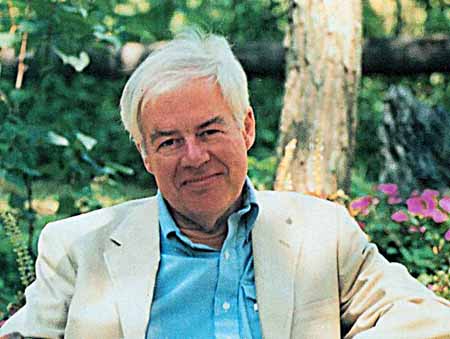
Rejecting the Platonist tradition at an early age, Rorty was initially attracted to analytic philosophy. As his views matured he came to believe that this tradition suffered in its own way from representationalism, the fatal flaw he associated with Platonism. Influenced by the writings of Darwin, Gadamer, Hegel and Heidegger, he turned towards pragmatism.
It was G. W. F. Hegel’s willingness in his Phenomenology of the Spirit (1977) to abandon certainty and eternity as philosophical and moral goals/ideals that inspired Rorty to appreciate the irreducible temporality of everything as well as to understand philosophy as a contingent narrative readable without a moral precept existing behind the storyline
June 19, 2007
Indigenous people,democracy, power
In an op-ed in The Australian Noel Pearson, the director of the Cape York Institute for Policy and Leadership, says that though Indigenous disadvantage stems from dispossession and the historical denial of rights poverty is also behavioural. Thus:
Disengagement from the real economy, passivity and dysfunction are not only symptoms of oppression, they are also unnecessary behaviours that can and must be changed at the same time as we fight for our rights. That is why we pursue welfare reform in Cape York Peninsula and why we want urgent responses to the grog, drugs, gambling and social order problems.We can't wait patiently.
He then adds that:
To those community leaders who reject land title arrangements ....I say: by all means wait, but you have an immediate and inescapable responsibility to stop the suffering of your children and your most vulnerable. You can't sit back and place all the blame on the Government for the suffering that happens tonight and the suffering that happens next week. To their political and public supporters I say: you have a responsibility to find alternative solutions to the crises because you cannot expect the entire cost of the strategy that you laud to be borne through the continued suffering of the most vulnerable.
So there is a need to tackle grog, welfare dependency and sexual abuse.As Pearson says there is an urgency in the concern to tackle the behavioural dimension of indigenous problems.
He adds:
But just because we admit that our problems are behavioural, that does not mean that we do not believe there are also structural barriers to indigenous progress. The principal structural problem faced by indigenous people concerns our power relationship with the rest of Australian society through its structures of government: judicial, legislative and executive. Australian democracy just does not work to enable the solution of our problems. Democratic participation in the existing judicial, legislative and executive institutions of governance in Australia is the only means available to indigenous Australians to achieve and exercise power. But do the existing mechanisms of democratic participation by such a small minority, who are unique in that they are indigenous to the country, and whose socioeconomic circumstances are so egregiously out of step with the rest of the country, work to ensure my people enjoy the same expectations of life as their fellow citizens? No, they do not.
Pearson then spells out the lack of structural power of Indigenous people. Indigenous people are too small a minority to make government work for them.. When it comes to indigenous dealings with the executive of government, again indigenous people - as a result of their small numbers - are not in a position to make government work for us.
Pearson then says that there are three ways to think about how to address this lack of structural power on the part of a small minority within an otherwise functioning democracy that serves its mainstream well.
First, one could seek to increase representation and participation of indigenous people in the institutions of power and in administration. This is the usual response and this aim should continue to be pursued. But even if aggressive affirmative action were adopted, the comparative weight of numbers means an increase in representation and participation would not fix the structural power deficit. Affirmative action is likely to be strongly resisted. Although proposals for special provisioning of parliamentary representation have been put on the agenda in Australia, the fight for such an outcome is likely to be far greater than the benefit of the outcome. Getting a small minority of political representatives into legislatures will not fix the nub problem.
He says that that secondly, one could establish separate institutions of governance for the indigenous community--as in the creation of the Aboriginal and Torres Strait Islander Commission and other national, regional and local institutions have been supported by federal and state governments from time to time for this purpose. Though Indigenous governance institutions are important it is their interface with government that is the nub question.
How do these indigenous institutions relate to the real sources of power in Australia, namely its governments? What is the relationship? Is the relationship based on negotiation and is there mutuality in the relationship?
It is one thing for governments to delegate to indigenous institutions certain space for governance of their own affairs (as was done with ATSIC), but the crucial question remains: what is the nature of the interface between the indigenous institution and government?
This was particularly important in the case of ATSIC because its jurisdiction did not cover the whole field of indigenous affairs.The commonwealth continued to be responsible for important components of indigenous affairs (such as education, health and income support), and state and territory governments also held a jurisdiction unconnected with ATSIC.
ATSIC's purview was not comprehensive and in any case its relation with the commonwealth was in the nature of a client commission, subject to direction by a commonwealth minister and accountable through various mechanisms to the federal government. This accountability relationship was not mutual; it did not impose return obligations on the federal government and no attempt was made to establish equality between the indigenous commission and government. The point of ATSIC was not to establish an interface with government; rather, it established an indigenous affairs ghetto away from the main game.
So we move onto the third option:
Third, one could focus on the interface between indigenous people and governments, state and federal, and construct mechanisms that ensured equality between them. Partnerships between grossly unequal partners are not real partnerships; rather, they are master-servant, boss-client relationships.If consultation and not negotiation is the principal official means of transaction between the parties, then there is not a true partnership. Rather, there is one party with the power to act unilaterally and one that is subject to that power.
Pearson concludes that there has never been a serious attempt to focus on the institutional interface between indigenous people and governments in Australia. To construct an interface that creates greater parity and mutual accountability (and true shared responsibility) would require governments to agree to limitations on their existing powers and prerogatives and to make accountability a two-way street rather than the existing one-way street. It would also require governments to be bound not just by policy commitment but by law.
This is not likely to happen in the near future.
June 18, 2007
Little Children Are Sacred: note on public policy
Brian Head, Professor of Governance at Griffith University, gave a seminar to The Centre for Research in Public Sector Management (CRPSM) at the University of Canberra, as part of its Seminar series. The abstract for Head's seminar, which was held early in 2007, says:
Public policy in OECD countries is increasingly supposed to be based on ‘evidence’ about the effectiveness of program design and implementation.The main catch-cries seem to be:
• what works?;
• are we getting the desired outcomes?’; and
• ‘what is affordable and effective or offers best value?’
This potentially provides a wider role for excellent social science research, both inside and outside government agencies, in filling gaps, analysing options and providing inputs to the forward agenda. Some reasons are given for why this enhanced role is distinctly limited.
This is certainly the rhetoric of how policy works within a neo-liberal mode of governance. Is there a gap between rhetoric and reality? Say in public policy around Indigenous issues?
Head's abstract goes on to say that some examples are provided, illustrating different contexts and outcomes for the impact of ‘evidence’ on policy settings. It is clear that some issues are ‘data-proof’ owing to established commitments and mandates.
Sadly, much of what happens in Indigenous Australia is quietly forgotten despite the exposure of the terrible conditions of violence, drunkenness, sexual abuse, educational failures, unemployment in indigenous communities. and loss of cultural meaning as spelled out in the Little Children Are Sacred report of the Northern Territory Board of Inquiry into the Protection of Aboriginal Children from Sex Abuse. Aborigines are 3% of the population, most living far from the leafy affluent spaces of white/Asian Australian suburbia. For the latter, anything happening north and west of Broken Hill is another country, and nothing that happens there to people white or black is of much concern, to politicians.
Head suggests that there are three lenses through which important stakeholders and decision-makers consider the challenges of policy change and maintenance. These correspond to three types of knowledge, with their own operating assumptions:
• Political knowledge
• Scientific expert knowledge
• Practical knowledge of managers/professionals
The question of what is relevant and ‘what works’ will look different through each of these lenses. Putting them together is a difficult but necessary part of the policy process. Collaborative approaches may attempt to do this.
This is right. As the Northern Territory Board of Inquiry into the Protection of Aboriginal Children from Sex Abuse says we know that terrible conditions exists in Indigenous communities:
...and we know the problems, we know how to fix many of them and the likely monetary cost.(And we pause here to interpose the question: What is the likely future cost of NOT now attempting to deal with the issues?). We have an enormous amount of knowledge in this country (at various times we have been described as the clever country and the lucky country -by our own people, of course) and in the Territory. The money is available. The Australian Government budget surplus last year was billions and billions of dollars. What has been acking is the political will. We have to stop marching on the spot and work with some real commitment to success to save Australia from an impending disaster.
It's politics that rules.
June 15, 2007
Arendt seeks to underscore the political paradoxes of the nation-state. If the nation-state secures the rights of citizens, then surely it is a necessity; but if the nation-state relies on nationalism and invariably produces massive numbers of stateless people, it clearly needs to be opposed. Statelessness was not a Jewish problem, but a recurrent 20th-century predicament of the nation-state.
If the nation-state is opposed, then what, if anything, serves as its alternative?
June 14, 2007
wellbeing and progress
Richard Eckersley, Australia 2 Fellow is part of a research project on wellbeing and economic growth. He is associated with the Wellbeing Manifesto and author of Well and Good. So his material picks up on this earlier post.
He questions the conventional view that prioritises economic growth as the basis for improving quality of life. The concept of material progress regards economic growth as paramount because it creates the wealth necessary to increase personal freedoms and opportunities, and to meet community needs and national goals, including addressing social problems. The equation is one of more with better.
Eckersley asks:
Is it enough to say that, because we are growing richer and living longer, life is getting better? Wealth and health are the main indicators by which we judge progress, and by these measures Australia, and most of the rest of the world, are making good progress. So is all well and good? Not exactly. There is growing evidence that standard of living is not the same as quality of life, and that how well we live is not just a matter of how long we live, especially in rich nations such as Australia.
His argument is that over the past several decades, we have witnessed a profound loss of faith in a future constructed around notions of material progress, economic growth and scientific and technological fixes to the challenges we face. Our lifestyles have come adrift from our values. Consequently, we ought to think less in terms of a ‘wealth producing economy’ and more about a ‘health producing society’, where health is defined as total wellbeing: physical, mental, social, and spiritual.
We need different criteria than GDP and life expectancy. If the goal of progress is to improve quality of life, not just standard of living - or how well we live, not just how long - then we need better measures of quality of life. There seems to be a period in which economic growth (as conventionally measured) brings about an improvement in quality of life, but only up to a point - the threshold point - beyond which, if there is more economic growth, quality of life may begin to deteriorate.
Eckresley says the incoherence that underlies the contemporary ‘official story’ of life in Australia, and which emerges from the research literature, can be expressed in a series of questions and their answers:
1. Is increased material wealth, measured as growth in GDP, the top priority of government? Yes. This is explicit in statements by prime ministers and implicit in the emphasis of government policy.
2. Is increased wealth the top priority of individual Australians? No. Surveys consistently show that prosperity ranks in importance well behind things like family and security.
3. Can the pursuit of economic growth harm civil society? Yes, when it is given priority over other goals. The research shows there is common perception that too much change, greed and materialism – all associated with the push for growth - are contributing to social problems and the loss of a sense of community.
4. Can increased wealth harm personal health and well-being? Yes, when becoming richer takes precedence over other aspects of life. Both public opinion and scientific research show that wealth is a poor predictor of happiness and the desire for riches can be detrimental to well-being.
5. Are current patterns of economic growth environmentally sustainable? No. The overwhelming weight of evidence and expert opinion is that economic growth, as currently defined and derived, is damaging the earth’s natural environment.
He says that beneath the satisfaction of everyday life, Australians are looking for a different paradigm, a new story to define who they are and where they want to go. Instead of one narrowly focused on material progress, they want a coherent vision that expresses a better balance between economic welfare, social equity and environmental sustainability, a vision that reflects the reality that these are, ultimately, inextricably linked.
deregulating higher education
Greg Craven assess the embrace of deregulation of higher education proposed the Group of Eight universities in an op-ed in The Australian. He says about this kind of academic capitalism:
Forget diversity, forget equity, forget policy. Whatever benefits Australia's oldest and richest universities is, by definition, the right thing to do. Naturally, Davis and his colleagues have had the good taste to dress it up a bit. The centrepiece of their proposal is the idea that university education would be funded through commonwealth-provided entitlements for which students would compete. Students could then take their entitlement to the university of their choice. n previous incarnations, this type of idea was referred to as vouchers, which carried about the right connotation of tacky, mercantile opportunism. Now the Go8 has rebranded them national scholarships, which sounds altogether more reassuring.
So what is wrong with competition and giving students what they think they want? Craven says that the market is rigged by status and power.
He rightly highlights the consequences:
The Go8 universities are sandstone colonials (or their equally wealthy but more recent brethren), with the accumulated benefits of decades of public funding. They were permitted to build up their market positions as state monopolies and near monopolies for many years and continue to exist - economically and reputationally - on their accumulated monopoly rents. Newer, innovative universities have no hope of competing on equal terms with these cheerful Telstras of Australian higher education. The fate of such also-ran universities is clear. A significant proportion of higher-scoring students presumably would follow the Nike brand of the Go8, undermining Australia's strong middle band of higher education. These universities in turn would raid the student base of more vulnerable institutions, which would go into free fall.
So we have first-class international research universities (G of 8) and pedestrian second-class teaching institutions whose academics' most recent research is minimal. So the key difference is between rich, real, research universities and the desperately disadvantaged universities, which service teachers, nurses, health professionals, and cannot afford to do basic research.
June 13, 2007
Convention and the Force of Practice
Convention does not have the force of law, but is assumed to have the force of practice, otherwise known as custom or tradition, and carry weight accordingly. This is the wrong way to view it, convention is in reality the sovereign's whim. Today's Senate sitting had an example with the first bill reading.
Andrew Bartlett said [pdf] after the first reading of the co-bundled Tax Amendments for Income Tax and Budget Measures:
I want to speak briefly to the part of the motion asking that the bills be taken together, and I believe I can. I make the point that the Democrats had requested that these bills not be taken together, that they be dealt with separately. They both deal with substantial and significant taxation matters.Certainly we do not wish to delay passage of them, but, given that they deal with substantial and significant matters each in their own right, we believe they each merit individual examination through the second reading stage. I want to record that as our preference.
I am not going to go on at length about it but I think it is preferable that convention applies: if a senator does not want them to be taken together, that it not happen unless there are compelling circumstances. I do not think any exist in this case.
Bartlett's appeal to convention was ignored. Abetz did the second reading of the two bills together, and Labor quite happily spoke on the bills 'cognate'.
Convention is subordinate to the sovereign, and is not guided by custom or history. We have to look at it as we would individuals expressing their liberty through self-interest. Convention is maintained only so long as it is in the self-interest of the sovereign to act within that convention.
Consequently we cannot look at past conventions as a single body of connected events that have the same force of history. They become unitary events, unconnected, except for the sovereign's self-interest in acting that way.
x-posted and prompted by the discussion of the convention of no confidence votes on Husi.
June 12, 2007
globalization backlash
Have you noticed the revaluation of globalization taking place --a kind of backlash--amongst the development nations?
The neo-liberal narrative of the 1980s and 1990s was that the path to greater prosperity lies in opening up national economies and closer integration with world market. So they have cut tariffs and other trade barriers, and liberalised capital flows, and creating a generally permissive policy environment for economic integration.
The narrative is now changing. Some are scared by the success of globalisation in creating powerful new competitors (Chinas and India) in global markets, or they spooked by the strategic and security implications of the resultant redistribution in economic power. So we have the increasing use of protectionist arguments amongst the developed nations.
June 11, 2007
politicising the bureaucracy
Andrew Podger, a former public service commissioner and head of three different federal departments, says that the current emphasis is on the responsiveness of the public service to the government. Thus we have the politicisation of the public service---the imposition of the electoral and ideological priorities of the party in power on supposedly apolitical officials---and a shift away from the classic Westminister system. Tensions between politicians and public servants are inherent in the Westminster system, a fact exploited to brilliant effect in television's Yes Minister The role of the bureaucracy is to implement the priorities of the elected government and also to use its expertise and experience to advise governments of the ramifications of their actions and to warn them off the wrong course.
However, the conditions under which departmental secretaries - they used to be called "permanent heads" - are employed, rewarded and penalised have eroded their independence and professionalism. The turning points were the introductions of job contracts for secretaries, performance-based bonuses as a percentage of their salaries and the increasing tendency to give all but "favoured" departmental chiefs contracts of three years, rather than five. these have heightened the tension between the requirements that they be both professionally impartial and responsive to government wishes. Podger puts the current emphasis thus:
the question now, however, is whether the balance has shifted too far towards responsiveness and away from apolitical professionalism and its focus on the long-term public interest. ...All secretaries are affected and they are being dishonest or fooling themselves if they deny it. They will hedge their bets on occasion, limit the number of issues on which to take a strong stand, be less strident, constrain public comments, limit or craft more carefully public documents and accept a muddying of their role and that of political advisers.
The Government decides each year whether departmental heads should receive bonuses of 20 per cent - which can be worth $60,000 - 10 per cent or nothing. It is clear that someone will not be rewarded for rightly doing something a minister doesn't like (or rightly not doing something a minister wants)?" Performance pay sends very clear messages.
June 10, 2007
Hadrian's Sovereignty
Hadrian is best known in Australia through Hadrian's wall in England which separated the Romans from the Celts of Scotland. Publius Aelius Traianus Hadrianus was the emperor of Rome between 117 and 138 AD. The emperors had been constantly changing the unwritten Roman Constitution in such a way to increase their power; by 138 AD there was no doubt that the emperor was sovereign.
The democratic component of the Roman Constitution had been in decay for quite a while. Apparently by the end of the first century AD, the assemblies were no longer being convened in order to pass law. Senatorial decrees were filling that function, even though the Roman Constitution had the Senate as a customary body who had no statutorial power.
It seems by Hadrianic times, the Senatorial decrees had the force of law. Colin Wells' writes:
... but some modern scholars credit him [Hadrian] with the initiative in giving senatorial decrees force of law. The first such decree which we know to have directly altered the civil law is in fact Hadrianic, but there may have been earlier ones, and the distinction is perhaps important only to the specialist in legal history.
The emperor rather than a vehicle for policy, and having the other components of the Roman Constitution complete the legal basis for those policies, was now undoubtedly sovereign. Hadrian's edicts and enactments had the full force of law as well.
In the Middle Republic the Roman Constitution was richer in its magistracy and assemblic bodies. There were the Consuls who acted as military and executive power, the oligarchic body of the Senate, the three assemblies, and the Tribunes who represented popular will through enacting law and the veto.
The magistracies were elected and the democratic bodies were composed of tribal, militaristic and popular forms.
With Hadrian's reign, the assemblies are no longer convened, he was appointed through dynastic means, and he held Tribune power for life. The Consuls still exist, but the legislative power is now in the Senate, an appointed body who has tenure for life unless removed by a Censor - a position which the emperors had also adopted.
This is a big change in where the sovereignty lies in the Constitution over the space of a century. Cicero would still recognise the structures, but would be aghast at where the real power in the constitution now was.
The Early Roman Republic, while adopting the forms that were present in Regal Rome, appeared to have a genuine fear of tyranny. Vetoes were absolute, and only was was required to scuttle any legislation.
The Roman Constitution was unwritten, and did change, most often through emergency. For instance the position of Tribune was established in response to a civil emergency.
This is the weakness in the unwritten constitution; emergencies tend to have a negative effect, and in the case of the late republic, the body the constitution relied on to enforce and remember custom, were wiped out in the civil emergencies and wars of the Caesars.
Tacitus commented in The Histories that by Nero's time, there was no-one left in the Senate who knew what a republic was like.
Of the twenty-six great patrician genus or clans that dominated the Senate when Augustus ascended to imperatur, only six of them remained with Senate appointments in Hadrian's reign.
The Senate had served as an genus based oligarchic memory of Roman constitutional custom and convention. It was a pretty closed shop, Cicero, as a 'new man' was an exception even in the Late Republic.
Between the proscriptions and series of Civil Wars that constitutional memory was lost, the desire for civil order at the end of civil emergency meant that the constitution expanded again, this time with the tribunicia potestus or tribune for life. This was to become the basis of an emperor's executive, legislative and constitutional power.
The noble description of the killing of Julius Caesar in the Senate is that his claiming dictator for life was an affront to the custom and convention of the Roman Constitution. Previously dictators were temporary positions of emergency, lasting no more than six months.
A less noble reading of the murder of Caesar is that his dictator potestus or dictator for life was a direct threat to the executive, judicial and policy making power of the Senate.
This was true, Augustus found a different means to become the dominant political power - imperium maius. By Hadrian's time as emperor the assemblies were not used, Tribunes were not elected, and the Consuls were not powerful outside of military command.
In fact, the pro-consuls often had more power in the Roman Empire as the legions in the provinces could lead to them becoming the next emperor. A-la Vespasian.
June 8, 2007
social liberalism
Marian Sawer’s The Ethical State? is motivated by concern about the recent erosion of social-liberal political traditions in Australia. She highlights the strong influence in Australia’s political history of social liberalism, which she distinguishes from the classical liberalism (or laissez-faire) formulated at the time of Britain’s industrial revolution.
The ideology of laissez-faire emphasised contracts between atomised individuals in opposition to the state. It is an ideology which has substantially re-emerged since the 1970s as ‘market liberalism’ or ‘neo-liberalism’ or ‘economic rationalism’. By contrast, ‘social liberalism’, Sawer argues, as articulated by the 19th century Oxford academic T.H. Green and as transferred by many of his pupils to Australia at a critical time in this nation’s building prior to the First World War, supported state intervention to promote positive liberty, equal opportunity, and fairness and to enable individuals to actually overcome barriers in the way of their reaching their full potential.
The ethical liberal state' is committed to the 'substantive goal of equal opportunity for its citizens.' (p 116) By equal opportunity, Sawer does not mean the competitive ideal currently in vogue in which each individual is free to compete with all others on a level playing field to reap their own rewards from the market. Rather, by equal opportunity Sawer refers to the social liberal ideal derived from the work of English political philosopher TH Green. Here, equal opportunity means enabling all individuals to realise their full potential and develop their skills and talents through 'wisely directed state action' (p 44) aimed at correcting the injustices and inequalities that an unchecked market creates.
June 2, 2007
Ethics of economic rationalism
The ABC's Philosophers Zone has a piece entitled The Ethics of Economic Rationalism. Interesting. I would have thought that the emphasis on instrumental reason and economic efficiency would have excluded ethics unless efficiency is regarded as ethics because it is a value. Is this the ethical base for this neo-liberal mode of governance in which governments should reduce their own activities and leave as much as possible up to the free market.
The interview is with John Wright at the University of Newcastle who has published a book entitled The Ethics of Economic Rationalism
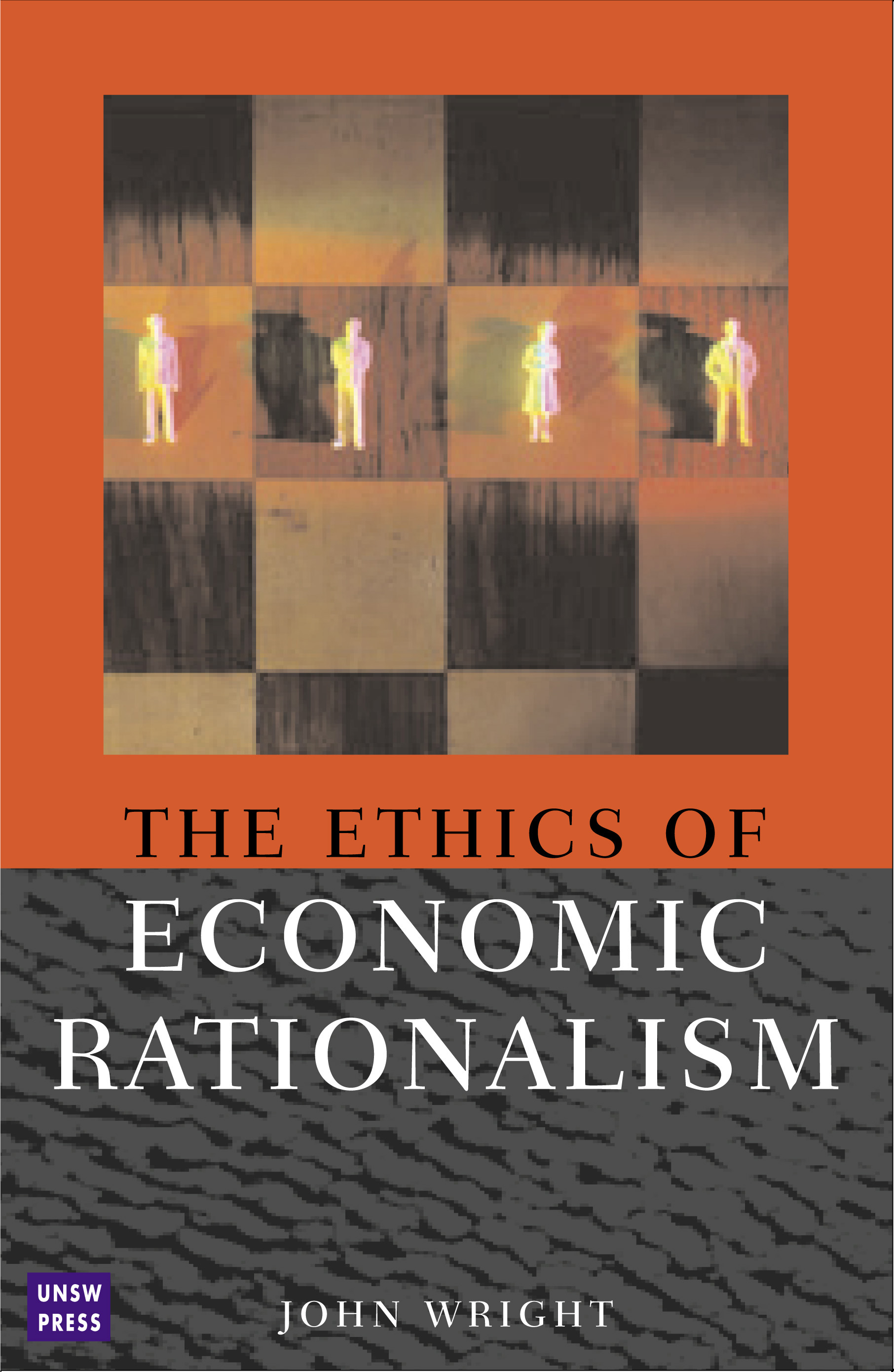
Wright identifies ‘economic rationalist’ policies as deregulation, privatisation, outsourcing, elimination (or minimisation) of public goods, corporatisation, and the abolition of minimum wages and compulsory trade unionism, and these are deployed to maximises total wealth.
What then is the ethics underpinning this mode of governance? Wright says that ethical justification goes something like a utilitarian one:
If something is the rational thing to do, then there seems to be a very straightforward sense in which it's the thing that you ought to do. So in that sense it could be seen as being something like an ethical justification .... Now one kind of ethical justification that perhaps most immediately springs to mind is something along the following lines: that if you've got an ideal market, then welfare will be maximised, and if welfare is maximised, or wealth is maximised, then people will be happier, the greatest happiness for the greatest number will occur when welfare is maximised, and if you've got the greatest happiness for the greatest number, then at least on a utilitarian perspective, which actually sees the best, the morally best perspective, or some versions of utilitarianism see the morally best perspective as the one in which there is the greatest happiness for the greatest number.