July 31, 2007
Enlightenment and Terror
In his Enlightenment and Terror ----The Thomas More Lecture, Amsterdam, 2004--John Gray links enlightenment and terror with the belief in progress. He says that:
The belief that the accelerating advance of knowledge produces a better world is a myth. Now I am far from thinking that humankind can do without myths, and the myth of progress may once have been useful. It may be that some of the genuine advances of recent times—such as the prohibition of torture--could not have been achieved without it. Yet the myth of progress has long since become harmful. It suggests that by remoulding human beings the evils of human life can be eliminated—an idea that is one of the main sources of terror in the late modern world.
The Jacobins believed through the use of terror they could reshape human nature on a more virtuous model. Lenin followed them in this belief and used terror on a much larger scale. At the same time he gave state terror a theoretical foundation. Communism was not just an ethical ideal. It was the only possible result of a scientific understanding of history. In using terror Lenin believed he was advancing the progressive forces of history.
July 29, 2007
Cheryl Saunders on judicial activism
Cheryl Saunders comments on judicial activism from the Law Report on ABC
People I think don't understand very well how Courts work in a Common Law system, or many people don't. But the fact of the matter is that at the margin, the role of Courts - and in particular, final Courts - is inevitably creative. The Common Law by definition was a law made by Judges. When Judges are confronted with novel questions that haven't been resolved previously, they must draw on various different sources to resolve those questions. It's not necessarily activism, it's creativity if you like, but it is within limits....I think that there will always be tension between the political arm, the executive arm and the Legislature and the Judges.
Sure there will be tension as the legislature and judiciary are part of the checks and balances of power. This is clearly seen in the way the High Courts dealt with fundamental rights and freedoms.
Sir Anthony Mason says"
More recently, the High Court has also expressed the view that an unambiguous expression of statutory intention is required to over-ride a fundamental right. The identification of fundamental rights and freedoms is more problematic than identifying the values protected by the Common Law. Which fundamental rights and freedoms should the Courts select and protect?
It has been suggested that Judges tend to assert without demonstrating that particular values are protected by the Common Law. The statement in Mabo no.2, that non-discrimination is one of the fundamental values of our Common Law, has been instanced as an example. The Australian constitution itself is a source of rights and values which can be used in the development of the general principles of law. Apart from express and implied rights in the constitution, representative Government, responsible Government, the separation of powers, an independent Judiciary, are among the values which can be derived - either from its express terms or from its structure.
Mason says that it has even been suggested that certain values could be derived from the concept of a modern Liberal democracy, of the kind for which the Constitution provides and from the concept of citizenship.
July 28, 2007
Expansion of judicial power
A quote from Katharine Betts Judicial Activism, Immigration and the One-Child Case in People and Place on the growth of the judiciary into areas that were once seen as the perogative of the executive and Parliament.
The role of the courts in Australian politics has expanded since the late 1970s and judicial decisions now affect a growing number of areas once seen as the province of parliament and the executive. This growth in judicial power is not something peculiar to Australia; in a number of democracies policy-making has, to a degree, shifted away from the elected institutions designed to express the will of the majority and moved towards the courts, institutions traditionally concerned with questions of individual or minority rights.Under a democracy, parliament and the executive are elected (directly or indirectly) by a majority of citizens, but the rights of the minority who did not win at the ballot box are protected by the rule of law. Drawing on Constitutions, Bills of Rights, case law, or international treaties, courts are increasingly using their power to enforce the rule of law in such a way as to restrict parliament’s and the executive’s autonomy in governing the lives of their nation’s citizens.
This growth in judicial power is not something peculiar to Australia; in a number of democracies policy-making has, to a degree, shifted away from the elected institutions designed to express the will of the majority and moved towards the courts, institutions traditionally concerned with questions of individual or minority rights.
Judicial activism is defined as creative interpretations of the law.This happens when judges decide cases dealing with fundamental moral and ethical issues. He said these kinds of cases show that when parliament fails to determine important social, economic and political questions, as was the case in Mabo, then the Courts will be called on to resolve them in the form of legal issues. He said sometimes politicians find it politically convenient to leave these kinds of questions to the Courts.
July 25, 2007
Michael Kirby on judicial activism
Justice Michael Kirby's Third Hamlyn Lecture 2003 addresses judicial activism. I'm interested in the hostility towards human-rights principles, which provide a source for consistent judicial decision-making where there is a gap to be filled in the common law or an ambiguity of the written law to be resolved. What we have is the shortened version of two lectures at the University of Exeter.
In the shortened version Kirby says:
Ironically, despite the texts and all the legal developments that have occurred, many of those in the vanguard of the legal Counter-Reformation want to return to, or stay in, a world in which basic human rights are kept in check and judges are kept as far away from them as possible. The slightest "rights talk" has a tendency to make the exponents of the legal Counter-Reformation furiously excited. They see proposals for a constitutional charter of rights as a frontal attack on their very notion of the rule of law and of the legitimate judicial method as they see it. They quake in their shoes at the thought of "hero judges" released to "strut their stuff". It is too late, in their view, to save the United Kingdom, Canada and India from this foreign folly. But in the South Seas lies a big land which they hope will keep the flame of the true faith of the common-law judge alive until the rest of the world repents the error of its ways.
Kirby points the finger at legal formalism, which he does not define.
Wikepdia says that:
Legal formalists argue that judges and other public officials should be constrained in their interpretation of legal texts, suggesting that investing the judiciary with the power to say what the law should be, rather than confining them to expositing what the law does say, violates the separation of powers.
On this account judges follow the law to the letter, leaving questions of its intent and underlying principles to elected representatives.
Kirby says the call for a return to the “strict and complete legalism” must be rejected as the fairytale that the legal Reformation taught it was.
July 23, 2007
a Bill of Rights
Rt Hon Sir Harry Gibbs:
A Bill of Rights is no substitute for a division of power in imposing restraints on the ill-advised exercise of power. Whereas a society that values moderation (as Australia has traditionally done) seeks to balance the rights of one individual against those of another, under a Bill of Rights supremacy is given to the particular rights favoured by prevailing ideology, causing in some cases absurdity and injustice.
Why so?:
If it is impossible for governments to resist the fashionable clamour for a Bill of Rights, at least it is to be hoped that no attempt is made to entrench constitutionally a Bill of Rights, thus giving to the judiciary a power greater than that of Parliament to decide matters of policy and in consequence politicising the judiciary.
July 22, 2007
judicial activism
I've always been puzzled by what conservative political commentators mean by judicial activism. In Australia they say judicial activism is bad thing. These commentators seem to have an antagonism to the judiciary expanding individual rights through decisions that depart from established precedent or are independent of supposed constitutional or legislative intent. Is human rights that is the problem? Or is it expanding the law through interpretation? Or is it that the judiciary is usurping the power of the legislature?
Greg Craven can helps us to sort through the theories of judicial activism that have gained widespread acceptance. He says by saying that judicial activism describes the process under which a judge takes a decision which involves the conscious moulding of the law by reference to the judge's own perception of the relevant policy imperatives. He adds:
It needs to be understood at the outset that courts can be active in very different circumstances, and with widely varying degrees of legitimacy. To take the simplest example, a court clearly can be judicially active in re-shaping the common law. At the next level, a court may pursue an activist path in so "interpreting" a statute that its meaning is fundamentally different from that intended by Parliament. Finally, a Court may seek to shape the Constitution itself, either by ascribing a particular meaning to a portion of text, or by discerning the existence of some "implied" constitutional doctrine. Constitutions are in fact particularly vulnerable to this type of activism, because of the width of expression they necessarily employ.
Craven says that three different forms of judicial activism have three, different degrees of legitimacy. He accepts the first, and challenges the second. The courts have no capacity to make or amend statutes as these are made by Parliaments elected directly by the people. This activism raises of democratic and legal illegitimacy.
It is the third form of judicial activism--called progressivism--- that is targeted:
Even worse is constitutional activism.... Australia thus has a democratically derived and democratically alterable Constitution, and it is difficult to imagine a context in which judicial activism could be more illegitimate.Nor is such constitutional activism much more plausible when plotted on an axis of competence. When the High Court engages in constitutional activism---often called progressivism---it essentially is involved in the taking of macro-policy decisions of the first order. For example, when the Mason Court in cases like Australian Capital Television created an implied freedom of political communication, it was involved in setting the mutual limits of privacy and speech in a political context, by reference to norms of political, media and corporate behaviour. Yet the Court is a body of legal distinction only, and has no obvious insight into any of these matters.
Craven grants that there is room for the Court to make choices in the interpretation of the Constitution: constitutional language can be highly ambiguous. What the Court cannot legitimately do, however, is consciously to mould the Constitution against the grain of its intention, text and historical scheme.the Mason Court's creation of an implied freedom of political communication represented a high-point in Australian judicial creativity in a constitutional context. This was, after all, a right with no plausible constitutional text to support it, and one utterly opposed to verifiable historical intent.
July 21, 2007
Different constitutionalisms
Greg Craven makes some interesting remarks on judicial activism in this article in the Proceedings of the Sixteenth Conference of the Samuel Griffith Society. The title of the Conference was 'Upholding the Constitution Craven says that judicial activism is not an isolated, aberrant constitutional virus.
In fact, constitutional activism represents only one strand of an inter-connected body of views that together form one of two quite distinct philosophies that presently are battling for the constitutional high-ground in Australia. These may for convenience be termed "the old constitutionalism" and "the new constitutionalism". Most serious contemporary controversies over the Australian Constitution are battles between these philosophies, and the nature and potential of constitutional activism only can be understood in their context.
What are these? Craven says:
The old constitutionalism, unsurprisingly, represents the "traditional" approach to Australia's constitutional order. It displays a basic belief in democratically elected Parliaments as the ultimate arbiters of day-to-day policy. It has a corresponding belief in the people themselves, at referendum, as arbiters of constitutional policy. It is sceptical of the notion of entrenched rights, believing that it is up to Parliament to mutually accommodate rights on an ongoing basis. It evinces a broad adherence to a functional version of the separation of powers, holding that Parliaments make laws, Executives implement them, and courts merely interpret legislation. As a matter of style, the old constitutionalism is deeply suspicious of abstract constitutional values and concepts: its métier is rules and language. Obviously, constitutional activism runs foul of every tenet of the old constitutionalism.
This Westminsterism holds that Parliament is supreme and does not see that the Australian political system as based on various checks and balances.
And the new constitutionalism? Craven says:
The new constitutionalism thoroughly dislikes Parliament as a nest of political hacks and fixers. It loathes the Executive as a body almost programmed for the violation of human rights. Indeed, it regards the Constitution generally with deep suspicion, regarding it as dated, partial and inadequate. Its principal obsession is with human rights: they are (or should be) the Constitution, and a Constitution is to be judged principally according to its status as a shrine for such rights. The people themselves are viewed ambivalently, with favour as the potential recipients of rights, suspiciously as willing despoilers of the rights of minorities. Crucially, the judiciary is much loved, as a vehicle by which the savage instincts of populace and Parliament alike may be restrained through the wielding of a Constitution whose meaning is almost infinitely malleable. Consistently with this conception, new constitutionalists are deeply attracted to abstract constitutional values and concepts, which give content and significance to the Constitution's uninspiring words.
Constitutional activism is not a vulnerable, isolated phenomenon, but an intrinsic part of a constitutional platform subscribed to by a great many lawyers and others, and which indeed represents orthodoxy in most Australian law schools.
July 19, 2007
High Court conservatism
Greg Craven has an op-ed in The Australian on Ian Callinan, who is to retire from the High Court. Craven says that Callinan was at his appointment, and remains, genuinely conservative is indisputable. He adds that:
What is interesting is to consider the nature of his conservatism.Too often, in discussing conservative High Court judges, observers confuse political and constitutional conservatives. Certainly, Callinan shared with other Howard appointments a general political conservatism. But he was almost alone in his profound, principled attachment to a genuinely conservative constitutional approach. Callinan's starting point was that he was an unapologetic intentionalist. When judges revelled in the remaking of the Constitution, Callinan believed in a document drafted by elected delegates, democratically ratified (and changeable) at referendums. It was to be interpreted according to that legitimate historical intention, not the length of Anthony Mason's foot. This stance inevitably meant that Callinan was utterly intolerant of many of the court's best loved constitutional magic tricks, notably including the shameless invention of sundry implied rights.
I'll put that attack on implied rights and judicial activism to one side for another post. Craven, who is the Executive Director and Professor of Government and Institutional Law of the John Curtin Institute of Public Policy, says something interesting about Callinan's approach to federalism. Constitutionally speaking, federalism is usually equated with centralism these days.
Craven thinks otherwise. Craven says that Callinan was one of the High Court's great - and possibly one of its last - federalists. His attachment to federalism was not a matter of simple states rights.Rather, Callinan understood Australian federalism not only as the fundamental feature of the Constitution but as system of government based on deeply conservative precepts for the division of power and the preservation of liberty.
Craven, the author of Conversations with the Constitution: Not just a piece of paper, adds that Callinan demonstrated this understanding once and for all in his judgment in the Work Choices case, where - with an unlikely ally in Michael Kirby - he stood against the remainder of the court in finding for the states against the commonwealth. He adds:
This case was the ultimate test of Callinan's principles as a constitutional conservative. Appointed by a conservative government, at least partly on the basis of his ostensible conservative connection, he faced an interesting choice. On the one hand, any promptings of political conservatism inevitably would suggest a broad reading of the commonwealth's corporations power so as to ground the Howard Government's industrial relations reforms. But such an approach would run foul of every historical intention behind the Constitution and spell ruin for Australian federalism. It would be the antithesis of the constitutional conservatism that had been the touchstone of Callinan's judicial career.
Callinan affirmed the conservative understanding of the Constitution as a delicate instrument of checks and balances. So why is this constitutional conservatism rather than simply federalism?
July 17, 2007
governing Australia the Howard way
Paul Kelly's Cunningham Lecture delivered in 2005 was concerned with how Australian Governance is being re-shaped and re-thought by John Howard. Kelly's argument is that from a historical looking back perspective:
Howard will be important for three ideas that, ultimately, underwrite his conception of Prime Ministerial Government – an expansion in executive power authorised and sustained by invoking the popular will; the re-shaping of our governance culture to incorporate the priority he attaches to economic liberalism and national security; and the upholding of parliamentary supremacy and popular sovereignty against the limitations involved in the emerging demand for a Bill of Rights.
Kelly understands Howard as a change-agent despite Howard understanding himself as a ‘Burkean’ conservative; albeit one who follows Burke's maxim that ‘a state without the means of some change is without the means of its conservation’. This is change justified in the name of the national interest that is then equated with the will of the people.
So how does Kelly consider the contradiction between Burkean conservatism and economic liberalism designed to role back the welfare state? What is the balance or relationship between the two conservatism and economic liberalism?
July 16, 2007
Indigenous communities: why the booze?
Noel Pearson has yet another op-ed in The Australian. This one is entitled An abyss beyond the bottle and he asks: 'Why is alcohol highly problematic to Aboriginal communities?' It is an important question since alcohol has been identified as a main cause of dysfunction and crime in remote Aboriginal communities. Alcohol is the overwhelming reason indigenous people become victims of violence.
So why the alcohol? Pearson considers two explanations that can be called the symptom theory of substance abuse. First up is theory that alcohol abuse is a response to, and symptom of, personal and inherited trauma. Pearson says:
Medical anthropologist Gregory Phillips is perhaps the most well known and prolific indigenous advocate of the hypothesis that indigenous hazardous use of alcohol, and destructive and dysfunctional behaviours generally, are responses to and symptoms of personal and inherited trauma. Drawing on international experience of indigenous people's efforts to strengthen their societies, Phillips concludes that a comprehensive healing process is necessary to deal with the original trauma. I do not deny the need for healing, whether for individuals or communities, but I think the focus must be on personal trauma: namely the (chiefly intra-indigenous) violence and abuse resulting from the breakdown of social and cultural order in communities occasioned by alcohol and other addictions in recent decades. There has been a tendency on the part of those advocating "inherited trauma" to point to traumatic events throughout the entire colonial history of Aborigines as an explanation for present problems.
Pearson rejects this He says that the biggest problem for the hypothesis that indigenous people's historical trauma is the main source of the malaise is that indigenous communities that have been least affected by dispossession, decimation, removal from land, removal of children, loss of culture and so on typically have problems that are as severe as the problems of communities that have the most traumatic histories.
Another theory explains dysfunction as a symptom in terms of substance abuse being correlated with, and caused by, general socioeconomic disadvantage.
This explanation overlooks the fact that, globally, there are many societies and communities that are materially more deprived than Aboriginal communities but that are socially stronger and more functional. Another problem with this hypothesis is its corollary: namely that general socioeconomic uplift (which of course is an important goal in its own right) may be believed to be a prerequisite for solving substance abuse problems. This deterministic thinking can have a paralysing effect because the scale of the solution that apparently is needed is so vast, when in truth people in poverty can be free of substance abuse.
Pearson says that the theory that informs our practical work in Cape York Peninsula is based on our rejection of the symptom theory of substance abuse. Alcohol abuse is not just a symptom of Aboriginal disadvantage as it's a problem in its own right. You could fix unemployment, you could fix poverty in Aboriginal communities and you would still have a problem with alcohol.
He adds that inter-generational trauma is an explanation, not an excuse. I would add that neither does historical explanation necessarily suggest a solution. Auto-catalytic dysfunctional behavioural patterns and negative social norms have become problems in their own right, and the methodical rebuilding of social norms is anecessary foundation for social and economic development.
July 15, 2007
a shadowy existence
In this Don Aitkin lecture at the University of Canberra in 2006 John Frow picks up on the concerns expressed around this event. He says:
Part of my concern in this lecture is a puzzle about what politics has become at a time when traditional concerns with open government and the rule of law have been devalued as, it seems, never before, and yet when this devaluation is conveyed in the very language of truth and justice which is denied at the level of actions. I call this politics 'postmodern', in the sense in which Bill Brown uses that word: to describe a post-Enlightenment and anti-pluralist politics, whether it be that of neoliberalism or of the new religious fundamentalisms, characterised by the invocation of a state of permanent exception and by the authoritarian consequences that flow from it.... And I use the metaphor – one I take from the conference to which this talk is a coda – of a place called UnAustralia, not in order to describe a national ethos, nor to accuse others of breaching some putative core of national values, but rather as a way of describing the logic of negation by means of which this shadowy realm of counter-terror, together with its corresponding politics, is conjured into being.
UnAustralia is the negative image of its positive counterpart, brought into being by means of a magical exclusion of whatever does not fit, an expulsion of the extraneous, of whatever comes from and seems to belong to an outside, of the stranger without and within.
July 14, 2007
Atheism and Morality
Michael Gerson has an article in the WaPo which argues that atheists are unable to explain how someone is moral without their being some theistic intervention in the natural world; acknowledged by the individual or not. Gerson discredits Kantian morality and Bentham's utilitarianism in coming to the conclusion that without understanding that the moral qualities of "love, harmony and sympathy" flow through God as creator then morality becomes a cruel joke of nature and is deprived of goodness or moral quality.
The core question Gerson asks is:
So the dilemma is this: How do we choose between good and bad instincts? Theism, for several millennia, has given one answer: We should cultivate the better angels of our nature because the God we love and respect requires it. While many of us fall tragically short, the ideal remains.Atheism provides no answer to this dilemma. It cannot reply: "Obey your evolutionary instincts" because those instincts are conflicted. "Respect your brain chemistry" or "follow your mental wiring" don't seem very compelling either. It would be perfectly rational for someone to respond: "To hell with my wiring and your socialization, I'm going to do whatever I please." C.S. Lewis put the argument this way: "When all that says 'it is good' has been debunked, what says 'I want' remains."
Because atheism does not recognise a god, creator or an omniprescient entity, then it cannot understand good, only want. Gerson is arguing that atheists are understand only selfishness, and not selflessness. For Gerson this does not stop atheists acting morally, but the consequence is:
Atheists can be good people; they just have no objective way to judge the conduct of those who are not.
Kantian morality and Benthem's utilitarianism both cover that aspect. Kant argues that reason makes an individual capable of seeing and understanding the 'supreme good'. Kant writes:
For reason recognizes the establishment of a good will as its highest practical destination.
Reason does not prohibit the understanding of moral attitudes and actions of others. According to Kant, the better developed an individuals reason, then the better capable they are of judging moral acts; and not necessarily their own.
So Gerson's argument is that an atheists ability to reason is absolutely selfish and only knowledge of god enables selflessness. Kant's morality disproves this, as it only requires one atheist to reason whether another has acted morally or immorally to make Gerson's conclusion false.
As an example, South Sea Republic focuses heavily on the morality of republicanism and the morality of democracy. Which Avocadia described in the past as having to serve the 'morality of liberty'. We spend a lot of time discussing what are immoral acts toward republican governance, of which tyranny is the most immoral.
This is not unique to South Sea Republic, Australian Republicans such as Dan Deniehy and Charles Harpur rooted their republicanism in the morality of liberty. In this environment if an atheists is capable of recognising tyranny and reasoning its destructive conclusion, then an atheist is just as capable of moral understanding in a social, cultural, economic and political environment as a theist is.
Gerson's other argument for atheism's inherent limited moral faculties is that:
In a world without God, however, this desire for love and purpose is a cruel joke of nature -- imprinted by evolution, but destined for disappointment, just as we are destined for oblivion, on a planet that will be consumed by fire before the sun grows dim and cold.
Gerson is arguing that materialism equates to immorality, and that theism' faith in God and presumably the infinite space of heaven, allows the theist to understand the immorality of materialism and atheism; where an atheist who has reasoned there is no valid proof for a supernatural being cannot.
Theism undeniably has a blind spot for reason. The thesis that atheists cannot recognise immorality in others must necessarily skip past the capability of atheists to reason.
x-posted at south sea republic
High Court +federalism
Martin Leet has a good paragraph on a centralizing High Court in Australia in this article archived at the Brisbane Institute:
Through the High Court's decisions over the last century one can draw a clear trend line. Initially, the Constitution set out a system of government in which most political authority was vested in the States. The powers of the Commonwealth were defined largely by a set of provisions under s 51 (such as the arbitration power, the corporations power, and the external affairs power), while the States were to have all other legislative responsibility. The doctrine of 'reserved powers' articulated this federal vision. Now, the Constitution reads in such a way that the States are better described, not as the main centres of political power, but as administrative agencies and service deliverers under ommonwealth control.
That's how many see federalism today. For them the centralisation of power makes sense from the point of view of values such as efficiency, consistency and security. But power can also become too concentrated, both for those values, and for other ideals such as democracy, liberty, flexibility and diversity.
July 12, 2007
Tin Dunlop's missing Blogocracy post
The post by Tim Dunlop’s, the centre-left News Limited blogger on the subject of the OZ editorial and the conflicting interpretations around Newspoll has disappeared from his Blogocracy As I understand it Dunlop was given an assurance that he, and he alone, would have full editorial control. This is the missing post:
-------------------
Who says the mainstream media don’t pay attention to the blogosphere? This extraordinary story relates to this week’s Newspoll results and the way The Australian reported it. Peter Brent runs the excellent psephological blog called Mumble. It’s one of a number of blogs that run analysis and commentary of opinion polls, and others include OzPolitics, Possums Pollytics, and Poll Bludger. Yesterday, Peter Brent noted that he had fallen foul of some of those at The Australian …
The editorial is up this morning and yes, they do “go” Peter Brent. They defend themselves in the strongest possible terms and attack, specifically and generally, just about anyone who disagrees with them, particularly “Australia’s online news commentariat that has found passing endless comment on other people’s work preferable to breaking real stories and adding to society’s pool of knowledge.”
There are a number of things to say about all of this. The first is that the editorial is as much concerned about charges of bias against The Australian as anything else … If bias is in the eye of the beholder, then there are a lot of “beholders” out there who think The Australian is biased, particularly in its coverage of polling data. The evidence for this is not just to found in the blogosphere but on their own pages where their columns and articles often fill up with criticism from their own readers accusing them of spinning information in favour of the Howard Government. In attacking the “online commentariat” they are also attacking a sizeable sampling of their own readership.
The latest bout of charges of bias were prompted by this week’s Newspoll and many people, including me, were struck by the way The Australian chose to cover the story. For instance, Bryan Palmer at OzPolitics wrote:
“When I first glanced at today’s headlines — Howard checks Rudd’s march — Kevin’s sizzle not snag-free — Howard finds fertile ground for support — I was expecting to read about a polling improvement for the Howard Government. What I found was a flat line.”
What’s interesting is that The Australian seems to believe that only they are capable of objectivity and they reject entirely any charge of bias. This is odd given that Chris Mitchell himself has said:
“Can I say something about The Australian’s contribution to the national political debate. It has made, as a newspaper, a remarkable contribution, I think back over the last 10 years that this government has been in office and I think of the positions taken by The Australian newspaper. It has been broadly supportive, generously so, of the government’s economic reform agenda. And it has been a strong supporter, consistently … of industrial relations reform. Its only criticism of the government is that it might not have gone far enough … I think editorially and on the Op Ed page, we are right-of-centre. I don’t think it’s particularly far right, I think some people say that, but I think on a world kind of view you’d say we’re probably pretty much where The Wall Street Journal, or The Telegraph in London are. So, you know, centre-right.”
It is precisely that “generous” “broadly supportive” “right-of-centre” tilt that people are responding to when they see Newspoll reported the way it was this week. For the editorial to deny that any such tilt exist seems disingenuous.
So I think the editorial is ill-conceived and way off the mark in singling out Peter Brent in the way that it does. His site largely confines itself to interpretation and in doing so, provides a great service. The idea that he can’t comment without the editor of The Australian ringing him up to say they are going to “go” him is disturbing.
Still, I think it is fair to say that News Ltd, including The Australian, has opened itself to comment and criticism from its readership more so than Fairfax, the other major news organisation. They have embraced readers comments and “blogs” more fully, and this site alone is evidence of that. So while most News news stories and columns allow reader comment, the same is not true of Fairfax. You can, for instance, comment on Dennis Shanahan’s and Paul Kelly’s columns, but not Michelle Grattan’s or Gerard Henderson’s.
But having embraced such an approach, they have to accept that not everyone is going to agree with them or buy into their particular take on a given issue or, indeed, their own self-image. The Australian is, of course, completely free to defend themselves, but it might also pay them to reflect on why so many people see them as the “government gazette” rather than just dismiss nearly all such criticism as “a waste of time”.
-------------------------------------------------------------------------------
Comments are made by John Quiggin
July 10, 2007
Martin Leet on reform
Martin Leet has an article at the Brisbane Institute entitled The Contradictions of Reform. He says:
For over 200 years, we have been conditioned to believe that time does not just pass by. Rather, it possesses a structure and a direction, it spirals upwards, it is a vehicle of improvement and progress. We do not just live in time, but use time in a process of continual refinement.
Reform refers to improvement in the sense of if we do not reform, even if we merely slacken off the pace, there will be a calamity. We will fall behind the rest of the world, our living standards will drop, our children will be the poorer for our failure to exercise more initiative, and so on. Leet adds:
The non-revolutionary political left monopolised this modern concept of reform for much of the last century. It had in mind for reform the stultifying effects of liberal institutions and conservative traditions, obstacles or perhaps way stations along the way to genuine emancipation and a future of universal equality. Since about the late 1970s, however, the political right has called most for reform, arguing for the eradication of hindrances blocking the operation of free markets. The broad consensus within policy circles today is that market principles, extended to an ever-wider range of activities, will provide us with the solutions to our problems.
Thii is pretty right.
He says that the problem with the modern understanding of reform is its simplistic conception of the dynamics of human societies:
The central, underlying metaphor of reform is the smooth and frictionless operation of a machine. The aim of policy thus becomes the progressive adaptation of human beings to this machine. And yet, as we consider how to 'optimise' our human resources, the machine metaphor soon becomes very inadequate for working out what is required. In contrast to machines, healthy forms of human life require a considerable amount of friction. If human resources become too responsive to the demands of the market, if it is too easy to move them around, then they are taken out of the web of social relationships that are required for health, wellbeing and inspired participation.
July 9, 2007
a utilitarian society
Is this a representation of the neo-liberal world governed by utilitarianism caught up in the war of terrorism. The ethos of devising policy to ensure the greatest happiness for the greatest number means that some need to be sacrificed to ensure the greatest happiness of the greatest number.
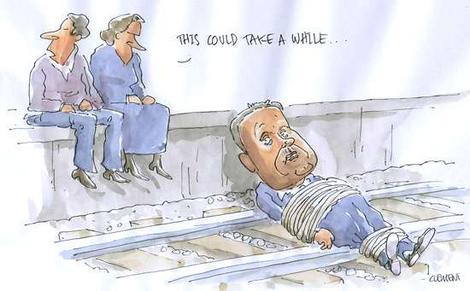
Clement
If that means some are detained, tortured or Moslem civilians lose their lives then that is the price that must be payed to ensure national security. You can see why some make the turn to human rights
July 7, 2007
Dame Roma Mitchell Oration: Hilary Charlesworth
One of session at the Adelaide Festival of Ideas that I attended on Saturday was the Roma Mitchell Oration hosted by the Equal Opportunity Commission and the Festival. It was delivered by Hilary Charlesworth and explored the past and future of human rights in an Australia governed by utilitarianism.
Charlesworth argued that the history of human rights discourse has been one of deep resistance from the 1890s when Andrew Inglis Clarke, Tasmanian Attorney-General, suggested entrenching some basic rights in the Constitution. Despite various attempts tried to introduce a Bill of Rights human rights has had a minimal presence in the 20th century that was dominated by states rights. But human rights has a future as a Bill of Rights has been introduced into the ACT and been promised in Victoria. South Australia continues to resist.
July 5, 2007
political action is...
In the conclusion to his book Deleuze, Marx, and Politics, Nicholas Thoburn says:
Paolo Virno (1996d: 189) expresses a common sentiment about the state of current political thought and practice when he writes, 'If nobody asks me what political action is, I seem to know; but if I have to explain it to somebody who asks, this presumed knowledge evaporates into incoherence.' This is a problem, but it is not a wholly new one. Indeed, inasmuch as it is in the nature of politics to have an openness to virtuality, to potential, and to undetermined worlds, a certain amount of uncertainty, if not 'incoherence', is one of its central features. Nevertheless, politics is necessarily subject to a form of ordering " a stratification of forms and potential around the question 'what is to be done?'" since it is an attempt to call forth other worlds through concrete engagement with the intricacies of the present. At the other pole to that of 'incoherence', the problem is that such ordering and engagement has so often occurred through regimes of truth and certainty that it has been characterized as much by dogma and ressentiment as by experimentation and creation.
noble savages and cultural musems
Barry Cohen, a minister in the Hawke government, was a federal Labor MP from 1969 to 1990, argues in an op-ed in The Australian that Rousseau and the 'noble savage' are responsible for what he calls the 'still substantial pockets of Aboriginal deprivation that include abysmal housing, appalling health, poor nutrition and minimal education together with the worst excesses of white society - unemployment, alcohol and drugs, crime, sexual abuse, imprisonment and a much higher mortality rate than their white contemporaries.'
This is part of a conservative discourse about brutal colonial histories and failed socialist experiments to fix the Indigenous problem and a return to government policies resonating with overtones of the assimilation of Aboriginal and Torres Strait Islander communities into mainstream Australian society, assimilationist overtones. It is a discourse that places land rights, human rights and the preservation of Aboriginal history and culture in opposition to a well educated community, able to compete in the marketplace. So what is the argument? Cohen says:
Much of this [failure] can be sheeted home to the white liberal "feel goods" who have encouraged many Aborigines to fantasise about living in a netherworld between modern Western society and their previous nomadic existence as hunter/gatherers. Somehow they managed to create this fantasy world where "the noble savage" continues to hunt and fish as they have had for millennia, speaking their native tongue and communing with nature while at the same time earning a good living in a highly sophisticated, technically advanced society. It was rubbish then and it is rubbish now. Unfortunately, few have the balls to say so. Certainly not the whitefellas.
The finger is pointed at Nugget Coombs, who for over 25 years, Nugget Coombs, was closely involved with the struggles of Aboriginal and Torres Strait Islander peoples for the recognition of their rights.
The reality is that the lack of education, limited institutional experience and vulnerability to abuses of power, which have Indigenous communities had left their organisations struggling to deliver to their constituents.These communities have attempted to develop their capacities to organise themselves, to resolve conflicts, to tackle dysfunction, and confront their own painful histories in order to imagine a sustainable future for themselves and their families.
So why haven't the liberals said that Coombs talked rubbish? Cohen says that they wouldn't be game:
Not those in positions of power - the politicians, bureaucrats and public figures. They would be flayed by the chattering classes, the media and those Aboriginal leaders who have a vested interest in defending the present system. It is dangerous to generalise about Aborigines and the array of problems they face for they vary enormously from those who live more traditional lifestyles to those who live in an urban environment. It is a fantasy to imagine that they can live rough in small, remote communities and also enjoy modern housing, health care, nutrition, education and also be gainfully employed. It is difficult to provide such essentials in large towns and cities, let alone in remote communities of 50 people or less.The former minister for Aboriginal affairs, Amanda Vanstone, had the courage to describe them as "cultural museums" and was pilloried by the baying media.
This ignores the economic development that has taken place or that indigenous communities have substantial capabilities to engage,deliver and develop with the mainstream economy in remote and urban contexts.
It also ignores what Nugget Coombs wrote in in his last book ‘Aboriginal Autonomy’ (1994) where he imagined an Aboriginal economy that:
would function in parallel and close interaction with the mainstream, not as set apart from
it. [it] would have its own cultural emphasis choosing its own stream of development and thepoint at which it enters and seeks to influence the mainstream.”
We have a hybrid economy. Coombs argued that the outstation or homeland movement as a response to the problems of contact and an attempt to evolve a lifestyle which preserves the essence of the Aboriginal way, whilst drawing on elements of non-Aboriginal society. One of the most important effects of this movement has been the rehabilitation of traditional authority and decision-making structures. This has introduced a political component into Aboriginal plans and a desire to resume control of those aspects of. their lives most severely weakened by European dominance.
July 3, 2007
Noel Pearson wobbles
Noel Pearson sails pretty close to the wind in his critique of social democratic welfarist governance of indigenous people. Take this op-ed in the Weekend Australian entitled 'Needless Misery', where he is addressing the trial concerned the alleged murder - amended to manslaughter - of a five-year-old white boy at the hands of his stepfather.
The Supreme Court of Victoria heard this evidence in the trial: “A five-year old boy allegedly murdered by his stepfather was found to have more than 160 bruises, a fractured skull and injuries to the abdomen so severe the force had ruptured the boy’s liver. The accused, 30, the disciplinarian of his household, told police: ‘I just see white’, when he lost control and beat his stepson.
Pearson comments on this domestic violence amongst indigenous people:
This boy’s death is a facsimile of many stories of child abuse and death in circumstances where one or more of the children’s supposed guardians are addicted to heroin and other drugs....The next day the Northern Territory Government belatedly released the report by Pat Anderson and Rex Wild into the neglect and abuse of children in indigenous communities in the Northern Territory, aptly titled Little Children are Sacred. This paper headlined its editorial even more aptly, “Little children are scared”.
He adds that my thought is this: what policies do we need so that all avoidable suffering is avoided in our society?
I am asking us to use our considerable human powers to escape avoidable suffering.
And:This is a question for social policy: are our policies maximising the avoidance of such suffering? My answer is no. There is too much misery - chiefly endured by the disadvantaged in our society, the lowest classes - that is avoidable.
Okay. That is fine. No problems. Pearson then addresses the reasons for this situation:
I believe that we do not have the optimum social policies to reduce suffering chiefly because of ideology and confusion. Australian policy analyses and strategic thinking are all mixed up when it comes to lifting the lot of the lowest classes. Strangely - but if you adopted an old leftist analysis it should not be surprising - the greatest impediment to the policies that are needed to relieve suffering is the confusion of those parts of the middle class who think themselves progressive. And it is particularly that section of the progressive middle class who are involved in the so-called helping industries who most contribute to the misery of those whom they believe they are helping.
Now I accept the arguments about welfare dependency. I accept Pearson's criticisms of the handout of welfare cheques-sit-down money-as having compounded the problems. His central thesis about passive welfare being soul-destroying, and destroying for Aboriginal communities, is entirely correct.
I concur with his point that there should be some reciprocity, they should give back to the community for what they receive, it's very important to get people to do something in return for the benefits they receive. I agree with his plan to send entrepreneurs into such communities to work with the people to build businesses which would give young aboriginal people the chance to become skilled and to take charge of their own destinies.
But the reason for indigenous suffering is the confusion of the progressive middle class? How about the failures of the Northern Territory or the Queensland governments to address the suffering? Or the inaction of the Howard Government of the last decade? Or the refusal by some indigenous people to take responsibility for their own social dysfunction communities ravaged by grog and violence? How about racist thinking that holds that it is Aboriginal to drink, and that it is somehow part of the identity of a people that they live in parks, that sit around in circles and drink, that they sit around and waste all of their money in gambling and stuff.
Pearson then adds:
We need to get our social policy thinking right. There is a connection between grog and child welfare among underclass black people. There is a connection between heroin addiction, stepfatherhood and child welfare in underclass white communities. There is a behavioural dimension to social suffering and we must face up to it. And so on.
Dead right. I can accept Pearson's argument that Australian social policy aimed at the distress of its black and white underclass produces thousands of programs, projects and initiatives that cost billions of dollars annually, the vast bulk of which are not at all decisive. Most of these initiatives miss the target; most are wasteful. Or that 90 per cent of the social policy interventions of John Howard, Peter Beattie, Morris Iemma, Steve Bracks, Mike Rann, Alan Carpenter, Paul Lennon, Jon Stanhope and Clare Martin, which are aimed at tackling the social dysfunction of those most in need, are useless.
Agreed. Pearson concludes:
The federal Government’s actions aimed at policing and tackling grog are decisive. Even the policy layperson can believe the welfare of children at risk can be improved only by an immediate attention to social order. Many unintended and negative consequences are likely to attend the federal Government’s initiatives, but these risks are not reasons to fail to act. Rather, the problems must be anticipated as best possible and acted on, and if they cannot be anticipated they must be decisively dealt with when they arise.
Agreed. Few disagree. So who is Pearson criticizing? The progressive middle class in the caring professions again?
He is sailing close to the wind as he is is buying into the culture wars and giving the appearance of aligning himself withe conservatives
July 2, 2007
ideology #2
Australia's Cardinal George Pell views environmental issues like climate change as a pagan substitute for people who lack God in their lives. As Pell said in 2006:
'Some of the hysteric and extreme claims about global warming are also a symptom of pagan emptiness, of Western fear when confronted by the immense and basically uncontrollable forces of nature . . . In the past pagans sacrificed animals and even humans in vain attempts to placate capricious and cruel gods. Today they demand a reduction in carbon dioxide emissions.'
The quote comes from Guy Pearse's online extract from his recent High and Dry text on the politics of climate change.
Pell's view denies the environmental problem. Hence the consensus between the neoliberals and the religious right.
ideology
The Australian argues that recent events in Indigneous affairs in Australia we are witnessing a dramatic turn in events - the equivalent of the fall of the Berlin Wall. It says:
Four decades of sterile debate bounded by the rhetoric of rights and reconciliation has given way to a new agenda in which fundamental questions about quality of life, social cohesion and, most importantly, the rights of the child have come to the fore....This is a rare moment in Australian politics, which is by nature evolutionary, not revolutionary, but the speed of change shows just how rotten and unworkable the old order had become. With hindsight, we can see that the rights-based, self-determination agenda that has driven indigenous policy since the 1960s was bound to fail. It was a tangle of ideological contradictions, symbolism and tokenism resulting in separateness or apartheid in the strictest sense of the Afrikaans word. The well-intentioned social engineers driving the policy were informed by left-Libertarian thinking that held that indigenous peoples should be free to live their lives as hunter-gatherers, theoretically uncluttered by modern society but able to tap into the resources of the welfare state. In fact, the two are totally incompatible.
Left-Libertarianism is the big problem for the conservatives. Since they talk in terms of the rights of the child I presume that they are hostile to both land rights and indigenous political autonomy, which would include some form of Aboriginal self-government.self determination as a right. This means that Aboriginal and Torres Strait Islander people must be able to make the important decisions regarding their future.
Though the the Keating government presented ATSIC to the other countries as the model for self determination representative, it was more an arm of the white bureaucracy. ATSIC, Nugget Coombs writes in his Aboriginal Autonomy: Issues and Strategies (1994):
was established as an instrument of government consultation; that is, of listening (or appearing to listen) to carefully selected Aborigines to create the appearance of consent, or at least conscious acquiescence, while continuing to make unilateral decisions.
The principle of self determination had become an important principle in Indigenous communities and also in the delivery of government services to Indigenous people. It is reflected in the establishment of Indigenous legal, health and other community services. This 'organisational self-determination' (the capacity for Indigenous people to realise their goals through their own incorporated bodies) implies self-management (the capacity to effectively administer them).
Self determination is predicated on the basis that Indigenous people themselves are uniquely placed to determine the needs of the community and that it is unlikely that mainstream services would be able in the same manner to incorporate the needs of the community in service delivery.
This self-determination is seen by conservatives as 'separateness or apartheid in the strictest sense of the Afrikaans word.' It is more likely that the recognition of native title is interpreted as a re-invention of apartheid. If he opposition to native title reflected the hostility to the Aboriginal political movement, then the debate is about development in Indigenous affairs. The conservatives are currently in the political and policy ascendancy, and they run a line that goes something like this:
1. The last 30 years of Indigenous affairs has been a failure.
2. This failure is associated with land rights and native title, so that Aboriginal people in remote Australia are land rich but still dirt poor and marginalised [although if land rights is the problem, then why are urbanized blacks without land rights also so marginalised and relatively poor?)
3. The way forward is to move policy from self determination [if some such ever existed] to mainstreaming, mutual obligation and shared responsibility, terms borrowed by and large from overseas welfare reformers.
4. The way forward is also to systematically abolish the institutions of Indigenous Australia, land rights, native title, ATSIC and the work-for-the-dole CDEP scheme.
Associated with this view is an interpretation of history. The period since 1972 has been a socialist-inspired [Nugget] Coombsian social engineering; that the period before 1972, the halcyon days of assimilation, are reinterpreted as a success;and that the post-1972 decolonisation of Aboriginal Australia was avoidable.