September 29, 2007
Adorno: History and freedom
Adorno's 'monadological viewpoint' is a micrological interpretation of life's fragments -- the melancholic memory of the dead and otherwise suppressed moments of human suffering. These fragments preserved the force of the concrete particular against the power of the abstract universal.
The paragraph below is from a review of Theodor W. Adorno, History and Freedom: Lectures 1964-1965, (2006), by David Ingram:
The lecture on negative universal history contains a very close reading of Thesis XVII of Walter Benjamin's renowned late masterpiece, "On the Concept of History" (which appears in the English volume Illuminations under the title "Theses on the Philosophy of History"), a work to which Adorno -- perhaps too generously -- credits with having encapsulated the core of his own philosophy of history. According to Adorno, if we follow Benjamin in interpreting history from the standpoint of the vanquished rather than from the standpoint of the victorious (who see themselves as the culminating endpoint of a logic that extends throughout all history), we will see each catastrophe as a singular constellation of possibilities -- the defiant acts of the crushed individual in the face of the overwhelming machinery of rational domination -- that open up a messianic rupture within history understood as the mythical return of the same.
September 27, 2007
restoring the social contract
A review by Jared Bernstein in American Propect of two books on the rational voter The Myth of the Rational Voter: Why Democracies Choose Bad Policies by Bryan Caplan and America Works: Critical Thoughts on the Exceptional U.S. Labor Market by Richard B. Freeman. Im not that interested in Caplan as he argues that because voters don't understand his version of economics, they are unable to evaluate economic policy alternatives correctly. In fact, according to Caplan, non-economists consistently support policies that they think will help them but will actually make them worse off. In other words, they are irrational.
Freeman's America Works is more interesting as he argues that relative to every other advanced economy, the US let markets rip. The problem is that during the past few decades, they've been ripping up the social fabric----markets becoming increasingly unfettered by collective bargaining, national health insurance, safety nets such as unemployment insurance, mandated vacation time, worker training, or what is broadly called the "social contract."
The result is much higher levels of inequality, and under the rubric of deregulation and expanded trade, economic power has shifted from labor to capital. So we have two Americas.
We can see signs of this happening in Australia with the attempts by the Howard Government to create more flexible labour markets through Workchoices. So what does Freeman suggest to counter this trend?
Bernstein says:
He offers two sets of proposals, the first targeted at workers and firms, the second at worker bargaining power. The first set includes boosting the pay of low-wage workers through higher minimum wages and an expanded Earned Income Tax Credit (those arguing against minimum wages always set these two ideas up as oppositional, but Freeman is right that we need both), national health care (among other advantages, it would "lower the marginal cost of hiring labor"), greater public investments, and more profit sharing.
And:
The second set includes greater corporate governance as an antidote to irresponsible boards run by old-boy networks, and expanding "modes of representation for workers beyond the dichotomy between a collective bargaining contract and nothing." In earlier work that's now widely accepted, Freeman almost single-handedly reversed economists' negative assessment of unions' impact by showing that organized labor pushes back against inequality without hurting productivity growth.
September 24, 2007
about populism # 1
One nation conservatism is a defensive reaction to neoliberal globalization that takes the form of populism. Populism has lost its original ideological meaning as the expression of agrarian radicalism. Ivan Krastev says in Eurozine that populism is too eclectic to be an ideology in the way that liberalism, socialism, or conservatism are. But growing interest in populism has captured the major trend of the modern political world – the rise of democratic illiberalism. He adds:
The new populism does not represent a challenge to democracy, understood as free elections or the rule of the majority. Unlike the extremist parties of the 1930s, the new populists do not plan to outlaw elections and introduce dictatorships. In fact, the new populists like elections and, unfortunately, often win them. What they oppose is the representative nature of modern democracies, the protection of the rights of minorities, and the constraints to the sovereignty of the people, a distinctive feature of globalization.
This assumes that populism is right wing. Is there not a populism on the left?
Krastev tries to account for the rise of populism today by the erosion of the liberal consensus that emerged after the end of the Cold War on one hand, and by the rising tensions between democratic majoritarianism and liberal constitutionalism – the two fundamental elements of liberal democratic regimes – on the other. The rise of populism indicates the decline of the attractiveness of liberal solutions in the fields of politics, economy, and culture, and the growing popularity of the politics of exclusion.
Divided nation
David Burchill has in an essay the Review on Divided Nation issue of the Griffith Review. Entitled 'Trying to find the sunny side of life' he reveals a pattern of marginalisation shaped by history, flawed policy and personal incapacity in Sydney and finds hope in the remarkable resilience of people under enormous pressure.
It's a familiar story---as the booming economy gives rises to a cornucopia: a horn of plenty and W
And yet the monsoon clouds were already gathering on the horizon. Burchill says:
In Sydney – an increasingly fractious town wracked by drought, heatwaves and traffic snarls – the apparently weightless property market had begun to reacquaint itself with the force of gravity, and people were watching their real estate magic puddings unaccountably beginning to shrink. Housing affordability had already a hit a historic low, while over the decade from 1995 housing debt rose from about 40 per cent to about 70 per cent of households’ disposable incomes. Almost two‐thirds of private renters had fallen into a state the statisticians define as “housing stress”.
He says three times within the space of a year or so, young men – men with different causes, and from different backgrounds – took to the streets to throw things and words about, attack property and police alike, and generally raise the social temperature. For the first time since the days of the Rum Corps, Sydney had become a riotous place to live. So we have the Macquarie Fields riots.
The events in Macquarie Fields, like those in Redfern before and Cronulla after, aroused such controversy in large part because rioting in suburbia seemed – at least prior to the overheated social temperature in Sydney of the last few years – to be strangely out of kilter with Australian mores.
September 20, 2007
Galarrwuy Yunupingu's backflip
Galarrwuy Yunupingu, who was opposed to the Howard Government's intervention into indigenous affairs, has now supported it. The reason for his initial opposition?
The answer is simple. I told him [Mal Brough, the Minister] I was a landowner and leader and he had not spoken to me. He had acquired my land and sought control of my life without talking to me, let alone seeking my consent. Nor had he spoken to the hundreds of people like me throughout the NT who spent their lives coping with Third World conditions, a lack of services and the abject failures of governments. That simple failure to consult, I told him, would eventually undermine his good intentions. The conditions that hurt children and that he was pledging to fix would remain while he sought to impose a solution. It really is that simple. He could not work for us unless he worked with us.
Despite saying at the Garma Festival recently that he was worried sick by the prospect of a land grab Galarrwuy Yunupingu signed a memorandum of understanding with the Howard Government. He says that this 99 year leasing agreement:
satisfies my concerns about the land-leasing issues and will ensure that the changes to the permit system will be workable and not undermine land rights. I believe this new model will empower traditional owners to control the development of towns and living areas, and to participate fully in all aspects of economic development on their land. I have also sought and received the minister’s agreement to the establishment of the Mala Elders group.
The Mala Elders group will remind governments that they are not to control our lives but to empower our people.
We will remind all politicians with great seriousness that the land is our backbone and that for Aboriginal children land remains central to their identity. This is something that must never be forgotten. Land ownership is the past, the present and the future for each child in Arnhem Land. Without their land they will not be people.
He adds that his concern is for indigenous people to have real jobs, which community development employment projects have not delivered. He adds:
Nearly all the real jobs in our communities are taken by non-Aborigines, which is an unacceptable situation. And we must have real schools and we must have real training. On these matters—low levels of education, training and employment, and the crippling of our people by alcohol and drugs—I am in agreement with Noel Pearson of Cape York. He came to meet me and we discussed these matters.
Noel Pearson was the crucial figure in this approach to indigenous people taking responsibility for their future. Is this self-determination, which the Howard Government is opposed to? Will this government show respect for indigenous land, law and culture?
That intervention involves, and is part of, a raft of components which appear to have little connection with protecting children. They include the following:
Small communities should be consolidated into "core concentration centres";
A health audit of all children should be conducted;
Local government should replace local councils, if necessary under a government-appointed administrator;
Communal title should be converted to leasehold;
Public housing should be privatised, with new houses and funding for maintenance to go only to those communities with 99-year leases;
The permit system should be abolished;
CDEP should be ended;
Customary law should be ended.
Most of these recommendations have since been implemented, under the guise of protecting children, despite the fact that they are supported by questionable scholarship.
September 19, 2007
making the world safe for freedom
Tony Karon at Rootless Cosmopolitan says that by invading Iraq, the U.S. has irreversibly altered the balance of power throughout the Middle East;. Consequently, Iraq cannot be treated as a policy decision in isolation from the full spectrum of U.S. interests throughout the region — all of which will be calamitously weakened if the U.S. were to precipitously retreat.
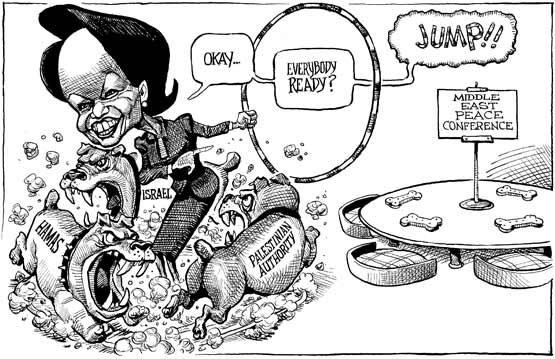
Kal
September 15, 2007
Sophocles: To him who is in fear, everything rustles
Some critical comments on the police surveillance deployed the national security state at APEC week in Sydney by Elisabeth Wynhausen in The Australian:
Seen from one of the helicopters hovering overhead, the city surely resembled something out of a Graham Greene novel, with motorcades rolling along deserted streets, snipers on the rooftops and police in their thousands protecting the dignitaries from the very sight of the colourful rabble daring to protest...It looked like a street party transported to Augusto Pinochet's Chile, with demonstrators hemmed in by rows of riot police. There were 3500 police. Behind them were police buses blocking the north side of the street. Behind them was a reserve army of 1500 defence force personnel. Dozens of police had removed their identification badges.
Wynhausen observes that:
politicians and police tried to suppress dissent by waging a psychological war of sorts against a population repeatedly reminded that anyone who ventured into central Sydney to shop, let alone protest, would be doing so while there were snipers on the rooftops in or near sensitive areas.
It appears that the law under the national security state is being used to d not prevent peaceful legitimate protest in a liberal democracy.
September 14, 2007
David Malouf on res publica
David Malouf makes some interesting comments on public spaces and how we are all related to the modern city in a talk to the Brisbane Institute. He says:
We have two lives there, a public life in which we adhere to citizenly values and requirements and which we share with others both in the public space of res publica and in real spaces where we move among strangers as if they were neighbours and feel secure in doing so. How we behave there is other people’s business as well as our own. But only there. The other life, the personal, the private life, is entirely our own. There we are free to believe what we please, to hold our own views, follow our own gods and customs, live inside our own culture, even an eclectic one of our own making. The play between the two, public and private, may require delicate negotiations with ourself. But as we see in the case of orthodox Jews for example, or Pentecostals, or Moslems or Buddhists – there are many examples of groups who live apart in one sense and fully among us in another – it is perfectly possible to be integrated without being assimilated, to live richly inside a culture or religion, follow its customs, keep its rules, and still be an active participant in the society at large.
Malouf highlights the complexity of what a big modern city --he is thinking of Brisbane---can provide: the variety of private worlds you bring to public occasion of listening to a talk at an institute: the degree of attention you have committed yourself to; the interest, the citizenly curiosity and seriousness; the mixture of talk and of listening, of exchanging news and opinions over food and wine; the dedication of the Institute, our host tonight, to the business of allowing voices to be heard and arguments to flourish.
September 11, 2007
about populism
An interesting article on populism by Paul Blokker in the German Law Journal. It argues that the rise of populism in both East and West in the last two decades or so attest to a growing discontent aimed against the political establishment in both Eastern and Western Europe, and underline the supposition that, rather than being merely a transitory phenomenon restricted to situations of social deprivation and unfulfilled popular expectations, populism should be regarded as a more structural phenomenon whose critique strikes at the centre of the modern democratic system itself.
Populism is understood by most of these analysts as a political ‘style' and a set of distinct arguments, rather than as a coherent ideology in its own right (which would need, apart from a coherent set of core superstructural, politico-philosophical premises, to include the ‘translation' of the latter into a set of institutions, such as those found in liberalism as a political doctrine and its institutional derivations in the form of representative, pluralist democracy, the division of powers, and 'checks and balances'
populism in modern democratic societies is best seen as an appeal to the ‘people' against both the established structure of power and the dominant ideas and values of the society.
The distinctive set of populist arguments includes an absolute prioritization of the people, its political participation (however defined) and its sovereign will, anti-élitism and an anti-establishment attitude, a claim for radical freedom and ‘direct democracy', a re-enchantment of the alienated people (an alienation which is deemed the result of the artificial constructions of legal-rational institutions) through the unification of the people with political power, combined with a disdain of formal institutions and pluralist representative democracy, and an organic and undivided vision of the ‘people'.The acknowledgement of a distinct relation between populism and democracy (most directly through the importance of the demos for both) also means that populism cannot be treated as a mere pathology of modern democratic society, as argued by many analysts
September 9, 2007
Joseph Schumpeter + creative destruction
Robin Blackburn makes some interesting remarks on Joseph Schumpeter's economics in the form of a review in The Nation of Thomas McCraw's biography of Joseph Schumpeter, entitled Prophet of Innovation: Joseph Schumpeter and Creative Destruction. Schumpeter is well known for characterizing capitalism with the famous phrase "creative destruction", in which the old ways of doing things are endogenously destroyed and replaced by the new.
Isn't creative destruction what is currently happening to Australia as a result of the impact of the global economy? Despite Schumpeter being pro-business, anti-New Deal and anti-welfare I've interpreted his work as offering us a keen insight into the world of globalized capitalism, a world built on the ruins of Keynesian-style national economic regulation, put into place after the 1930s Great Depression.
Blackburn says:
Schumpeter's Theory of Economic Development conveyed his conviction that entrepreneurship and competition were constant sources of growth and disruption in capitalist economies. While other economists saw competition as focusing on price, Schumpeter argued that the process also embraced the development of new products and processes, with often devastating effects on established producers. This was the germ of what he was later to call "creative destruction," the wavelike process in which yesterday's leaders are replaced by those with something radically new to offer, be it the railway, the automobile, the PC or the iPod. Others were so mesmerized by the great trusts, and their apparent power to control the market, that they did not see how vulnerable even the greatest could be if challenged by a new product.
Blackburn says that if Schumpeter's work on business cycles was too compendious and complex to have much impact on his colleagues his 1942 Capitalism, Socialism and Democracy became a bestseller. It was in this book that he gave definitive expression to "creative destruction" as the animating principle of capitalist competition.
While admitting that such competition brings ruin to whole industries and regions, he stressed that the accompanying rise of innovating industries will bring new goods within the reach of working men and women...In Schumpeter's view this surge of capitalist prosperity would allow for the solution of all social problems but would also undermine the conditions that made it possible. The motivation of the great business families would be eroded, capitalist growth taken for granted and the anticapitalist moralizing of intellectuals indulged. A drift toward socialism would ensue as governments intervened ever more intimately in the capitalist mechanism. Like Friedrich August von Hayek and Mises, Schumpeter believed in the power of capitalism, but he rejected what he saw as their absurd prejudice against the state, capitalism's necessary handmaiden.
The state is capitalism's necessary handmaiden---that is insightful, as it indicates the action of the state in creating markets for new products--eg., health care and telecommunications.
What hasn't developed in Australia is the strategy of creating markets for new products with industrial groups investing in R&D and a string of research institutes that would keep Australia at the forefront of the information economy.
September 8, 2007
Noel Pearson: integration /assimilation
I often wonder about Noel Pearson. Where does he stand on the Howard/Brough NT intervention, given that Pearson's Cape York model of quarantining welfare payments only when recipients are demonstrably irresponsible, and only after they have received financial counselling, is very different from the federal government's heavy-handedness in the NT.Yet Pearson gives the impression of appearing to support Howard's Northern Territory intervention.
In his more recent column in The Australian he writes:
I have previously talked about the Government's failure to rise above the sense in indigenous policy that it is mean and pursuing a traditional, punishing negativity. The Prime Minister's line at Hermannsburg this week about the "thugs and bullies" sheltered by the permit system, and the assimilationist emphasis of his policy articulation, underscores how the Government simply cannot transcend the prism of cultural war in which it conceives policies concerning native Australians.
In the 1930s there was a general commitment to the concepts of advancement and assimilation. Advancement referred to poverty and the lack of access of indigenous people to opportunity in a discriminatory society We know that the white Australian emphasis on assimilation met with an Aboriginal desire for equality and advancement.
In the 1960s there was a general commitment to the concepts of self-determination and advancement, and a banishing of assimilation. The idea that Aborigines, particularly in remote areas, should be able to choose to pursue a more or less traditional lifestyle became dominant, but the basic capabilities necessary for true choice (such as good health and a good education) were neglected such that life in remote communities was in no sense a matter of choice: it was the only option. Since the 1990s there has been a return to the concepts of advancement and assimilation.
Pearson distinguishes between integration and assimilation.
September 6, 2007
Ackerman on the separation of powers
Yale law professor Bruce Ackerman has an interesting op-ed in the Financial Times highlighting the ways that President Bush is corrupting military leaders and the Pentagon in putting them to work on his political message:
President George W. Bush's campaign to stay the course in Iraq is taking a new and constitutionally dangerous turn. When Senator John Warner recently called for a troop withdrawal by Christmas, the White House did not mount its usual counterattack. It allowed a surprising champion to take its place. Major General Rick Lynch, a field commander in Iraq, summoned reporters to condemn Mr Warner's proposal as "a giant step backwards".
It was Maj Gen Lynch who was making the giant step into forbidden territory. He had no business engaging in a public debate with a US senator. His remarks represent an assault on the principle of civilian control -- the most blatant so far during the Iraq war.
I though military generals engaging in political debate was standard practice in the US during the Iraq war.They have been providing running commentary in selling the war since the Americans invaded Iraq.
Ackerman continues:
Nobody remarked on the breach. But this only makes it more troubling and should serve as prologue for the next large event in civilian-military relations: the president's effort to manipulate General David Petraeus's report to Congress. Once again, nobody is noticing the threat to civilian control. Mr Bush has pushed Gen Petraeus into the foreground to shore up his badly damaged credibility. But in doing so, he has made himself a hostage. He needs the general more than the general needs him. Despite the president's grandiose pretensions as commander-in-chief, the future of the Iraq war is up to Gen Petraeus. The general's impact on Congress will be equally profound. If he brings in a negative report, Republicans will abandon the sinking ship in droves; if he accentuates the positive, it is the Democrats who will be spinning.In fact, if not in name, it will be an army general who is calling the shots -- not the duly elected representatives of the American people.
So we have a politicized military with Bush hiding behind Petraeus. Ackerman concludes:
Wars are tough on constitutions, but losing wars is particularly tough on the American separation of powers. Especially when Congress and the presidency are in different hands, the constitutional dynamics invite both sides to politicise the military. With the war going badly, it is tempting to push the generals on to centre stage and escape responsibility for the tragic outcomes that lie ahead. But as Iraq follows on from Vietnam, this dynamic may generate a politicised military that is embittered by its repeated defeats in the field.
September 3, 2007
a marketplace of moral sentiments, images,
I came across this idea. Cultural citizenship ("the right to know and speak") can be distinquished from the zones of political ("the right to reside and vote") or economic ("the right to work and prosper") citizenship. Cultural practice matters as much to citizenship as do political rights and economic status, whilst understanding culture necessitates engagement with popular mass media, especially television; and that coming to terms with the mass media requires attention to the political economy in which it is situated, and the way the mass media works. How then does the mass media work.
This text----The Political Brain: The Role of Emotion in Deciding the Fate of the Nation by Drew Westen, which focues on how voters experience politics, offers a suggestion. Westen argues that the dominant model of mind, brain, and decision making for three centuries has been an essentially dispassionate one, a view that privileges rational decision making. The view of democracy that naturally flows from the dispassionate view of the mind is of a marketplace of ideas. Parties and politicians who want to convince others of their point of view lay out the data, make their best case, and leave it to the electorate to weigh the argument.
That's pretty right.
The central thesis of Westen's book is that this view of mind and brain could not be further from the truth. In politics, when reason and emotion collide, emotion invariably wins.
Although we have a marketplace of ideas, the marketplace that matters most of the time in American politics is the marketplace of moral sentiments, images, analogies, frames of reference, and moving oratory. These "markets" matter because they in turn create a marketplace of emotions. Of particular importance for understanding politics are "networks of associations" -- bundles of thoughts, feelings, sounds, images, memories, and emotions that have become linked through experience.
Westen argues that republicans have a keen eye for markets, and they have a near-monopoly in the marketplace of emotions. They have kept government off our backs, torn down that wall, saved the flag, left no child behind, protected life, kept our marriages sacred, restored integrity to the Oval Office, spread democracy to the Middle East, and fought an unrelenting war on terror. The Democrats, in contrast, have continued to place their stock in the marketplace of ideas. And in so doing, they have been trading in the wrong futures.
Isn't this an account of the importance of political rhetoric? A rhetoric that speaks to the unconscious - isn't this what Westen is talking about?
September 1, 2007
legal blogging
Margaret A. Schilt, a faculty services librarian at the D'Angelo Law Library for the University of Chicago, in Is the Future of Legal Scholarship in the Blogosphere? addresses some of the conflicts between academia and blogging in Australia that result in academia versus blogging. Referring to the American context she asks:
Who are the bloggers? The uninitiated might think they would be young professors, those who have grown up with the Internet and are comfortable with self-publication in that format. While there are some of those, the legal blogosphere tends to be populated by midcareer professors who have tenure, are intimately familiar with traditional legal scholarship and see the Internet as a way to reach more readers in a less ritualized format. Younger scholars, in contrast, debate whether blogging is worth the time taken away from traditional legal scholarship, still necessary for achieving tenure.....You may inadvertently offend someone important, you may be -- gasp! -- wrong or you may simply be lured into spending too much time blogging and not enough time creating scholarship and knowledge in the more traditional forms. Blogging, in short, can be addictive. Regular posting to maintain the dialogue and interchange that leads to readership drains time from other pursuits.
This is how the situation is understood in Australia. Academics are not rewarded in terms of their career by blogging.
Schilt asks: "Can blogging be viewed as service?" Her answer is that:
Instead of scholars focusing inward, writing for and expecting to be read only by other academics, legal academics blog with the desire and the expectation that they will be read by the public. Law-related blogs such as the University of Chicago Faculty Blog bring the perspective of the academy to the attention of anyone interested in the issue under discussion, educating both sides of the dialogue. The Internet functions as a public square, where Main Street, Wall Street and the ivory tower meet. Bloggers haven't abandoned law review articles and other scholarship, but even there, blogging has its effect. Law reviews may be the tortoise to the blogging hare, secure in the prestige that tenure requirements confer on the traditional law review article, but they are not immune to the siren call for more casual prose, shorter paragraphs and fewer footnotes. No one thinks the law review article is going away, but it is undergoing its own more or less painful transformations.
Blogs are where the scholarly dialogue increasingly takes place.So different to Australia isn't it